






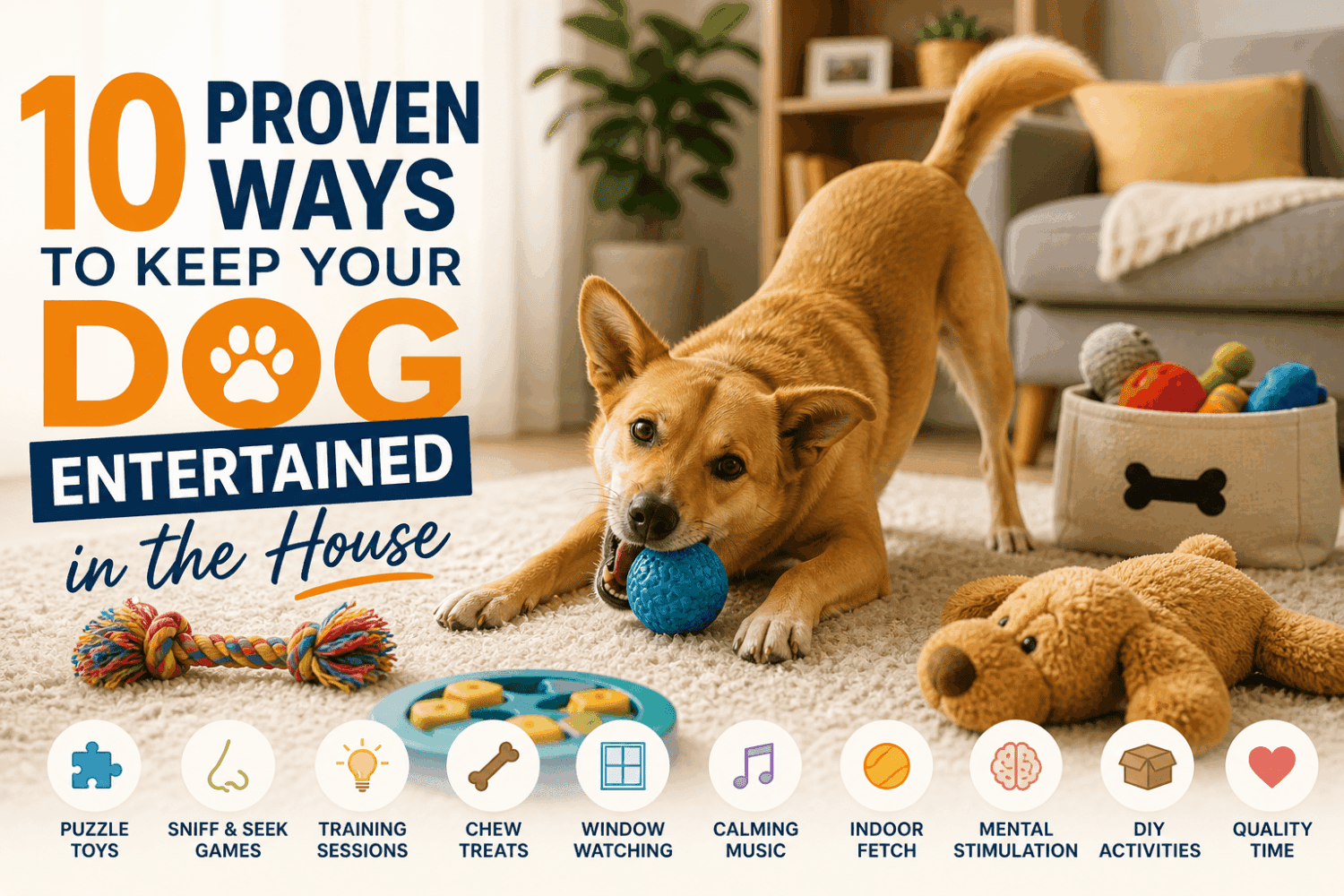
We all know the look. You are sitting at your desk, trying to finish an important project, and you feel a heavy chin rest on your knee. You look down, and your dog is staring at you with those deep, guilt-inducing eyes. They are bored. And if you don’t find something for them to do, they are going to find a job themselves—which usually involves redesigning your couch cushions with their teeth.
Keeping a dog entertained indoors, especially during extreme weather or when you are stuck working from home, is a daily challenge.
Over the years of managing high-energy dogs, I learned a hard truth: throwing a tennis ball down the hallway for five minutes simply isn’t enough. Dogs need a combination of physical exertion and mental stimulation to truly settle down.
Here are 10 highly effective, practical ways to keep your dog busy, happy, and out of trouble while you are in the house, plus my top 5 product recommendations for 2026.

⚡ Quick Summary: How to Entertain a Dog Indoors
Need answers fast? Here are the most effective strategies to exhaust your dog without leaving the living room:
- Interactive Food Puzzles: Force them to use their brain for their meals.
- Frozen Stuffed Toys: A frozen Kong provides up to 45 minutes of intense focus.
- Scent Work (Nose Games): 15 minutes of sniffing burns as much energy as a brisk walk.
- Micro-Training Sessions: Teach a new trick in 5-minute intervals.
- Rotate Their Toy Box: Hide old toys and bring them back weeks later so they feel brand new.
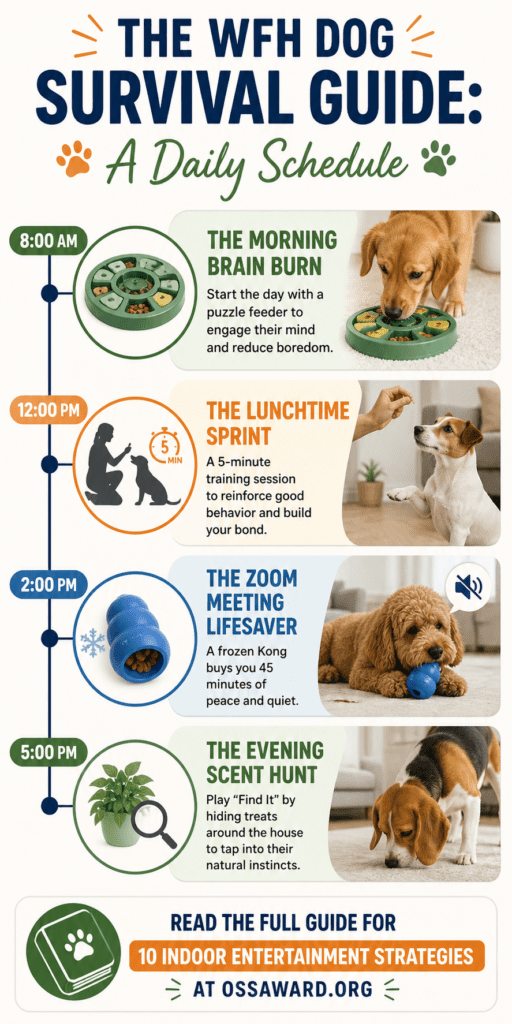
How to Entertain a Dog Indoors (Infographics)
1. Ditch the Food Bowl for Puzzle Feeders
If you are dumping two cups of kibble into a stainless steel bowl, you are wasting the best entertainment opportunity of the day. Dogs are natural foragers. Earning their food provides massive mental satisfaction.
- How it works: Swap the bowl for a snuffle mat (a fabric mat with hiding spots) or a hard plastic puzzle toy where they have to slide compartments to reveal food.
- Actionable Step: Start easy. Put half their breakfast in a simple puzzle ball. Once they master it, upgrade to a more complex puzzle board.
- Expert Tip: Monitor them the first few times to ensure they don’t get frustrated and try to chew the plastic puzzle to pieces.
2. The Frozen Kong Strategy
This is the ultimate secret weapon for working dog owners. Licking is a naturally soothing behavior for canines; it lowers their heart rate and releases endorphins.
- How it works: Take a durable rubber chew toy (like a Kong), fill it with a mixture of wet food, peanut butter (ensure it is entirely Xylitol-free!), and some kibble, and freeze it overnight.
- Actionable Step: Keep three or four stuffed toys in the freezer at all times. When you have a Zoom meeting, hand one over. It will buy you 30 to 45 minutes of total silence.
- Safety Warning: Always ensure the rubber toy is appropriately sized so it cannot become a choking hazard.
3. Teach “Find It” (Indoor Scent Work)
A dog’s primary way of experiencing the world is through their nose. Engaging their olfactory system is incredibly exhausting for them. Canine behaviorists frequently note that intense sniffing tires a dog out just as fast as physical running.
- How it works: Hide high-value treats around the living room and encourage them to sniff them out.
- Actionable Step: Put your dog in a “stay” in another room. Hide small pieces of dried liver or cheese behind chair legs, under a rug edge, or on low shelves. Release them with the command “Find it!”
- Expert Tip: Start by letting them watch you hide the first treat so they understand the game, then increase the difficulty.
4. Master the Art of Toy Rotation
Dogs get bored of their belongings just like kids do. A toy basket overflowing with thirty toys actually causes choice paralysis and boredom.
- How it works: Box up 70% of your dog’s toys and put them in a closet. Leave only three or four out.
- Actionable Step: Every two weeks, take the current toys away and bring out a “new” batch from the closet. The novelty factor will make your dog act like it’s their birthday every single rotation.
5. Build an Indoor Obstacle Course
If you have a high-energy breed like a Collie, a Shepherd, or a persistent Terrier, you have to burn off that physical tension before they can relax.
- How it works: Use household items to create a safe agility course in a carpeted room or hallway.
- Actionable Step: Line up dining chairs and teach them to weave through the legs. Drape a blanket over two chairs to make a tunnel. Use a broomstick resting on books as a low jump.
- Safety Warning: Keep jumps very low, especially for puppies whose joints are still developing, and avoid slippery hardwood floors to prevent torn ligaments.
6. Engage in 5-Minute Micro-Training
You don’t need an hour-long obedience class to tire out a dog. Short, intense bursts of learning are far more effective.
- How it works: Pick one simple trick (like “spin,” “paw,” or “play dead”) and practice it using high-value rewards.
- Actionable Step: Set a timer for exactly 5 minutes. Work on the trick rapidly. When the timer goes off, stop immediately, even if they are doing well. This keeps them eager for the next session.
7. The “Name Game” for Toys
This requires patience but results in an amazing parlor trick and a highly engaged dog.
- How it works: Teach your dog the specific names of their toys so you can ask them to retrieve a specific item.
- Actionable Step: Hold up a specific toy (e.g., a stuffed bear) and say “Bear.” Toss it and say “Get Bear.” Reward them heavily. Once they know “Bear,” introduce “Rope.” Eventually, you can scatter toys in a room and ask them to find a specific one.
8. Utilize Interactive Tech Gadgets
If you have to leave the house, technology can bridge the gap. Smart home gadgets have revolutionized pet care.
- How it works: Invest in a Wi-Fi-enabled pet camera that tosses treats, or an automatic ball launcher.
- Actionable Step: Set up a pet camera with two-way audio. When you are at the office and see them pacing, use the app to call their name and dispense a treat to break their boredom cycle.
9. Create a Window Watching Station
Dogs are inherently nosy. They want to know who is walking down the street and what the neighborhood squirrels are doing.
- How it works: Give them comfortable, authorized access to a window view.
- Actionable Step: Move a sturdy ottoman or a dedicated dog bed under a front-facing window. Open the blinds.
- Expert Tip: If your dog is highly reactive and barks at everything they see, skip this step, as it will cause anxiety rather than entertainment.
10. Schedule Dedicated “Chew Time”
Chewing is a natural, necessary behavior that relieves stress, cleans teeth, and releases calming endorphins. If you don’t provide an outlet, they will choose your shoes.
- How it works: Provide highly durable, safe chews that take a long time to break down.
- Actionable Step: Offer items like beef tendons, bully sticks, or heavy-duty nylon bones. Give it to them in a designated spot, like their crate or a specific mat.
- Safety Warning: Never leave a dog entirely unsupervised with a chew that can splinter (like cooked bones) or be swallowed whole.
Read More >> PetHydro Max: A Miracle Fountain or Overpriced Bowl?
🏆 Top 5 Products to Keep Your Dog Entertained in 2026
If you want to fast-track your dog’s indoor entertainment, having the right gear makes a massive difference. Based on durability, engagement, and safety, here are the top 5 interactive products on the market right now:
1. Nina Ottosson by Outward Hound Puzzle Games
These are the gold standard for canine cognitive development. Available in varying difficulty levels (from Level 1 for beginners to Level 4 for canine geniuses), these durable plastic boards require your dog to slide blocks, flip lids, and spin wheels to uncover hidden kibble. They are fantastic for slowing down fast eaters and exhausting a restless mind.
2. The KONG Classic Dog Toy
A tried-and-true legend that belongs in every pet household. Made from ultra-durable natural rubber, its unpredictable bounce makes it a great fetch toy. More importantly, its hollow center is perfect for the “Frozen Kong Strategy.” Stuffing it with treats and freezing it provides the ultimate long-lasting, soothing challenge for anxious or bored dogs.
3. Snuffle Mats (e.g., Pet Parents Forager)
If your dog loves to use their nose, a snuffle mat is a must-have. These fabric mats mimic the texture of tall grass. By burying dry kibble deep inside the fleece folds, you force your dog to forage for their food. Sniffing naturally lowers a dog’s pulse rate, making this the perfect calming tool for high-anxiety pups.
4. Interactive Smart Balls (e.g., Cheerble Wicked Ball)
For dogs that love movement but have owners busy on Zoom calls, smart balls are a lifesaver. These rechargeable, app-free spheres feature automatic obstacle avoidance sensors. They roll, bounce, and shake erratically on their own to stimulate your dog’s natural hunting and chasing instincts, eventually going into a “rest mode” to prevent your dog from overworking themselves.
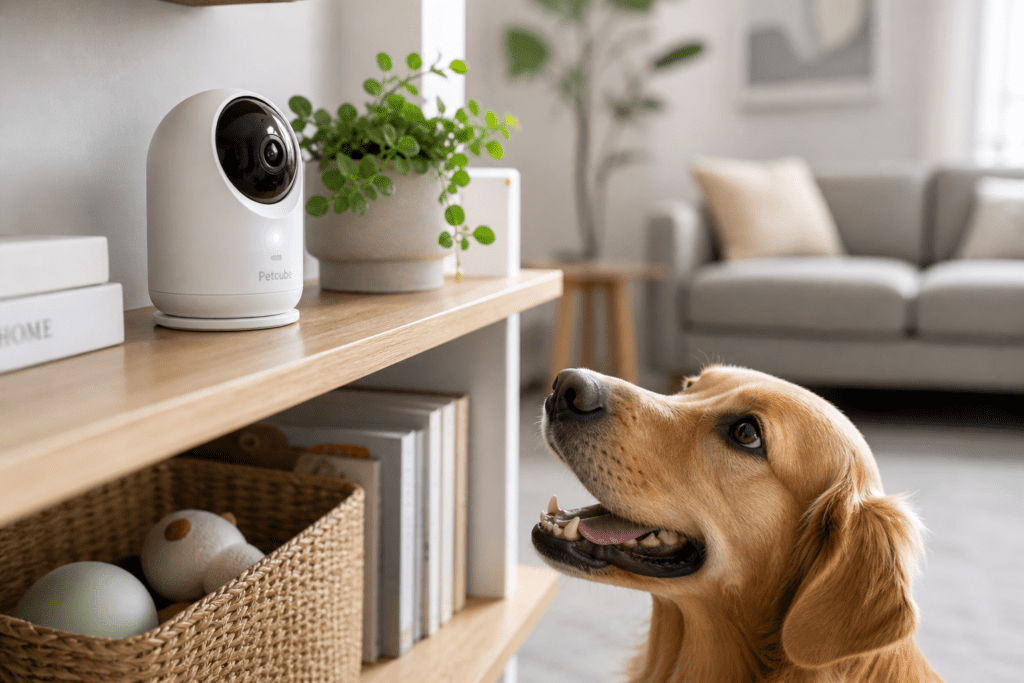
5. Treat-Dispensing Pet Cameras (e.g., Blurams Owl Robot)
Taking remote interaction to the next level, treat-dispensing cameras allow you to entertain your dog even when you aren’t home. You can check a live feed from your phone, speak to your dog via two-way audio, and swipe your screen to launch a treat across the room. It acts as a brilliant positive interruption if you catch your dog pacing or acting destructively while you are away.
🎙️ Frequently Asked Questions
How long can a dog entertain itself indoors?
Most adult dogs can comfortably entertain themselves with a puzzle toy or chew for 30 to 45 minutes before they need human interaction, a nap, or a bathroom break. Puppies have much shorter attention spans and may need a new activity every 10 to 15 minutes.
Do dogs get bored of the same toys?
Yes. Dogs experience habituation, meaning they lose interest in objects that are always available to them. This is exactly why implementing a strict toy rotation schedule is highly recommended to keep their environment engaging and fresh.
Is it safe to leave my dog alone with a puzzle toy?
It depends heavily on the toy and your dog’s chewing habits. Hard rubber toys like Kongs are generally safe for unsupervised use. However, complex plastic puzzle boards, snuffle mats, or plush toys should only be used under supervision, as heavy chewers can break them apart and swallow dangerous pieces.
Does mental stimulation actually tire a dog out?
Absolutely. Canine behaviorists consistently note that 15 to 20 minutes of intense mental stimulation (like advanced scent work, puzzle-solving, or learning a new trick) can be just as exhausting for a dog as a 30-minute brisk walk or run.
How do I know if my dog needs more entertainment?
A bored dog will often exhibit destructive behaviors, such as chewing on furniture, excessive barking at windows, pacing the house, or constantly bringing you toys and pawing at your legs. If your dog is doing this, it’s time to introduce an interactive puzzle or training session.

