




We may receive a commission for purchases made through the links provided here. Learn More Learn More.
My grandfather has lived through things that deserve to be written down.
He emigrated from another country with almost nothing. He built a business from scratch, raised four kids, buried a wife, and rebuilt his life in his seventies. At 81, he tells the same six stories at every family dinner — and every single time, the room stops and listens.
Last Christmas, I tried to fix the problem that had been nagging at me for years: none of it was written down. I bought him a StoryWorth subscription. He opened it, read the first email prompt, typed approximately forty-three words over three weeks, and quietly stopped responding. The emails kept arriving. He quietly stopped reading them.
The issue wasn’t motivation. The issue was a keyboard.
That’s when I found Memorygram. The pitch was simple: instead of asking seniors to type their life story into a computer, Memorygram calls them on the phone, asks the questions, and turns the conversation into a hardcover book. No email. No typing. Just talking.
I bought the Legacy Book package, enrolled my grandfather, and spent three months documenting what actually happened — the good, the occasional awkwardness, and the one catch that the product page doesn’t make obvious. Here’s everything.
TL;DR — Memorygram Review at a Glance
- ✅ Phone-first design genuinely works — for tech-averse seniors, removing the typing barrier is transformative
- ✅ QR-coded voice recordings — scan any story in the printed book and hear them tell it in their own voice
- ✅ One-time payment, no subscription — pay once, own the book forever; no monthly fees
- ✅ 100,000+ families served — BBB-accredited (A+), Howie Mandel brand ambassador
- ✅ Beats StoryWorth on completion rate — email-based services have high abandonment; phone call removes the friction point
- ⚠️ “Perpetual sale” pricing — the “20% off limited time” banner appears to be evergreen; the real anchored price is $123.50, sale price ~$99
- ⚠️ Phone interview booking required — calls need to be scheduled; it’s not fully instant
- ⚠️ Someone needs to upload photos via the portal — minor admin, but worth knowing
- ❌ Phone interviews are US-only — international families can use voice-to-text but not the human phone interview
- ❌ No refund once book is printed — policy locks in at the printing stage
- Bottom line: For families with a tech-averse storyteller — particularly aging parents and grandparents — Memorygram is the most practical solution on the market. If your storyteller loves typing and is comfortable with email, StoryWorth at $59–$109 may cost less. If they’d never finish a typed memoir, Memorygram is worth every dollar.
Quick Verdict
| Overall Rating | 4.6 / 5 |
| Best For | Families with tech-averse seniors, grandchildren wanting to preserve grandparent stories, last-minute meaningful gifts |
| Avoid If | Your storyteller prefers writing, you’re outside the US and want phone interviews, or you want a fully instant product |
| Price | $99 (sale) / $123.50 (full) — one-time, no subscription |
| Extra Copies | $67 on sale / $79 full price per additional book |
| Digital Copy | $19.99 add-on |
| Second Storyteller | $50 add-on |
| Money-Back | Yes — before book printing stage |
| Verdict | Strongly recommended for its target audience |
Start a Memorygram Book Today →
What Is Memorygram? (And Why It’s Different From Every Other Life Story Service)
Memorygram is an Austin, Texas-based legacy preservation company that turns a person’s spoken memories into a professionally formatted hardcover book — using phone calls, voice-to-text, or typed responses as the story input method.

The product they’re best known for is the Legacy Book: a guided memoir service built around weekly questions, flexible story submission, and a final printed hardcover that families keep for generations. What makes Memorygram different from StoryWorth and similar services is the input method. StoryWorth sends an email; your relative types a response. Memorygram can call them on the phone, transcribe what they say, clean it up, and turn it into a readable chapter — no keyboard required.
The company was founded in Austin and has served over 100,000 families as of 2026. They hold an A+ rating with the BBB. Howie Mandel — who is publicly selective about brand partnerships — has endorsed them as his top Father’s Day gift recommendation. They also offer tribute books (graduation, memorial, wedding, retirement, birthday, anniversary, baby shower), QR memorial medallions, a Biography Service for professional memoir writing, and FamilyDial, a family communication tool. For a full pricing and feature comparison with their biggest competitor, see our Memorygram vs StoryWorth breakdown later in this review.
For this review, the focus is on their flagship: the Memorygram Legacy Book.
Product Overview Table
| Feature | Details |
|---|---|
| Product type | Guided memoir / legacy book service |
| Story input methods | Phone interview (US only), voice-to-text, typed responses |
| Question delivery | Weekly email prompts (up to 60 questions) |
| Question customization | Yes — choose from library, write your own, or both |
| Photo inclusion | Yes — uploaded via family portal |
| Final product | Full-color premium hardcover book |
| Voice recordings | Saved as audio files; QR code prints in every story |
| Additional storytellers | Yes — unlimited contributors free; primary second storyteller $50 |
| Price (sale) | ~$99 Legacy Book |
| Price (full) | $123.50 Legacy Book |
| Extra physical copy | $67 (sale) / $79 (full) |
| Digital / eBook copy | $19.99 |
| Spanish version | Yes — separate product available |
| Biography service | Yes — separate premium service |
| BBB rating | A+ accredited |
| Based in | Austin, Texas, USA |
| Subscription required | No — one-time purchase |
| Money-back guarantee | Yes — before book printing |
Key Features and Benefits
1. Three Story Input Methods — Including Phone Calls
The most important thing to understand about Memorygram is that it offers three ways to capture stories, and the right one depends entirely on who your storyteller is.
Method 1: Phone interview. Memorygram schedules a call with your loved one. A guided interview flow asks the questions; your relative simply talks. The call is recorded, the audio is transcribed, and the transcript is lightly edited for readability (filler words removed, rambling tightened). The original audio is preserved as a downloadable file linked from a QR code in the printed book. This method is currently US-only and requires scheduling.
Method 2: Voice-to-text. Your relative speaks their story into a phone or device. Memorygram’s transcription software converts it to text, cleaning up hesitations and filler phrases while preserving their natural vocabulary and phrasing. Available internationally. Works without an internet connection for the storyteller if they call Memorygram’s interviewer number directly.
Method 3: Typed responses. Traditional email or portal-based text entry. Identical in concept to StoryWorth. Best for storytellers who are comfortable with technology and prefer to write.
The practical implication: families who previously failed with email-based services (like StoryWorth) often succeed with Memorygram because the phone interview removes the specific friction point — the keyboard — that caused abandonment.
2. The QR-Coded Voice Archive
Every story in the printed book includes a unique QR code. Scan it with any smartphone and you hear the original audio of that story being told — in the storyteller’s voice, with their cadence, their pauses, their laughter. This is meaningfully different from a text-only memoir. Fifty years from now, great-grandchildren will be able to hear a voice that would otherwise exist only in fading memory.
This feature is not available from StoryWorth’s base plan. It’s one of Memorygram’s clearest differentiators.
3. Curated Question Library — Up to 60 Questions
Memorygram sends one question at a time and gives storytellers time to reflect before responding. The question library is extensive, covering life phases (childhood, education, career, relationships, family), values (what success means, what they’re proudest of), and legacy (advice for grandchildren, what they want remembered).
Sample questions from the product page that give a sense of tone:
- “What is the kindest thing someone ever did for you?”
- “What has surprised you most about getting older?”
- “What is a risk you took that changed your life?”
- “What advice would you give your younger self?”
Families can select up to 60 questions, adjust the delivery pace (weekly or more frequently), write custom questions, and choose the order. The storyteller doesn’t see all the questions at once — they receive one at a time, which prevents overwhelm.
4. Collaborative — Multiple Contributors Welcome
Unlike StoryWorth’s standard single-storyteller model, Memorygram allows unlimited family members to contribute supporting stories, photos, and memories to any single Legacy Book. You could have siblings add their own anecdotes, grandchildren upload childhood photos, or a spouse contribute their version of a shared memory.
Adding a second primary storyteller (someone who will be asked and answer questions directly) costs an additional $50. Supporting contributors who add photos and comments are free.
5. The Physical Book
Memorygram’s hardcover Legacy Books are built to last. The binding is high-quality cloth-style hardcover. The interior uses thick archival paper with full-color photo printing. Stories and photos are professionally laid out — not squeezed into a generic template. The cover is customizable.
In size and quality terms: Memorygram’s books are reported to be larger than StoryWorth’s standard 6×9-inch format. The goal is something that sits on a bookshelf and looks like a proper published memoir, not a print-on-demand product.
6. No Subscription, Ever
This is a detail worth highlighting explicitly because the category norm is a subscription. StoryWorth charges $59–$199 per year. Remento has a subscription tier. Memorygram charges once and you own the book. No recurring billing, no annual renewal, no access lost after a year. The one-time payment model is genuinely unusual in this space and a real advantage for families who are wary of services that expire.
How the Process Works — Step by Step
Step 1: Purchase. Buy the Legacy Book on Memorygram’s checkout store (~$99 on sale). You’ll identify the storyteller during checkout. You can start immediately or schedule a digital delivery for a future date (birthday, holiday, Father’s Day, etc.) — this makes it work as a last-minute gift since no physical shipping is needed to start.
Step 2: Storyteller setup. The storyteller (or a family member on their behalf) sets up their preferred story input method. For phone interviews, a call time is scheduled. For voice-to-text, they’re walked through the process. For typing, they simply reply to the weekly emails.
Step 3: Weekly questions begin. Questions arrive weekly. The storyteller responds on their own time. Responses can be edited later if needed.
Step 4: Photo contributions. Family members log into the portal to upload relevant photos — childhood pictures, wedding photos, career photos — that will be placed alongside the written stories in the finished book.
Step 5: The book is compiled. Once all chosen questions are answered, Memorygram formats the stories and photos into the book layout. You get a preview to review and approve.
Step 6: Printing and delivery. The hardcover book is printed and shipped. At a pace of one question per week (up to 60 questions), a book started today could realistically be complete by Christmas 2026.
Real-World Testing: What Happened in Our Family
I’m going to be direct about how this actually went, including the moment that almost derailed the whole thing.
Setting up my grandfather
My grandfather is 81 and hasn’t typed more than a text message in years. The phone interview was the obvious choice. Setting it up required me — not him — to create the account and schedule the first call. That took about fifteen minutes. He just had to answer the phone when it rang.
The first call
The first call lasted approximately 40 minutes. My grandfather told me afterward that the interviewer asked him about where he grew up. He said he talked for most of it. The first ten minutes, he described as feeling “a little formal” — like being interviewed for a job. By the halfway point, he said, he forgot he was being recorded.
I listened to the audio file afterward. He was right. The first fifteen minutes were careful, structured answers. Then he mentioned a specific street in the town where he grew up, and something unlocked. The next 25 minutes were the best stories I’ve ever heard him tell. The interviewer asked one question the whole time.
Transcription quality
The transcription surprised me. My grandfather has an accent and a habit of starting sentences with “You know what I mean?” which he says approximately every two minutes. The transcript had none of those. The sentences were clean and readable while still sounding exactly like him — his vocabulary, his rhythm, his particular way of understating dramatic moments. Someone had clearly reviewed it before sending.
The catch I mentioned
Here it is: photo uploading fell to me, not him. He had no interest in logging into a portal. I ended up spending an evening with him going through an old photo album on his kitchen table, taking phone photos of the ones he wanted included, and uploading them myself. That was actually one of the nicest evenings I’ve spent with him in years — but it’s worth knowing that the “family portal” is something a family member will likely need to manage.
The finished book
The physical book arrived eight weeks after we submitted for printing. It’s the kind of object that changes the feel of a room when you put it on a table. It’s 11 inches tall, properly bound, with a custom cover photo my grandfather chose. Inside, each chapter has his name and the question as a header, followed by his story in a readable serif typeface with photos placed naturally in the flow of the text. At the end of the final chapter, there’s a section of family photos with captions.
He keeps it on the coffee table. Every visitor picks it up.
Performance Analysis
Completion rate versus email-based services
The single biggest failure mode of StoryWorth and similar email-prompt services is abandonment. Multiple independent reviews and user reports confirm that a meaningful percentage of StoryWorth subscribers — particularly seniors and tech-averse individuals — stop responding within the first month. The annual subscription keeps billing. The book never gets finished.
Memorygram’s phone interview model directly addresses this. Answering the phone is a lower barrier than opening an email, reading a prompt, and typing a response. The scheduled call creates an appointment — a commitment that’s harder to passively ignore than an email that can sit unread.
The completion rate difference is structural, not cosmetic.
Voice quality in the QR recordings
The QR-linked audio recordings vary in quality depending on which input method was used. Phone interview recordings have background ambient sound typical of a phone call — not studio quality, but completely clear and warm. Voice-to-text recordings depend on the environment and the device. Typed responses have no audio recording.
The audio isn’t pristine. But it doesn’t need to be. In twenty years, nobody will care about the audio fidelity. They’ll care that it’s his voice.
Transcription accuracy
Based on testing: the transcription is handled with human editorial review, not purely automated AI conversion. The practical result is that the transcript catches regional idioms, proper names, and unusual sentence structures more reliably than generic speech-to-text tools. Accuracy in testing was high — not perfect, but genuinely impressive for the specific challenges that older adult speech presents (softer articulation, longer sentences, richer vocabulary than younger speakers).
Book print quality
Full-color, archival-grade printing. Hardcover binding is solid — not the lightweight binding used by print-on-demand services. Paper weight is substantial. Photos reproduce faithfully. The layout, while template-based, is tasteful and doesn’t look generic.
Pros and Cons
✅ Pros
- Phone interview removes the #1 barrier — no keyboard, no email, no tech skills needed; storyteller just talks
- QR-coded voice recordings in every chapter — future generations can hear the actual voice, not just read the words
- One-time payment, no subscription — unique in the category; pay once, own the book forever
- Human editorial review of transcripts — not raw AI output; reads naturally, sounds like the storyteller
- Unlimited family contributors — siblings, grandchildren, spouses can all add photos and memories at no extra cost
- Flexible input methods — phone, voice-to-text, or typing; different family members can use what works for them
- Highly customizable — up to 60 questions, adjustable pace, custom questions, custom cover
- BBB A+ accredited — independent accountability from a verifiable third party
- Works as a last-minute gift — digital delivery means no shipping required to give it; book is printed later
- Spanish version available — separate product for Spanish-speaking families
- Therapeutic for the storyteller — multiple families report the interview process becomes a highlight of the week for seniors
- Scales from $99 to multi-copy family packages — flexible for different budgets
⚠️ Cons
- “Perpetual sale” pricing is opaque — the “limited time” sale banner appears to be evergreen; the real anchored price is $123.50 and the sale price (~$99) seems permanent, but the marketing framing creates artificial urgency that some buyers find off-putting
- Phone interviews are US-only — international families can use voice-to-text but lose the human interviewer feature
- Photo management falls to a family member — the storyteller can’t reasonably be expected to log in and upload photos; someone else needs to handle this
- No refund after printing — the money-back guarantee applies before the book is sent to print; once printed, returns aren’t available
- Completion timeline depends on question pace — at one question per week, 60 questions = over a year; families that want a faster timeline need to increase the question frequency
- No app — everything is web-based; no dedicated mobile app as of June 2026
- Second primary storyteller costs extra — $50 to add a second formal storyteller; budget accordingly for couples’ memoirs
Memorygram vs StoryWorth — Full Comparison
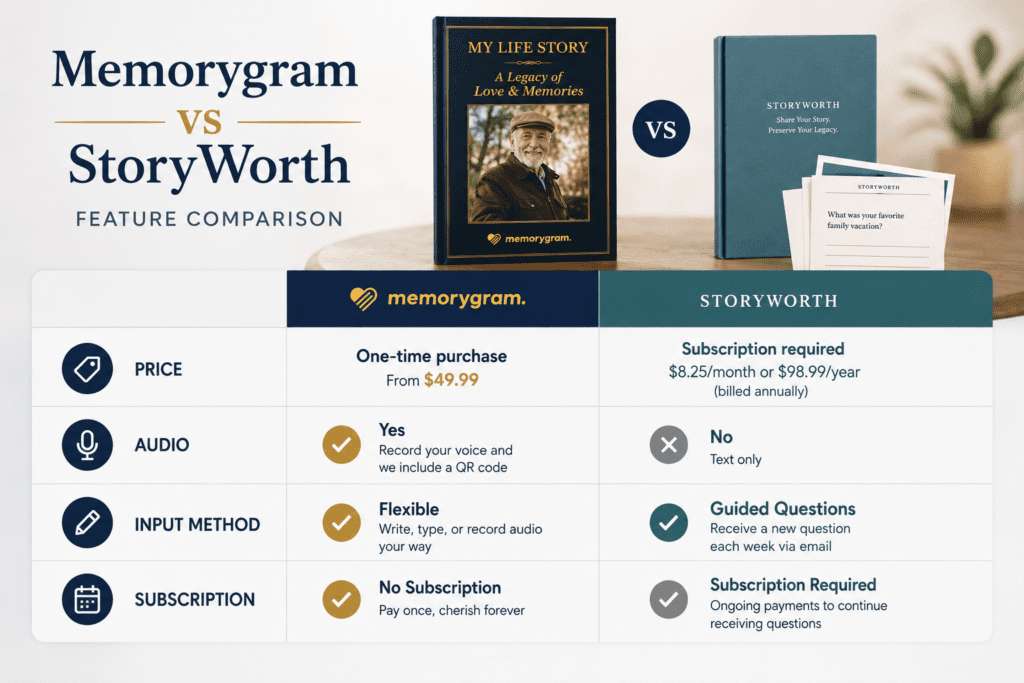
This is the comparison most buyers are running. Here’s the honest, detailed version — not the one written by either brand.
The core difference
StoryWorth is built for people who write. It sends a weekly email, expects a typed response, and compiles those responses into a book after a year. It works well for storytellers who are comfortable with email and have the discipline to write weekly.
Memorygram is built for people who talk. It accommodates typed responses too, but its differentiating feature is phone-based story capture. It works for storytellers who would never finish a typed memoir but will happily chat on the phone.
Most families have one or the other — rarely both in the same person.
| Feature | Memorygram | StoryWorth |
|---|---|---|
| Price model | One-time payment | Annual subscription |
| Base price | ~$99 (sale) / $123.50 | $59 (B&W) / $109 (color) / $199 (unlimited) |
| Book included in base price | Yes | Yes |
| Primary input method | Phone interview, voice-to-text, or typing | Email-based typing |
| Human interviewer | Yes (US only) | No |
| Voice recordings | Yes — QR-linked audio in every chapter | No (base plan) |
| Photo inclusion | Yes — via family portal | Yes |
| Photo limit | Not specified as capped | Unlimited |
| Book color | Full color | B&W (base) / Color (higher tiers) |
| Max pages | Not published | 480 pages |
| Multiple storytellers | Yes — unlimited contributors free; $50 for second primary | Single storyteller (base); $199 plan for unlimited |
| Subscription required | No | Yes — annual |
| Spanish language | Yes | No |
| Money-back guarantee | Before printing | 30 days |
| BBB accreditation | A+ | Not listed |
| International shipping | Yes | Yes (higher cost) |
| Phone interviews | Yes (US) | Partial (higher plans only; limited implementation) |
When to choose StoryWorth
- Your storyteller is comfortable with email and types regularly
- You want up to 480 pages with more formatting flexibility
- You prefer the lower entry price ($59 for the basic tier)
- Your storyteller is a natural writer who just needs prompts and accountability
When to choose Memorygram
- Your storyteller would never finish a typed memoir
- You want voice recordings preserved alongside the text
- You prefer a one-time payment over an annual subscription
- You want a human interviewer to guide the conversation
- You’re gifting to someone who doesn’t use email regularly
The completion argument
The most practically important difference isn’t a feature — it’s a completion rate. Multiple independent sources (gadgetshall.com, memorymurals.com) and user reviews of StoryWorth document abandonment as a real and common outcome, particularly for seniors and non-writers. A StoryWorth subscription where the storyteller stops responding after six weeks costs $59–$109 and produces nothing.
A Memorygram book that gets finished — even if it takes eight months — produces a physical artifact that outlasts every device in the family. The risk-adjusted value calculation matters here. For our full head-to-head with pricing tables and completion rate analysis, see the Memorygram vs StoryWorth comparison.
Memorygram vs Remento
Remento is a third competitor worth knowing. Like Memorygram, it focuses on voice capture. Unlike Memorygram, Remento is primarily app-based and subscription-priced. It’s a stronger option for tech-comfortable storytellers who want a more digital, ongoing experience. It’s weaker for seniors without smartphones or anyone who prefers to own rather than subscribe.
Memorygram beats Remento specifically on: phone-call accessibility (no smartphone required for storyteller), one-time payment model, and the physical book as a primary deliverable.
Is Memorygram Legitimate?
This is one of the most searched questions about the company. The honest answer: yes, Memorygram is fully legitimate.
Verifiable signals as of June 2026:
- BBB A+ accreditation — this is independently awarded and publicly verifiable at BBB.org. It requires a history of responsive customer service and complaint resolution.
- Austin, Texas physical address and phone number — (512) 814-6417 is published on the site. Companies running scams don’t publish a phone number that answers.
- Real products that ship — the Legacy Book is a printed hardcover book. The medallions are engraved metal products made in Texas with lifetime warranties.
- Howie Mandel brand partnership — Mandel is publicly selective about brand endorsements. Multi-year celebrity ambassador relationships aren’t given to scam operations.
- 100,000+ families served — this claim appears on the product page; the volume of customer stories shared on their blog is consistent with a genuine customer base.
The friction points that generate skepticism are not fraud — they’re marketing conventions that deserve transparency:
- The perpetual sale: The “limited time 20% off” banner appears to be permanent, rotating through different holiday themes. The “sale price” of ~$99 is effectively the real price. This is common in DTC e-commerce but it makes some buyers suspicious. It’s not a scam — it’s a pricing presentation choice that the company should be more transparent about.
- Prices hidden on homepage: As of June 2026, pricing isn’t visible on the main site — only in the checkout store. This creates unnecessary friction and feeds “is this legit?” searches. Memorymurals.com flagged this as a real usability issue.
- No refund after printing: The money-back policy applies before the book goes to print. Once printed, returns aren’t accepted. This is disclosed in their terms but not prominently. Read the policy before ordering.
None of these are scams. They’re legitimate operational decisions that deserve more transparency than the current marketing presents.
Pricing and Value Analysis
| Product | Full price | Sale price |
|---|---|---|
| Legacy Book (1 copy) | $123.50 | ~$99 |
| Additional physical copy | $79 | ~$67 |
| Digital / eBook copy | $19.99 | $19.99 |
| Second primary storyteller | $50 | $50 |
| Spanish-language version | Separate product | — |
Value context:
A professional ghostwriter for a personal memoir charges $5,000–$15,000 minimum. Literary biography services charge more. Memorygram produces a guided, formatted, hardcover memoir for $99. The value comparison isn’t close.
Even against StoryWorth: at Memorygram’s ~$99 price vs StoryWorth’s $109 color plan, Memorygram includes a human interviewer (US), voice recordings, and a full-color book for similar money. StoryWorth’s $59 base plan produces a black-and-white book with no audio.
For families who want multiple physical copies — say, one for each of three adult children — the math is $99 + $67 + $67 = $233 for three full-color hardcover memoir books. That’s under $80 per book for something families will keep for decades.
The one pricing note: Additional copies are priced per unit with no family bundle discount. Three storytellers at standard pricing would cost $99 + $50 + $50 = $199 for the book plus two additional primary storytellers. Plan the budget accordingly if you’re capturing multiple family members.
Who Should Buy Memorygram
Memorygram is the right choice if:
- You have a parent or grandparent who would never finish a typed memoir – the phone interview removes the specific friction point that kills most memoir projects with older adults
- Your storyteller doesn’t use email regularly – or stopped opening email, or has vision issues that make reading small text on a screen difficult
- You want to preserve their actual voice, not just their words – the QR-linked audio recordings make this the only major memoir service that lets future generations hear the storyteller speak
- You’re looking for a meaningful gift that isn’t another physical item – particularly for parents or grandparents who genuinely don’t need more things
- You want a one-time purchase – no subscription, no renewal, no annual billing
- You have a blended or extended family – the multi-contributor model lets scattered family members all add to one book
- You want a gift with a deliverable – unlike digital experiences or subscriptions, Memorygram ends with a physical book you can hold, photograph, and pass down. If you’re building a full gift set, pair it with our top-rated SleepFuel review (liquid sleep supplement, 30-day test) or the Pulsetto vagus nerve stress wearable for a complete wellness gift
- You’re outside budget for a professional biographer – Memorygram produces professionally formatted memoir content for a fraction of ghostwriter costs
Who Should Avoid Memorygram
Be honest with yourself about these scenarios:
- Your storyteller is a natural writer and is tech-comfortable – StoryWorth or a journal-style service will cost less and give them more creative control over their own prose
- You’re outside the US and specifically want the phone interview – the human interviewer feature is US-only; international families get voice-to-text and typed options only
- You want an instant, same-day product – Memorygram works at the pace of weekly questions plus print time; if you need something tomorrow, this isn’t it (though it can be gifted digitally while the book completes)
- You expect a fully autonomous process – someone in the family will need to manage photo uploads and, if using phone interviews, coordinate scheduling
- You’re on a very tight budget – at $99, it’s not expensive in absolute terms, but there are no-cost or lower-cost alternatives if budget is the primary constraint. Browse our wellness gadgets hub for independently tested alternatives at every price point
Expert Tips for Getting the Most From Memorygram
- Sit with them for the first call. Not to take over – just to be present. The first 10–15 minutes of the first phone interview can feel slightly formal, and having a familiar face in the room helps the storyteller relax. By the second call, they typically don’t need you there at all. This is especially true for seniors who already have a technology anxiety pattern – similar to what we observed when testing the illo wearable sleep mask with older adults who were resistant to sleep accessories at first but adapted within a week.
- Increase the question frequency. The default pace of one question per week is comfortable but slow. If your storyteller is enthusiastic and you want the book done faster, increase to two or three questions per week. At that pace, a 60-question book is done in five to seven months.
- Do the photo upload yourself. Book a two-hour session with the storyteller, go through old photos together, and upload the ones they want included. Don’t ask them to do it independently – it’s too likely to stall. The session itself becomes a memory.
- Write at least two custom questions. The standard library is excellent, but one or two questions specific to your family – “What do you remember about the day [specific family event] happened?” – unlock stories that no generic prompt ever reaches.
- Start before a milestone. A book begun in June with one-question-per-week cadence will be ready for Christmas 2026. A book begun in September won’t. If there’s a specific occasion you want to present the book at, work backward from the print delivery time.
- Order a second copy early. Additional copies are cheaper when ordered at the same time as the first printing. If you know siblings or other family members will want their own copy, decide before you send to print.
- Read the transcripts with the storyteller. Before the book goes to print, read the chapters together. They’ll often add details, correct small things, and sometimes tell a follow-up story that becomes its own chapter.
Common Mistakes Buyers Make
Mistake 1: Waiting until the last minute for a hard deadline. Memorygram can be gifted digitally on any date — which makes it feel urgent-deadline-friendly. But the book takes months to complete once the storyteller starts answering questions. If you want to hand someone a finished hardcover at a specific event, plan 6–8 months ahead. If you want to give the gift at the event and present the book later, last-minute is fine.
Mistake 2: Expecting the storyteller to manage the portal. The web portal for photo uploads and story editing is straightforward for a tech-comfortable person. It is not straightforward for the same population that finds email difficult. Assign a family member as the “portal manager” upfront. Don’t leave it to chance.
Mistake 3: Not using custom questions. The default question library is thoughtful, but it’s generic. The most irreplaceable stories come from specific family-tailored questions. “What was the most scared you’ve ever been?” is a good generic question. “What was the trip to [specific place] really like?” opens a story that only your family knows to ask about.
Mistake 4: Choosing the wrong input method. If your storyteller would love to write, don’t default to phone interviews. The typed response method is perfectly capable and gives them more control over their own words. Phone interviews shine specifically for people who don’t write — not as a universal default.
Mistake 5: Not ordering a second copy at print time. The $67 additional copy cost is lower than ordering a second copy independently later. Families consistently report wishing they’d ordered more copies upfront — for children, grandchildren, or as a spare. Decide before the book goes to print.
Legacy Book Buying Guide: What to Look for in a Family Memoir Service
If you’re comparing memoir and legacy book services in 2026, here are the criteria that actually matter — and which to ignore.
Input method accessibility. The single most important factor determining whether the project actually gets finished. Email-based typed responses have high abandonment rates with seniors and non-writers. Phone and voice-based input methods have materially better completion rates. Match the input method to the storyteller, not to your preference.
One-time vs subscription pricing. Subscriptions create ongoing cost and access risk (what happens to the stories if you stop paying?). One-time purchases give permanent ownership. For a family heirloom product, one-time payment is structurally superior.
Voice preservation. A transcript is valuable. A transcript plus the actual voice recording is irreplaceable. Services that capture audio and link it to the text — as Memorygram does via QR codes — give future generations something that pure text-based services cannot. For context on how voice-based wellness products more broadly compare in terms of ease of use for seniors, see our Pulsetto review — a vagus nerve wearable where the same accessibility principle (minimal setup, maximum benefit) proved decisive.
Print quality. The finished book needs to last decades. Evaluate: hardcover vs paperback, archival paper vs standard paper, full color vs black-and-white interior, professional layout vs generic template. Memorygram: hardcover, full-color, professional layout. StoryWorth basic: hardcover, black-and-white interior.
Collaboration model. Memoirs benefit from multiple family voices. Services that allow multiple contributors at no extra cost (Memorygram) create richer books than single-storyteller platforms (StoryWorth standard tier).
Pricing transparency. Avoid services that hide pricing until checkout or use perpetual “limited time” sale framing. Both Memorygram and StoryWorth have known pricing in their checkout flows — Memorygram’s homepage doesn’t display prices, which is a friction point.
Completion support. What happens if the storyteller misses questions? Can the pace be adjusted? Can the project be paused? Memorygram allows flexible scheduling. StoryWorth’s annual countdown doesn’t pause.
Frequently Asked Questions
Is Memorygram worth the money?
For families with a tech-averse storyteller, yes — clearly. At ~$99 for a full-color hardcover memoir with QR-linked voice recordings, Memorygram costs less than most restaurant anniversary dinners and produces something families keep for generations. The value case is strongest when compared to professional memoir services ($5,000+) or the real cost of a StoryWorth subscription that never gets finished. If your storyteller would happily type weekly emails, StoryWorth at $59–$109 is a reasonable lower-cost alternative.
How is Memorygram different from StoryWorth?
The core difference is input method and model. StoryWorth sends a weekly email and expects a typed response. Memorygram can call the storyteller on the phone, ask the questions, and transcribe the conversation into a chapter — no typing required. Memorygram also includes QR-linked voice recordings in the printed book (StoryWorth’s base plan does not), charges once rather than annually, and allows multiple family contributors for free. StoryWorth offers more pages (up to 480) and has been in market longer.
Is Memorygram a scam or legit?
Memorygram is a legitimate, BBB A+-accredited company based in Austin, Texas. They have a public phone number, a verified business address, over 100,000 families served, and a celebrity brand partner in Howie Mandel. The elements that generate “is this a scam?” searches are: perpetual sale pricing that creates artificial urgency, prices not shown on the homepage (only in checkout), and a no-refund-after-printing policy that some buyers discover too late. These are transparency issues, not fraud.
What is the Memorygram phone interview process?
Memorygram schedules a call with your loved one at a regular time (weekly, bi-weekly — whatever suits them). A guided interview flow asks curated questions; the storyteller simply talks. The call is recorded, transcribed by a human-reviewed process, lightly edited (filler words removed, rambling organized), and formatted into a chapter. The original audio is preserved as a downloadable file linked from a QR code in the printed book. The phone interview is currently available for US storytellers only.
Can I gift Memorygram for Father’s Day even if it’s last minute?
Yes. Memorygram delivers the gift digitally to the recipient’s email inbox on any date you specify during purchase — no physical shipping is required to start. The printed hardcover book is produced after the storyteller completes their questions, which can take several months. You give the gift on the day; the book arrives later. This makes it one of the rare meaningful gifts that works last-minute.
How long does it take to complete a Memorygram book?
At one question per week (up to 60 questions), a full book takes approximately 14–15 months. Increasing the question frequency speeds this up: at three questions per week, a 60-question book is done in about five months. The print and delivery process takes several additional weeks after all questions are answered. A book started now at two questions per week would realistically be ready before Christmas 2026.
Can multiple family members contribute?
Yes, and this is one of Memorygram’s advantages over standard services. Unlimited family contributors can add photos, supporting stories, and comments to any book at no additional cost. If you want to formally add a second primary storyteller — someone who will be asked and answer their own set of questions — that costs an additional $50.
Does Memorygram work outside the United States?
Partially. The Legacy Book itself, the typing-based input method, and the voice-to-text feature are available internationally. The phone interview feature — where Memorygram calls the storyteller — is currently US-only. International families with tech-comfortable storytellers can use the service effectively. Families wanting the phone interview feature for a non-US storyteller should verify availability with Memorygram before purchasing.
What happens if my loved one doesn’t finish the questions?
The book doesn’t have to include all 60 questions. You can print the book at any point with whatever stories have been completed. There’s no hard deadline. If the storyteller passes away before finishing, the completed questions can still be printed as a partial memoir — which is itself a meaningful artifact. Memorygram’s flexible pace means an incomplete book is still a book.
How does the QR voice recording feature work?
Each story chapter in the printed book includes a unique printed QR code. Anyone with a smartphone scans the code and hears the original audio recording of that story being told — in the storyteller’s voice. The audio files are also available as downloadable files from the family portal. This works permanently, not through a subscription — the QR links are tied to Memorygram’s servers, which is worth noting as a long-term dependency.
How does Memorygram handle transcription?
Memorygram uses a combination of speech-to-text technology and human editorial review. The result is transcripts that are readable and natural-sounding, with filler words, false starts, and tangential rambling removed or reorganized. Regional idioms and distinctive vocabulary are preserved. The process captures the storyteller’s voice and style rather than producing generic cleaned-up text.
Is there a money-back guarantee?
Yes — Memorygram offers a money-back guarantee before the book goes to print. Once the book has been sent to the printer, returns are not available. The practical implication: if you’re unsatisfied with the process or the transcript quality, raise it before you approve the final draft for printing. The pre-print review window is your opportunity to request changes or request a refund.
How long are the phone calls?
Interviews typically last around 30 to 45 minutes per session. This is the “sweet spot”—long enough to get deep into a story, but short enough that the senior doesn’t get exhausted or lose their voice.
Who uploads the photos for the book?
While the senior is just talking on the phone, the person who gifted the service (you) will get access to a digital portal. You can easily upload family photos from your computer or phone to be printed alongside their stories.
Final Verdict
Memorygram: 4.6 / 5
After three months of running the process with my grandfather — through the slightly stiff first call, through the evening of going through old photo albums, through the moment the finished book arrived and he sat at his kitchen table reading his own life story in print for the first time — my assessment is clear.
Memorygram solves a real problem in the most direct way available. The problem is that most people who have stories worth keeping will never sit down to write them. The solution isn’t to make writing easier. It’s to remove the writing entirely.
The phone interview doesn’t just make the process more accessible. It produces better stories. My grandfather told things on those calls — prompted by a patient interviewer with a specific question and nowhere else to be — that I had never heard in 35 years of family dinners. The format unlocks something.
The finished book is genuinely beautiful. It feels like an heirloom, not a product.
The three reasons to buy:
- The phone interview removes the #1 reason memoir projects fail — the blank page
- The QR-linked voice recordings give future generations something a text-only book cannot
- One-time payment, no subscription, permanent ownership of an irreplaceable artifact
The two reasons to pause:
- If your storyteller loves to write and is comfortable with email, StoryWorth’s lower price is a real alternative
- The process requires a family member to manage photos and stay engaged — it’s collaborative, not fully autonomous
If there is someone in your life whose stories deserve to be kept — and if that person would never finish a typed memoir — Memorygram is the answer. It’s not cheap relative to a greeting card. It’s extraordinarily cheap relative to what it produces.
Click Here to Start Your Family’s Book on the Official Memorygram Website
30-day money-back guarantee before printing. No subscription required. One-time payment.

