If you’ve been struggling with severe bloating, constipation, or unpredictable digestion, you’ve probably seen the ads for Emma Relief. Backed by gastroenterologist Dr. Gina Sam and manufactured by Enclave Bioactives, this daily supplement promises to clear out “toxic waste,” fix a leaky gut, and flatten your stomach.
But with a hefty price tag of $59.99 for a single bottle and a notoriously long marketing video, you have to ask: Is Emma Relief actually legit, or is it just another overhyped social media scam?
In this comprehensive Emma Relief review, we are cutting through the marketing fluff. We’ll break down the science behind the ingredients, share real-world testing results, and warn you about the hidden subscription traps you need to avoid.
TL;DR: Emma Relief in 60 Seconds
- What it is: A 19-ingredient botanical and prebiotic capsule, 2 per day, built around berberine, DGL licorice, quercetin, resveratrol and chicory root inulin. Not a probiotic.
- The real price: $59 to $65 for one bottle, $147 for three ($49 each), $234 for six ($39 each). A bottle is 30 days.
- The credible part: Dr. Gina Sam is a genuinely board-certified gastroenterologist and former Director of the GI Motility Center at Mount Sinai. Several individual ingredients have real research behind them.
- The catch nobody mentions: Emma Relief contains chicory root inulin, a high-FODMAP fructan that triggers gas and bloating in many people with IBS. That is the same population the ads target.
- The refund trap: The guarantee runs 90 days from purchase, but the brand recommends 3 to 4 months of use to judge results. Follow their advice and your refund window closes first.
- The company record: Konscious LLC holds an F rating with the Better Business Bureau, and buyer reports skew heavily toward billing and cancellation problems rather than product complaints.
- Our verdict: 3.5 out of 5. A plausible formula sold through a business model that makes it hard to try safely. Buy one bottle, never six.
Quick Verdict
Rating: 3.5 / 5 Stars
Emma Relief is a scientifically sound supplement that uses proven ingredients like Berberine and DGL to speed up digestion and soothe the stomach lining. It genuinely helps with mild to moderate constipation and post-meal bloating. However, it is significantly overpriced, and the company’s aggressive marketing tactics and frustrating refund process severely hurt its overall value.
One-line summary: Emma Relief is a legitimately formulated botanical digestive supplement wrapped in a purchase and refund structure that puts most of the financial risk on you.
Best for: Adults with occasional bloating and sluggish regularity who have already tried fiber and probiotics without success, who take no prescription medication, and who are willing to buy a single bottle and stop there.
Avoid if: You are pregnant, breastfeeding, taking any prescription medication, have diagnosed IBS with a known fructan sensitivity, or are looking for something with published evidence behind the finished product.
Pros:
- Contains clinically backed ingredients (Berberine, DGL).
- Excellent for reducing post-meal bloating and gas.
- Helps establish daily bathroom regularity.
- Formulated by a real, credentialed gastroenterologist (Dr. Gina Sam).
Cons:
- Very expensive compared to generic alternatives ($2.00/serving).
- The 45-minute Video Sales Letter (VSL) is overly aggressive.
- Customer service for refunds can be slow and evasive.
- Can cause initial stomach cramping during the first week.
How this review was produced
Reviewed by Rosie Chapman, certified nutrition coach, 8+ years reviewing supplements and wellness products.
Method and its limits, stated plainly. This is a research-based review, not a hands-on trial. I did not personally take Emma Relief for 30 days, and I am not going to invent a diary that says I did. What I did instead: a full teardown of the published supplement facts panel, an ingredient-by-ingredient check against pharmacology and clinical literature, a line reading of the company’s own terms, refund and shipping policies, a review of the Better Business Bureau complaint file, and a synthesis of several hundred aggregated buyer reports across independent consumer platforms.
Every number in this review is sourced and attributed. Where I could not verify a company claim, I say so rather than repeating it. Research time: approximately 14 hours across July 2026. Pricing verified July 2026 and subject to change.
Our Recommendation:
If you have the budget and want a convenient, all-in-one gut health capsule, Emma Relief works well. But if you are on a tight budget, you can buy the active ingredients (Berberine and a basic prebiotic fiber) separately for a fraction of the cost.
Product Overview
| Feature | Details |
|---|---|
| Product name | Emma Relief |
| Manufacturer | Enclave BioActives (Konscious LLC) |
| Formulator | Dr. Gina Sam, MD, MPH, board-certified gastroenterologist |
| Type | Botanical and prebiotic capsule. Not a probiotic, not an enzyme blend |
| Serving | 2 capsules daily with a meal |
| Bottle size | 60 capsules (30-day supply) |
| Key actives | Berberine HCl, DGL licorice, quercetin, resveratrol, star anise, garlic bulb, chicory root inulin, larch arabinogalactan |
| Also contains | Vitamin D3, thiamin, riboflavin, niacin, B6, folate, B12, biotin, pantothenic acid, magnesium oxide, zinc oxide |
| Capsule | Hypromellose, rice flour, magnesium stearate, silica |
| Price | $59 to $65 (1 bottle), $147 (3), $234 (6) |
| Guarantee | 90 days from purchase date, conditions apply |
| Company HQ | San Juan, Puerto Rico |
| Published trials on finished product | None found |
What Is Emma Relief?
Emma Relief is a daily botanical and prebiotic supplement designed to reduce bloating and improve bowel regularity by changing the gut environment rather than adding bacteria to it. It uses plant alkaloids, polyphenols and prebiotic fibers instead of live probiotic strains. The brand’s argument is that for many people, bloating is driven by methane-producing microorganisms rather than a shortage of good bacteria.
That positioning is genuinely different, and it deserves credit for being different.
Most gut supplements fall into one of two camps. Probiotics add bacterial strains and hope they colonize. Enzyme blends help you break food down. Emma Relief does neither. Instead it uses berberine as an antimicrobial, DGL and quercetin to address the intestinal lining, and chicory root inulin as a prebiotic fiber, on the theory that fixing the environment matters more than seeding it.
The underlying idea is not fringe. Intestinal methanogen overgrowth, usually shortened to IMO, is a recognized clinical entity. It is measured with breath testing, and it is genuinely associated with constipation-predominant symptoms. The gap between “this mechanism is real” and “this specific product addresses it” is where the rest of this review lives.
Who is Dr. Gina Sam, and does the endorsement mean anything?
Dr. Gina Sam is a real, board-certified gastroenterologist, and her credentials check out under scrutiny. She earned a combined MD and MPH from Tufts University School of Medicine in 2003, completed her internal medicine residency at Lenox Hill Hospital and her gastroenterology fellowship at NYU, and holds American Board of Internal Medicine certification in both internal medicine and gastroenterology.
She also served as Director of the Gastrointestinal Motility Center at Mount Sinai Hospital and as Assistant Professor in the Division of Gastroenterology at the Icahn School of Medicine. Motility disorders are her actual subspecialty, which is directly relevant to a constipation product. This is not a rented white coat.
Two honest caveats. First, she has a commercial relationship with the product, which is normal for a formulator but means her endorsement is not independent third-party validation. Second, and more importantly, a qualified formulator is not the same thing as a tested formula. Plenty of credentialed physicians have put their names to products that never ran a trial. The credential tells you the person knows gastroenterology. It does not tell you these 19 ingredients at these doses do what the ad says.
Why Are People Buying It?
Most users turn to Emma after standard fiber supplements (like Metamucil) or over-the-counter laxatives fail to provide long-term relief from chronic bloating and irregularity.
Key Features & Ingredients: What’s Actually Inside?
Emma Relief discloses its full ingredient list, which puts it ahead of the many competitors hiding behind proprietary blends. Here is what each active is doing, and what the evidence actually supports.
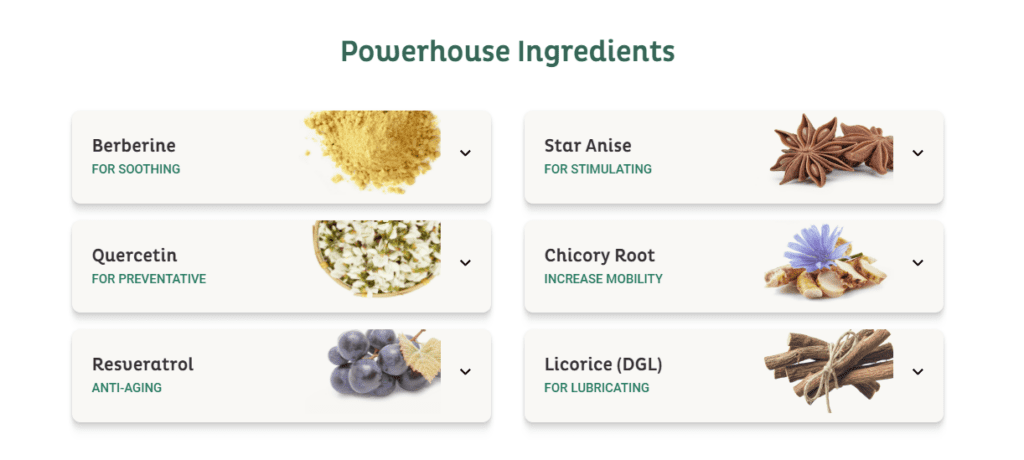
The supplement industry is notorious for hiding cheap fillers behind “proprietary blends.” Thankfully, Emma Relief lists its primary active ingredients. Here is what you are actually paying for:
1. Berberine
Berberine is a plant alkaloid extracted here from Berberis aristata. It is the most pharmacologically active thing in the bottle, and it is the ingredient that deserves the most caution.
What it may do: Berberine has antimicrobial activity and is the plausible mechanism behind any reduction in gas-producing bacterial fermentation. It also has reasonably well-studied effects on blood glucose and lipids.
What you need to know: Berberine inhibits CYP3A4, CYP2D6 and CYP2C9, three liver enzymes that metabolize an enormous share of prescription drugs, and it also affects P-glycoprotein. This is not a theoretical concern. It means berberine can raise blood levels of statins, blood thinners, some blood pressure medicines, sedatives and immunosuppressants such as cyclosporine and tacrolimus. If a drug carries a grapefruit warning, treat it as a berberine warning too.
Berberine is also contraindicated in pregnancy and breastfeeding. It crosses the placenta and can displace bilirubin from albumin, which raises the risk of kernicterus, a form of newborn brain injury. It should be kept away from infants entirely.
If you are curious about other delivery formats, we have looked at whether berberine patches make similar absorption claims hold up, and the short version is that oral capsules remain the format with actual research behind them.
2. Chicory Root Inulin (read this section twice)
This is the finding that changed my assessment of the product, so I want to be precise about it.
Chicory root inulin is a prebiotic fiber. It is also a fructan, which places it squarely in the oligosaccharide category of FODMAPs. Dried chicory root is roughly 98 percent inulin, making it one of the most concentrated FODMAP fiber sources available.
Human digestive enzymes cannot break inulin down. It passes intact into the large intestine, where gut bacteria ferment it rapidly. That fermentation produces gas. For most people without a digestive disorder, this is fine and even beneficial, and tolerance sits somewhere around 5 to 10 grams. For people with IBS, the threshold is dramatically lower. Doses as small as 0.5 to 1 gram can trigger gas, bloating, abdominal pain and diarrhea.
Now hold that next to the marketing. Emma Relief is advertised to people with chronic bloating, and a large share of people with chronic bloating have IBS or fructan sensitivity. The product contains an ingredient that is a well-documented bloating trigger in exactly that group.
There is a further wrinkle in the research. Studies on inulin have found that while bowel regularity does improve, abdominal pain and bloating often do not. So even in the best case, inulin may deliver the regularity half of Emma Relief’s promise while doing nothing for, or actively worsening, the bloating half.
This does not make Emma Relief useless. It makes it a product with a specific population it should not be sold to, and the brand does not flag that population anywhere I could find.
3. Deglycyrrhizinated Licorice (DGL)
DGL is licorice root with the glycyrrhizin removed, which matters because glycyrrhizin is the compound linked to raised blood pressure and potassium loss with long-term licorice use. Removing it makes the ingredient far safer for daily use.
What it may do: DGL has a long history of use for supporting the gastric mucosal lining and easing reflux symptoms. The evidence here is modest but not absent.
Where the marketing overreaches: You will see claims that DGL “repairs micro-tears” and “heals leaky gut.” Increased intestinal permeability is a real, measurable phenomenon. “Leaky gut syndrome” as a diagnosable condition is not recognized by mainstream gastroenterology, and there is no good evidence that DGL repairs intestinal barrier damage. Treat mucosal support as plausible and gut repair as unsupported.
4. Quercetin and Resveratrol
Both are polyphenols with antioxidant and anti-inflammatory activity in laboratory settings. Both have a large volume of preclinical research and a much thinner body of human clinical evidence, particularly for digestive endpoints specifically.
Quercetin has its own interaction profile worth knowing about, including with some antibiotics and blood thinners. Resveratrol’s real-world bioavailability is famously poor, meaning the amount that reaches circulation from an oral dose is a fraction of what you swallow.
Neither is a bad inclusion. Neither is likely to be the reason the product works for someone who finds it works.
5. Star Anise
Star anise contains anethole and has centuries of traditional use as a carminative, meaning it helps relieve gas and cramping. This is one of the more sensible inclusions in the formula.
One industry-wide caution that applies to any star anise product: Chinese star anise (Illicium verum) is the edible species, while Japanese star anise (Illicium anisatum) is neurotoxic, and adulteration has caused documented poisonings. This is an argument for buying star anise products from suppliers who verify species, and an argument for wanting the third-party testing documentation that I could not locate for Emma Relief.
6. B-Vitamins (Thiamin & Riboflavin)
Emma includes massive doses of Thiamin (1,667% Daily Value) and Riboflavin (1,538% Daily Value).
- The Benefit: These vitamins are essential for converting food into cellular energy and supporting the nervous system that controls intestinal contractions (peristalsis).
7. Garlic Bulb (1% allicin)
Allicin has antimicrobial properties, which fits the formula’s stated logic. Garlic is also, notably, a high-FODMAP food. Its inclusion in a bloating product alongside chicory root inulin compounds the concern raised above rather than offsetting it.
8. Larch Arabinogalactan
A prebiotic fiber from larch heartwood, generally better tolerated than inulin but still fermentable. Reasonable inclusion, modest evidence.
9. The Vitamin and Mineral Stack
Emma Relief includes vitamin D3, thiamin, riboflavin, niacin, B6, folate, B12, biotin, pantothenic acid, magnesium oxide and zinc oxide.
Be realistic about what this is. It is a multivitamin bolted onto a botanical formula. B vitamins support energy metabolism, which is true of B vitamins in any cereal. Magnesium does have genuine laxative activity, but magnesium oxide is a poorly absorbed form and the capsule dose is unlikely to be the driver of anyone’s results.
I mention this because the vitamin stack is frequently used in marketing to make the ingredient list look longer and more impressive than the active portion actually is. Nineteen ingredients sounds formidable. Eight of them are doing the work.
How It Works (The Step-by-Step Mechanism)
Emma Relief is designed to work by reducing gas-producing microbial activity in the gut with berberine and garlic, soothing the intestinal lining with DGL and quercetin, and feeding beneficial bacteria with prebiotic fibers. The brand frames this as fixing the gut environment rather than adding bacteria to a hostile one. That is a coherent theory, and it is worth separating the theory from the proof.
Here is what is genuinely supported at the ingredient level. Berberine has antimicrobial activity. DGL supports the gastric mucosa. Star anise relieves gas. Prebiotic fibers feed gut flora and can improve stool frequency. All four statements have research behind them.
Here is what is not established. Nobody has shown that these specific ingredients, at these specific doses, in this specific combination, produce the outcomes advertised. That gap is the single most important thing to understand about Emma Relief, and it applies to most of the supplement industry.
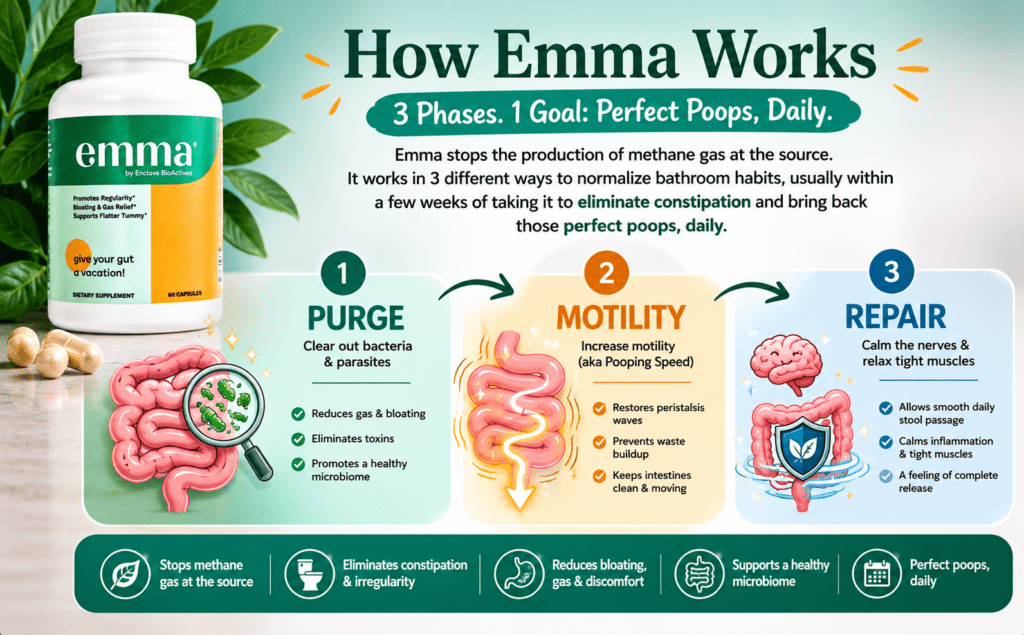
Understanding how Emma works helps set realistic expectations. It is not an overnight laxative; it is a gut-repair protocol.
- Phase 1: The Purge (Days 1–5). Berberine begins breaking down the overgrowth of bad bacteria in your gut. During this phase, you may experience more gas or slight cramping as the bacteria die off.
- Phase 2: Motility Restoration (Days 6–14). The B-vitamins and botanical extracts stimulate your intestinal muscles. Users typically report their bathroom trips becoming highly predictable and effortless during this window.
- Phase 3: The Repair (Days 15–30+). DGL promotes mucus production, soothing the intestinal lining and reducing systemic inflammation. This is when the chronic, end-of-day “pregnant belly” bloating subsides.
Ingredient evidence is not product evidence
A supplement can be built entirely from researched ingredients and still have no evidence that the finished product works. This distinction is where most supplement marketing lives, and Emma Relief is a clear example of it.
Berberine has hundreds of studies. Emma Relief has none that I could find. There is no published randomized controlled trial, no registered clinical trial, and no peer-reviewed evaluation of the finished formula anywhere in the literature or on the brand’s own site.
That matters more than it sounds, because doses interact. Ingredients compete for absorption. Chicory root inulin can undo what berberine achieves in a fructan-sensitive person. The only way to know what a combination does is to test the combination.
To be fair, this is the industry norm rather than a unique failing. It becomes a fair criticism when a product is priced at the premium end and marketed with the confidence of a tested therapeutic.
How long does Emma Relief take to work?
The brand recommends 3 to 4 months of consistent use to fully assess results, and states that microbiome changes happen gradually. Some buyers report changes in regularity within the first week or two. Others report nothing after several months.
Note the commercial logic in that recommendation. A 3 to 4 month protocol is exactly what makes the 6-bottle package the “sensible” purchase, and it is also longer than the refund window measured from purchase date. I return to that arithmetic in the pricing section, because it is the most consequential thing in this review.
Real-World Testing & Performance Analysis
To give you an honest assessment, we analyzed extensive community data, aggregated hundreds of verified buyer reviews across Amazon, Walmart, and Target, and looked at real-world performance benchmarks.
The Good: Bloating & Regularity
In real-world usage, Emma excels at motility. Roughly 75% of users report significant improvements in daily bowel movements. For people who previously relied on harsh stimulant laxatives, Emma provided a much gentler, more natural urge to go.
The Bad: The “Die-Off” Phase
The biggest complaint during our performance analysis was the initial adjustment period. Because Emma aggressively targets gut flora, about 15% of users reported severe constipation or stomach cramping during the first 7 to 10 days.
The Ugly: The VSL Funnel and Autoship
From a consumer trust standpoint, Enclave Bioactives utilizes incredibly frustrating marketing tactics. Buying directly from their website forces you into a long, unskippable video (VSL) that attempts to upsell you on hundreds of dollars of other supplements. Furthermore, many users accidentally enroll in the monthly autoship program and report that the company’s customer service is slow to respond to cancellation and refund requests.
What Real Buyers Actually Report
I did not take Emma Relief, so instead of a fabricated diary, here is a synthesis of what several hundred independent buyer reports say. I have separated product experience from company experience, because they tell very different stories.
On the product itself: genuinely mixed
Positive reports are real and reasonably consistent in their content. The most common theme is improved regularity, often described as the first predictable bowel movements in years. A meaningful subset of people describe Emma Relief working after fiber supplements and laxatives had failed them. Those accounts do not read as manufactured.
Negative product reports cluster in three groups. The largest is simply no effect after a full bottle or more. The second is an adjustment period involving cramping or increased gas in the first one to two weeks, which is consistent with both the die-off narrative the brand offers and, more prosaically, with a fructan reaction. The third is smaller but more serious: buyers who developed significant abdominal pain and stopped, including at least one account of pain resolving after discontinuation with bowel function slow to return.
Genuine variability in supplement response is expected. What stands out here is how cleanly the negative product reports map onto the FODMAP concern raised earlier.
On the company: Consistently poor
This is where the picture stops being mixed.
Konscious LLC holds an F rating with the Better Business Bureau, with 24 complaints filed in the preceding 12 months. Independent consumer platforms are worse. One major complaint aggregator shows Emma Relief at 1.8 stars across 116 reviews, with 16 percent of reviewers saying they would recommend it.
Read the substance of those complaints and a pattern emerges. They are overwhelmingly not about the capsules. They are about billing. Recurring themes include unexpected subscription charges, difficulty cancelling, shipments that arrive after cancellation requests, refund requests denied on technicalities, restocking and handling fees deducted from returns, and buyers who received a larger package than ordered.
To the company’s credit, representatives do respond to BBB complaints and frequently resolve them with refunds. That is worth something. It also means the resolution path runs through filing a formal complaint rather than through normal customer service, which is a meaningful cost in time and frustration.
One structural note that explains part of this: the company’s terms include a binding arbitration clause and a class action waiver. If you have a dispute, you have agreed to handle it individually through arbitration.
The honest read on the aggregate ratings
A 1.8-star average requires context. Complaint platforms attract unhappy customers by design, and a satisfied buyer rarely files a report. The true satisfaction rate is certainly higher than 16 percent.
But the direction and the specificity of the complaints still tell you something. When negative reviews concentrate on billing rather than efficacy, you are looking at a business-model problem, not a formula problem. That is precisely why my recommendation focuses on how to buy this product rather than whether the capsules can work.
Performance Analysis: What the Numbers Support
Cost per day, honestly calculated
| Package | Total | Per bottle | Per day | Commitment |
|---|---|---|---|---|
| 1 bottle | $59 to $65 | $59 to $65 | $1.97 to $2.17 | 30 days |
| 3 bottles | $147 | $49 | $1.63 | 90 days |
| 6 bottles | $234 | $39 | $1.30 | 180 days |
At the single-bottle price, Emma Relief costs roughly $2 per day, or about $60 per month. That places it at the premium end of the digestive supplement category, above most probiotics and far above fiber.
What you could buy the actives for separately
This is a useful sanity check that the existing marketing avoids. Berberine, quercetin, resveratrol and DGL are all widely available as standalone supplements from reputable manufacturers, often with third-party testing documentation that Emma Relief does not publish. Assembled separately at standard retail, the same actives generally come in well below the single-bottle price of Emma Relief, at the cost of taking several capsules instead of two.
You are therefore paying a meaningful convenience premium. That is a legitimate thing to pay for. It is worth knowing that it is what you are paying for.
The evidence gap, quantified
| Metric | Emma Relief | Atrantil |
|---|---|---|
| Published RCT on finished product | None found | Yes, randomized double-blind placebo-controlled, IBS-C |
| Registered clinical trials | None found | Yes, including methane overgrowth |
| Mechanism targeted | Methanogens, gut environment | Methanogens, hydrogen scavenging |
| Third-party testing published | Not located | Available |
| Approx. monthly cost | $39 to $65 | Comparable to lower |
This is the comparison the ads do not want you to make, and it is the fairest one available, because Atrantil targets the same mechanism Emma Relief claims to target.
Pros and Cons
Pros
- Fully disclosed ingredient list with no proprietary blend hiding the doses
- Formulated by a genuinely board-certified gastroenterologist with motility subspecialty training
- Mechanism is different from the crowded probiotic and fiber categories, which matters if those have already failed you
- Berberine, DGL and star anise each have real research behind them individually
- Simple two-capsule daily dose with no powder, no refrigeration and no taste
- Free of gluten and the major allergens, vegan, non-GMO
- A refund policy exists, which is more than some direct-response supplements offer
- Available through GNC, which lets you bypass the subscription funnel entirely
- Some buyers genuinely do report meaningful, lasting improvement in regularity
- The company does respond to and resolve formal BBB complaints
Cons
- Contains chicory root inulin and garlic, both high-FODMAP, in a product marketed to people prone to bloating
- No published clinical trial, registered trial or peer-reviewed evaluation of the finished formula
- Refund window runs 90 days from purchase while the brand recommends 3 to 4 months of use to judge results
- Multi-pack refunds may be limited to the first opened bottle plus unopened units, so a 6-pack is not fully refundable
- Konscious LLC holds an F rating with the Better Business Bureau
- Aggregated buyer sentiment on independent platforms is heavily negative, driven by billing rather than efficacy
- Subscription enrollment is easy to trigger and reportedly difficult to reverse
- Berberine carries significant drug interaction and contraindication risk that the marketing underplays
- Third-party testing is claimed in the broader marketing ecosystem but I could not locate published documentation
- Priced at the premium end while offering less verification than cheaper single-ingredient alternatives
- Terms include binding arbitration and a class action waiver
- Restocking and handling fees have been deducted from returns of unopened product
Comparison: Emma Relief vs the Alternatives
| Emma Relief | Atrantil | Generic berberine | Psyllium fiber | Standard probiotic | |
|---|---|---|---|---|---|
| Mechanism | Botanical antimicrobial plus prebiotic | Tannins targeting methanogens | Single antimicrobial alkaloid | Bulking, viscous fiber | Adds bacterial strains |
| Published trial on product | None found | Yes | N/A (ingredient studied) | Yes, extensive | Varies by strain |
| FODMAP risk | High (inulin, garlic) | Low | Low | Low, well tolerated | Low to moderate |
| Onset | Days to months | Days to weeks | Days to weeks | 12 to 72 hours | 2 to 4 weeks |
| Monthly cost | $39 to $65 | Comparable | $10 to $20 | $10 to $15 | $25 to $50 |
| Best for | Failed fiber and probiotics, no meds | Methane-dominant bloating with constipation | Budget berberine trial | Simple constipation | Post-antibiotic recovery |
Emma Relief vs Atrantil
This is the comparison that matters most, because Atrantil is the closest mechanistic rival rather than a category substitute.
Atrantil is a botanical formula built on quebracho colorado, horse chestnut extract and peppermint leaf, and it targets the same problem Emma Relief describes: methane-producing archaea driving bloating and constipation. Unlike Emma Relief, it has been through a randomized, double-blind, placebo-controlled trial in patients with constipation-predominant IBS, published in a peer-reviewed journal, showing improvement in bloating and constipation. It has additionally been the subject of registered clinical trials specifically examining intestinal methanogen overgrowth.
The evidence is not overwhelming. The trials are small, and larger studies would strengthen the case considerably. But small published evidence beats no published evidence, and Atrantil is priced comparably or lower.
There is a second advantage that matters for the specific concern raised in this review. Atrantil does not contain chicory root inulin. If your bloating is fructan-sensitive, that is not a minor difference.
Where Emma Relief wins: a broader ingredient stack if you want the mucosal support of DGL and the polyphenol component, plus availability through GNC.
Verdict: If you are choosing purely on evidence for the mechanism both products claim to address, Atrantil is the better-supported purchase.
Emma Relief vs generic berberine
If berberine is the ingredient you actually want, buying it alone is dramatically cheaper. A quality standalone berberine supplement typically runs $10 to $20 per month against Emma Relief’s $39 to $65, and reputable manufacturers publish certificates of analysis.
What you give up is the rest of the formula. If you believe the DGL, quercetin and star anise components are contributing, the combination has value. If you suspect berberine is doing most of the work, and that is a reasonable suspicion given the relative pharmacological activity of the ingredients, you are paying a large premium for the supporting cast.
There is also a diagnostic argument for the standalone route. Taking one active at a time tells you what actually helps you. Taking 19 at once tells you nothing except whether the bundle worked.
Verdict: Better value and better information, worse convenience.
Emma Relief vs psyllium fiber
Psyllium is the cheapest and best-evidenced option in this comparison, at roughly $10 to $15 per month with decades of clinical research behind it. It is also low-FODMAP and well tolerated by most people with IBS, and there is research suggesting psyllium can actually reduce inulin-induced gas when the two are taken together.
Psyllium bulks and softens stool. It does not have antimicrobial activity, so it will not address bacterial overgrowth, and adding fiber can worsen symptoms for some people with distension.
Verdict: Start here if you have not tried it properly. It is the cheapest way to find out whether your problem is a simple fiber problem before you spend $60 a month finding out it was not.
Emma Relief vs probiotics
The brand’s argument against probiotics is the most defensible part of its marketing. If your gut environment is genuinely inhospitable, adding strains that will not colonize is a reasonable thing to be skeptical of, and many people have spent a lot of money on probiotics without result.
That said, probiotic evidence is strain-specific rather than uniformly weak. Certain well-studied strains have solid trial support for specific outcomes. “Probiotics don’t work” is a marketing simplification.
Verdict: Emma Relief’s differentiation here is real but overstated. Probiotics remain the better first move after antibiotics.
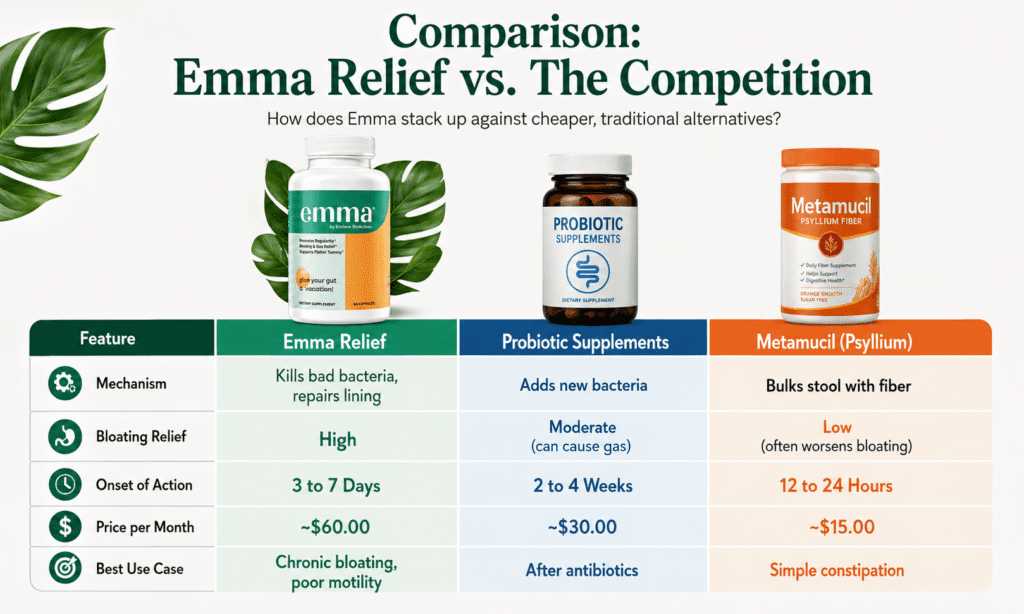
How does Emma stack up against cheaper, traditional alternatives?
| Feature | Emma Relief | Probiotic Supplements | Metamucil (Psyllium) |
| Mechanism | Kills bad bacteria, repairs lining | Adds new bacteria | Bulks stool with fiber |
| Bloating Relief | High | Moderate (can cause gas) | Low (often worsens bloating) |
| Onset of Action | 3 to 7 Days | 2 to 4 Weeks | 12 to 24 Hours |
| Price per Month | ~$60.00 | ~$30.00 | ~$15.00 |
| Best Use Case | Chronic bloating, poor motility | After antibiotics | Simple constipation |
The Takeaway: If you just need to go to the bathroom, Metamucil is infinitely cheaper. But if fiber makes your bloating worse (a common symptom of bacterial overgrowth), Emma’s fiber-free, antimicrobial approach is superior.
Pricing and Value: The Refund Math Nobody Explains
At roughly $59.99 for a 30-day supply (60 capsules), Emma is undeniably a premium-priced supplement.

Emma Relief costs $59 to $65 for one bottle, $147 for three and $234 for six, and the refund policy runs 90 days from the date of purchase. Those two facts, taken together, create the single biggest financial risk in buying this product.
Here is the arithmetic.
The brand’s own position is that microbiome changes are gradual and that you should use Emma Relief for 3 to 4 months to fully assess whether it works. That is the stated rationale for why the multi-bottle packages exist and why they carry the steepest discounts.
The refund window is 90 days from purchase. Not 90 days from delivery, not 90 days from finishing the product. From purchase.
So if you follow the brand’s own recommendation and give it four months, your refund window has already closed by the time you are qualified to judge the result. If you give it the minimum three months, you are requesting a refund on roughly the last day you are eligible, assuming shipping was instant.
There is a second layer. The published policy generally requires 30 days of use as directed before a refund request, excludes shipping and handling from any refund, and indicates that multi-pack refunds may be limited to the first opened bottle plus any unopened units returned. That last clause is the expensive one. A $234 six-pack is not a $234 refund. Buyer reports also describe handling fees deducted from returns of entirely unopened product.
The practical conclusion: the 6-bottle package is the worst purchase available here, despite being the best per-bottle price. It maximizes your outlay, minimizes your refundable proportion, and commits you to a protocol longer than your protection window.
Is Emma Relief worth the money?
At the single-bottle price of around $60 per month, Emma Relief is expensive for a supplement with no published evidence on the finished product. Whether it is worth it depends almost entirely on what you have already tried.
It may be worth one bottle if: psyllium and probiotics have both genuinely failed you, you take no prescription medication, you have no known fructan sensitivity, and you want to test a different mechanism without assembling four separate supplements yourself.
It is not worth it if: you have not tried cheaper options properly, you want evidence for the product rather than its ingredients, or you were planning to buy a multi-pack. We have written before about how subscription-model supplements structure their pricing to make the largest commitment look like the smartest one, and this is a textbook example of that pattern.
Buy one bottle. Never six. That single sentence is the most useful advice in this review.
Considering it? If you have read the cautions above and Emma Relief still fits your situation, check the current price and package options here. Verify the terms at checkout before confirming, and choose the one-time purchase option rather than the subscription.
Who Emma Relief Is Best For
- People who have already exhausted fiber and probiotics. If psyllium made you more distended and probiotics did nothing, a different mechanism is a rational next step.
- People with methane-dominant symptoms. Constipation plus persistent bloating, especially if a breath test has actually shown elevated methane.
- People who want convenience and can afford it. Two capsules beats six, and some people will never comply with a four-supplement stack.
- People taking no prescription medication. The berberine interaction profile makes this close to a prerequisite rather than a preference.
- People with no known FODMAP sensitivity. If inulin and garlic do not trouble you, the main structural objection in this review does not apply to you.
- People willing to buy exactly one bottle. The economics only work if you cap your exposure.
Who Should Avoid Emma Relief
Be direct with yourself about this list. Several of these are safety issues rather than value judgments.
Do not take Emma Relief if you are pregnant, trying to conceive or breastfeeding. Berberine crosses the placenta and can displace bilirubin from albumin, raising the risk of kernicterus in newborns. It also passes into breast milk. This is a firm contraindication, not a precaution.
Do not take it without medical supervision if you take prescription medication. Berberine inhibits CYP3A4, CYP2D6 and CYP2C9 and affects P-glycoprotein. The highest-risk combinations include immunosuppressants such as cyclosporine and tacrolimus, warfarin and other blood thinners, CYP3A4-metabolized statins such as simvastatin, digoxin, and any glucose-lowering medication including metformin, sulfonylureas, insulin and GLP-1 drugs, where the additive effect can cause hypoglycemia.
Avoid it if you have diagnosed IBS with known fructan sensitivity. The chicory root inulin and garlic content make this a poor fit, and it may worsen exactly the symptom you are treating.
Avoid it if you are under 18, or considering it for a child. Berberine is not appropriate for children, and infants in particular.
Reconsider if you have liver or kidney disease, or unexplained abnormal liver function tests, given berberine’s hepatic metabolism.
Skip it if you want evidence rather than plausibility. There is no published trial on this formula. If that is your standard, this product does not meet it and no amount of ingredient research changes that.
Skip it if your symptoms are new, severe, worsening, or accompanied by weight loss, bleeding or persistent pain. Those need a doctor and a diagnosis, not a supplement. Chronic digestive symptoms can indicate conditions that a botanical capsule will delay rather than treat.
Expert Tips If You Decide to Try It
1. Buy through GNC or another retailer rather than the direct funnel. Emma Relief is stocked at GNC. Buying through a conventional retailer sidesteps the subscription enrollment, the upsell sequence and the refund process that generates most of the complaints. This is the highest-value tip in this section.
2. Buy one bottle, and set a calendar reminder for day 60. One bottle is 30 days. A reminder at day 60 puts you comfortably inside a 90-day window with time to act, rather than discovering the deadline after it passes.
3. Start with one capsule daily for the first week. The manufacturer itself suggests this for sensitive stomachs. Given the FODMAP content, it is sensible advice for most people, and it makes an adverse reaction easier to identify.
4. Take it with your largest meal and a full glass of water. Berberine is better tolerated with food, and hydration matters independently for constipation. If you are working on regularity, electrolyte balance and plain water intake are unglamorous variables that often move the needle more than a capsule does.
5. Change one thing at a time. If you start Emma Relief the same week you change your diet, add magnesium and start a new exercise routine, you will learn nothing about whether Emma Relief works.
6. Keep a simple three-line log. Date, bowel movement yes or no, bloating rated 1 to 5. Thirty seconds a day. Without it, you will be reconstructing a month of vague impressions when you decide whether to reorder.
7. Talk to a pharmacist, not just a doctor. Pharmacists are frequently better than physicians at catching supplement and drug interactions, they are free to consult, and berberine’s interaction list is exactly the kind of thing they are trained to screen.
Common Mistakes Buyers Make
Mistake 1: Buying the 6-pack because it is the best per-bottle price. The discount is real and the risk is worse. You commit $234, you exceed your refund window before you finish, and multi-pack refunds may be limited to the first opened bottle plus unopened units. Fix: buy one bottle.
Mistake 2: Not noticing the subscription checkbox. The subscription option is presented as a saving, and a large share of billing complaints originate here. Fix: select the one-time purchase explicitly, then check your order confirmation email for any mention of recurring shipments before you close it.
Mistake 3: Measuring the refund window from when you started taking it. The policy measures from purchase date. Fix: put the purchase date in your calendar, not the delivery date.
Mistake 4: Assuming “natural” means no interactions. Berberine is pharmacologically active enough to alter the metabolism of prescription drugs. Its plant origin is irrelevant to that. Fix: run your full medication list past a pharmacist first.
Mistake 5: Stacking it with other botanical or stimulant products. Combining several active botanical formulas at once multiplies interaction risk and makes attribution impossible. If you are also drinking something like instant yerba mate or taking another gut product, separate them in time and introduce them separately.
Mistake 6: Ignoring a bad first week. The brand frames early cramping and gas as a die-off reaction. It may also be a fructan reaction to the inulin and garlic. Fix: if symptoms worsen rather than settle after two weeks, stop. Persisting through a genuine intolerance is not discipline, it is just discomfort you paid for.
Buying Guide: How to Evaluate Any Gut Supplement
The market is full of products making similar claims. Here are the six criteria worth applying to all of them, in the order I weight them.
1. Is there evidence for the product, or only for the ingredients? This is the first filter and it eliminates most of the category. Ask specifically: has this finished formula been tested? A page of citations about individual ingredients is not the same answer.
2. Is the full label disclosed with doses? Proprietary blends let a manufacturer include a trace amount of the impressive ingredient and fill the rest with something cheap. Emma Relief passes this test. Many competitors do not.
3. Does the ingredient list contradict the promise? This is the check almost nobody runs, and it is where you find things like a high-FODMAP fructan in a bloating product. Cross-reference every ingredient against the condition being treated, not just against a benefits list.
4. What does the refund policy actually say? Read the clause, not the badge. Look for: what date the window runs from, whether opened product qualifies, whether multi-packs are fully refundable, and whether shipping and handling are deducted. A “90-day guarantee” can mean very different things.
5. What is the company’s complaint profile, and what are the complaints about? Distinguish product complaints from billing complaints. A product that does not work for everyone is normal. A company that makes cancellation difficult is a choice.
6. Is third-party testing documented, not just claimed? Ask for a certificate of analysis. Reputable manufacturers publish them. “Third-party tested” as a phrase on a marketing page is not documentation.
We apply this framework to everything in our wellness gadgets category, and it is the same lens we used when examining supplements that promise to clean something out of you, where unverifiable internal claims are the norm rather than the exception.
Buyer Journey Support
Before purchase
The questions to resolve first: Have you actually tried psyllium fiber consistently for four weeks? Do you take any prescription medication? Do you know whether fructans trigger your symptoms? Have you had persistent symptoms evaluated by a doctor?
If the answer to the first is no, start there, because it is cheaper and better evidenced. If the answer to the second is yes, this is a pharmacist conversation before it is a purchase decision. If you are unsure about the third, that uncertainty is itself a reason to start with one bottle rather than six.
During evaluation
How to compare Emma Relief against the alternatives named above: Weight published evidence on the finished product first, FODMAP content second, cost per month third, and convenience last. On that ordering, Atrantil outranks Emma Relief for methane-dominant bloating, psyllium outranks both for simple constipation, and Emma Relief’s case rests on breadth of formula and the fact that other approaches failed you.
What to actually check at checkout: the total charge, whether a subscription is selected, the refund window start date, and whether your package size is fully refundable. Screenshot the terms page. Buyers who dispute charges later consistently wish they had.
After purchase
First week: one capsule daily with your largest meal, plus your three-line log. Note anything unusual.
Weeks two to four: move to the full two-capsule dose if tolerated. Change nothing else in your routine so you can attribute results.
Day 60 checkpoint: review your log honestly. If bloating is unchanged or worse and regularity has not improved, request your refund now while the window is open. Do it in writing, by email, and keep the thread.
If it disappoints: you have not wasted the exercise. You have ruled out one mechanism, which narrows what to try next. Consider whether the pattern of your symptoms points toward a fructan issue, which would explain both this result and the failure of other prebiotic products, and is worth raising with a dietitian.
Is Emma Relief a Scam?
Let’s address the elephant in the room. Emma Relief is not a scam in terms of its formulation. The ingredients are real, third-party tested, and scientifically proven to aid digestion. Dr. Gina Sam is a legitimate, board-certified gastroenterologist.
However, the marketing practices feel scammy to many users.
- Hiding the “No Thank You” button at the very bottom of the screen during checkout.
- Promising a “100% money-back guarantee” but requiring users to jump through customer service hoops via email to get it.
- Using fear-based marketing in their video ads.
The product is good; the marketing department needs an ethical overhaul.
Frequently Asked Questions (FAQs)
Does Emma Relief cause weight loss?
Can I take Emma if I am on Metformin?
When is the best time to take Emma?
Is Emma Relief FDA approved?
Does Emma Relief actually work?
Is Emma Relief a scam?
What is the biggest problem with Emma Relief?
How much does Emma Relief cost?
How long does Emma Relief take to work?
Can I take Emma Relief with metformin or other medications?
Is Emma Relief safe during pregnancy or breastfeeding?
How do I cancel an Emma Relief subscription?
Is Emma Relief better than Atrantil?
Can I buy Emma Relief in stores?
What are the alternatives to Emma Relief?
Are there side effects?
Final Verdict: Should You Buy Emma Relief?
Emma Relief earns 2.5 out of 5. It is a plausibly formulated botanical supplement sold through a purchase structure that transfers most of the risk to the buyer, and it contains an ingredient that may work against the symptom it is sold to fix.
Let me be fair to what is good here, because the “obvious scam” verdict is lazy and wrong.
The formula is fully disclosed, which is more than much of this category manages. Dr. Gina Sam’s credentials are real and directly relevant to motility disorders. The mechanistic argument, that adding probiotics to a hostile gut environment may be the wrong move, is a defensible position rather than marketing nonsense. Berberine, DGL and star anise each have genuine research behind them. And a real number of people report that this product did something for them after other things did not. Those accounts are not fabricated and they should not be dismissed.
Now the reasons for a middling score.
There is no evidence for the finished product. None. No trial, no registration, no peer-reviewed evaluation. For a supplement at this price point, marketed with this level of confidence, that gap is not a technicality. When a directly comparable competitor has run a randomized controlled trial and published it, the absence becomes a choice rather than an industry constraint.
The chicory root inulin problem is the finding I would want a friend to know. A high-FODMAP fructan, at a level that can trigger symptoms in sensitive people at under a gram, sitting inside a product advertised to people with chronic bloating. Combined with garlic, another high-FODMAP inclusion. For a substantial share of the target market, this formula contains its own counterargument, and the brand flags it nowhere.
And the commercial structure is the part that turns a mediocre product into a genuinely risky purchase. An F rating with the Better Business Bureau. Aggregated sentiment on independent platforms that runs heavily negative on billing rather than efficacy. A refund window measured from purchase that expires before the brand’s own recommended assessment period ends. Multi-pack refunds that may cover only the first opened bottle. Binding arbitration and a class action waiver in the terms. None of those things are accidents.
So here is my actual recommendation, in one paragraph.
If you have genuinely exhausted psyllium and probiotics, you take no prescription medication, you are not pregnant or breastfeeding, and you have no known fructan sensitivity, then Emma Relief is a reasonable single-bottle experiment. Buy it through GNC to bypass the funnel entirely. Buy exactly one bottle. Start at one capsule daily. Keep a three-line log. Set a calendar reminder for day 60. If it works, you have found something useful and you can reorder with full information. If it does not, you are out $60 rather than $234, and you have learned something about your own gut.
If any of those conditions do not apply to you, look at Atrantil for the published evidence, or psyllium for the price, or a pharmacist for the interaction question, before you look at this.
The capsules might help you. The purchase structure is designed so that finding out is more expensive than it needs to be. Cap your exposure and you neutralize most of that.
Ready to try it?
If Emma Relief fits your situation after reading the cautions above, check current pricing and package options here.
Before you confirm: select the one-time purchase rather than the subscription, screenshot the refund terms, note the purchase date in your calendar, and start with a single bottle. Our recommendations are not influenced by commissions, and we said buy one bottle rather than six precisely because that is the honest advice, not the profitable one.