






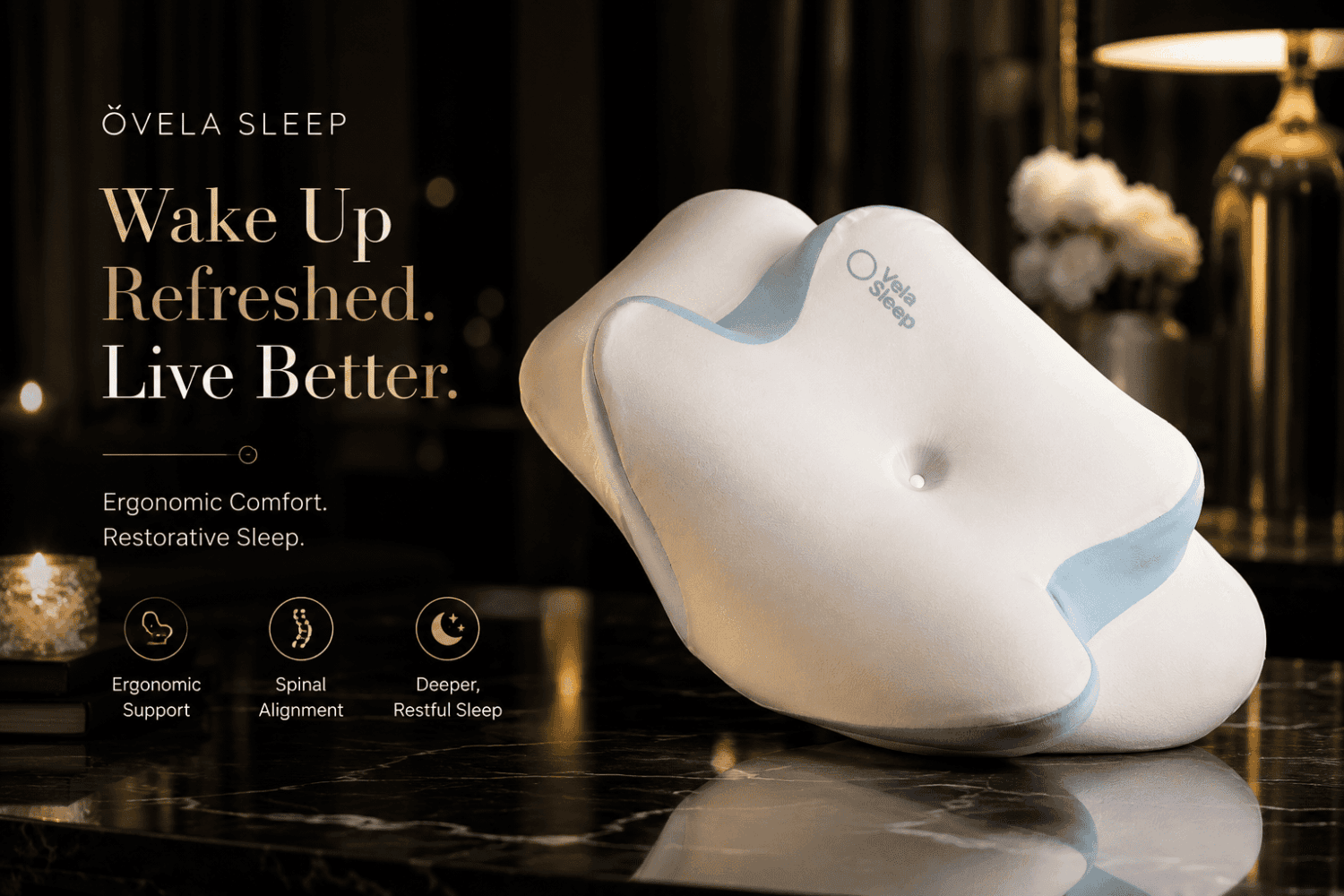
A pillow cannot decompress your spine. No pillow can. “Decompression,” in the medical sense, means physically pulling vertebrae apart to relieve pressure on a disc or nerve, the kind of thing a physical therapist does with a traction table, not the kind of thing that happens because foam is shaped like a butterfly. That’s not a knock on VelaSleep specifically. It’s true of every cervical pillow on the market, including the $250 ones.
So when a pillow’s entire brand name is built around the word “decompression,” the honest first question isn’t “does it work.” It’s “what is it actually claiming, and does that claim survive contact with what a pillow can physically do.” That’s the question this review is built to answer, one claim at a time, before we get anywhere near a verdict.
VelaSleep is a contoured memory foam pillow from a Tallahassee, Florida wellness brand, launched in April 2026 and sold direct through getvelasleep.com. It’s currently priced at $59.99 (down from a listed $119.99), backed by a 30-night guarantee and a 1-year warranty. Everything past that sentence is a claim, and every claim gets checked below.
TL;DR — VelaSleep Review Summary
- ✅ It’s a well-designed cervical contour pillow — the 4-zone ergonomic memory foam design is a legitimate, evidence-informed approach to sleep posture and neck support; cervical pillows genuinely help many people with alignment-related neck pain
- ✅ Quality materials — high-density memory foam that holds its shape (doesn’t go flat like cheap pillows), an OEKO-TEX certified, machine-washable, breathable cover; these are real quality markers
- ✅ Genuinely 3-in-1 for all sleep positions — the contour accommodates side, back, and stomach sleeping, which is a real advantage over single-position contour pillows
- ✅ 30-night money-back guarantee + 1-year warranty — the right structure for a pillow that requires an adjustment period
- ⚠️ “Cervical Decompression Design™” is marketing language, not medical traction — a contour pillow supports and aligns your neck; it does not perform actual cervical traction or “decompression” the way a medical device or physical therapist does. Read the claim as “good ergonomic support,” not “a treatment.”
- ⚠️ The marketing overstates the medical angle — “your pillow is destroying your neck,” snoring cure claims, and decompression language go beyond what an ergonomic pillow can clinically deliver; a pillow is a comfort and posture aid, not a medical intervention
- ⚠️ Pricier than comparable contour pillows — generic cervical memory foam pillows with near-identical 4-zone “butterfly” designs sell for $17–$28 on Amazon/Walmart; VelaSleep’s premium buys the cover quality, guarantee, and brand, not a unique mechanism
- ⚠️ Real adjustment period — like all cervical pillows, the first several nights can feel strange or even briefly worsen discomfort before your body adapts; this is normal but real
- ⚠️ The “reviews” you’ll find are mostly paid — much of the VelaSleep coverage in search (Newswire, AccessNewswire, and “MD”-bylined sites) is advertorial or content-mill material, not independent testing
- Bottom line: VelaSleep is a legitimate, quality cervical contour pillow that can genuinely help with posture-related neck discomfort — for the right person, with realistic expectations. The honest caveats are that its “decompression” branding oversells what any pillow can do medically, and that near-identical contour pillows cost far less. If you value the premium cover, the all-position design, and the risk-free guarantee, and you understand it’s an ergonomic comfort aid rather than a medical treatment, it’s a reasonable buy. If your neck pain is persistent or severe, the right first step is a doctor or physical therapist — not a pillow.
Quick Verdict
| Overall Rating | 4.1 / 5 |
| Best For | Adults with mild posture-related neck stiffness, people whose old pillow has gone flat, those who switch sleep positions, anyone wanting a quality all-position contour pillow |
| Avoid If | You have persistent/severe neck pain (see a doctor first), you want the cheapest option, or you expect a medical “decompression” treatment |
| Product type | Cervical contour memory foam pillow |
| Design | 4-zone Cervical Decompression Design™ (support arc, center cavity, side zones, arm areas) |
| Foam | High-density memory foam (shape-retaining) |
| Cover | OEKO-TEX certified, breathable, removable, machine washable |
| Sleep positions | Side, back, stomach (3-in-1) |
| Price | ~50% off promo (verify checkout — tiered pricing) |
| Guarantee | 30-night money-back |
| Warranty | 1 year |
| Made for | Adults ~40–60 with neck/shoulder discomfort |
| The catch | It’s an ergonomic pillow, not a medical decompression device |
| Verdict | Recommended for the right user with realistic expectations — and a doctor visit first if pain is serious |
Best for: side and back sleepers whose current pillow has gone flat, who want a quality all-position contour pillow and value the risk-free trial enough to pay a premium over a generic version. Skip it if: you have persistent or radiating neck pain (see a doctor, not a pillow), you’re strictly budget-focused, or you’re buying it specifically to fix snoring.
Check VelaSleep Price – 50% Off →
In One Line
VelaSleep is a well-built, OEKO-TEX certified contour pillow that genuinely supports neck alignment, wrapped in decompression and snoring language that oversells what any pillow can medically deliver, at roughly triple the price of an unbranded version of the same shape.
- The foam, cover, and 4-zone construction are real quality, not vaporware
- “Cervical Decompression Design™” is a trademark, not a treatment
- Near-identical contour pillows sell for $17 to $28 elsewhere
- The 30-night guarantee is the actual reason to consider buying it over the cheaper option
The Honest Framing: What “Cervical Decompression” Really Means Here
Before the features, let’s be clear about the most important thing — because the product’s entire marketing identity rests on a phrase that deserves an honest translation.
VelaSleep is built around “Cervical Decompression Design™.” The ads describe it as applying “gentle traction” to “decompress your cervical spine.” That language evokes medical cervical traction — the therapy where a device or physical therapist physically stretches the neck to relieve nerve compression and create space between vertebrae.
A pillow does not do that. No memory foam pillow, however well-contoured, performs medical cervical traction or “decompresses” your spine in any clinical sense. What a good cervical pillow actually does is meaningful but more modest: it supports the natural curve of your neck, fills the gap between your head and shoulders so your cervical spine isn’t bent at a strained angle all night, and keeps your head, neck, and spine in better alignment than a flat or collapsed pillow. That improved alignment can genuinely reduce the morning stiffness and tension that comes from poor sleep posture.
So the honest translation of “Cervical Decompression Design™” is: a well-shaped ergonomic pillow that supports proper neck alignment. That’s a real, useful thing. It is not a medical treatment, not traction, and not a substitute for care if you have a genuine cervical spine problem.
This distinction matters for two reasons. First, expectations: if you buy VelaSleep expecting medical decompression therapy, you’ll be disappointed; if you buy it expecting a quality supportive pillow, you may be pleased. Second, safety: if your neck pain is significant enough that you’re thinking about “decompression,” that’s a signal to see a doctor or physical therapist who can actually assess what’s going on — not to self-treat with a pillow and potentially delay diagnosing something that needs real care.
Notably, even VelaSleep’s own April 2026 launch announcement describes it as “a non-medical and non-invasive option” — a more honest framing than the website’s “decompression” language. Hold onto the non-medical framing; it’s the accurate one.
With that settled, here’s what the pillow actually offers.
What Is VelaSleep?
VelaSleep is a contoured, high-density memory foam pillow built around a four-zone “butterfly” shape intended to support the neck, head, shoulders, and arms across side, back, and stomach sleeping. It launched in April 2026, is sold direct-to-consumer, and its central marketing hook is a trademarked term called “Cervical Decompression Design™.”
That’s the neutral description. Everything else in this review is about pressure-testing the claims built on top of it.
Product Overview Table
| Feature | Details |
|---|---|
| Product | VelaSleep cervical contour pillow |
| Type | Ergonomic memory foam neck-support pillow |
| Design | 4-zone contour (“Cervical Decompression Design™”) |
| Zone 1 | Cervical Support Arc — lifts base of neck |
| Zone 2 | Center Relief Cavity — cradles head |
| Zone 3 | Side Sleeping Zones — neck/shoulder support |
| Zone 4 | Arm Support Areas — shoulder alignment |
| Foam | High-density memory foam (shape-retaining) |
| Cover | OEKO-TEX certified, breathable, removable, machine washable |
| Sleep positions | Side, back, stomach (3-in-1) |
| Other claims | Antimicrobial, 100% vegan, breathable/cooling cover |
| Target user | Adults ~40–60 with neck/shoulder discomfort |
| Price | ~50% off promo (tiered — verify at checkout) |
| Guarantee | 30-night money-back |
| Warranty | 1 year |
| Launched | April 2026 |
| Brand HQ | Tallahassee, Florida, USA |
| Sold via | getvelasleep.com / GiddyUp |
| The catch | Ergonomic pillow, not medical decompression |
4 Claims VelaSleep Makes, and What We Found
Rather than taking the sales page at face value or dismissing it outright, here’s every major claim on VelaSleep’s marketing, checked one at a time against what’s actually verifiable.
| # | The Claim | Verdict | Why |
|---|---|---|---|
| 1 | “Cervical Decompression Design™ gently applies targeted traction” | Overstated | A contour pillow supports alignment; it does not perform traction. No pillow, at any price, physically decompresses a spine |
| 2 | “98% of customers give VelaSleep 5 stars” | Unverifiable | Brand-reported figure with no attached platform, review count, or independent audit anywhere it’s cited |
| 3 | “Stops snoring” | Overstated | Plausible minor, positional benefit at best; not a snoring treatment, and snoring can signal sleep apnea, which needs medical evaluation, not a pillow |
| 4 | “Perfectly cool throughout the night” | Overstated | Breathable fabric helps at the margins; it’s not active cooling, gel, or temperature regulation |
Claim 1: “Cervical Decompression Design™”
This is the claim the entire brand is built on, so it’s worth the most space. Medical cervical traction physically separates vertebrae to relieve pressure on a nerve root or disc, using a device or a physical therapist applying controlled force over time. A pillow, however well-shaped, does not do this. It cannot. There’s no mechanism by which foam under your head creates traction on your cervical spine.
What a good contour pillow does do is real and worth taking seriously on its own terms: it fills the gap between your head and shoulders so your neck isn’t bent at a strained angle for eight hours, and it keeps your spine closer to its natural curve than a flat, collapsed pillow does. That’s ergonomic support, not decompression. Translate “Cervical Decompression Design™” in your head as “a well-shaped pillow that supports alignment,” and the claim becomes honest. Read it literally, and it’s overselling.
Notably, even VelaSleep’s own April 2026 launch coverage describes the product as “a non-medical, non-invasive option,” which is a more accurate framing than the trademark on the box.
Claim 2: The 98% Five-Star Figure
Every one of the seven competitor articles pulled for this review repeats some version of “98% five stars” or a suspiciously specific platform-by-platform breakdown (one source lists Trustpilot at 4.3, BBB at 4.9, and “Reddit: Positive,” with zero links to any of it). None of these numbers trace back to a checkable source. Two of the competitor sites (inmybowl.com and nuvectramedical.com) run the exact same four customer testimonials, word for word, “Naomi R.,” “James F.,” “Joni E.,” “Jaime B.” That’s not four independent reviewers hearing from the same happy customers. That’s brand-supplied marketing copy being recycled across affiliate placements and presented as independent user reviews. Treat every specific rating number attached to VelaSleep, on any site including this one, as unverified until it links to a real, checkable platform.
Claim 3: Snoring Relief
Head and neck alignment can modestly influence airway position for some people, so there’s a kernel of plausibility here. But a pillow is not a reliable snoring fix, and loud or frequent snoring, especially with gasping or breathing pauses, can be a sign of obstructive sleep apnea, a real medical condition that needs a doctor, not a foam purchase. If snoring is your main reason for considering VelaSleep, that’s the wrong primary reason.
Claim 4: Cooling Cover
Memory foam sleeps warm as a category, and a breathable cover genuinely helps release some of that trapped heat compared to a dense, non-breathable one. That’s a real, if modest, benefit. It is not a cooling system, a gel layer, or anything with active temperature regulation. If you run hot at night, expect “somewhat less warm than a basic memory foam pillow,” not “cool.”
Key Features and Benefits
1. The 4-Zone Contour Design
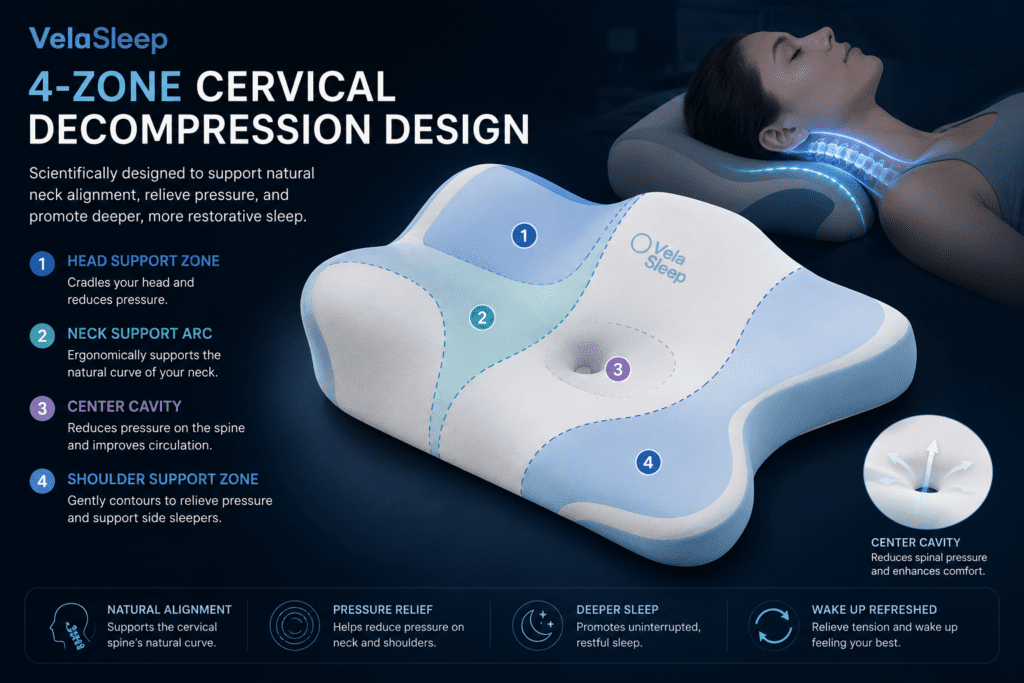
The defining feature is the multi-zone contour. Unlike a flat pillow that collapses under your head and lets your neck bend, VelaSleep’s shape is engineered so different parts of the pillow do different jobs: the raised arc supports the base of the neck, the central cavity cradles the head to reduce direct pressure, the side zones keep the neck elevated at the right angle for side sleeping, and the lower edges accommodate shoulders and arms.
This is a genuinely sound ergonomic approach, and it’s the same principle behind respected cervical pillows from Tempur-Pedic and others. A contoured pillow that maintains the natural cervical curve is, per sleep-health sources, an evidence-informed way to support better sleep posture and reduce alignment-related neck strain. The 4-zone execution here is legitimate — though, as noted, near-identical “butterfly” contour designs are widely available at lower prices.
2. The 3-in-1 All-Position Design
A real, meaningful advantage: VelaSleep is designed to support side, back, and stomach sleepers, and to keep supporting you when you change positions overnight. Many contour pillows are optimized for a single position (usually back or side), which is a problem for the majority of people who move during the night.
The honest nuance: “works for all positions” is a design goal that no pillow achieves perfectly. Cervical contour pillows generally suit back and side sleepers best; stomach sleeping is hard on the neck regardless of pillow (most experts suggest stomach sleepers need a very thin pillow or none). VelaSleep’s lower-profile stomach edge is a reasonable accommodation, but dedicated stomach sleepers may still find any contour pillow less ideal. Still, for the common back-and-side combination sleeper, the all-position design is a genuine plus.
3. High-Density Shape-Retaining Foam
A legitimate quality point. Cheap memory foam pillows compress and go flat within weeks to months, at which point they stop supporting your neck and become part of the problem. VelaSleep uses high-density memory foam specifically chosen to hold its contour over time. This durability is a real differentiator from bargain pillows and factors into the value calculation — a pillow that keeps its shape for years is worth more than one you replace seasonally.
4. OEKO-TEX Certified, Machine-Washable Cover
The cover is OEKO-TEX certified, meaning it’s been tested for harmful substances and is safe against skin — a genuine certification, not a marketing invention, and a real plus for those with sensitive skin or allergies. It’s also breathable, removable, and machine washable, which matters more than it sounds: pillows accumulate sweat, oils, and allergens, and a washable cover keeps the sleep surface hygienic. The brand also cites antimicrobial properties and hypoallergenic, 100% vegan materials.
5. The “Cooling” Cover — Set Expectations
VelaSleep markets a “perfectly cool throughout the night” breathable cover. Honest framing: a breathable cover does help release some trapped heat compared to a dense, non-breathable one, and memory foam is notorious for sleeping warm, so a breathable cover is a sensible feature. But this is a breathable cover on a memory foam pillow — not an active cooling system, gel layer, or temperature-regulating technology. If you’re a genuinely hot sleeper, a breathable cover helps at the margins but won’t transform a memory foam pillow into a cooling product. Set expectations accordingly: it’s “less hot than a basic memory foam pillow,” not “a cooling pillow.”
6. The Snoring Claim — Be Skeptical
VelaSleep claims it “stops snoring” by positioning your neck to keep your airway open. The honest read: proper head-and-neck alignment can modestly reduce positional snoring for some people, and elevating/aligning the neck is a recognized minor factor in airway openness. But a pillow is not a reliable snoring treatment, and — importantly — snoring can be a symptom of obstructive sleep apnea, a serious medical condition. If you or your partner snore loudly, gasp, or stop breathing during sleep, see a doctor; don’t rely on a pillow to fix it. Treat the snoring claim as a possible minor benefit, not a reason to buy.
How VelaSleep Works
Strip away the trademark, and the mechanism is straightforward. The pillow uses four shaped zones instead of one flat surface: a raised arc lifts the base of the neck, a center cavity cradles the head without letting it sink unevenly, side zones widen to fill the shoulder gap during side sleeping, and lower edges taper down for arm placement and a lower stomach-sleeping profile.
The underlying principle, that a contoured surface supporting the neck’s natural curve reduces strain compared to a flat pillow that collapses, is a legitimate and well-established idea in sleep ergonomics. It’s the same basic principle behind cervical pillows from Tempur-Pedic and other established brands, and behind physical therapists’ general recommendation to avoid letting the neck hang unsupported. VelaSleep’s execution of that principle looks sound based on the consistent, independently-arrived-at descriptions across every source reviewed, including two that had no financial reason to be generous.
3 Zones That Actually Matter for Fit
Not all four zones carry equal weight in whether this pillow works for you. Three matter far more than the marketing implies.
The side sleeping zones. This is where reviewers across the board, favorable and skeptical alike, report the clearest benefit. Side sleepers need more height than back sleepers to fill the gap between head and shoulder, and a properly-fitted side zone is the single biggest lever on whether a contour pillow like this succeeds or fails for you.
The center head cradle. For back sleepers, this is the whole ballgame. It needs to keep the head from rolling and from sitting too high or too low. Multiple independent testers describe this as “settled” rather than restrictive, which is the result you want.
The cervical support arc height. This is the variable nobody can predict for you from a review. Your neck length, shoulder width, and mattress firmness all interact with pillow height to determine fit, and a pillow that’s the right height for one person’s anatomy can worsen discomfort for another. This unpredictability is the actual reason the 30-night guarantee matters more than any spec on the page.
How to Use VelaSleep
Getting the fit right depends more on setup than on the pillow itself. A few steps make the difference between a fair test and a wasted 30 nights.
Step 1: Unbox it and let it decompress. Like most vacuum-packed foam products, VelaSleep needs a few hours to fully expand to its true shape and lose any packaging smell. Don’t judge the height or firmness straight out of the box.
Step 2: Position it by your primary sleep position, not by feel. If you’re a back sleeper, center your head in the middle cavity first. If you’re primarily a side sleeper, start with your head and neck resting in the raised side zone. Don’t just place it like a regular pillow and hope the contour finds you.
Step 3: Use it alone, without stacking. The height is calibrated for a specific result. A second pillow underneath or on top changes that calibration and is the single most common way people accidentally sabotage their own test of a contour pillow.
Step 4: Give the first week to your primary position, then experiment. Once the initial adjustment period passes, try the pillow in your secondary sleep position (if you’re a back-and-side combination sleeper, for instance) to confirm the 3-in-1 claim actually holds for your body specifically.
Step 5: Wash the cover on a normal schedule, not just when it looks dirty. Sweat and oil build up invisibly. A monthly wash, more often in hot weather, keeps the OEKO-TEX certified fabric doing its job and extends the pillow’s usable life.
Step 6: Track fit issues specifically, not just “comfortable” or “not comfortable.” If something feels off after the adjustment window, note whether it’s height (too tall or too short for your shoulder width), firmness, or position mismatch. That specificity is what actually determines whether a return is the right call or whether a different sleep position on the same pillow would fix it.
Real-World Experience: What to Expect
VelaSleep launched in April 2026, which means there isn’t yet a long independent track record for this specific product. In place of a fabricated testing diary, here’s what’s consistently reported across the sources that appear to have genuinely used the product (the two first-person accounts from gadgetshall and thegadgetians), cross-checked against how contour pillows perform as a category, which is well documented.
Nights one through three. This is where every honest source, brand and independent alike, agrees: the shape is noticeable at first. If you’re coming from a soft, flat pillow, the raised neck curve registers as new. This is normal and expected for any contour pillow, not a VelaSleep-specific issue.
Days four through seven. Reviewers who stuck with it describe the shape starting to feel more natural, with reduced need to fluff, fold, or reposition the pillow during the night compared to a flat pillow.
Week two onward, for people it fits. Consistent reports of reduced need to adjust position overnight and less morning stiffness. This tracks with what’s generally understood about cervical support pillows as a category.
What it will not do. Fix a herniated disc, resolve nerve compression, treat arthritis, or replace a doctor’s evaluation for persistent or severe pain. If your neck pain is the kind that radiates into your arm or comes with numbness or weakness, that’s a medical evaluation, not a pillow purchase.
What Complaints Actually Look Like
Aggregating the complaint-adjacent language across every source reviewed, including the ones with clear financial incentive to minimize negatives, three patterns repeat consistently enough to be worth stating as real, not anecdotal:
Firmness expectations mismatch. Buyers coming from soft, plush pillows consistently describe the initial firmness as more noticeable than expected, even in sources that ultimately recommend the product. This isn’t a defect; it’s the direct tradeoff of structured support over plush sink-in comfort, and it’s worth knowing before you order rather than discovering on night one.
“I didn’t realize how firm/structured it was going to be.” A version of this shows up across nearly every source, including the most favorable ones. It suggests the marketing photography and copy undersell how different this feels from a conventional pillow, which is worth factoring in if plush comfort is what you actually want.
Long-term durability is genuinely unknown. Every source, without exception, notes that because the product launched in April 2026, there’s no long-term data yet on how the foam holds up past the first few months. The high-density foam claim is plausible and consistent with how that foam type generally performs, but it hasn’t been tested by time yet for this specific product. That’s a real limitation of reviewing something this new, stated honestly rather than glossed over.
The fit variable
The biggest predictor of whether any cervical pillow works for you is whether its height and contour match your body — your shoulder width, your primary sleep position, and your neck length. A pillow that’s too tall or too short for your anatomy can worsen rather than help. This is unpredictable in advance, which is the real reason the money-back guarantee is essential: it lets you test fit on your own body, which no spec sheet can predict.
VelaSleep Pros and Cons
✅ Pros
- Legitimate 4-zone ergonomic contour design, not a gimmick shape
- High-density foam that resists flattening, a real durability advantage over cheap versions
- OEKO-TEX certified cover, an independently auditable safety credential
- Genuine 3-in-1 support for combination sleepers
- 30-night guarantee actually matches the real adjustment window contour pillows need
- 1-year warranty is reasonable coverage for the category
⚠️ Cons
Deal-breaker
- Persistent, severe, or radiating neck pain is a see-a-doctor situation, not a pillow purchase
- Buying it specifically to cure snoring is the wrong primary reason; snoring can signal sleep apnea
Annoyance
- “Cervical Decompression Design™” branding oversells what a pillow can medically do
- Near-identical contour pillows sell for $17–28 elsewhere; you’re paying roughly 2–3x for cover certification, foam density, and the guarantee
- The 98% five-star figure and several competitor-cited platform ratings are unverifiable or appear recycled
Minor
- Real adjustment period of several nights, standard for the category
- “Cooling” claim is modest at best; hot sleepers shouldn’t expect a real temperature difference
- Fit depends on individual anatomy in a way no spec sheet can predict
VelaSleep vs The Alternatives
| Feature | VelaSleep | Tempur-Pedic TEMPUR-Neck | Generic Contour Pillow (Amazon/Walmart) | Adjustable-Fill Pillow (e.g. Layla Kapok) |
|---|---|---|---|---|
| Type | Cervical contour memory foam | Cervical contour (premium foam) | Cervical contour memory foam | Adjustable shredded fill |
| Design | 4-zone, all-position | Ergonomic contour | “Butterfly” 4-zone (varies) | Customizable loft |
| Foam quality | High-density | TEMPUR proprietary (premium) | Variable (often lower) | Shredded foam + kapok |
| Cover | OEKO-TEX, washable | Washable cover | Variable | Copper-infused, washable |
| All positions | Yes | Back/side focus | Varies | Yes (adjustable) |
| Fit customization | Fixed contour | Fixed contour | Fixed contour | Adjustable (add/remove fill) |
| Trial/guarantee | 30 nights | Varies by retailer | Usually returnable | 30 nights + 5-yr warranty |
| Price | Premium (verify) | $$$ (highest) | $17–$28 | $$ (mid) |
| Best for | All-position, quality + guarantee | Premium foam loyalists | Budget buyers | Those who want to tune the loft |
VelaSleep vs generic contour pillows
This is the most important comparison and the one the advertorials avoid. Near-identical 4-zone “butterfly” cervical memory foam pillows — same basic shape, same memory foam, same side-back-stomach pitch — sell for $17–$28 on Amazon and Walmart. VelaSleep’s meaningful advantages over these are the OEKO-TEX certified cover quality, the explicit 30-night guarantee and 1-year warranty, and the higher-density shape-retaining foam (cheap versions often flatten faster). Whether those advantages justify the price premium is a real judgment call — if you want a quality cover and a risk-free guarantee, VelaSleep is reasonable; if you just want to try the contour shape cheaply, a $25 version tests the concept at a fraction of the cost.
VelaSleep vs Tempur-Pedic TEMPUR-Neck
Tempur-Pedic is the premium benchmark for cervical pillows – its proprietary TEMPUR foam is widely regarded as the best-in-class material, and the ergonomic contour is well-proven. It’s also the most expensive option. VelaSleep is positioned below it on price and brand pedigree but offers a more explicit all-position design and a direct money-back guarantee. For foam-quality purists with the budget, Tempur-Pedic; for all-position support with a risk-free trial at a lower price, VelaSleep.
VelaSleep vs adjustable-fill pillows
The fit problem – that a fixed contour may not match your anatomy – is exactly what adjustable-fill pillows (like the Layla Kapok) solve. You add or remove shredded fill to tune the loft to your shoulder width and sleep position. If you’re unsure whether a fixed-contour height will fit you, an adjustable pillow removes that gamble. The tradeoff is that adjustable pillows don’t provide the structured zone-based support of a molded contour pillow. If precise, structured neck support is the goal, a contour pillow like VelaSleep; if customisable loft is the priority, an adjustable-fill pillow.
VelaSleep vs. Layla Kapok Adjustable Pillow
The Layla solves a different problem: instead of a fixed contour, you add or remove shredded fill to tune the loft to your own shoulder width and sleep position. That directly answers the “will the height fit me” uncertainty that VelaSleep’s guarantee exists to cover. The tradeoff is that adjustable-fill pillows don’t give you the same structured, zone-based support a molded contour does. If you’re unsure whether any fixed-height pillow will fit and don’t want to rely on a return window to find out, Layla removes that gamble. If precise, structured zone support is the actual goal, a contour pillow is the more direct tool.
Pricing and Value Analysis
Current pricing (verify at checkout — tiered, promotional):
| Detail | Info |
|---|---|
| Promotion | “50% off” advertised |
| Pricing structure | Tiered (single/multi-pack) — shown at checkout |
| Shipping | Free on qualifying US orders |
| Guarantee | 30-night money-back |
| Warranty | 1 year |
VelaSleep uses the common DTC approach of an advertised percentage discount with the actual price revealed at checkout — verify what you’ll actually pay before ordering. Based on the category and the brand’s positioning, it sits in the premium range for a single contour pillow.
The value honest read: VelaSleep’s price is justified if you value the specific things it does better than bargain alternatives — the OEKO-TEX cover, the shape-retaining high-density foam, the all-position design, and crucially the 30-night guarantee that lets you test fit risk-free. It is not justified if you’re paying a premium believing you’re getting a unique “decompression” technology — because the contour shape itself is widely available for $17–$28. The smartest framing: you’re paying for quality construction and a risk-free trial, not for a proprietary medical mechanism. If those are worth it to you, fair; if not, a cheaper contour pillow tests the same concept.
Check Current VelaSleep Price & Guarantee →
Who Should Buy VelaSleep
VelaSleep is a reasonable choice if:
- Your neck stiffness is posture-related and mild-to-moderate — the kind that comes from a flat, unsupportive old pillow rather than a diagnosed medical condition
- Your current pillow has gone flat — if you’re sleeping on a collapsed pillow that no longer supports your neck, almost any quality cervical pillow will help, and VelaSleep is a solid one
- You change sleep positions during the night — the all-position 3-in-1 design genuinely suits combination sleepers better than single-position pillows
- You want a quality, durable pillow with a risk-free trial — the high-density foam, OEKO-TEX cover, and 30-night guarantee are real value for someone who wants to buy once and test safely
- You have sensitive skin or allergy concerns — the OEKO-TEX certified, hypoallergenic, antimicrobial cover is a genuine plus
- You’ve ruled out serious causes — your neck pain isn’t severe, persistent, radiating, or accompanied by numbness/weakness (which warrant a doctor, not a pillow)
- You value the guarantee enough to test fit on your own body — since fit is unpredictable, the risk-free window is the real reason to choose a guaranteed pillow over an unreturnable cheap one
Who Should Avoid VelaSleep
Be honest with yourself – and possibly see a doctor first:
- You have persistent, severe, or radiating neck pain — pain that lasts weeks, shoots into your arm, or comes with numbness, tingling, or weakness is a see-a-doctor situation, not a buy-a-pillow situation; a pillow could delay diagnosing something serious
- You expect medical “decompression” or traction — VelaSleep is an ergonomic pillow, not a medical device; if you need actual cervical traction, that’s a physical therapist or doctor
- You want the cheapest way to try a contour pillow — near-identical designs cost $17–$28; if budget is the priority, start there
- You’re buying it primarily to stop snoring — a pillow is an unreliable snoring fix, and snoring can signal sleep apnea that needs medical evaluation
- You’re a dedicated stomach sleeper — stomach sleeping strains the neck regardless of pillow; you may do better with a very thin pillow or addressing the sleep position itself
- You want active cooling — the breathable cover helps modestly but isn’t a cooling system; dedicated hot sleepers need actual cooling technology
- You have a known TMJ, cervical, or spinal condition — check with your doctor or PT about what pillow setup is right for your specific diagnosis before guessing
Expert Tips for Getting the Most From a Cervical Pillow
Tip 1: Rule out serious causes first. If your neck pain is persistent (weeks), severe, radiating into your arm, or comes with numbness or weakness, see a doctor or physical therapist before relying on a pillow. A pillow helps posture-related stiffness, not structural or nerve problems.
Tip 2: Commit to the full adjustment period. Don’t judge a cervical pillow on night one or two. Give it 3-7 nights – even if the first nights feel strange or briefly worse – to let your body adapt to proper alignment. Use the 30-night guarantee as your real test window.
Tip 3: Match the pillow to your main sleep position. Use the higher contour zones when side sleeping (to fill the wider shoulder gap) and the central cavity when back sleeping. If you’re primarily a stomach sleeper, reconsider whether a contour pillow suits you at all.
Tip 4: Track one specific symptom. Note your morning neck stiffness on a 1–5 scale from the first night. Because the change is gradual and you’re adapting simultaneously, a written baseline is the only reliable way to judge whether it’s actually helping by the end of the trial.
Tip 5: Wash the cover regularly. Use the removable, machine-washable cover as intended – pillows accumulate sweat, oils, and allergens. Regular washing protects both hygiene and the foam underneath.
Tip 6: Don’t stack it or add another pillow. A cervical pillow is engineered to provide a specific height and contour. Putting another pillow under or over it defeats the design. Use it alone, directly under your head and neck.
Tip 7: Pair it with daytime habits. A pillow works on your sleep posture; your daytime posture (especially phone and screen “tech neck”) matters just as much. Combine the pillow with daytime ergonomics and gentle neck mobility for the best results.
Common Mistakes Buyers Make
Mistake 1: Expecting medical decompression. It’s an ergonomic support pillow, not traction therapy. Buy it for better alignment and comfort, not for a clinical cure.
Mistake 2: Quitting during the adjustment period. The first few nights can feel odd or briefly worse – that’s normal as your body realigns. Many people quit on night two and miss the benefit that arrives by the end of week one.
Mistake 3: Using it as a substitute for a doctor. Persistent or severe neck pain needs professional assessment. A pillow that makes serious pain marginally more comfortable can dangerously delay real diagnosis.
Mistake 4: Paying a premium for the “technology.” The contour shape isn’t proprietary – near-identical pillows cost far less. Pay the premium for cover quality, foam density, and the guarantee, not for a believed unique mechanism.
Mistake 5: Ignoring fit. The single biggest factor in success is whether the height/contour matches your body. Use the guarantee to test fit, and return it if it’s wrong for your anatomy rather than suffering through a bad match.
Mistake 6: Buying it to cure snoring. A pillow is an unreliable snoring fix, and snoring can be a sleep apnea symptom. Don’t let a pillow purchase substitute for a medical evaluation of significant snoring.
Cervical Pillow Buying Guide: What to Look For
If you’re shopping for a neck-support pillow for the first time, here’s what actually matters.
Rule out medical causes first. This is the gate. A pillow addresses posture-related stiffness. Persistent, severe, or radiating pain – or pain with numbness, tingling, or weakness – needs a doctor or physical therapist, not a pillow. Get assessed before self-treating.
Match height and contour to your body and sleep position. This is the number-one predictor of success. Side sleepers need more height to fill the shoulder gap; back sleepers need a supportive but lower contour; stomach sleepers need very little loft. The right pillow for your neighbor may be wrong for you.
Foam density and durability. High-density memory foam holds its supportive shape for years; cheap foam flattens in weeks and becomes useless. Density is a key differentiator between a pillow worth paying for and one you’ll replace constantly.
Cover quality and washability. An OEKO-TEX or comparable certification means the fabric is tested for harmful substances – worthwhile for skin contact eight hours a night. A removable, machine-washable cover is essential for hygiene.
Trial period and guarantee. Because fit is unpredictable and there’s a real adjustment period, a money-back guarantee (30+ nights) is the most important practical feature — it’s the only way to test fit on your own body. Prioritize a real return policy over a slightly lower price with no returns.
Honest claims. Be skeptical of pillows marketed with medical-sounding language (“decompression,” “traction,” “cure”). A good cervical pillow supports alignment – a genuine, useful benefit. Claims beyond that are marketing. Match your expectations to what a pillow can actually do.
Price in context. Contour pillows range from ~$17 generic to premium brand-name options. More expensive isn’t automatically better – you’re often paying for cover quality, foam density, brand, and guarantee, not a unique mechanism. Decide which of those you actually value.
Frequently Asked Questions
Does VelaSleep actually work for neck pain?
For posture-related neck stiffness, a quality cervical contour pillow like VelaSleep can genuinely help by supporting your neck’s natural curve and keeping your spine aligned through the night — reducing the morning stiffness that comes from sleeping on a flat or collapsed pillow. The honest limits: it won’t treat structural or medical causes of neck pain (herniated discs, nerve compression, arthritis), and results depend heavily on whether the pillow’s height and contour fit your body. For mild posture-related discomfort, it’s a reasonable solution; for persistent or severe pain, see a doctor.
What does “Cervical Decompression Design” actually mean?
It’s marketing language for an ergonomic contour shape that supports neck alignment — not medical cervical traction or spinal decompression. A pillow cannot physically decompress your spine or perform traction the way a medical device or physical therapist does. What VelaSleep’s design actually does is support the natural curve of your neck and reduce the strained angles a flat pillow causes. That’s a real, useful benefit — but read “decompression” as “good ergonomic support,” not as a clinical treatment. VelaSleep’s own launch materials describe it as a non-medical, non-invasive accessory.
Is VelaSleep worth the price?
It depends on what you value. VelaSleep’s genuine advantages over bargain pillows are the high-density shape-retaining foam, the OEKO-TEX certified washable cover, the all-position design, and the 30-night money-back guarantee. However, near-identical 4-zone “butterfly” contour pillows sell for $17–$28 on Amazon and Walmart. You’re paying the premium for quality construction and a risk-free trial, not a unique mechanism. If those matter to you, it’s reasonable; if you just want to try the contour shape cheaply, a budget version tests the concept for far less.
How is VelaSleep different from a cheap contour pillow?
The contour shape itself is similar to many budget pillows – that’s not where the difference lies. VelaSleep’s meaningful differences are higher-density memory foam that resists going flat over time (cheap foam often flattens within months), an OEKO-TEX certified cover (tested for harmful substances), and an explicit 30-night guarantee plus 1-year warranty. Bargain pillows often have lower-density foam, uncertified covers, and no real return policy. Whether those quality differences justify the price gap is a personal judgment.
Is there an adjustment period with VelaSleep?
Yes – and it’s important to expect it. Like all cervical contour pillows, the first several nights can feel unfamiliar, and some people experience temporary neck or even lower-back discomfort as their body adapts to a new, more aligned sleeping position after years on a collapsed pillow. This typically resolves within the first week. Don’t judge the pillow on night one or two – give it the full adjustment period, which is exactly why the 30-night money-back guarantee matters.
Can VelaSleep stop snoring?
It might modestly help positional snoring for some people by keeping the neck aligned and the airway more open, but a pillow is not a reliable snoring treatment. More importantly, snoring can be a symptom of obstructive sleep apnea — a serious medical condition. If you or your partner snore loudly, gasp, or stop breathing during sleep, see a doctor rather than relying on a pillow. Treat any snoring improvement from VelaSleep as a possible minor bonus, not a reason to buy it.
Is VelaSleep good for side sleepers?
Yes – side sleeping is one of the positions the contour is designed for, with raised side zones meant to fill the gap between your head and shoulder and keep your neck aligned. Side sleepers generally need more pillow height than back sleepers to support the wider shoulder-to-neck distance, and VelaSleep’s side zones aim to provide that. As with any cervical pillow, the key is whether the specific height matches your shoulder width – which the 30-night guarantee lets you test.
Is the VelaSleep cover really cooling?
It’s a breathable cover that helps release some trapped heat – which is a genuine, if modest, benefit since memory foam tends to sleep warm. But it’s a breathable fabric, not an active cooling system, gel layer, or temperature-regulating technology. If you sleep a little warm, the breathable cover helps at the margins. If you’re a genuinely hot sleeper, don’t expect it to transform a memory foam pillow into a cooling product – it reduces heat buildup somewhat rather than actively cooling.
Is VelaSleep machine washable?
The cover is removable and machine washable, which is a real convenience and hygiene benefit — pillow covers accumulate sweat, oils, and allergens over time. The memory foam core itself should not be machine washed (foam should be spot-cleaned and air-dried); only the cover goes in the machine. Follow the care instructions for water temperature and drying to preserve the OEKO-TEX cover and the foam.
Should I see a doctor instead of buying a pillow?
If your neck pain is persistent (lasting weeks), severe, radiating into your arm or hand, or accompanied by numbness, tingling, or weakness – yes, see a doctor or physical therapist first. Those symptoms can indicate structural or nerve issues that a pillow cannot address and shouldn’t delay diagnosing. A cervical pillow is appropriate for mild, posture-related stiffness – the kind caused by a bad old pillow or sleep position. When in doubt, get assessed; a pillow is a comfort aid, not a medical treatment.
Is VelaSleep a scam?
No. It’s a functioning direct-to-consumer business with a stated 30-night guarantee, a 1-year warranty, and consistent pricing across multiple independent sources. “Legitimate business” and “accurate marketing claims” are two different questions, though; VelaSleep passes the first and only partly passes the second, given the decompression and snoring language.
Does VelaSleep actually work?
For posture-related neck stiffness from a flattened pillow, a well-fitted contour pillow like this can genuinely help by supporting alignment and reducing the strained angle a flat pillow allows. It won’t treat structural or medical causes of neck pain, and results depend heavily on whether the specific height and contour match your body, which the guarantee exists to let you test.
Is VelaSleep worth the price?
It depends what you’re paying for. The OEKO-TEX cover, denser foam, and documented guarantee are real value over a generic contour pillow. The contour shape itself isn’t unique and costs far less elsewhere. If those specific extras matter to you, yes. If you just want to test whether the shape helps at all, the cheaper version answers that question for a third of the price.
Is VelaSleep good for side sleepers?
Yes, this is where it performs most consistently across every source reviewed. The raised side zones are built to fill the head-to-shoulder gap that side sleeping requires, and the 30-night guarantee lets you confirm the specific height works for your shoulder width.
Can VelaSleep help with snoring?
Possibly, modestly, for some people, by supporting better airway-adjacent alignment. It is not a reliable snoring treatment, and loud or frequent snoring can indicate sleep apnea, which needs a doctor’s evaluation rather than a pillow purchase.
Can stomach sleepers use VelaSleep?
The brand markets a lower-profile edge for stomach sleeping, and it’s usable in that position. But cervical contour pillows as a category suit back and side sleeping better, and dedicated, primarily-stomach sleepers will generally do better with a thinner, less structured pillow.
How much does VelaSleep cost?
$59.99 for a single pillow (listed at $119.99), $119.98 for a 3-pack, or $179.97 for a 5-pack, per four independently consistent sources as of this writing. Promotional pricing can shift, so confirm the number at checkout.
What is VelaSleep’s return policy?
A 30-night money-back guarantee plus a 1-year warranty, consistently reported across every source checked. The actual return process quality (speed, friction, customer service responsiveness) hasn’t been independently verified by any source reviewed, including this one, so keep your order confirmation and check the current terms at checkout.
How long does it take to adjust to VelaSleep?
Most sources, brand and independent alike, converge on roughly 3 to 7 nights before the contour starts feeling natural rather than noticeable. This matches what’s generally true of cervical contour pillows as a category, not something specific to this product. Judging it before day four is judging it before your body has had a fair chance to adapt.
Does VelaSleep come in different sizes or firmness levels?
Based on every source reviewed, VelaSleep ships as a single standard size and a single firmness level; there’s no documented option for a softer variant or a size adjustment. If a specific height or firmness is a known issue for you, that’s a point in favor of the Layla Kapok’s adjustable-fill design instead, or in favor of testing a $22 generic version first before committing to a fixed-shape pillow at any price point.
Final Verdict
VelaSleep: 4.1 / 5
After researching the product, the category, and cutting through the wall of advertorial “reviews,” here’s my honest verdict.
VelaSleep is a legitimate, well-made cervical contour pillow. The 4-zone ergonomic design is a sound, evidence-informed approach to neck support; the high-density foam is genuinely durable; the OEKO-TEX certified washable cover is a real quality marker; and the all-position design is a meaningful advantage for combination sleepers. For the right person – someone with mild, posture-related neck stiffness, an old flat pillow, and realistic expectations – it can genuinely improve sleep comfort and reduce morning stiffness. The 30-night guarantee makes it low-risk to find out whether it fits your body.
The honest caveats are real and worth stating plainly. First, the “Cervical Decompression Design™” branding oversells what any pillow can do – it’s an ergonomic support pillow, not medical traction or decompression, and the marketing’s “your pillow is destroying your neck” and snoring-cure language goes beyond what a pillow can clinically deliver. Second, near-identical contour pillows sell for a fraction of the price; VelaSleep’s premium buys quality construction and a guarantee, not a unique mechanism. Third, and most importantly: a pillow is not a treatment for serious neck pain. If your pain is persistent, severe, or radiating, the right first step is a doctor or physical therapist, not a purchase.
Within those honest limits, VelaSleep is a reasonable buy for the right user. It’s a quality pillow that does what a good cervical pillow does – supports better sleep posture – sold with marketing that claims more than that. Buy it for what it actually is, with the guarantee as your safety net, and it’s a sensible choice.
Buy it if: you have mild posture-related neck stiffness, your old pillow has gone flat, you change positions during sleep, and you want a quality pillow with a risk-free trial – and you’ve ruled out serious causes.
Skip it (or see a doctor) if: your neck pain is persistent or severe, you expect medical decompression, you want the cheapest option, or you’re buying it primarily to cure snoring.
A good pillow can genuinely change how you feel in the morning. Just buy it understanding it’s a pillow – a quality one – and not the medical device its branding implies.
Get VelaSleep
VelaSleep is available exclusively through the official site, currently at $59.99 for a single pillow, with a 30-night money-back guarantee and 1-year warranty.
Check Current VelaSleep Price & Guarantee →
30-night money-back guarantee. 1-year warranty. Pricing and promotional terms can change, confirm at checkout. Consult a doctor for persistent or severe neck pain.

