The TIBO Titanium Cutting Board is a dual-sided board with a medical-grade titanium surface on one side and a wheat-straw surface on the other, plus a built-in knife sharpener, an integrated garlic grater, a juice groove, and a non-slip base. Its main selling point is health: unlike plastic boards, which shed microplastics into your food, a titanium surface never breaks down, and unlike porous wood, it does not harbor bacteria. The real question is whether those benefits are as significant as the marketing claims, and whether a premium titanium board is genuinely worth it for your kitchen.
If you have seen the ads warning that your plastic cutting board is shedding millions of toxic particles into your meals, you were right to look closer before buying. Here is our honest position up front: the core concern is real, plastic cutting boards genuinely do shed microplastics, and a titanium surface genuinely avoids that, along with offering real hygiene and durability advantages. But the marketing overstates the proven health danger, titanium is not the only microplastic-free option, the board has one significant drawback the ads gloss over (it is harder on your knives than wood or plastic), and a few of its claims do not fully hold together. This review separates the legitimate science from the salesmanship, covers the real pros and cons, and tells you exactly who should buy it.
We analyzed the product, checked the actual microplastics research, weighed the knife-impact and hygiene questions against independent sources, and compared it to the alternatives. Here is the complete, balanced picture.
TL;DR Summary
- What it is: A dual-sided cutting board, titanium on one side and wheat straw on the other, with a built-in sharpener, garlic grater, juice groove, and non-slip base.
- The core claim is real: Plastic boards do shed microplastics (a 2023 study estimated up to roughly 79 million particles per year from polypropylene boards), and titanium does not shed plastic.
- But the health danger is unproven: Microplastics are a legitimate, growing concern, but their health effects are still being researched, so “toxic” and “dangerous” overstate what is established.
- Genuine benefits: Non-porous and hygienic, very durable, low maintenance (no oiling, dishwasher safe), no microplastic shedding, and handy bundled tools.
- The big drawback: Titanium is harder than wood or plastic, so it dulls knives faster, is noisier, and feels firmer to cut on.
- Telling detail: The board needs a built-in sharpener precisely because a hard surface dulls blades.
- A small irony: The second side is wheat-straw composite, a fiber-and-plastic material, on a board sold as microplastic-free.
- Best for: People focused on hygiene and durability, especially for raw meat prep, who do not mind a firmer cutting surface.
- Skip it if: You are a knife enthusiast, want the cheapest microplastic-free option, or expect a proven health cure.
Quick Verdict Box
Ossaward Rating: 3.4 / 5
One-line summary: A genuinely hygienic, durable, microplastic-free cutting board that addresses a real concern and bundles useful tools, held back by overstated health marketing, a knife-dulling surface the ads downplay, a premium price, and cheaper alternatives that are also microplastic-free.
| Best for | Hygiene- and durability-focused cooks, especially for raw meat |
| Avoid if | You are a knife enthusiast, on a budget, or expect a health cure |
| Material | Titanium surface plus a wheat-straw second side |
| Bundled tools | Built-in sharpener, garlic grater, juice groove, non-slip base |
| Maintenance | No oiling; dishwasher safe |
| Knife impact | Harder than wood or plastic; dulls knives faster |
| Guarantee | 30-day money-back; warranty claims vary (see below) |
| Sold here via | The GiddyUp offer page |
Reviewed by Rosie Chapman, Ossaward reviewer. Approach: checking the microplastics science against the original research, weighing knife and hygiene claims against independent sources, and comparing TIBO to other microplastic-free boards.
Product Overview Table
| Specification | Detail |
|---|---|
| Product | TIBO Titanium Cutting Board |
| Type | Dual-sided cutting board (titanium and wheat straw) |
| Material | Titanium surface (described as medical-grade) plus wheat-straw composite side |
| Built-in tools | Ceramic knife sharpener, garlic grater, juice groove, non-slip base |
| Maintenance | No oiling required; dishwasher safe |
| Key benefit | No microplastic shedding; non-porous and hygienic |
| Main drawback | Harder surface dulls knives faster than wood or plastic |
| Guarantee | 30-day money-back; free return shipping |
| Warranty | Stated inconsistently (1-year badge and a lifetime claim both appear) |
| Sold here via | The GiddyUp offer page |
What Is the TIBO Titanium Cutting Board?
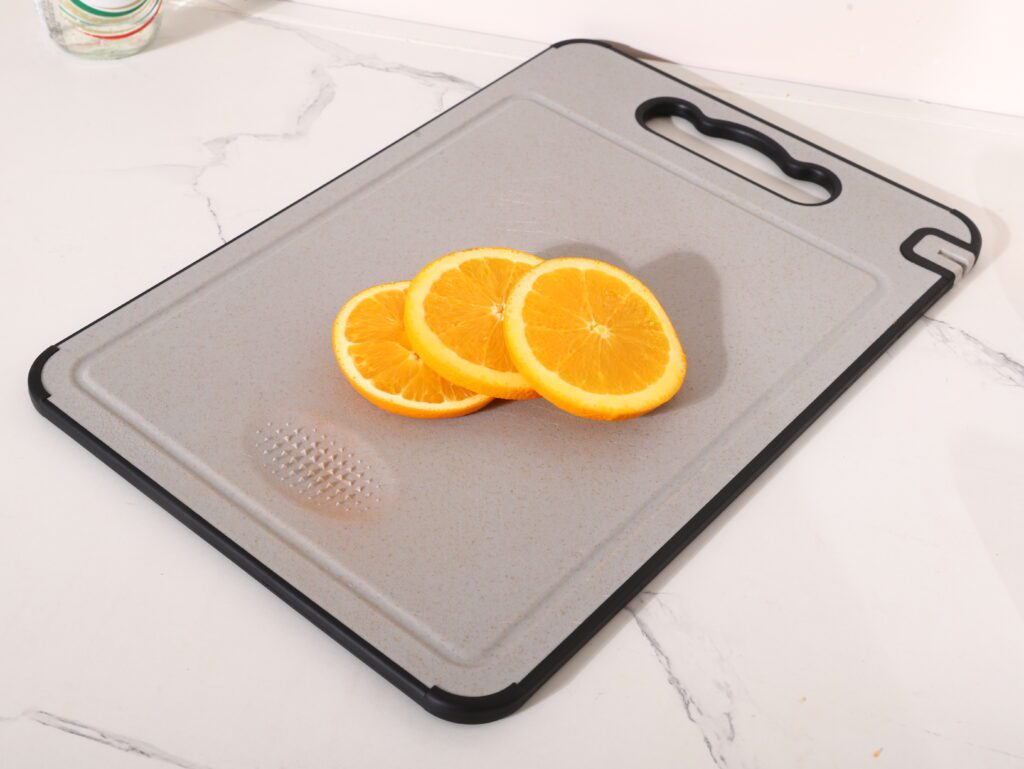
The TIBO is a dual-sided cutting board built around a non-porous titanium surface, designed to avoid the microplastic shedding of plastic boards and the bacteria-harboring porosity of wood, with several kitchen tools built in. One side is titanium, intended for raw meat and heavy prep, and the other is a wheat-straw surface positioned for produce. Around the board you get a built-in ceramic knife sharpener, an integrated garlic and ginger grater, a deep juice groove to catch liquids, and a non-slip base.
The pitch is that this is the last cutting board you will ever need: hygienic because titanium is non-porous and does not absorb liquids or harbor bacteria the way scratched plastic or porous wood can; safe because titanium does not break down into microplastics; durable because metal lasts; and convenient because the sharpener and grater are built in and the whole thing is dishwasher safe with no oiling. It is sold direct through a promotional funnel, with a 30-day money-back guarantee.
The concept is genuinely reasonable, and it targets a real, increasingly discussed concern. The important thing, which we get into next, is to separate the parts of the pitch that are well supported from the parts that are oversold.
The Microplastics Claim: What the Science Actually Says
The headline claim is largely true: plastic cutting boards do shed microplastics, and a titanium surface avoids that entirely. But the marketing’s framing of those particles as proven toxins overstates what the science has actually established. Both halves of that matter.
Here is what is genuinely supported. A 2023 study published in the journal Environmental Science and Technology examined cutting boards as a source of microplastics in food, and estimated that polypropylene plastic boards could release up to roughly 79 million microplastic particles per person per year through normal chopping, with polyethylene boards in the range of about 14.5 to 71.9 million. The study also found that chopping firmer foods and deeper knife grooves increased shedding, meaning an older, more scratched plastic board sheds more. So the “79 million particles” figure TIBO cites is real and accurately drawn from legitimate research, and because titanium is a metal rather than a polymer, it does not break down into plastic particles no matter how long you use it. That is a real, verifiable advantage over plastic.
Here is the important context the marketing leaves out. The researchers themselves noted that these are estimates based on specific assumptions, and that how the laboratory findings translate to real-world exposure and, crucially, to health outcomes remains an active area of research. Microplastics are increasingly being detected in human tissue and blood, and there are growing concerns about possible effects, but those effects are not yet established, and there is no proven harm threshold. So calling the particles “dangerous” and “toxic” as settled fact, as the sales page does, runs ahead of the evidence. The honest summary: reducing the microplastics you ingest is a sensible, precautionary goal, and titanium genuinely helps with that, but you should buy it as a reasonable precaution, not as protection from a proven poison.
One more point of fairness: titanium is far from the only way to avoid microplastics. Wood, bamboo, glass, stone, and stainless steel all avoid plastic shedding too, and several of them cost less. Titanium’s case rests on combining that with hygiene and durability, not on being the only safe choice.
The Hygiene Question: Genuine, With Nuance
Titanium’s non-porous surface is genuinely hygienic and easy to sanitize, which is a real benefit, especially for raw meat. But “naturally antibacterial” slightly overstates it, and the dig at wood is not entirely fair. Because titanium does not absorb liquids, does not swell, and has no pores or deep knife grooves to trap food and moisture, it is easy to clean thoroughly, which is exactly why non-porous surfaces are favored for raw meat and fish prep. That advantage is real.
The nuance is that titanium is not actively antibacterial in the way copper or silver are; it does not kill bacteria, it simply gives them nowhere to hide and is easy to sanitize. And the marketing’s framing of wood as harboring invisible contamination is only half the story: research suggests wood has some natural antibacterial properties, and the real hygiene problem across materials is deep knife grooves in any porous or aging surface, including scratched plastic, where bacteria can persist even after washing. So titanium is genuinely a strong hygienic choice, particularly as a board ages, but the “wood is dirty, titanium is clean” contrast is more marketing than settled science.
The Big Drawback the Ads Downplay: Knife Dulling
The most important practical thing to know is that a titanium surface is harder than wood, bamboo, or plastic, so it will dull your knives faster, and it is noisier and firmer to cut on. The marketing’s “keeps knives razor-sharp” framing is misleading. This is the single biggest reason to think carefully before buying.
To be fair to titanium, it is softer than glass, ceramic, or stone, which are the worst surfaces for blades, so it is not the most damaging metal option. But independent sources consistently agree that titanium is harder than the knife-friendly materials most cooks use, and that using it as your only board, especially for heavy chopping or any twisting of the blade, will dull your knives faster than wood or plastic would. It is also noticeably louder, with a metallic clack on each cut, and the firmer, less cushioned feel is something some cooks dislike. Many people who own a titanium board specifically pair it with a softer, knife-friendly board and reserve the titanium for raw meat and tasks where hygiene matters most.
This is also why the built-in sharpener is a telling detail. The board needs a sharpener precisely because a hard cutting surface dulls blades; the surface itself does not keep knives sharp, despite the marketing language. So the honest framing is the reverse of the ad: the titanium surface is tougher on your edges, and the included sharpener is there to compensate. If you are a knife enthusiast who babies your edges, this board will likely frustrate you unless you rotate it with a softer one.
The Bundled Tools: Useful, With Caveats
The built-in sharpener, grater, juice groove, and non-slip base add genuine convenience, but the sharpener in particular is a convenience feature, not a quality sharpening solution. The integrated garlic and ginger grater is a nice touch that saves reaching for a separate tool, the deep juice groove genuinely helps contain liquids from meat and produce, and the non-slip base is a real safety and stability benefit during chopping. These are sensible, useful inclusions.
The built-in ceramic sharpener deserves a caveat. Pull-through style sharpeners like this are convenient and will put a quick working edge on a dull knife, but they are generally considered aggressive by knife enthusiasts: they remove a fair amount of metal, do not produce as fine or durable an edge as a whetstone, and used often can shorten a knife’s lifespan. So treat it as a handy way to maintain a usable edge, not as a replacement for proper sharpening, and the marketing claim that it saves you a specific amount on professional sharpening is a sales estimate, not a guarantee.
The Wheat-Straw Side: A Small Irony
It is worth flagging the second side honestly. TIBO is dual-sided, with the titanium surface on one side and a wheat-straw surface on the other, positioned for produce. Wheat-straw composite is made from natural fiber bound with a polymer, essentially a plant-based plastic composite. That is a slightly awkward inclusion on a board whose whole selling point is avoiding plastic and microplastics, because a fiber-and-polymer surface can itself scratch and potentially shed particles over time, and it is not the same inert, never-degrading material as the titanium side. It is not a dealbreaker, and the wheat-straw side is fine for light produce work, but if your reason for buying is strictly to eliminate microplastic exposure, be aware that you would want to stick to the titanium side, which makes the second side less of a feature than it sounds.
Maintenance and Durability
This is where titanium genuinely shines. Unlike wood, which needs regular oiling, careful hand washing, and thorough drying, the titanium surface requires no oiling and is dishwasher safe, so day-to-day maintenance is minimal. Metal is also extremely durable and will not warp, crack, or develop the deep grooves that plastic and wood do over time. One caveat on the marketing: the warranty is stated inconsistently, with a one-year warranty badge appearing alongside language about a lifetime durability guarantee and the board lasting forever. Before buying, confirm exactly what warranty you are actually getting, because “lasts forever” and “1-year warranty” are not the same promise.
Pros and Cons
Pros
- No microplastic shedding. Titanium does not break down into plastic particles, a real advantage over plastic boards.
- Genuinely hygienic. Non-porous, does not absorb liquids, easy to sanitize, good for raw meat.
- Very durable. Will not warp, crack, or develop deep grooves.
- Low maintenance. No oiling, dishwasher safe, unlike wood.
- Useful bundled tools. Grater, juice groove, and non-slip base add real convenience.
- 30-day money-back guarantee. Lowers the risk of trying it.
Cons
- Dulls knives faster. Harder than wood or plastic; the key practical drawback.
- Noisier and firmer to cut on. A metallic clack and a hard feel some cooks dislike.
- Overstated health claims. Microplastic harm is unproven; “toxic” overstates the evidence.
- Not the only or cheapest microplastic-free option. Wood, bamboo, and glass also qualify.
- The sharpener is a convenience, not quality sharpening. Pull-through sharpeners are aggressive.
- Wheat-straw side is a plastic composite. Ironic on a microplastic-free board.
- Premium price and inconsistent warranty claims. Plus brand-cited review stats.
Who Should Buy the TIBO Titanium Cutting Board
It makes sense for cooks whose top priorities are hygiene and durability rather than knife care. If you do a lot of raw meat or fish prep and want a non-porous, easy-to-sanitize surface, if you are bothered by the idea of microplastics from a scratched plastic board and want a precautionary upgrade, if you value a low-maintenance board that never needs oiling and goes in the dishwasher, and if you do not mind a firmer, louder cutting surface, then TIBO delivers real value. It is also a reasonable single board for someone who wants the bundled convenience of a grater, juice groove, and sharpener in one. The 30-day guarantee lets this kind of buyer try it with limited risk.
Who Should Skip It
Skip it if you are a knife enthusiast who cares about keeping a fine edge, because a hard titanium surface will dull your blades faster than wood or plastic, and you would be better served by a quality end-grain wood board (and a proper sharpener). Skip it if your only goal is avoiding microplastics on a budget, since a solid wood, bamboo, or glass board achieves that for less. Skip it if you dislike the firm feel and metallic noise of cutting on metal. And do not buy it expecting protection from a proven health threat, because the science on microplastic harm is not settled; buy it as a sensible precaution and durability upgrade, or not at all.
How TIBO Compares to the Alternatives
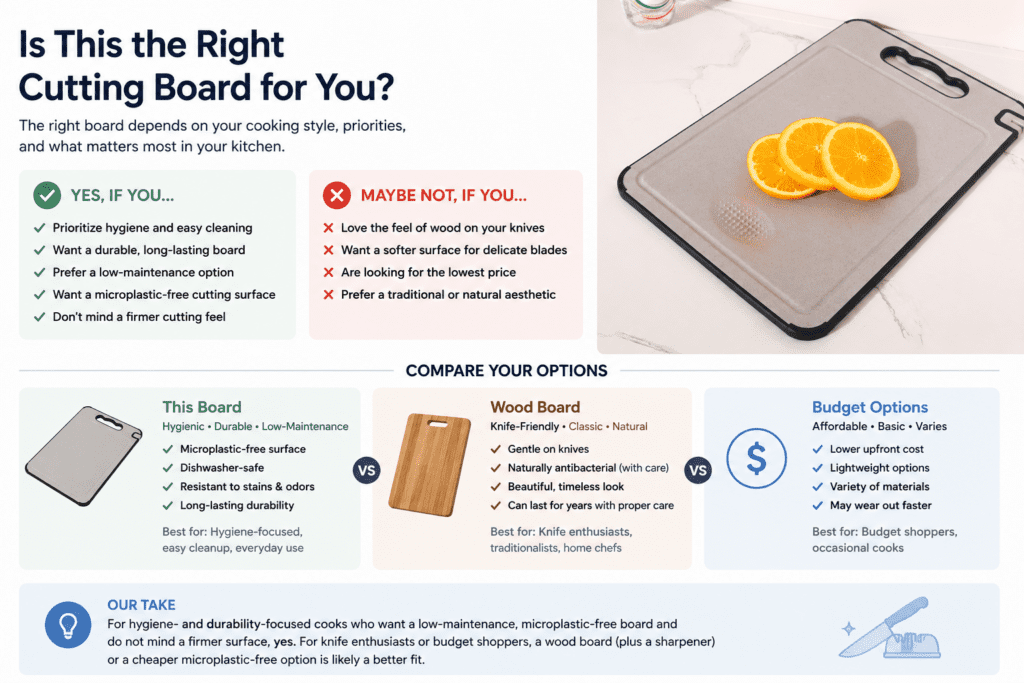
Every microplastic-free board involves trade-offs, and the right pick depends on whether you prioritize knife care, hygiene, budget, or convenience.
Versus wood or bamboo: Wood and bamboo are knife-friendly, microplastic-free, and often cheaper, and wood has some natural antibacterial properties. The trade-offs are maintenance (regular oiling, hand washing, careful drying) and that they are porous, so they can develop grooves over time. If knife care is your priority, wood wins; if low maintenance and maximum hygiene are, titanium wins.
Versus glass or stone: Glass and stone are non-porous and microplastic-free, but they are even harder than titanium and will dull and even damage knives badly, plus they can break or chip. Titanium is the gentler of the hard non-porous options, though still harder than wood.
Versus a quality plastic board, replaced regularly: Plastic is cheap, knife-friendly, and dishwasher safe, but it sheds microplastics and harbors bacteria in grooves as it ages, so it should be replaced periodically. Titanium trades the microplastic and replacement issues for a higher upfront cost and harder surface.
The sensible real-world setup: Many cooks use two boards, a non-porous board like titanium for raw meat and hygiene-critical tasks, and a softer wood or plastic board for everyday chopping to protect their knives. Viewed that way, TIBO is a strong specialist board rather than a do-everything replacement. For related home-health upgrades, see our NUUD Showerhead review, and browse our other tested gadget reviews.
Frequently Asked Questions
Does the TIBO titanium cutting board really prevent microplastics?
Do titanium cutting boards dull knives?
Is titanium really more hygienic than wood or plastic?
Is the TIBO board dishwasher safe?
What is the wheat-straw side made of?
Is the built-in sharpener any good?
Is TIBO medical-grade titanium?
How much does the TIBO cutting board cost?
What is the warranty?
Is TIBO worth it?
Final Verdict
The TIBO Titanium Cutting Board is a genuinely good product built around a real concern, sold with marketing that pushes a little too hard. The foundation is solid: plastic cutting boards really do shed microplastics, titanium really does avoid that, and a non-porous metal surface really is hygienic, durable, and low-maintenance in ways wood and plastic are not. The bundled grater, juice groove, and non-slip base add real convenience, and for raw-meat prep and easy sanitizing, titanium is a legitimately strong choice. As a hygiene-and-durability board, TIBO does what it promises.
Where it asks for skepticism is the framing and the trade-offs. The health danger of microplastics is presented as settled fact when the science is still developing, titanium is sold as uniquely safe when wood, bamboo, and glass are also microplastic-free and often cheaper, the hard surface dulls knives faster than the knife-friendly materials most cooks prefer (which is exactly why a sharpener is built in), the included pull-through sharpener is convenience rather than quality, the wheat-straw second side is itself a plastic composite, and the warranty is described inconsistently. None of these make it a bad board; they make it a board to buy for the right reasons.
So here is our honest recommendation. If your priorities are hygiene, durability, and reducing microplastics as a sensible precaution, and you are happy to cut on a firmer surface or pair it with a softer board for everyday chopping, TIBO is a reasonable, well-featured buy, and the 30-day guarantee lets you test the feel risk-free. If you are a knife enthusiast, on a budget, or hoping for protection from a proven health threat, a quality wood board or a cheaper non-porous option will serve you better. Buy TIBO for clean, durable, low-maintenance prep, not for the miracle the ads imply.
Ossaward Rating: 3.4 / 5. A genuinely hygienic, durable, microplastic-free board with useful tools, held back by overstated health claims, a knife-dulling surface, a premium price, and cheaper alternatives.
If you want a hygienic, durable, microplastic-free board for raw-meat prep and easy cleanup, and you are comfortable with a firmer cutting surface (or will pair it with a softer board for everyday chopping), you can check current TIBO pricing here: