






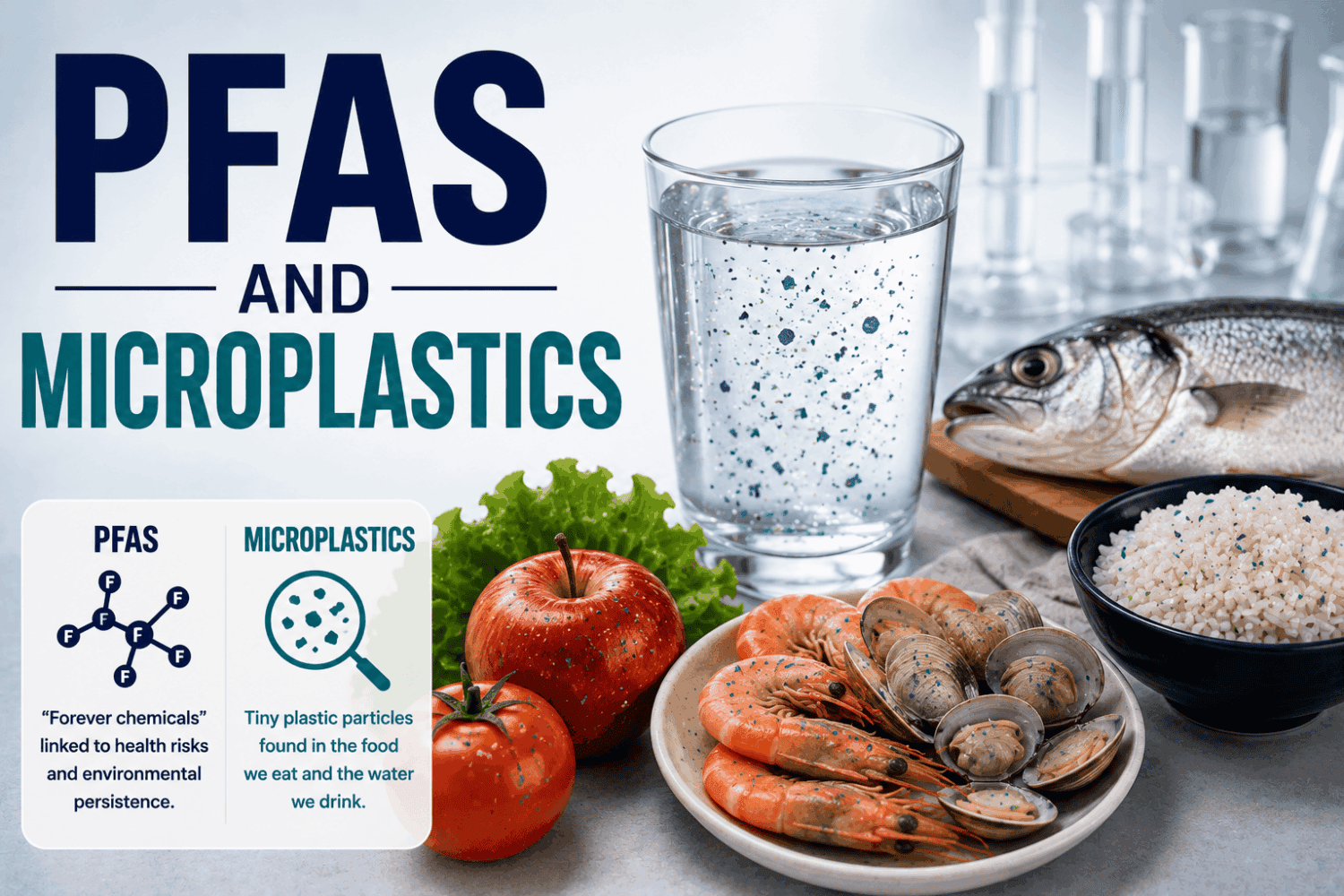
Environmental health discussions tend to treat PFAS and microplastics as separate issues. PFAS are the “forever chemicals” linked to cancer and thyroid disruption. Microplastics are the “everywhere particles” found in blood and brain tissue. They appear in separate news cycles, separate regulatory discussions, and separate supplement marketing campaigns.
But treating them as separate issues misses a connection that has significant practical implications for how you address both: microplastic particles and PFAS compounds are deeply linked through shared sources, shared exposure routes, and a physical mechanism by which microplastics serve as carriers of concentrated PFAS into the body.
This article explains both categories clearly, details the connections between them, identifies the shared sources where combined exposure is highest, and provides practical guidance for addressing both simultaneously.
TL;DR
- PFAS are synthetic organofluorine chemicals with extremely stable carbon-fluorine bonds; over 12,000 distinct compounds exist
- Microplastics are synthetic plastic fragments below 5mm; they carry PFAS and other persistent organic pollutants adsorbed onto their surfaces
- The “Trojan horse” mechanism: when you ingest a microplastic particle carrying adsorbed PFAS, you’re ingesting a concentrated PFAS delivery vehicle
- Non-stick cookware is a significant source of both polymer particle exposure and PFAS chemical exposure
- Drinking water is a primary route for both microplastic particles and dissolved PFAS
- Reverse osmosis filtration is the most effective individual intervention for both simultaneously
What Are PFAS?
PFAS (per- and polyfluoroalkyl substances) are a large class of synthetic chemicals defined by the presence of multiple carbon-fluorine bonds. The carbon-fluorine bond is among the strongest single bonds in organic chemistry, it is this extraordinary chemical stability that gives PFAS their characteristic properties: resistance to heat, water, oil, and biological degradation.
Over 12,000 distinct PFAS compounds have been identified, though regulatory attention has focused primarily on perfluorooctanoic acid (PFOA), perfluorooctane sulfonic acid (PFOS), and their near-chain-length relatives, which have the most extensive health and environmental data.
PFAS are used across an enormous range of applications:
Non-stick cookware (PTFE and alternatives): The original polytetrafluoroethylene (Teflon) coating is itself a fluoropolymer with PFAS-related chemistry. Many PFAS-free alternative coatings use other fluorine-containing compounds that share chemical similarities.
Food packaging: PFAS-coated paper and cardboard is used extensively for grease-resistant food packaging, fast food wrappers, microwave popcorn bags, pizza boxes. The PFAS is applied to prevent oil and grease from penetrating the paper.
Water-resistant outdoor gear: Gore-Tex and many other water-resistant fabric treatments use PFAS to prevent water penetration.
Firefighting foam (AFFF): Military bases, airports, and industrial facilities that use aqueous film-forming foam have contaminated surrounding soil and groundwater with PFAS that persists for decades.
Stain-resistant treatments: Scotchgard and similar stain-resistant treatments for carpets and upholstery contain PFAS.
Dental floss: Some dental floss uses PFAS to provide the waxy, slippery coating. Studies have found elevated PFAS blood levels in people who use certain floss brands.
What Are Microplastics? (Brief Review)
Microplastics are synthetic plastic particles below 5mm in size. They enter the environment from degrading plastic products, synthetic textile washing, tire wear, and other sources, and are now found in all environmental compartments: oceans, freshwater, soil, air, food, and human bodies.
The chemical composition of microplastics varies by plastic type: polyethylene, polypropylene, PET, polystyrene, PVC, and many others. Each polymer type has different surface chemistry, but most develop a net negative surface charge in environmental conditions, which has implications for what they adsorb.
The Connection: Microplastics as PFAS Carriers
This is the most important link between the two categories, and it’s one that most general coverage misses entirely.
Microplastic particles have extraordinarily large surface areas relative to their volume (a 100-micrometer diameter sphere has a surface area of approximately 31,000 square micrometers). These vast surfaces adsorb, attract and hold onto, hydrophobic (water-repelling) organic pollutants from the surrounding environment.
PFAS compounds, particularly the long-chain variants like PFOA and PFOS, are hydrophobic and lipophilic. They are attracted to and accumulate on microplastic surfaces with high affinity. A microplastic particle in contaminated water or soil will progressively concentrate PFAS onto its surface through adsorption, reaching concentrations on the particle surface that are many times higher than the concentration in the surrounding environment.
When a PFAS-contaminated microplastic particle is ingested with food or water, you are not ingesting a single equivalent of the ambient PFAS concentration, you are ingesting a concentrated delivery vehicle for PFAS that has accumulated from many volumes of environmental exposure onto a single particle surface.
This is the “Trojan horse” mechanism: the microplastic carries its chemical payload into your gut, and the concentrated PFAS then becomes available for absorption alongside or independently of the particle itself.
Other Pollutants Microplastics Carry
PFAS are not the only concern in this regard. Microplastics adsorb a broad range of persistent organic pollutants (POPs):
- BPA and BPA alternatives (bisphenol compounds): Endocrine-disrupting chemicals used in polycarbonate plastics and epoxy resins
- Phthalates: Plasticizers that disrupt endocrine signaling, used in flexible PVC
- Polychlorinated biphenyls (PCBs): Industrial chemicals now banned but persistent in the environment
- Polycyclic aromatic hydrocarbons (PAHs): Combustion byproducts
- Heavy metals: Lead, cadmium, mercury can adsorb to plastic surfaces
- Pesticides and herbicides: Hydrophobic agricultural chemicals accumulate on plastic surfaces in agricultural soil
The microplastic particle is not a neutral carrier, it is a concentration device for whatever persistent organic pollutants exist in its environmental history.
Shared Exposure Sources
Understanding which sources contribute to both PFAS and microplastic exposure simultaneously allows for more efficient combined reduction strategies.
Drinking Water
Water contamination is the primary shared exposure route for most people in areas not near industrial contamination sites.
PFAS in drinking water: PFAS contamination of public water supplies is documented in over 2,300 US communities according to Environmental Working Group data. The contamination comes from industrial facilities, military bases, airports, and firefighting foam use that leached into groundwater.
Microplastics in drinking water: Both tap water and bottled water contain microplastics from various sources (atmospheric deposition, pipe materials, bottle materials).
Combined exposure from bottled water: Bottled water in plastic bottles contributes both microplastic particles from the PET bottle and dissolved PFAS chemicals. PFAS from the bottle manufacturing process can leach into the water, and PFAS from the source water (if PFAS-contaminated) is present in the water itself.
The filtration solution: Reverse osmosis systems remove both dissolved PFAS compounds and microplastic particles with high efficiency (90%+ for PFAS, near-complete removal for particles above the membrane pore size). This makes RO filtration the single most efficient intervention for combined PFAS and microplastic exposure from drinking water.
NSF/ANSI 58 certification for RO systems and NSF/ANSI 53 certification for activated carbon filters specifically test for PFAS removal. Verify certification before purchasing a filtration system.
Non-Stick Cookware
Non-stick cookware contributes both PFAS chemical exposure and microplastic (fluoropolymer) particle exposure.
PFAS exposure from non-stick: PTFE (Teflon) and alternative fluoropolymer coatings are stable at normal cooking temperatures but begin releasing PFAS-related compounds and particles when scratched, degraded, or overheated (above approximately 260°C/500°F).
Polymer particles: When non-stick coating is physically damaged (scratched by metal utensils, chipped from normal wear), fluoropolymer particles, which are effectively microplastics from a material perspective, enter food.
The replacement strategy (cast iron, stainless steel, or true ceramic cookware) eliminates both exposure routes simultaneously.
Food Packaging
PFAS-treated paper packaging (fast food wrappers, microwave popcorn bags, pizza boxes) contributes both the PFAS chemical exposure from the coating and, in some cases, microplastic or nanoplastic particles from the paper coating or backing layers.
Avoiding food in PFAS-treated packaging where possible (preparing food at home, choosing alternatives to heavily packaged fast food) reduces both exposures.
Health Implications of Combined Exposure
PFAS Health Effects (More Established)
PFAS have a considerably more developed human epidemiological evidence base than microplastics, because PFAS contamination was recognized earlier and health studies have followed exposed populations for longer periods.
Documented associations in human epidemiological research include:
Thyroid disruption: PFAS compete with thyroid hormone for binding sites, potentially affecting thyroid function. Multiple epidemiological studies have found associations between PFAS exposure and thyroid disease.
Immune effects: Higher PFAS levels in blood are associated with reduced antibody response to vaccines and potentially reduced immune competence more broadly. This is particularly concerning for children’s immune development.
Cancer: PFOA specifically has been classified as possibly carcinogenic to humans (Group 2B) by the International Agency for Research on Cancer. Kidney cancer and testicular cancer associations are among the most extensively studied.
Reproductive effects: PFAS have been associated with reduced fertility, lower birth weight, and altered developmental trajectories in children exposed prenatally.
Cardiovascular effects: Emerging research connects PFAS exposure to increased cardiovascular risk through effects on cholesterol metabolism (PFAS are associated with higher LDL cholesterol levels).
Microplastic Health Effects (Emerging)
As covered in the blood research article, microplastic health effects in humans are less completely characterized but include the 2024 NEJM cardiovascular association study and consistent laboratory evidence of oxidative stress and inflammatory effects.
Combined Effects: What We Don’t Know Yet
The combined effects of co-exposure to microplastic particles and PFAS (particularly through the Trojan horse mechanism of PFAS-contaminated microplastics) have not been specifically studied in humans. Research on combined effects of multiple pollutants (“mixture toxicology”) is an active area but is technically and methodologically challenging.
The reasonable expectation from the mechanism is that the total health burden from combined exposure is at least additive and potentially synergistic. PFAS-contaminated microplastics deliver a concentrated dose of PFAS to gut tissue alongside the physical particle exposure, potentially compounding both effects.
A Combined Reduction Strategy
The good news is that the most impactful interventions for PFAS reduction and the most impactful interventions for microplastic reduction are largely the same actions:
Replace non-stick cookware with cast iron, stainless steel, or true ceramic. Eliminates both fluoropolymer particle exposure and PFAS chemical exposure from cookware.
Install reverse osmosis water filtration. Removes both dissolved PFAS and microplastic particles from drinking water simultaneously, the most comprehensive water treatment solution for both categories.
Avoid PFAS-treated food packaging. Reduces both the PFAS chemical exposure from the coating and the associated packaging-adjacent microplastic exposure.
Use activated carbon block filters (NSF/ANSI 53 certified) as a minimum. A cost-effective partial solution if reverse osmosis is not feasible, removes significant fractions of both PFAS and microplastics from tap water.
Support gut-based elimination of ingested particles. Chitosan supplementation reduces the gut retention and gut-to-blood transfer of ingested particles, including PFAS-contaminated microplastic particles that carry their chemical payload into the gut. By increasing fecal excretion of these particles, chitosan may reduce both the particle exposure and the PFAS payload delivered through the Trojan horse mechanism. See the Sifts Daily Review for complete analysis.
Frequently Asked Questions
Are PFAS and microplastics the same thing?
No. PFAS are chemical molecules (organic compounds with carbon-fluorine bonds). Microplastics are physical particles of synthetic plastic polymers. They are distinct categories of contamination that often coexist and interact.
Which is more dangerous, PFAS or microplastics?
Both are concerning. PFAS have a more developed human health evidence base with documented associations with thyroid disruption, immune effects, and cancer. Microplastic health effects are emerging, with the 2024 NEJM cardiovascular study being the most clinically significant finding. The two categories interact in ways that may compound their individual effects.
How do microplastics carry PFAS into the body?
Microplastic surfaces adsorb (attract and hold) hydrophobic organic pollutants including PFAS from the surrounding environment. When these PFAS-contaminated particles are ingested, the concentrated PFAS on the particle surface becomes available for absorption in the gut. This “Trojan horse” mechanism can deliver PFAS at concentrations much higher than the ambient environmental concentration.
Does reverse osmosis remove both PFAS and microplastics from drinking water?
Yes. Reverse osmosis membranes remove dissolved PFAS compounds and microplastic particles simultaneously with high efficiency. This makes RO filtration the most comprehensive water treatment option for combined PFAS and microplastic reduction.
Is non-stick cookware a significant PFAS exposure source?
Yes, particularly scratched, degraded, or overheated non-stick coatings. PTFE (Teflon) and alternative fluoropolymer coatings release both PFAS-related compounds and fluoropolymer particles (a form of microplastic) when damaged or overheated. Replacing non-stick with cast iron, stainless steel, or true ceramic eliminates this exposure route.
Does chitosan help with PFAS as well as microplastics?
Chitosan’s electrostatic binding mechanism targets negatively charged surfaces. PFAS compounds themselves (dissolved in solution) are not necessarily captured by chitosan through this mechanism. However, chitosan’s effect on PFAS-contaminated microplastic particles may be significant: by increasing fecal excretion of the particles, it also increases excretion of the PFAS chemical payload carried on those particles.
Are PFAS in bottled water?
Yes. PFAS contamination has been found in some bottled water sources, and PFAS compounds can also leach from the PET bottle material during storage and transport. Bottled water is a source of both PFAS and microplastic exposure, making filtered tap water a superior alternative on both dimensions.
What is the most important action to reduce combined PFAS and microplastic exposure?
Reverse osmosis water filtration addresses both simultaneously and is the highest combined-impact single intervention. Replacing non-stick cookware with cast iron or stainless steel is the next highest-impact combined action.

