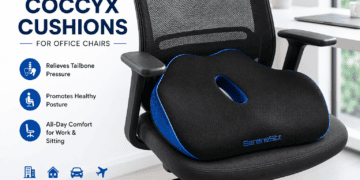
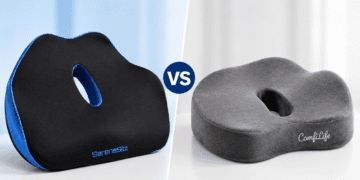
There is a simple test for any wellness gadget that sells for more than its shelf-mates: point to the number that justifies the gap. With SereneSitz, a W-shaped memory foam seat cushion sold for around $79.99, that number is exactly what you cannot find. The cushion is genuinely well designed. The price sits at double a ComfiLife and triple an Everlasting Comfort. And the specifications that would let you check whether you are paying for more foam, more density or more size are simply not published. That tension is the whole review.
The short answer
Is SereneSitz any good? Yes, mechanically. The W-shaped rear cutout is a legitimate design that lifts the coccyx off the seat instead of loading it, and high-density foam is the right material for people tired of watching cheap cushions flatten by month four. Nothing about the engineering is fake.
Should you buy it? Only if you have already tried a cheaper cutout cushion and want a step up, or if the specific W contour fits you where a plain U notch did not. At $79.99 it asks a premium it has not justified in public, because it declines to publish the dimensions, foam density or weight capacity that a $30 rival prints on the box.
Grade: B−. A well-made cushion carrying a premium it has not earned in the open.
Check current SereneSitz pricing→
Grade breakdown
| Criterion | Grade | One-line reason |
|---|---|---|
| Mechanism design | A− | The rear W-cutout offloads the coccyx and spreads load to the hips and thighs, exactly as claimed. |
| Build and materials | B | High-density foam, non-slip base, breathable washable cover, all correct, none verifiable without a density figure. |
| Spec transparency | D | No dimensions, density, weight capacity or thickness. In a fit-critical category, that silence is a real deduction. |
| Evidence quality | C+ | A small review pool averaging 4.7 with zero sub-four-star entries is a curated marketing surface, not a representative sample. |
| Price and value | C− | Its closest functional equivalents sell for $30 to $45 with vastly larger validation pools. |
| Purchase terms | B− | 30-day money-back and a 1-year warranty are fair. “55% off” with no dollar figure until checkout is not. |
| Overall | B− | Sound product, unproven premium. |
What is SereneSitz, really?
SereneSitz is a memory foam seat cushion with a W-shaped cutout at the rear edge, designed to suspend your tailbone above the seat and shift your weight onto the hips and thighs. It sits on top of an existing office chair, car seat or sofa rather than replacing it, and sells for around $79.99 through the brand’s direct offer page and partner storefronts.
That is the entire product. No motor, no battery, no app, no heating element, a shaped block of foam in a washable cover. Any review that makes it sound more complicated than that is selling rather than describing.
The category exists because of one anatomical fact. When you sit properly, your weight loads through the ischial tuberosities, the two bony “sit bones” evolution built for the job. The coccyx, the small fused tailbone at the base of the sacrum, was never meant to carry weight. Slump so your pelvis rolls backward (a “sacral slump”) and the load shifts onto the tailbone. Do that for eight hours a day and you get the microtrauma that presents as coccydynia: a sharp ache at the base of the spine that worsens the longer you sit and eases the moment you stand. (See what is coccydynia.)
A cutout cushion’s answer is elegant: keep foam under the parts that can carry load, remove it under the part that cannot. Air does not press back. SereneSitz’s particular twist is the shape of the removal, a W rather than the more common single U notch, with extra contouring either side the brand says cradles the hips and nudges the pelvis toward neutral.
One practical note before you buy: SereneSitz appears under several sellers (the direct offer page, ReAthlete, ZS Brands and third-party marketplace listings under variant spellings). Whichever page you buy from governs your price, return window and warranty, and those terms are not identical across channels.
Does the W-cutout actually work?
Yes, for what it is designed to do. The physics is unglamorous and sound: pressure equals force divided by area, your body weight is fixed, so the only lever a cushion has is the area it spreads load over, and for the coccyx specifically, the trick is to give it zero contact area. Remove the material beneath a bony point and you remove the reaction force through it. Category pressure-mapping research supports this, contoured and cutout seats reduce localised pressure in the sacrococcygeal region.
But be clear about what that evidence supports: pressure reduction, not a specific clinical cure, and it does not show a W cutout beats a U cutout, because no one has published that comparison. (See W-shaped vs U-shaped cushion.)
There are two honest limits every seller skips:
The cutout only works while it is under your tailbone. Shift forward, cross your legs, or slump while concentrating, and your coccyx can slide onto the firmer foam ridge at the back of the notch, the exact pressure point you were avoiding. Many “worked for twenty minutes, then didn’t” reports are a position problem, not a foam problem. (See how to position a coccyx cushion correctly.)
Foam compresses. High-density foam resists bottoming out better than cheap foam, but no foam is incompressible. As it compresses, the effective depth of the cutout shrinks, which is exactly why foam density is the number that matters most here, and exactly why SereneSitz declining to publish it is the most frustrating blank on the page.
And the part brands dislike: specialists are lukewarm about cushions as a primary fix. The recurring position among ergonomists and physical therapists is that seat geometry and, above all, movement outrank any pad on top. The consensus lands around a posture break every 20 to 30 minutes. No cushion delivers that. SereneSitz will make hour four less painful than it would have been; it will not make hour four good for you. Most durable improvement is free and lives in the desk-setup changes that do more than any cushion.
What does the price actually buy (and hide)?
Here is the uncomfortable table at the heart of this review, the specs SereneSitz does not publish that its cheaper rivals do:
| Specification | SereneSitz | Why it matters |
|---|---|---|
| Dimensions | Not published | You cannot check it fits your chair or bucket car seat |
| Foam density (kg/m³) | Not published | Predicts whether it bottoms out at hour six |
| Weight capacity | Not published | Heavier users are guessing above ~220 lbs |
| Thickness | Not published | Determines how much you must lower your chair |
| Cutout depth/width | Not published | Determines whether the notch clears your tailbone |
Competitors in this space publish these numbers, some to the tenth of an inch. SereneSitz asks you to buy on adjectives (“high-density,” “universal fit”) and trust. In a product whose entire function depends on a notch landing in the right place, that is the most consequential omission on the page, and it is why the 30-day return window is load-bearing rather than decorative: it is the only fit test you get.
On heat, SereneSitz is foam-only with a breathable cover, not gel-infused. Independent category testing has measured gel-layer cushions running several degrees cooler over a few hours. The breathable cover narrows that gap; it does not close it. If you work in a warm room or a hot car, that is the feature most likely to decide whether the cushion is still in use in six months.
The one genuinely strong value argument the brand under-sells is portability. It is light, has no electronics, and moves between office chair, car, sofa and plane without adaptation, which multiplies the contexts the $79.99 covers. A cushion used at a desk, on a commute and on a bad sofa costs the same as one used at a desk alone; the per-hour cost falls accordingly. Owners routinely end up buying a second so they stop relocating it, which is about as strong a satisfaction signal as reviews produce.
What do the claims and the reviews really say?
A quick, honest audit of the brand’s headline claims:
| Claim | Ruling |
|---|---|
| The W-cutout relieves coccyx pressure | Supported |
| High-density foam resists flattening | Partly supported (true in principle; no density published) |
| Promotes correct posture and alignment | Partly supported (a pad assists; it cannot fix a slump) |
| Relieves lower back pain and sciatica | Unsupported as stated (comfort, not treatment) |
| Universal dimensions fit most seats | Unverifiable (no dimensions published) |
| Save 55% | Unverifiable (no dollar figure before checkout) |
The one to watch is the sciatica and back-pain language, which appears across some listings. Back pain and sciatica have many causes; a cushion addresses exactly one (sustained loading in a poor seated position). Where seated posture is the driver, relief is plausible and owners report it. Where it is not, a cushion does nothing. No FDA clearance for this product was confirmed in the materials reviewed, so treat any pain-relief wording anywhere as a comfort claim, not a medical one. (See [does a seat cushion help sciatica in the FAQ below].)
On reviews, be careful. The largest visible pool is small (dozens of reviews) averaging 4.7, with 38 five-star, a handful of four-star, and zero below four stars. That is not evidence of fraud, curated display is routine in direct-to-consumer retail, but it is statistically unusual: across any fit-variable product, some people find the cutout sits wrong or it slides on leather. Their complete absence means the corpus is a marketing surface, not a representative sample, and it cannot tell you the failure modes, which is most of what a buyer needs. For contrast, the cheaper rivals carry review pools two to three orders of magnitude larger. (See SereneSitz complaints.)
How do you set it up so it actually works?
Almost every disappointed first week traces to setup, so do this before you judge it:
- Let it recover. Memory foam ships compressed; give it several hours flat at room temperature before sitting on it seriously.
- Cutout goes at the rear. The W notch sits against the chair back. A cutout at the front is just a gap under your thighs, this is the single most common setup error.
- Sit all the way back. Slide your hips fully against the chair back so the notch is under the coccyx, not behind it.
- Check the clearance. Reach behind and confirm you can slide a finger into the notch under your tailbone without resistance.
- Reset your chair height. A cushion raises the seat; lower the chair so your feet stay flat and elbows near desk height, or you trade tailbone pain for shoulder and wrist strain.
- Test the grip. Non-slip works well on fabric and mesh, less so on leather and vinyl; stand and sit a few times to confirm it stays put.
- Give it a fortnight, and clean it right: cover unzips and machine washes; the foam core never goes in a washing machine or dryer, spot-clean and air-dry it. (See how to clean a memory foam seat cushion.)
Who should buy it, and who should skip it
Buy SereneSitz if: you have tried a basic U cutout and want to try the W contour; you value portability across chair, car and sofa; you run cool enough that foam-only heat is not an issue; and the premium does not bother you.
Skip it if: this is your first cutout cushion (start cheaper and transparent, like ComfiLife or Everlasting Comfort); you are a heavier user who needs a published weight capacity; you need to verify it fits a specific bucket car seat; or you run hot and want a gel layer.
Do not buy it as a medical treatment. It is a comfort cushion. For persistent or severe tailbone pain, sciatica or an injury, see a doctor, and build in movement, no cushion replaces a posture break.
Check current SereneSitz pricing→
Position it correctly before you judge it
Almost every negative outcome in this category traces back to the cushion being used wrong for the first week, so this section comes before the features rather than after them.
Step 1. Unbox and let it recover. Memory foam ships compressed. It needs time and warmth to return to full loft, and a cushion evaluated in the first hour out of the box is being evaluated at the wrong thickness. Give it several hours flat, at room temperature, before you sit on it seriously.
Step 2. Find the cutout and orient it. The W notch goes at the back, against the chair back. This sounds obvious. It is the single most common setup error in the entire category, and it produces the specific complaint of a cushion that does nothing, because a cutout at the front of the seat is just a gap under your thighs.
Step 3. Sit all the way back. Slide your hips fully against the chair back before you settle. The cutout has to be under the coccyx, not behind it. If you perch forward, your tailbone lands on the rear foam ridge and you have engineered the exact pressure point you were trying to avoid.
Step 4. Check the clearance by hand. Sit normally, reach behind, and confirm you can slide a finger into the notch under your tailbone without meeting resistance. If you cannot, either you are sitting too far forward or the cutout depth is insufficient for your body weight. Both are diagnosable in ten seconds and neither requires waiting three weeks to find out.
Step 5. Reset your chair height. A cushion adds thickness. Every inch you gain at the seat is an inch your desk effectively drops relative to your elbows, and an inch your feet move away from the floor. If you do not lower the chair to compensate, you will trade tailbone pain for shoulder and wrist strain, and then blame the cushion. Feet flat, thighs roughly parallel to the floor, elbows near desk height.
Step 6. Confirm the base is actually gripping. Non-slip works well on fabric and mesh, less reliably on polished leather and vinyl. Test it by standing and sitting a few times. If the cushion travels, deal with it now rather than adjusting your position a hundred times a day to chase it.
Step 7. Give it a fortnight, and expect a settling-in period. Foam conforms to you over the first several days, and your body adapts to a changed seat height and pelvic angle. Reports of mild unfamiliarity in the first few days are common across the category and usually resolve. Reports of a new pain that appears and stays are not a settling-in period, and that is a return, not a persistence test.
Step 8. Clean it correctly. Unzip and remove the cover, machine wash, tumble dry on low or no heat. The foam core does not go in a washing machine under any circumstances, and it does not go in a tumble dryer. Water breaks down the cell structure and the cushion never fully recovers its loft. Spot clean the core with a barely damp cloth and let it air dry completely before the cover goes back on.
Weigh the features that actually change your day
Five features do real work here. The rest is packaging.
Judge the W-shaped cutout on fit, not on novelty
The cutout is the product. Everything else is support infrastructure for the cutout.
Judged as a design, it is well positioned: the notch sits at the rear where the coccyx actually lands, rather than being centred like a donut hole, which is a meaningfully different and generally better choice for anyone sitting for hours rather than recovering from a specific procedure.
The practical caveat is one of fit. Because the cushion’s dimensions are not published, you cannot check in advance whether the cutout width and depth suit your pelvis. Cutout geometry varies more than buyers expect across this category, and a notch that clears one person’s tailbone comfortably can sit slightly wrong on someone with a wider or narrower pelvic structure. Competing products publish cutout depth figures, some as precise as 2.8 inches at a 15 degree angle. SereneSitz publishes nothing. That makes the 30-day guarantee load-bearing rather than decorative, because the return window is the only fit test available to you.
Treat “high-density memory foam” as a claim, not a specification
High-density foam is genuinely the right call. It resists the compression set that turns cheap cushions into flat pads, it maintains cutout depth under load for longer, and it is the difference between a cushion that lasts three years and one that lasts eight months. Owners repeatedly report the SereneSitz holding its shape under daily use, including one four-star reviewer noting no loss of shape with daily use over an extended period. That pattern is consistent enough to take seriously.
The frustration is that “high-density” without a number is marketing vocabulary. Competitors in this space publish density in kg/m³, and the ones worth buying tend to sit around 50 kg/m³. Independent testers use that figure precisely because it predicts whether a cushion bottoms out during an eight-hour session. Without it, you are buying on the brand’s adjective.
Why this matters: density is the one specification that predicts long-term performance in a product with no moving parts. Its absence is the difference between a claim you can check and a claim you have to trust.
Take the breathable cover more seriously than you expect to
Heat is the underrated failure mode of memory foam seating. Foam insulates. Sit on it for four hours and the interface between you and the cushion becomes noticeably warmer and damper than a chair pan would be, which is the origin of most “I stopped using it in summer” abandonment in this category.
SereneSitz addresses this with a breathable removable cover, described on some listings as a 4D airflow construction and on others as ventilation-hole assisted. Owner reports back this up more specifically than most feature claims survive. One verified reviewer’s comparison against previously owned cushions came down to exactly this: less sweating than the alternatives they had used.
Independent testing in the category quantifies the stakes. Gel-layer cushions have been measured running roughly 4 to 6°F cooler than foam-only designs at the three-hour mark. SereneSitz is foam-only with a breathable cover rather than gel-infused, which means it manages heat rather than actively countering it.
Why this matters: if you work in a warm room or a car in summer, this is the feature most likely to determine whether the cushion is still in use in six months, and it is the area where a gel competitor has a measurable rather than rhetorical edge.
Check the non-slip base against your specific chair
The slip-resistant bottom is genuinely functional and appears consistently in owner reports as something that works. A cushion that migrates is a cushion whose cutout is no longer under your tailbone, so this feature is not a convenience item. It is load-bearing for the primary mechanism.
The variable is your chair surface. Grip performs well on fabric and mesh, adequately on textured vinyl, and least reliably on smooth leather and polished wood. Nothing about SereneSitz is unusual here. The whole category behaves this way, and any review claiming a cushion never slides on any surface has not tested it on a leather car seat in August.
Why this matters: on the wrong surface the cushion needs repositioning several times a day, which is exactly the friction that ends with it living in a cupboard.
Do not overlook the portability, because it changes the value maths
The cushion is light, has no electronics, and moves between an office chair, a car seat, a sofa and an aeroplane seat without any adaptation. That sounds like a minor convenience and it is actually the strongest value argument the product has, because it multiplies the number of hours the $79.99 covers.
One owner report captures the behaviour pattern precisely: bought for the office, then carried to the living room in the evening, then the dining table, with the conclusion that you should probably buy two so you stop moving it around. Another describes it as a genuine improvement to flying. A third specifically credits it during driving.
Why this matters: a cushion used for eight desk hours costs you $79.99 for one context. A cushion used for eight desk hours, a two-hour commute and evenings on a bad sofa costs the same $79.99 across three contexts, and the per-hour cost falls accordingly. This is the single most persuasive line in the product’s favour, and the brand markets it as an afterthought.
Count the secondary wins most buyers miss
Beyond the advertised job, several second-order effects show up consistently in owner reports and in category literature. None of these should drive a purchase on its own. Together they widen who the cushion is genuinely useful for.
Seat height correction for short users and bad chairs. A large share of office chairs do not adjust low enough or high enough for the people using them. Adding a cushion raises the seat by its compressed thickness, which for someone stuck at a fixed-height dining chair or a conference table can be the difference between elbows at desk height and shoulders permanently shrugged. This is a real ergonomic benefit that has nothing to do with tailbone pain, and it is why some buyers who never had coccyx trouble end up keeping the cushion anyway.
Thigh pressure relief at the seat’s front edge. Hard chairs with a square front edge compress the underside of the thighs, restricting circulation and producing the numbness and pins-and-needles that make people fidget. A conforming foam layer softens that edge. Ergonomists solve this properly with a waterfall seat edge; a foam cushion is a partial substitute, and partial is better than nothing on a chair you cannot replace.
A physical prompt to sit back. This one is behavioural rather than mechanical. Because the cutout only works when you are seated fully back, users who understand the mechanism develop a habit of checking their position. That habit is worth more than the foam. Sitting back keeps the pelvis out of a sacral slump, which is the posture that causes coccyx loading in the first place.
Long-haul travel and flights. Aircraft seat pans are firm, flat and unforgiving, and there is no adjustment available. A portable cushion is one of the few interventions possible in that environment. Owner reports specifically call out flying as a use case where the cushion earns its keep, and category testing supports the general point that cutout cushions are among the more effective options for extended seated travel.
Post-injury and post-procedure comfort in non-clinical settings. Coccyx cushions get used by people recovering from tailbone bruises, from prolonged desk work after a fall, and during pregnancy and postpartum. SereneSitz is not marketed as a medical device and no FDA clearance or classification was confirmed in the materials we reviewed, so this belongs in the category of comfort rather than treatment. Anyone in genuine post-injury or postpartum recovery should be taking the cushion recommendation from their clinician, not from a review page.
A reason to reassess the whole workstation. Buying a cushion tends to be the moment people finally look at their chair height, monitor position and break frequency. The cushion gets the credit for improvements that came from the audit it triggered. That is fine. It is still a benefit, and it belongs in the same self-management category as self-directed pressure relief elsewhere in the body.
Read what owners actually report
Sourcing note: no one at Ossaward has sat on a SereneSitz. Everything in this section is aggregated from published owner reviews across the brand’s storefronts, retail listings and third-party coverage, gathered on 30 July 2026. Where a pattern is thin, we say so rather than inflating it.
That caveat matters more here than it usually would, because the corpus is small.
Size the review pool honestly
The largest single pool we could locate is the ReAthlete storefront: 51 verified reviews, 4.7 average, with 100% of reviewers indicating they would recommend the product. The distribution is 38 five-star and 13 four-star.
Zero three-star. Zero two-star. Zero one-star.
We are going to be precise about what that means, because it is the most important observation in this section and it is easy to state badly. It is not evidence of fraud. Curated review display is routine in direct-to-consumer retail: some platforms surface only reviews from verified purchasers, some brands moderate for content rather than sentiment, and a genuinely well-liked product in a small sample can skew high.
It is, however, statistically unusual. Across a 51-review sample of any physical product with fit variability, you expect a handful of returns-adjacent reviews: the person for whom the cutout sat wrong, the person on a leather seat where it slid, the person who found it too firm. Those people exist for every cushion ever made. Their complete absence from the visible corpus means the corpus is a curated marketing surface rather than a representative sample, and it should be weighted accordingly.
For contrast, the closest competitor products carry review pools two to three orders of magnitude larger, one of them exceeding 127,000 Amazon reviews. That is a genuinely different quality of evidence, and it is one of the reasons the price gap is difficult to defend.
Smaller pools exist elsewhere. A second brand storefront shows a 4.7 average across a low-double-digit review count with a similar top-heavy split. Third-party Walmart listings under variant names carry their own scattered feedback. Nothing we found across any channel changes the shape of the picture.
Identify the recurring delight
Four themes repeat with enough consistency across the available reports to treat as real signal rather than noise.
Pressure relief arrives fast. The most common structure in positive reports is immediate rather than gradual: users describe sitting down and noticing the absence of a pressure point rather than a slow improvement over weeks. This tracks with the mechanism. Removing contact area is instantaneous, unlike anything that works through tissue change or habituation. One reviewer with three broken lumbar vertebrae described sitting on it as taking the pain away and making sitting bearable, which is an individual report rather than a clinical outcome, but it is the kind of report that shows up repeatedly at the severe end of this category.
Heat management beats expectations. Multiple reports specifically compare it favourably against previously owned cushions on sweating, which is unusual specificity. Generic praise is cheap. A comparison against a named prior product the reviewer actually owned is a more reliable signal.
Shape retention holds up. Reports at the multi-month mark consistently describe daily use without loss of shape. Given that foam collapse is the single most common long-term failure in this category, this is the durability signal buyers most want and the one owners most reliably supply.
Cross-context use is habitual. Owners describe moving it between office chair, car, sofa and dining chair, and describe flying with it. Several independently arrive at the same conclusion, that a second unit would save the constant relocation, which is about as strong a satisfaction signal as consumer reviews produce.
Customer service draws unprompted praise. At least one detailed review is about the support interaction rather than the product. In a category where fit uncertainty makes returns common, responsive support is a genuine risk-reducer and it is worth noting that it appears organically rather than in response to a prompt.
Name the recurring complaint, and be honest that it is missing
Here is where an aggregated review has to do something uncomfortable, which is report the absence of data rather than inventing the data.
We could not identify a recurring complaint pattern for SereneSitz specifically, because the visible review corpus contains almost no criticism. The lowest-rated visible reviews are four-star and most contain no stated reservation at all. One four-star entry consists of the word “no” as both title and body, which tells you nothing except that review-request emails work on people who have nothing to say.
Reporting that as “no complaints exist” would be dishonest. What is accurate is that no complaints are visible, and that the two facts are different.
So the responsible substitute is category-level complaint data, which is abundant, applies to every cushion in this class, and gives you an accurate picture of what goes wrong even when a specific brand’s page does not show it. Across independent testing and large-pool reviews of comparable cutout cushions, the recurring failures are:
- Foam compression under heavier users. Testers repeatedly flag that cushions rated medium-firm compress faster than expected above roughly 220 pounds, which shrinks the effective cutout gap. One independent test explicitly caps confident foam retention at 220 lbs for a well-regarded competitor. SereneSitz publishes no weight capacity at all, so you cannot check where it sits on this axis.
- Heat build-up over long sessions. Foam-only cushions run warmer than gel-layer designs, measurably so. SereneSitz mitigates with a breathable cover rather than eliminating the problem.
- Sliding on smooth surfaces. Universal across the category, worst on leather and vinyl.
- Thickness disrupting desk ergonomics. Adding two to three inches of seat height without re-adjusting the chair moves the problem to the shoulders and wrists.
- Cover wear and colour change over time. Independent long-term testing notes lighter covers showing wear, and cover fabric is where budget cushions cut cost.
- Cutout misalignment for outlier body sizes. The most common cause of “it did nothing for me” in this category, and unfixable without published dimensions.
Assume SereneSitz is subject to all six until owner evidence shows otherwise. Nothing about its construction exempts it.
Where the reports conflict, and why
The one genuine conflict in the available material is not about the cushion. It is about the seller.
The offer page positions SereneSitz as the originator of the product. A June 2026 press release attributes the launch to ReAthlete. Both descriptions are live simultaneously across different channels, and a paid advertorial covering the product explicitly declined to resolve which framing is definitive, recommending instead that buyers treat a purchase from the offer page as governed by that offer’s specific terms rather than assuming the terms are identical everywhere.
That is the correct advice and we will repeat it. The conflict has no bearing on whether the foam works. It has considerable bearing on who processes your refund.
Audit the brand’s six claims one at a time
| # | Claim | Ruling |
|---|---|---|
| 1 | The W-shaped cutout relieves pressure on the coccyx | Supported |
| 2 | High-density memory foam resists flattening | Partly supported |
| 3 | The cushion promotes correct spinal alignment and posture | Partly supported |
| 4 | It relieves lower back pain and sciatica | Unsupported as stated |
| 5 | Universal dimensions fit most seats | Unverifiable |
| 6 | Save 55% | Unverifiable as presented |
Claim 1: the cutout relieves coccyx pressure. Supported. The mechanism is straightforward and the category-level pressure-mapping evidence backs it. Removing material from beneath a bony prominence removes the reaction force through it. This is the claim doing the real work and it is the one that holds.
Claim 2: high-density foam resists flattening. Partly supported. High-density foam does resist compression set better than low-density foam. That is materials science, not marketing. What is unsupported is any specific durability expectation, because the density is not published. Owner reports at the multi-month mark support shape retention. Owner reports are not a substitute for a kg/m³ figure, and the brand could close this gap with one line on a spec sheet.
Claim 3: promotes correct spinal alignment and posture. Partly supported. A contoured seating surface can influence pelvic orientation, and pelvic orientation drives lumbar posture. That chain is real. What the claim overstates is the degree of control a passive foam pad exerts over a person who slumps. Specialists are consistent on this: seat geometry and posture changes every 20 to 30 minutes do the heavy lifting, and the pad on top is an assist. A cushion cannot fix posture. It can make good posture more comfortable to hold, which is not nothing and is not the same sentence.
Claim 4: relieves lower back pain and sciatica. Unsupported as stated. This is the claim that needs the hardest look, and it appears in various forms across the retail listings rather than uniformly on the brand’s own page. Lower back pain and sciatica have many causes: disc pathology, facet joint irritation, piriformis involvement, spinal stenosis, muscular imbalance. A seat cushion addresses exactly one contributing factor, which is sustained loading in a poor seated position. Where seated posture is the driver, relief is plausible and owners report it. Where it is not the driver, a cushion does nothing, and clinical sources are explicit that cutout cushions are not a treatment for sciatica even where they provide comfort during flare-ups. No FDA clearance, approval, or authorisation for this product was confirmed in the materials we reviewed. Treat any pain-relief language across any listing as a comfort claim.
Claim 5: universal dimensions fit most seats. Unverifiable. No dimensions are published, which makes “fits most seats” a statement that cannot be checked before purchase. Competitors publish figures like 17.5 by 13.5 by 3.5 inches precisely so buyers can measure their chair. Car bucket seats with aggressive bolstering are the usual failure case, and you cannot rule that out in advance here.
Claim 6: save 55%. Unverifiable as presented. The offer page advertises a 55% discount without displaying a discounted total or a reference price. A confirmed dollar figure appears only at checkout. Independent coverage of the offer reached the same conclusion and flagged it. Holding pricing until the cart is common in direct-response funnels and is not evidence of anything improper. It does mean the headline percentage is not a number you can act on, and the honest instruction is to click through to checkout, read the actual total, and decide there. The comparison figure you should be holding in your head is the $79.99 list price visible on the ReAthlete storefront.
Balance what works against what frustrates
What works
- The cutout is correctly positioned at the rear, not centred. Why this matters: a rear notch protects the coccyx while keeping the sit bones supported. A centred donut hole removes support from under the sit bones as well, which is why specialists warn against donut cushions for extended sitting. SereneSitz got the fundamental geometry right.
- Relief is immediate rather than cumulative. Why this matters: you find out inside a single working day whether it works for you, which makes the 30-day guarantee genuinely usable rather than theoretical.
- High-density foam is the right material specification. Why this matters: it is the difference between a three-year cushion and an eight-month one, and it is where low-cost competitors most often cut corners.
- The breathable cover measurably outperforms owners’ previous cushions. Why this matters: heat is the most common reason cushions get abandoned, and this is one of the few feature claims that owner reports corroborate with specific comparisons.
- Portability across chair, car, sofa and plane is real and heavily used. Why this matters: it multiplies the contexts the purchase price covers, and it is the strongest available answer to the price objection.
- The cover is removable and machine washable. Why this matters: a seat cushion is a hygiene item used for thousands of hours. Non-removable covers are a genuine design failure and this one avoids it.
- The non-slip base works on fabric and mesh. Why this matters: cushion migration breaks the mechanism, not just the comfort.
- 30-day money-back plus a 1-year materials warranty. Why this matters: in a category with unpublished dimensions, the return window is your only fit test.
- Free US ground shipping on the brand storefront. Why this matters: shipping charges on a bulky foam item can add meaningfully to the effective price.
- FSA and HSA cards are accepted at the ReAthlete checkout. Why this matters: for buyers with a balance to use, this changes the real cost more than any discount code. Note that we could not confirm it applies to the GiddyUp offer page.
- No electronics, no battery, no app, nothing to fail. Why this matters: the failure surface is one material and one seam. That is a genuine advantage over the powered wellness gadgets this product competes with for attention.
- Support quality draws unprompted positive mention. Why this matters: in a returns-prone category, a responsive support desk is a real part of the value.
What frustrates
- No published dimensions. (Deal-breaker for some buyers.) Why this matters: you cannot check whether it fits a bucket car seat, a narrow task chair, or your pelvis. In a product whose entire function depends on a notch landing in the right place, this is the most consequential omission on the page.
- No published foam density. (Deal-breaker for heavier users.) Why this matters: density predicts whether the cushion bottoms out at hour six. Competitors publish it. Its absence means the durability claim rests entirely on the brand’s adjective and a small pool of owner reports.
- No stated weight capacity. (Annoyance, escalating to deal-breaker above roughly 220 lbs.) Why this matters: independent testing of comparable cushions repeatedly identifies 220 pounds as the point where medium-firm foam starts compressing faster than expected. Without a figure, heavier buyers are guessing.
- $79.99 against $30 to $45 functional equivalents. (Deal-breaker on value.) Why this matters: this is the central problem. The price sits at Cushion Lab and Purple territory while the specification disclosure sits below the budget tier.
- The review corpus contains no criticism at all. (Annoyance, and an evidence problem.) Why this matters: a 51-review pool with an empty bottom three tiers cannot be used to assess failure modes, which is most of what a prospective buyer needs from reviews.
- “Save 55%” with no dollar figure before checkout. (Annoyance.) Why this matters: it prevents price comparison at the moment of decision, which is when comparison is useful.
- Foam-only rather than gel-infused. (Minor, unless you run hot.) Why this matters: gel-layer competitors have been measured running 4 to 6°F cooler at three hours. The breathable cover narrows that gap. It does not close it.
- Multiple sellers with different terms. (Annoyance, occasionally worse.) Why this matters: your refund path, warranty and price depend on which page you bought from, and the channels do not match.
- The cutout stops working when you shift position. (Minor, and inherent to the design.) Why this matters: it is not a defect, it is physics, but it explains a large share of disappointed first weeks and nobody warns buyers about it.
- Adds seat height that most buyers will not compensate for. (Minor, easily fixed.) Why this matters: an uncorrected chair height converts tailbone relief into shoulder strain.
- Not a medical device, marketed adjacent to medical language. (Annoyance.) Why this matters: listings across channels reference sciatica, pressure ulcers and orthopedic support. No FDA classification was confirmed. Buyers with clinical conditions may read more into that language than the product supports.
- Colour and variant information is inconsistent across channels. (Minor.) Why this matters: some listings offer navy, blue and black; the offer page does not specify what you are getting.
Choose between SereneSitz and the four cushions people cross-shop
Anyone searching for a serenesitz alternative lands on roughly the same four products. Here they are as a decision tree rather than a spec grid, because the specs in this category are less decisive than the situation you are buying for.
Compare SereneSitz against ComfiLife Gel Enhanced
The serenesitz vs comfilife question is the one that decides most purchases in this category, and it is not close on paper.
The ComfiLife Gel Enhanced Coccyx Seat Cushion sells around $41 and is the most frequently recommended cushion across independent category testing. Its construction is a one-inch gel layer over 2.5 inches of high-density memory foam, total 3.5 inches, with published dimensions of roughly 17.5 by 13.5 inches, a non-slip rubber base, a machine-washable velour cover and a built-in carry handle. Independent testers have measured its surface running 4 to 6°F cooler than foam-only alternatives at the three-hour mark, and describe the cutout as deep and well positioned, in one case specified at 2.8 inches deep and angled at 15 degrees.
Where ComfiLife wins: price, published specifications, measured cooling advantage, an enormous review pool, and a carry handle that SereneSitz lacks despite portability being SereneSitz’s best argument.
Where SereneSitz wins: the W contour adds hip shaping a plain U cutout does not attempt, and the breathable cover draws unusually specific praise from owners comparing it against cushions they previously owned. Independent testers also note that the ComfiLife’s medium-firm rating means heavier users above 220 pounds may see it compress faster than expected, and SereneSitz’s foam may or may not behave better. Nobody can say, because nobody publishes the number.
Round winner: ComfiLife. It costs roughly half as much, tells you what you are buying, and has been measured rather than described. SereneSitz would need to publish a density figure meaningfully above ComfiLife’s to justify the gap, and it has chosen not to.
Compare SereneSitz against Everlasting Comfort
Everlasting Comfort is the volume leader. Its memory foam seat cushion ranks first in Amazon’s automotive seat cushions category with a review pool exceeding 127,000, which is a scale of validation no other product here approaches. Independent testers describe 50 kg/m³ memory foam that did not bottom out during eight-hour test sessions, a velour cover, a non-slip base, and dimensions around 17 by 14 by 3 inches. It typically sells between $30 and $40, and it carries a lifetime replacement guarantee.
Where Everlasting Comfort wins: price, review volume, a published density figure that independent testers explicitly praise at that price point, and a guarantee that outlasts SereneSitz’s one-year materials warranty by an unlimited margin.
Where it loses: testers consistently note it traps more heat than mesh or gel alternatives, and it caps confident foam retention around 220 lbs. Its cutout is a conventional U. It also has no meaningful contouring beyond the notch, so if your interest is specifically in a shaped surface that influences pelvic tilt, it does not attempt that.
Round winner: Everlasting Comfort, decisively on value. SereneSitz costs more than twice as much and offers a materially shorter guarantee. The counter-argument is heat, where SereneSitz’s breathable cover is genuinely better suited to warm environments, and a lifetime guarantee on a cushion you stopped using in July is not worth much.
Compare SereneSitz against Cushion Lab Pressure Relief
Cushion Lab is the closest thing to a like-for-like premium competitor, sitting around $99. It is designed from an ergonomics-first position rather than a pain-relief-first one: dense, slow-recovery foam, aggressive contouring across the entire seating surface, and a design intent aimed at long sitting sessions generally rather than at the coccyx specifically.
Where Cushion Lab wins: the contouring is more comprehensive, the brand publishes its specifications, and the foam is generally regarded as the firmer, more supportive end of the category, which suits heavier users and longer sessions.
Where SereneSitz wins: it is $20 cheaper, and its cutout is more aggressively targeted at the coccyx. If your problem is a specific point of tailbone pain rather than general seated fatigue, targeted beats comprehensive.
Round winner: split, and it depends entirely on the problem. Point pain at the tailbone favours SereneSitz. Whole-seat fatigue, numb thighs and eight-hour sessions favour Cushion Lab. This is the one comparison where SereneSitz’s price is not the deciding weakness.
Compare SereneSitz against Purple Simply Seat Cushion
Purple is the outlier, and worth considering precisely because it is not foam. Its grid elastomer structure, around $99 and roughly 15 by 12 by 3 inches with a machine-washable cover, buckles under pressure points rather than compressing uniformly, and it moves air through the structure itself rather than relying on a cover to breathe.
Where Purple wins: heat management is structural rather than cosmetic, so it stays cooler over long sessions without a gel layer. The material does not develop compression set the way foam does, so long-term shape retention is strong.
Where it loses: it has no coccyx cutout in the conventional sense, relying on the grid to relieve pressure points instead of removing material. For a person with genuine coccydynia and a specific point of pain, that is a materially different and generally less targeted approach. Feel is polarising: people who like memory foam’s conforming sink often dislike the grid’s springiness, and reviews reflect that split. Some Purple seating products carry noticeably softer average ratings than the brand’s mattress reputation suggests.
Round winner: SereneSitz for coccyx-specific pain. Purple for heat and durability. If you searched for a tailbone cushion, the cutout is the feature you came for, and Purple does not have one.
Read the comparison as a whole
Across four head-to-heads, SereneSitz wins one outright, splits one, and loses two on price and transparency. That is a fair summary of the product: competent, correctly designed, and priced as though it had evidence it has not published.
Do the maths on what SereneSitz really costs
The question of whether SereneSitz is worth it has three answers depending on how you count, and the brand would prefer you use the third one.
Count one: against direct equivalents. $79.99 versus roughly $41 for a ComfiLife with published specs and measured cooling, or roughly $30 for an Everlasting Comfort with 127,000 reviews and a lifetime guarantee. On this count SereneSitz is paying a premium of $40 to $50 for the W contour, the breathable cover, and the brand’s direct support. That is a real premium for genuinely uncertain benefit, and if pure value is your priority, this count is the one that matters and the answer is no.
Count two: cost per sitting hour, single context. Take a desk worker sitting six hours a day, five days a week. That is roughly 1,560 hours a year. At $79.99, the first year costs about 5.1 cents per hour. If the high-density foam delivers three years, which owner reports at the multi-month mark make plausible without proving, it falls to about 1.7 cents per hour. Against that framing, the difference between SereneSitz and a $30 cushion is roughly a cent an hour, which is not a number anyone makes decisions on.
Count three: cost per hour across every context. This is where the portability argument earns its place. Add a 45-minute round-trip commute, evenings on a sofa that is worse for your back than your office chair, and a few long flights a year, and the annual hours roughly double. The per-hour figure halves again. Owners who describe carrying the cushion from office to car to living room to dining table are describing exactly this, and several independently conclude they should have bought two.
The total cost of ownership, honestly. There is no consumable, no battery, no subscription and no replacement part. The cover is washable, so there is no cleaning cost beyond a laundry cycle. The genuine ongoing cost is zero. The genuine risk cost is a return: if the cushion does not fit your seat or your pelvis, you have a 30-day window and you may be liable for return shipping on a bulky item, since neither the guarantee’s clock-start date nor the return-shipping terms are spelled out anywhere publicly accessible. Ask before you buy if that matters to you.
Where the price becomes defensible. Two situations. First, if you have an FSA or HSA balance and buy through a checkout that accepts it, the effective cost drops by your marginal tax rate and the comparison against a $30 Amazon cushion paid with post-tax money narrows sharply. Second, if you have already bought a cheap cutout cushion, found the concept works but the execution flattened or slid or cooked you, then you are not choosing between $79.99 and $30. You are choosing between $79.99 and repeating a $30 mistake.
Where it stays indefensible. If this is your first cushion and you have no idea whether a cutout suits you, spending $79.99 to find out is poor risk management when $41 answers the same question with better documentation.
Check the current SereneSitz total at checkout →
Match it to your sitting profile
The desk worker who has already tried a cheap cushion. You know the cutout concept works for you. Your last one flattened, slid, or ran hot. You are upgrading rather than experimenting, and the breathable cover addresses the specific thing that annoyed you. This is the single best-fit buyer for SereneSitz.
The multi-context sitter. Office chair by day, car for a real commute, sofa in the evening, a few flights a year. You will actually carry it, and the per-hour maths works in your favour rather than against it. If you are already turning the front seat into a workspace, a portable cushion belongs in the same kit as the rest of the gear worth keeping in the car.
The person with a fixed-height chair they cannot replace. Dining chair, conference room, a rental office with furniture you do not control. The added seat height is a genuine ergonomic gain independent of the tailbone benefit.
The buyer with an FSA or HSA balance to spend. Purchased through a checkout that accepts those cards, the effective cost moves into a bracket where the price objection largely dissolves.
The traveller who flies frequently in economy. Aircraft seat pans are flat, firm and non-adjustable. A portable cushion is one of very few interventions available, and owners specifically call flying out as a context where it earns its cost.
The buyer who wants one support channel. A direct-brand purchase with a named guarantee and a phone number is a different experience from an Amazon marketplace seller. Support quality draws unprompted praise here, and for some buyers that is worth a premium on its own.
Skip it if any of these describe you
You have never used a cutout cushion. Buy a $41 ComfiLife first. If the concept works for you, you have learned that for half the money and you can upgrade later with actual knowledge. If it does not work for you, you have saved $39 finding out.
You weigh above roughly 220 pounds and need certainty. Independent testing repeatedly identifies that region as where medium-firm foam begins compressing faster than expected, shrinking the effective cutout gap. SereneSitz publishes no weight capacity and no foam density. You would be buying blind on the specification that matters most to you, and there are cushions in this category that publish both.
You need to know the dimensions before ordering. Deeply bolstered car bucket seats, narrow task chairs, and anyone at the extremes of pelvic width all need measurements. SereneSitz does not publish them, and “fits most seats” is not a measurement.
Your tailbone pain is post-injury, post-partum, or has persisted for months. Coccydynia with a structural cause needs assessment, not foam. This product is not classified as a medical device and no FDA clearance, approval or authorisation was confirmed in the materials we reviewed. Get the diagnosis, then buy whatever the clinician specifies.
You are buying it to fix your posture. It will not. Specialist consensus is consistent and unglamorous: seat geometry, chair fit, and posture changes every 20 to 30 minutes do that work. A cushion makes good posture more comfortable to hold. It does not create it, and buying one instead of fixing the chair is the exact mistake occupational therapists describe seeing on repeat.
You run very hot and sit for eight-hour blocks. A gel-layer cushion has a measured 4 to 6°F advantage at the three-hour mark, and Purple’s grid structure ventilates better still. The breathable cover here is good. It is not the best available answer to this specific problem.
Value is your primary criterion. Everlasting Comfort delivers most of the function at under half the price with a lifetime replacement guarantee and a review pool three orders of magnitude larger. That is not a close call, and no amount of contouring closes a $50 gap for a value-first buyer.
You want your purchase decision backed by a large, honest review corpus. Fifty-one reviews with nothing below four stars is not the evidence base you are looking for. Products in this category exist with six-figure review counts including plenty of critical ones, which is far more useful for predicting how a cushion will fail you.
Get more out of it with these adjustments
Mark the back edge on day one. Take a marker and put a small dot on the underside of the cover at the rear. It takes four seconds and it eliminates the single most common cause of a cushion “not working,” which is somebody in a hurry putting it down the wrong way round. The cutout at the front of the seat does nothing except make your thighs comfortable.
Re-set your chair height the same day the cushion arrives, not a week later. Lower the seat by roughly the compressed thickness of the cushion. Feet flat on the floor, thighs close to parallel with the ground, elbows near desk height. Every complaint about a cushion causing shoulder or wrist trouble traces back to skipping this step.
Pair it with a timer rather than trusting your own judgement. Specialists converge on a posture change every 20 to 30 minutes: stand, recline, walk, or shift forward. Set a repeating reminder. This is the intervention with the strongest evidence behind it in the entire discussion, it costs nothing, and the cushion exists to make the sitting between the breaks tolerable rather than to replace the breaks.
Test the grip on your worst surface before you commit to a spot. Leather car seats and polished wooden dining chairs are where non-slip bases lose. If it migrates, a thin rubber shelf liner cut to size underneath fixes it permanently for a few dollars.
Let the cover breathe overnight. Foam holds moisture from a full day of body heat. Standing the cushion on its edge overnight rather than leaving it flat on the chair lets both faces dry, which meaningfully slows the development of odour in warm climates.
Wash the cover on a schedule, not when you notice. Monthly for daily desk use, fortnightly in summer or in a car. Cold wash, low or no heat in the dryer. Heat is what destroys the elastic fibres that keep the cover taut, and a loose cover lets the cushion slide inside it.
If you buy a second unit, do not rotate them daily. Assign one to the car and one to the desk permanently. Foam conforms to a specific seat pan shape over time and performs slightly better in a consistent home. It also removes the daily friction of carrying it, which is the thing that ends most multi-context intentions.
Check the cutout clearance again at the two-week mark. Foam settles. Repeat the finger test under the tailbone. If clearance has visibly reduced, that is your early warning on foam density and you are still inside the 30-day window, which is exactly when you want to find out.
Confirm the FSA or HSA position before checkout, not after. The ReAthlete storefront advertises acceptance of those cards. We could not confirm the same for the direct offer page. Ask support in writing if the tax treatment is part of your reason for buying.
Ask two specific questions before you order. First, does the 30-day clock start at order date or delivery date. Second, who pays return shipping. Neither is published, and both materially affect what “risk free” means on a bulky foam item.
Avoid the mistakes that make cushions fail
Mistake 1: putting the cutout at the front. The fix: the notch goes against the chair back. Mark it. This is not a subtle error and it accounts for a startling share of “did nothing for me” reports across every brand in the category.
Mistake 2: perching on the front third of the seat. The fix: slide your hips fully back before you settle. Perching puts the tailbone on the rear foam ridge, which is firmer than the chair pan you were escaping. If you perch because your chair is too deep for your leg length, that is a chair problem and a lumbar cushion behind you is the actual solution.
Mistake 3: judging it in the first hour. The fix: let the foam recover its loft after shipping, then give it a fortnight. Bodies adapt to a changed seat height and pelvic angle over several days.
Mistake 4: not re-adjusting the chair. The fix: covered above, and worth repeating because it is the most common way a successful cushion produces an unhappy owner.
Mistake 5: expecting it to treat a diagnosed condition. The fix: separate comfort from treatment. Sciatica, disc pathology and structural coccydynia are clinical problems. A cushion can make sitting with them more bearable. It does not address the cause, and no FDA classification was confirmed for this product.
Mistake 6: buying it instead of fixing the chair. The fix: if your chair has no height adjustment, no forward tilt, no lumbar support and a square front edge, the cushion is treating a symptom of the chair. Specialists say a waterfall front edge plus forward tilt usually outperforms a cutout for everyday coccydynia. A refurbished quality chair is a bigger intervention than any pad.
Mistake 7: washing the foam core. The fix: cover in the machine, core never. Water collapses the cell structure permanently. Spot clean the core with a barely damp cloth and mild detergent, then air dry completely.
Mistake 8: leaving it in a hot car all summer. The fix: sustained high temperature accelerates foam breakdown and cover degradation. Bring it inside if the car is going to sit in direct sun for days.
Troubleshoot it before you return it
| Symptom | Most likely cause | What to try |
|---|---|---|
| No noticeable relief at all | Cutout at the front, or sitting too far forward | Check orientation, slide fully back, do the finger clearance test |
| Worked for 20 minutes, then stopped | Position drift, tailbone now on the rear ridge | Reset position. Consider a lumbar cushion to stop the slide into a slump |
| New lower back ache that was not there before | Chair height not re-adjusted after adding thickness | Lower the seat, restore feet-flat and elbow-height alignment |
| New shoulder or wrist strain | Same cause as above | Same fix. Check monitor height at the same time |
| Cushion slides constantly | Smooth chair surface defeating the non-slip base | Rubber shelf liner cut to size underneath |
| Gets uncomfortably warm after 2 to 3 hours | Foam insulation, inherent to the material | Stand more often, consider a gel-layer cushion if it persists |
| Feels thinner after several weeks | Foam compression under your body weight | Repeat the clearance test. If clearance is gone, return inside 30 days |
| Cover loose and rucking up | Cover washed too hot, elastic fibres damaged | Cold wash and low heat from now on. Cover replacement if available |
| Does not fit the car seat | Bolstered bucket seat geometry | No fix. This is the case for published dimensions and it is a return |
| Odour developing | Moisture retention in the foam | Stand it on edge overnight, wash the cover more often, air the core |
Shop the category with these seven checks
If you are choosing a memory foam seat cushion for tailbone pain rather than specifically evaluating this one, these are the specifications that actually predict satisfaction. Note how many of them SereneSitz does not publish.
1. Foam density, stated in kg/m³. The most predictive number in the category and the one most often omitted. Around 50 kg/m³ is where independent testers stop worrying about bottoming out during eight-hour sessions. A brand that publishes it is telling you it can afford to be checked. A brand that says only “high-density” is telling you something too, and it is not as reassuring.
2. Cutout depth and total thickness. Three inches of total thickness is the working minimum for sustained tailbone clearance, and the best-documented competitors publish both figures, some down to cutout depth in inches and cutout angle in degrees. If the cutout is shallow, foam compression eliminates your clearance by mid-afternoon.
3. Overall dimensions, in inches. Measure your seat pan first. Typical good-fit cushions land around 17 by 14 inches. Too large and it fouls the chair arms or hangs over a car bucket seat’s bolsters. Too small and your thighs hang off the front edge onto the hard pan, which creates a new pressure problem.
4. Cutout shape: rear notch, not a centred hole. This is the single most consequential shape decision and it is where a lot of buyers go wrong. A rear U or W cutout removes support from under the coccyx while keeping the sit bones loaded, which is what you want. A centred donut hole removes support from under the sit bones as well, creating an unstable perimeter-loaded surface. Clinicians are direct about this: donut cushions are appropriate for specific acute situations such as post-childbirth recovery or hemorrhoids, and are widely regarded as unsuitable for sustained ergonomic seating because they compromise alignment. If you are buying for eight hours a day at a desk, buy the notch.
5. Heat strategy. Three approaches exist and they are not equivalent. Foam-only with a breathable cover manages heat. Gel-infused foam actively counters it, with a measured 4 to 6°F advantage at three hours. Grid elastomer ventilates structurally. Match the approach to your climate and your session length rather than to the marketing.
6. Non-slip base plus a removable washable cover. Both are effectively mandatory. Cushion migration breaks the mechanism, and a non-removable cover on an item you sit on for thousands of hours is a hygiene failure, not a cost saving.
7. Return window versus evidence window. Cutout cushions reveal themselves fast, usually inside a single working day, but foam compression takes two to three weeks to show. A 30-day window covers both. Be suspicious of anything shorter, and read the return-shipping terms on a bulky item before you assume “money-back” means free.
A note on weight capacity. Independent testing keeps landing on roughly 220 pounds as the threshold where medium-firm foam begins compressing faster than advertised. If you are near or above it, treat a published weight capacity as a requirement rather than a nice-to-have, and be willing to pay for a firmer, denser cushion.
For the wider set of products we have put through this process, see our wider wellness gadget testing.
Answer the questions buyers keep asking
Do coccyx cushions actually work?
Is SereneSitz worth it?
What type of seat cushion do physical therapists recommend?
Is a donut cushion or a coccyx cutout cushion better?
How thick should a seat cushion be for tailbone pain?
Can a seat cushion fix bad posture?
How long does memory foam in a seat cushion last?
Are seat cushions HSA or FSA eligible?
Can you use a coccyx cushion in a car?
Does a seat cushion help with sciatica?
How do you clean a memory foam seat cushion?
Why does my tailbone hurt when I sit?
Is SereneSitz legit, or is it a scam?
Why does the offer page say 55% off without showing a price?
What is the difference between SereneSitz and Serene Sitz on Walmart?
Does SereneSitz come with a carry handle?
Will it work if I weigh over 220 pounds?
How does SereneSitz compare to Everlasting Comfort?
Can I use it on a sofa or a dining chair?
Decide with the grade in front of you
The engineering is not the problem. A rear-positioned W cutout that suspends the coccyx while keeping the sit bones loaded is the correct design for this problem, the pressure-relief mechanism is supported by category-level evidence, and high-density foam is the right material call. Owners report relief arriving immediately, heat management outperforming cushions they previously owned, and shape holding up across months of daily use. Portability across desk, car, sofa and plane is genuine and is the strongest argument for the price.
The deduction is entirely about what the brand declines to tell you. Six blanks in a fourteen-row specification table, in a category where dimensions and foam density are the two numbers that decide whether a cushion fits your seat and holds up under your weight. A visible review corpus of 51 entries containing not a single criticism, which cannot be used to predict how the product fails. A headline discount with no dollar figure attached. And a $79.99 price sitting alongside a $41 competitor that publishes its cutout depth in inches and has been measured running cooler.
Buy it if you already know a cutout cushion suits you, your last one flattened or cooked you, you will use it across more than one seat, and you have an FSA or HSA balance or simply prefer buying direct with a support desk attached.
Skip it if this is your first cushion, if you weigh enough for foam density to matter, if you need to measure before you order, or if value is the criterion you are optimising for. Those are not edge cases. They describe most of the market.
The grade would move to a solid B or better on one change, and it is not a design change. Publish the dimensions, publish the density, publish a weight capacity, and show the price. Every one of those is a line of text the brand already knows.
Get SereneSitz
SereneSitz is available through the brand’s direct offer page and through the ReAthlete storefront, where it lists at $79.99 with free US ground shipping.
What comes with it: a 30-day money-back guarantee and a 1-year warranty covering materials.
Before you complete the order, do these four things.
Read the actual dollar total at the checkout stage rather than relying on the advertised percentage, since no price is displayed earlier in the funnel. Ask support whether the 30-day clock starts at order or at delivery. Ask who pays return shipping, because it is a bulky item and the terms are not published. And confirm the FSA or HSA position for the specific checkout you are using, since acceptance is advertised on the ReAthlete storefront but we could not verify it for the direct offer page.
Whichever page you buy from governs your price, your guarantee and your warranty. Those terms differ across channels, so keep the confirmation email from the page you actually used.