







What is the difference between AirPhysio and an incentive spirometer? An AirPhysio makes you exhale against oscillating resistance to shake mucus off your airway walls; an incentive spirometer makes you inhale slowly and hold, to re-expand collapsed alveoli after surgery. One clears secretions, the other restores lung volume. They treat opposite problems, so the right device depends on which problem you have.
⚕️ Medical disclaimer. Ossaward publishes consumer research. Nothing here is medical advice, and none of it replaces the instructions that came with a device your hospital issued you. Airway clearance and lung expansion devices both carry real contraindications, including untreated pneumothorax, recent chest, facial or oesophageal surgery, and active haemoptysis. Ask the clinician managing your recovery before you start, stop or swap a breathing device. Coughing blood, fever, or breathlessness at rest needs care, not a gadget.
Living with a heavy, congested chest—feeling like there is a wet sponge sitting at the bottom of your lungs that you just can’t quite cough up—is terrifying. Whether you are dealing with asthma, recovering from a severe respiratory virus, battling a chronic smoker’s cough, or simply trying to survive the heavy, toxic smog of your city, all you want is to take one clear, deep breath.
You’ve probably seen AirPhysio all over your feeds, with thousands of people claiming it helped them breathe again.
But wait a minute, you think to yourself. Didn’t the doctor recommend a 3-ball spirometer? I can buy one of those plastic lung exercisers on PharmEasy for next to nothing. Isn’t that the same thing?
Comparing AirPhysio to a standard 3-ball spirometer is the biggest, most common mistake people make regarding their respiratory health.
Here is the brutally honest truth: AirPhysio and a Spirometer do completely opposite things. They are not competitors. They are entirely different medical tools designed for entirely different lung problems.
If you are using a 3-ball spirometer to try and clear mucus or pollution out of your chest, you are using a screwdriver to hammer a nail.
In this medical deep dive, we are going to break down the exact science of AirPhysio vs Spirometer, explain why that plastic 3-ball device isn’t clearing your throat, and reveal which device you actually need to finally breathe easy.
⏳ The Quick Verdict: Which Do You Need?
Don’t have time to read the medical breakdown? Here is the absolute bottom line:
- You need a Spirometer if: You just had surgery, you are on bed rest, and you need to slowly inhale to stretch your lungs and prevent them from collapsing. It does not clear mucus.
- You need AirPhysio if: You have thick, stubborn mucus stuck in your chest from asthma, smoking, viruses, or urban air pollution. You exhale into AirPhysio, and it physically shakes the phlegm loose so you can cough it out.
Our Recommendation: If you are actively struggling with chest congestion and a wet cough, a spirometer will not help you. You need the targeted, mucus-clearing power of an OPEP device like AirPhysio.
🚨 URGENT SCAM WARNING: Because AirPhysio has gone viral, cheap, dangerous knockoffs are flooding online marketplaces. These fakes often lack the medical-grade steel ball inside, rendering them useless. Only buy through the official, safe manufacturer link below.
👉 Click Here to Check the Best Price on the Official AirPhysio Site
🧬 The Fundamental Difference: Inhaling vs. Exhaling
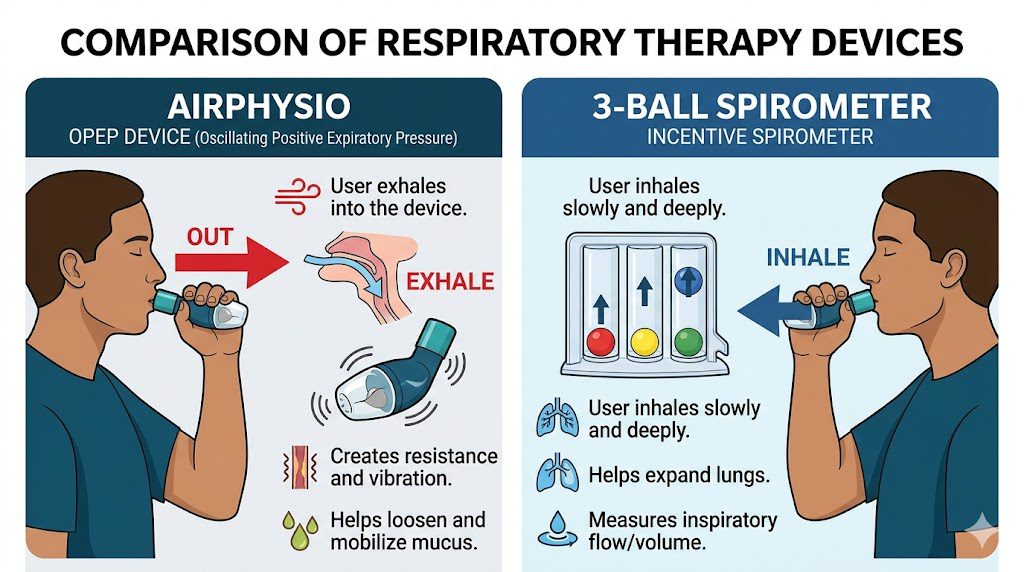
To understand why these devices are completely different, we have to look at the medical mechanics behind them.
1. The 3-Ball Spirometer: The “Lung Stretcher” (Inhale)
When you are recovering from an illness or surgery, it hurts to breathe. Because it hurts, you take shallow breaths. If you take shallow breaths for too long, the tiny air sacs at the bottom of your lungs can stick together.
A standard 3-ball spirometer is an SMI (Sustained Maximal Inspiration) device.
- How it works: You put your mouth on the tube and suck air IN slowly and deeply, trying to make the three plastic balls rise and stay levitated.
- The Goal: It forces you to take a massive, deep breath to stretch your lungs open.
2. AirPhysio: The “Mucus Shaker” (Exhale)
Now, imagine your lungs are fully open, but they are coated in thick, sticky mucus or microscopic urban smog particles (PM2.5). Stretching them with a spirometer doesn’t get the toxic gunk out. You need vibration.
AirPhysio is an OPEP (Oscillating Positive Expiratory Pressure) device.
- How it works: You blow OUT into the device. Inside, a heavy steel ball bounces up and down rapidly.
- The Goal: This bouncing creates intense vibrations that travel down your throat and into your lungs. These vibrations literally shake the sticky mucus and pollutants off the walls of your airways, allowing you to easily cough them up and spit them out.
2 devices, 2 directions: the mechanism in one table
Everything else on this page follows from one row of this table: which way the air moves. An oscillating positive expiratory pressure (OPEP) device and an incentive spirometer both attach to your mouth and both involve controlled breathing, which is why retailers shelve them together. They make you exhale against resistance while vibrating the air column, which nudges mucus off the airway walls so a cough can finish the job. An incentive spirometer does the reverse: it measures the volume of air you draw in and gives you a visual target to inhale against slowly and hold, so alveoli that collapsed under anaesthetic or bed rest reopen.
| Incentive spirometer | AirPhysio (OPEP device) | |
|---|---|---|
| Direction of breath | Inhale, slow and sustained (SMI) | Exhale, against oscillating resistance |
| Physiological target | Re-expands collapsed alveoli, restores lung volume | Mobilises retained mucus off the airway wall |
| Problem it treats | Atelectasis and shallow post-operative breathing | Retained secretions: chronic bronchitis, COPD, bronchiectasis, cystic fibrosis |
| Who puts it in your hands | A nurse or respiratory therapist at the bedside, usually issued free at discharge | You do. Direct from the manufacturer, no prescription, no clinician involved |
| Typical setting | Hospital ward, then home for the first days or weeks after surgery or trauma | Home, ongoing, once or twice daily |
| Adjustment | Inhaled volume target, marked in mL on the chamber | Swap the ball bearing (19, 20 or 22 mm) to change resistance |
| US regulatory record | Class II, 21 CFR 868.5690, product code BWF | Class II, 21 CFR 868.5665 (powered percussor), product code BYI, 510(k) K203209, cleared 15 Jan 2021 |
| Price checked 14 Aug 2026 | $10.95 (Voldyne 5000, MedexSupply), commonly issued free after surgery | $66.99 (Average Lung Capacity model, official store) |
| Does it clear mucus? | No | Yes. That is its only job |
Can I use an incentive spirometer and AirPhysio together? Yes, and after chest surgery or pneumonia the two are often used together, because reopening lung volume and shifting mucus are separate jobs, but ask the clinician managing your recovery before adding a device nobody has cleared you to use.
If you want the model range, the ball-bearing sizes and the returns terms on the AirPhysio device itself rather than the head to head, that sits in our full AirPhysio review.
🏆 Deep Dive: AirPhysio Review
What is AirPhysio?
AirPhysio is a premium, multi-award-winning OPEP device designed in Australia. It is internationally recognized and is rapidly becoming the gold standard for at-home respiratory care and daily lung hygiene.
The Pros of AirPhysio:
- It Actually Clears Mucus: It targets the root cause of chronic coughs by dislodging trapped phlegm and urban pollutants.
- Medical-Grade Build: Made from shatter-resistant polycarbonate. It is built to last for years of daily use.
- Adjustable Resistance: The device comes with different steel ball bearings. If your lungs are incredibly weak, you can use the lower resistance ball to ensure you still get the vibration therapy you need.
- Drug-Free: It uses pure physics to clear your chest, meaning no steroids, no inhalers, and no chemical side effects.
The Cons of AirPhysio:
- The Price: It is a premium medical device, so it costs significantly more than a cheap plastic 3-ball spirometer.
- Requires Cleaning: Because it processes the mucus you cough up, you must take it apart and wash it daily to keep it sanitary.
🥈 Deep Dive: Incentive Spirometer Review
What is an Incentive Spirometer (3-Ball)?
It is a cheap, disposable plastic device featuring three chambers and three colored balls, used primarily to encourage deep breathing.
The Pros of a Spirometer:
- Excellent for Lung Expansion: It is the absolute best tool for preventing lung collapse after an operation or a severe bout of pneumonia.
- Visual Feedback: The rising balls give you a clear visual goal, which is highly motivating when you are recovering.
- Very Cheap: You can buy them easily on pharmacy sites like PharmEasy for a very low cost.
The Cons of a Spirometer:
- Useless for Mucus Clearance: It does absolutely nothing to break up thick, stubborn phlegm or detoxify lungs from smog.
- Flimsy Build: They are meant to be disposable. They crack easily and are not built for years of chronic management.
sources that decide this comparison, and what each one cannot tell you
Every ranking page in this search result asserts which device works. None of them cites anything. Here is the actual evidence base for both sides, with the limitation column doing the honest work.
| Source | Year | Population | Key finding | Limitation |
|---|---|---|---|---|
| Sum SK et al. “Using an incentive spirometer reduces pulmonary complications in patients with traumatic rib fractures: a randomized controlled trial,” Trials 20:797 | 2019 | 50 adults with traumatic rib fractures (24 using an incentive spirometer, 26 controls) | Pulmonary complications in 29.2% of the spirometer group against 80.7% of controls (p=0.001). FVC improved 18.65% in the spirometer group and fell 4.85% in controls (p<0.001) | 50 patients at one hospital. Patients with COPD, asthma or an injury severity score of 16 or above were excluded. No difference in length of stay |
| do Nascimento Junior P et al. “Incentive spirometry for prevention of postoperative pulmonary complications in upper abdominal surgery,” Cochrane Database of Systematic Reviews CD006058.pub3 | 2014 | 12 studies, 1,834 participants after upper abdominal surgery | No significant benefit over no respiratory treatment or over deep-breathing exercises. Relative risk of clinical complications 0.59 (95% CI 0.30 to 1.18) | The authors rate the evidence low quality. A confidence interval crossing 1.0 means uncertainty, not proof of no effect |
| Eltorai AEM et al. “Clinical Effectiveness of Incentive Spirometry for the Prevention of Postoperative Pulmonary Complications,” Respiratory Care 63(3):347–352 | 2018 | Narrative review of the incentive spirometry literature | No clear evidence establishes a benefit in preventing postoperative pulmonary complications, and clinical practice guidelines advise against routine postoperative use | A review, not new data. It argues the trials are poor, not that the device does nothing |
| Franklin E, Anjum F. “Incentive Spirometer and Inspiratory Muscle Training,” StatPearls, NCBI Bookshelf NBK572114 | updated 27 Apr 2023 | Clinical reference for practitioners | Describes the device and its use in inspiratory muscle training to maintain or increase inhaled lung volume, prevent post-surgical lung infection and improve sputum expectoration. Inexpensive, with no known side effects | A teaching reference, not a trial. It describes intended use rather than measuring outcomes |
| Morris NR, Griffith University. “Validation of AirPhysio Oscillating Positive Expiratory Pressure Device” | report dated Feb 2020 | Bench apparatus. AirPhysio with 19, 20 and 22 mm ball bearings against the Flutter | “the AirPhysio and Flutter devices behaved similarly across a range of flow rates and tilt angles.” Oscillation frequency tended to fall above 10 L/min, lowest at 30 L/min | Commissioned by and hosted on the manufacturer’s site, not peer reviewed. No patients, no clinical outcome, and no incentive spirometer in the comparison |
| Franks LJ et al. “Comparing the Performance Characteristics of Different Positive Expiratory Pressure Devices,” Respiratory Care 64(4):434–444 | 2019 | Bench apparatus, six OPEP and PEP devices at flows of 5 to 30 L/min | Performance differs significantly by device, flow and resistance setting. Some devices deliver more pressure the harder you blow; others barely change | Mechanical measurements only, no patients. AirPhysio was not one of the six devices tested |
| US FDA 510(k) K203209, AirPhysio PEP device | cleared 15 Jan 2021 | US premarket notification record | Class II, 21 CFR 868.5665 (powered percussor), product code BYI | A 510(k) establishes substantial equivalence to an existing device. It is never a finding of effectiveness |
| 21 CFR 868.5690, Incentive spirometer (eCFR) | current | US device regulation | “a device that indicates a patient’s breathing volume or flow and that provides an incentive to the patient to improve his or her ventilation.” Class II, product code BWF | Defines the category, not any particular product’s performance |
1 finding nobody else states: the $10.95 device carries the evidence, the $66.99 one carries the marketing
Run the arithmetic before the physiology. A Voldyne 5000 volumetric incentive spirometer listed at $10.95 at a US medical supplier on 14 August 2026, and most American patients never pay even that, because the ward issues one at the bedside and it disappears into the hospital charge. The AirPhysio Average Lung Capacity model listed at $66.99 on the manufacturer’s own store the same day. That is a 6.1x price gap, direct to your door, with no clinician in the loop.
Now put the evidence next to the price. The cheap device has been through a Cochrane review of 12 trials and 1,834 patients, a 2018 Respiratory Care review, and a randomised controlled trial in rib fractures. The expensive device’s entire public evidence base is one bench report its own manufacturer commissioned in February 2020, testing it against a Flutter, with no patients in the room. Note carefully what that asymmetry means, because it cuts both ways: decades of trials found the incentive spirometer’s benefit uncertain in its main indication, while the AirPhysio’s benefit is not uncertain, it is unmeasured. Those are different states of knowledge, and the marketing on both sides collapses them into the same confident sentence.
There is a second layer, and it is the reason no product code on a box will tell you what a device does. AirPhysio was cleared as a powered percussor under 21 CFR 868.5665, product code BYI. The incentive spirometer has its own regulation, 21 CFR 868.5690, product code BWF. But the Acapella, an exhale device doing precisely AirPhysio’s job, was cleared under 868.5690, the incentive spirometer regulation (K181660, October 2019). The FDA’s taxonomy tracks predicate lineage, not the direction of the breath. Anyone using regulatory category as a shortcut for what a device does will get it backwards, which is one reason the affiliate layer keeps calling these two products rivals.
1 case where the free device is the only right answer: fractured ribs
Broken ribs make a deep breath hurt, so patients breathe shallowly, and the lung base collapses. That is a volume problem, not a mucus problem, and the numbers in Sum’s 2019 trial are the sharpest in this whole page: pulmonary complications in 29.2% of patients using an incentive spirometer against 80.7% of those who were not, with five control patients needing a chest drain and none in the spirometer group. Fifty patients is a small trial and one hospital is one hospital. It is still far more than exists for any consumer OPEP device in this situation. If you have fractured ribs, use the plastic tube they gave you.
📊 The Head-to-Head Comparison Table
Let’s look at the raw clinical data side-by-side.
| Feature | AirPhysio 🏆 | 3-Ball Spirometer |
| Primary Action | Exhale (Blowing Out) | Inhale (Sucking In) |
| Medical Purpose | Mucus Clearance & Detox | Lung Expansion |
| Best For | Asthma, Smog, Smoker’s Cough | Post-Surgery Recovery |
| Mechanism | OPEP (Vibration) | SMI (Deep Breathing) |
| Build Quality | Medical-Grade Polycarbonate | Disposable Plastic |
| Clears Phlegm? | YES | NO |
🚨 Real-World Use Cases: Which Device Do You Reach For?
It is easy to look at plastic medical devices on a screen and think, “I’ll just drink some hot tea and wait for this cough to pass.” But real life is messy, and chronic lung issues do not cure themselves.
Here are four common real-world scenarios. See which one describes your life, and discover exactly which device you need to fix it.
Use Case 1: The Urban Smog & Pollution Morning
- The Scenario: You live in a dense city with terrible Air Quality (AQI). You wake up, and your chest feels tight and heavy. You have a dry, scratchy cough, but nothing comes up. You feel like you are breathing through a wet blanket because of the invisible PM2.5 particulate matter trapped in your airways.
- The Mistake: Using a 3-ball spirometer here will only force you to suck more stagnant air into lungs that are already coated in microscopic urban dust.
- The Winner: AirPhysio. You need daily lung hygiene. Just like you brush your teeth, you use AirPhysio for 5 minutes every morning. The intense vibrations shake the toxic smog particles and dirty mucus off your airway walls so you can spit them into a tissue and breathe freely for the rest of the day.
Use Case 2: The “Morning Hack” (Smoker’s Cough)
- The Scenario: You are a current or former smoker. Every morning begins with a violent, exhausting 10-minute coughing fit as your body tries to expel the thick, brown phlegm and tar that settled in your chest overnight.
- The Mistake: Stretching your lungs with a spirometer will not remove tar. The sticky residue is glued to your bronchioles.
- The Winner: AirPhysio. AirPhysio acts like a physical jackhammer for your lungs. The heavy steel ball creates an oscillating back-pressure that physically breaks the bond between the sticky tar and your lung tissue. It turns a 10-minute painful coughing fit into a controlled, 2-minute clearance routine.
Use Case 3: The Post-Surgery Fear
- The Scenario: You just had abdominal surgery, a C-section, or a severe bout of pneumonia. You are lying in bed. Every time you breathe deeply or laugh, your stitches burn. Because of the pain, you are taking tiny, shallow breaths, which puts you at massive risk for a collapsed lung (atelectasis).
- The Mistake: Using AirPhysio right now is a bad idea. AirPhysio is designed to make you cough aggressively to expel mucus. If you just had stomach surgery, coughing aggressively is the last thing you want to do.
- The Winner: 3-Ball Spirometer. This is exactly what the spirometer was built for. You don’t need to cough; you need to gently and slowly stretch your lung sacs back open. By focusing on levitating the plastic balls, you safely train your lungs to expand without violently disrupting your surgical incisions.
Use Case 4: The Asthmatic’s “Mucus Plug”
- The Scenario: You are managing chronic asthma or bronchitis. You take a puff of your expensive rescue inhaler, but you still feel tight. Why? Because while the medicine relaxed the muscles around your airway, the actual tube is still physically blocked by a thick, stubborn “plug” of sticky mucus. The air simply cannot get through.
- The Mistake: A 3-ball spirometer requires deep, sustained inhales—something an asthmatic suffering from an airway obstruction physically cannot do without triggering a coughing spasm.
- The Winner: AirPhysio. You must remove the blockage before your lungs can function. You exhale into the AirPhysio, the flutter valve vibrates the mucus plug loose, you cough it out, and then your airways are clear enough for your inhaler medicine to actually penetrate deeply into your lungs.
Use Case 5: The “Bad Air Quality” Morning
You wake up and the AQI (Air Quality Index) is off the charts. Your chest feels incredibly tight, and you have a dry, unproductive cough. Solution: You use the AirPhysio for 5 minutes. The vibrations loosen the microscopic particles trapped in your mucus, allowing you to cough them up and breathe freely for the rest of the day.
Use Case 6: The Bedridden Parent
Your elderly parent has been in bed with a severe fever for a week. Their breathing is shallow. Solution: You purchase a 3-ball spirometer from PharmEasy. Having them practice keeping the balls elevated ensures their lungs stay expanded, preventing the onset of secondary pneumonia.
🩺 Which Device is Best for YOUR Specific Condition?
Stop guessing. Here is exactly what you need based on your specific health profile.
For Urban Smog, Pollution & Smoker’s Cough
Winner: AirPhysio.
If you live in a highly polluted city and wake up with a heavy chest, stretching your lungs won’t do it. You need the aggressive, vibrating oscillation of AirPhysio to shake that toxic sludge loose. It is daily hygiene for your lungs.
For Asthma & Bronchitis
Winner: AirPhysio.
These conditions are categorized by excessive mucus production and chronic airway obstruction. A 3-ball spirometer will just pull air into clogged lungs. AirPhysio vibrates the obstruction loose, making it the mandatory choice.
For Recovering from Surgery
Winner: Spirometer.
If you are afraid to take a deep breath because you’ve been bedridden, the spirometer is your best friend. It will gently coax your lungs back to full capacity.
Can I Use Both?
Yes! In fact, for severe post-viral recovery, doctors often recommend using both. You use the AirPhysio first to shake the mucus loose and cough it out. Then, once your airways are clear, you use the Spirometer to stretch your newly cleaned lungs back to their full, healthy capacity.
💡 The Final Verdict: Stop Suffering in Silence
When you compare AirPhysio vs Spirometer, you aren’t really comparing two competing products. You are looking at two entirely different medical tools.
If you need to stretch your lungs, grab a basic 3-ball spirometer.
But if you are exhausted from coughing, wheezing, and feeling like you can’t get a full breath because of stubborn phlegm, smog, or smoking—a 3-ball spirometer will not save you.
You need the dedicated, vibrating power of an OPEP device.
AirPhysio is the undisputed champion of at-home mucus clearance. Stop letting chest congestion dictate what you can and cannot do.
Ready to finally clear your chest and breathe easy again?
✅ Claim Your AirPhysio from the Official Safe Store Here
✅ Need Lung Expansion? View Spirometers on PharmEasy
Frequently Asked Question
Here are the most common questions users ask when deciding between an OPEP device and a standard lung exerciser.
Can a 3-ball spirometer clear mucus and phlegm?
No. This is the most common misconception. A 3-ball spirometer is strictly for expanding your lungs by inhaling. It does not create the vibrations necessary to break up and clear sticky mucus. For mucus clearance, you need an OPEP device like AirPhysio.
Does AirPhysio help clear pollution and urban smog from my lungs?
Yes. In areas with hazardous AQI levels and heavy PM2.5 pollution, microscopic toxins get trapped in the mucus lining of your airways. AirPhysio’s vibrations shake this contaminated mucus loose so you can cough it out, providing essential daily lung hygiene.
Why is it so hard to raise the 3rd ball on my spirometer?
The third chamber of a spirometer requires a massive amount of sustained inspiratory volume. If you are recovering from a severe illness, surgery, or simply have a smaller frame, it is entirely normal to only raise one or two balls. Do not force it; lung expansion takes time.
Do I use AirPhysio by breathing in or breathing out?
You must breathe OUT (exhale) into the AirPhysio. If you try to inhale through it, it will not work.
How often should I use AirPhysio vs a spirometer?
For AirPhysio, most users find relief using it for 5 to 10 minutes, 1 to 3 times a day (especially in the morning to clear overnight congestion). For a spirometer, doctors typically recommend using it every 1 to 2 hours while awake during post-surgery recovery.
Can I wash my 3-ball spirometer?
Yes, but you must be careful. You can detach the corrugated breathing tube and mouthpiece to wash them with warm, soapy water. However, getting the main chamber (with the balls) wet can cause the balls to stick to the plastic. AirPhysio, on the other hand, is designed to be fully disassembled and washed daily.
Are there fake AirPhysio devices sold online?
Yes, highly dangerous counterfeits exist on major online marketplaces. They often use cheap plastic that shatters or lack the precision-weighted steel ball, making them useless for therapy. You should only purchase AirPhysio directly from the official manufacturer.
Does AirPhysio replace my asthma inhaler?
Absolutely not. AirPhysio is a supplementary physical therapy device used to clear mucus. It does not contain medication and will not stop an active asthma attack or bronchospasm. Always use your rescue inhaler as prescribed by your doctor.
Is AirPhysio safe for children?
Yes, there is a specific AirPhysio Children’s Edition designed for kids who suffer from asthma or frequent chest colds. It utilizes a lighter steel ball bearing because children do not have the same expiratory lung force as adults.
Can I use a spirometer and AirPhysio on the same day?
Yes! For comprehensive lung rehabilitation, they work brilliantly together. You would use the AirPhysio first to break up and cough out the obstructive mucus. Once your airways are clear, you would use the 3-ball spirometer to stretch your clean lungs to their maximum capacity.
My physiotherapist said PEP therapy. Is that the same as incentive spirometry?
No, and the two run in opposite directions. PEP and OPEP therapy are exhale techniques: you blow against resistance, which holds small airways open long enough to shift mucus. Incentive spirometry is an inhale technique that restores lung volume. A physiotherapist prescribing PEP is treating secretions. A nurse handing you an incentive spirometer after surgery is treating shallow breathing.
The hospital just called it a spirometer. Is a spirometer the same as an incentive spirometer?
Not quite. A diagnostic spirometer measures how much air you can move and how fast, and a technician uses it to test lung function. An incentive spirometer treats rather than tests: it gives you a visual volume target to inhale against, so collapsed alveoli reopen. Same root word, opposite purposes, and only one of them is sent home with you.
My discharge sheet said respirometer. Is a respirometer the same as a spirometer?
On a hospital ward the two words often point at the same handheld device, and staff use respirometer loosely for the volume-measuring one. Strictly, a respirometer measures gas exchange and belongs in a laboratory. If your paperwork says respirometer and you were handed a plastic tube with a piston inside it, you have an incentive spirometer.
They gave me one free at the hospital. Why would I pay $66.99 for an AirPhysio?
Only if your problem is mucus. The free device reopens lung volume after surgery and is the right tool for that job, for the week or two you need it. An AirPhysio does the opposite thing. It earns its price only when retained secretions are the reason you keep coughing, which is a chronic problem rather than a post-operative one.
Is the AirPhysio device FDA approved?
AirPhysio is 510(k) cleared rather than FDA approved, and the distinction matters. The FDA cleared it in January 2021 under 21 CFR 868.5665 as substantially equivalent to an existing device, clearance number K203209. That permits marketing. It is not a finding of effectiveness, and no clinical trial was required. Incentive spirometers clear the same way, under 868.5690.
Sources and references
- Sum SK et al. “Using an incentive spirometer reduces pulmonary complications in patients with traumatic rib fractures: a randomized controlled trial.” Trials, 2019;20:797. DOI 10.1186/s13063-019-3943-x
- do Nascimento Junior P et al. “Incentive spirometry for prevention of postoperative pulmonary complications in upper abdominal surgery.” Cochrane Database of Systematic Reviews, 2014, CD006058.pub3
- Eltorai AEM, Szabo AL, Antoci V, Ventetuolo CE, Elias JA, Daniels AH, Hess DR. “Clinical Effectiveness of Incentive Spirometry for the Prevention of Postoperative Pulmonary Complications.” Respiratory Care, 2018;63(3):347–352
- Franklin E, Anjum F. “Incentive Spirometer and Inspiratory Muscle Training.” StatPearls, NCBI Bookshelf NBK572114, updated 27 April 2023
- Morris NR, School of Allied Health Sciences and Menzies Health Institute Queensland, Griffith University. “Validation of AirPhysio Oscillating Positive Expiratory Pressure Device”, report hosted by the manufacturer, dated February 2020
- Franks LJ, Walsh JR, Hall K, Jacuinde G, Yerkovich S, Morris NR. “Comparing the Performance Characteristics of Different Positive Expiratory Pressure Devices.” Respiratory Care, 2019;64(4):434–444
- US FDA 510(k) K203209, AirPhysio Positive Expiratory Pressure Device, decision 15 January 2021
- 21 CFR 868.5690, Incentive spirometer, eCFR, accessed 14 August 2026
- Voldyne 5000 incentive spirometer supplier listing, MedexSupply, price captured 14 August 2026
- AirPhysio official store and returns and refunds policy, prices and terms captured 14 August 2026

