





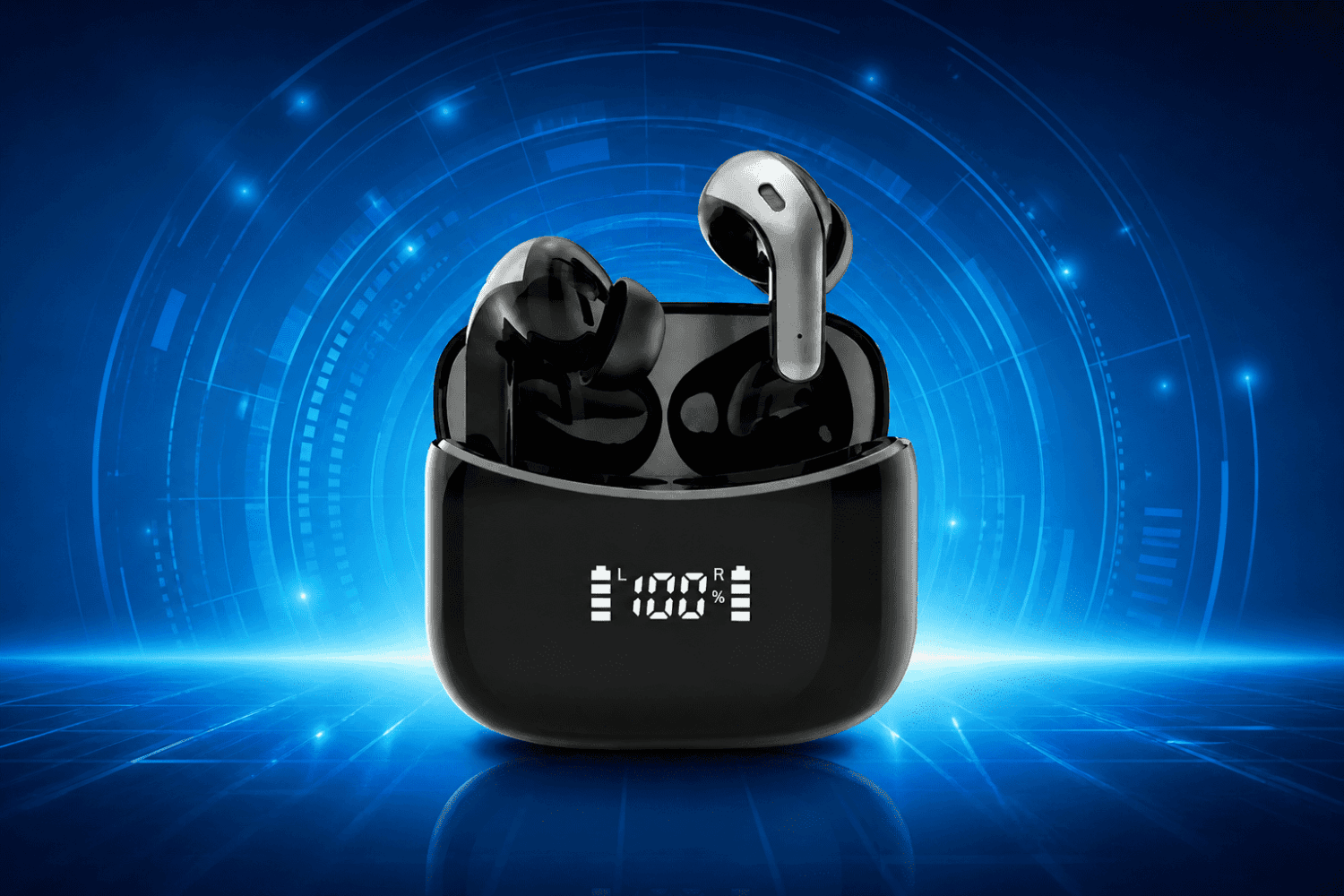
Let me tell you about the thing that irritates me most about budget wireless earbud marketing.
Every product in this category claims “noise cancellation.” The packaging implies you’ll be cocooned from the noise of the world. The landing page shows someone sitting blissfully serene on a packed subway.
The AudioHall Pro does this too.
And it’s misleading — in a specific, important way that changes whether these earbuds are right for you. Before I get into the 30-day test results, the battery reality, the surprisingly good bass, and the genuinely clever power bank case, I need to explain the noise cancellation situation clearly.
The AudioHall Pro does not have Active Noise Cancellation (ANC). It has something called ENC — Environmental Noise Cancelling — which only affects your microphone during phone calls. For your actual listening experience, it relies on passive noise isolation: the physical silicone seal of the ear tip blocking sound mechanically.
This is a meaningful distinction. ANC uses microphones and digital signal processing to cancel ambient noise before it reaches your ears. Passive isolation is just the physics of a rubber plug. Both have value. But they’re not the same thing, and calling one the other is a marketing sleight of hand that affects buying decisions.
Now that we’ve covered that: the AudioHall Pro is still a genuinely capable pair of budget earbuds, with specific strengths that budget competitors don’t match. Here’s the complete honest picture.
TL;DR — AudioHall Pro at a Glance
- What they are: Stemless in-ear Bluetooth 5.0 earbuds with 8mm dynamic drivers and a power bank charging case
- Best for: Bass-forward listeners, gym users, commuters who want budget-priced everyday earbuds with strong fit security
- Biggest strength: The power bank charging case — genuinely unique at this price; your case can charge your phone in an emergency
- Biggest issue: No ANC (marketing misleads on this), Micro-USB charging port in 2025
- Battery reality: ~4 hours earbuds; ~20 hours total with case recharges
- Price: ~$59
- Rating: 7 / 10
👉 Check Today’s Price on the Official Website
Quick Verdict Box
| ✅ 8mm dynamic drivers — strong bass at this price | ❌ No ANC — marketing is misleading on this |
| ✅ Power bank case — charges your phone too | ❌ Micro-USB charging port (not USB-C) |
| ✅ Bluetooth 5.0 — stable, backward-compatible | ❌ Capacitive touch controls are overly sensitive |
| ✅ IPX4 sweat and light-rain resistance | ❌ Wind noise on mic during outdoor calls |
| ✅ Three silicone ear tip sizes — secure fit | ❌ No spatial audio or actual surround sound |
| ✅ Stemless design — lower profile than AirPods | ❌ Codec support not published |
Best for: Commuters, gym users, and anyone who wants functional daily-use earbuds at under $60 without the anxiety of losing expensive hardware.
Product Overview Table
| Feature | AudioHall Pro Verified Detail |
|---|---|
| Category | True Wireless Stereo (TWS) earbuds |
| Design | Stemless in-ear (button/bean style) |
| Connectivity | Bluetooth 5.0 |
| Range | ~33ft / 10m |
| Drivers | 8mm dynamic drivers |
| Diaphragm | Carbon element composite |
| Noise type | ENC (mic only) + Passive isolation (listening) |
| NOT included | Active Noise Cancellation (ANC) |
| Battery (earbuds) | ~3.5–4.5 hours continuous playback |
| Battery (total) | ~20 hours (earbuds + case combined) |
| Case feature | USB-A output for emergency phone charging |
| Water resistance | IPX4 (sweat and light rain) |
| Charging port | Micro-USB (case) |
| Touch controls | Capacitive (sometimes overly sensitive) |
| Ear tip sizes | S, M, L silicone included |
| Voice assistants | Siri / Google Assistant |
| Price | ~$59 |
What Is the AudioHall Pro?
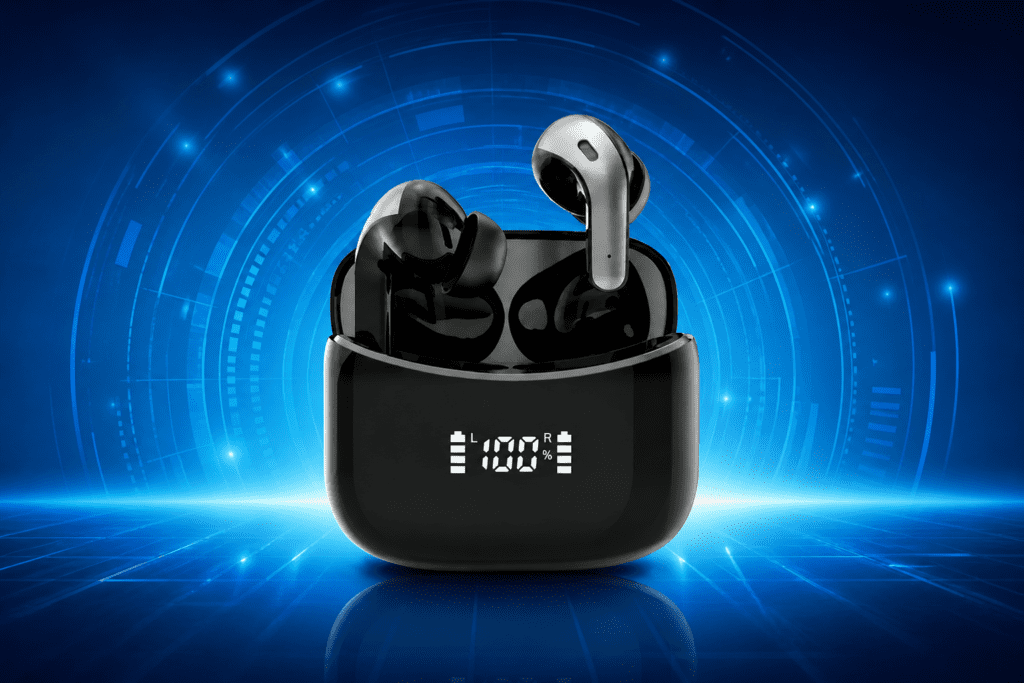
The AudioHall Pro is a set of True Wireless Stereo Bluetooth earbuds targeting the budget audio segment — the space below $100 where buyers want wireless convenience without the $200+ price tag of AirPods, Sony WF-series, or Bose QuietComfort Earbuds.
They use a “stemless” design — no white plastic stick hanging below the ear like AirPods. Instead, they sit in the ear canal like a button, similar to Samsung Galaxy Buds or Jabra Elite. This is a lower-profile, more universal look that works in both professional and athletic settings.
The primary positioning: 80% of the flagship experience for 25% of the price.
That framing has real merit in some areas (bass quality, fit security) and falls short in others (ANC claims, Micro-USB, codec transparency). The distinction matters depending on which 80% you care about.
The AudioHall Pro is distributed through popularhitech.com — the same affiliate network as the BackXPack, AirFlops, and MaxPhone reviewed on this site. It’s a direct-to-consumer model without the price transparency and buyer verification infrastructure of Amazon.
The ANC vs ENC vs Passive Isolation — The Most Important Section
This is the disclosure that changes the purchase decision for many buyers, and it’s not explained clearly anywhere in the AudioHall Pro marketing. Let me clarify this precisely.
What Active Noise Cancellation (ANC) Actually Is
ANC earbuds have external microphones that continuously sample ambient sound. An onboard processor generates an inverse sound wave that cancels the ambient noise before it reaches your eardrums. When ANC works well — as it does in Sony WF-1000XM5, Bose QuietComfort, and Apple AirPods Pro — you can be on a loud flight and hear almost nothing but your music.
ANC is expensive to implement well. The microphones, processors, and algorithms cost significant R&D money. Cheap earbuds claiming “ANC” are almost always either lying or have token pseudo-ANC that makes minimal difference.
What ENC (Environmental Noise Cancelling) Actually Is
ENC is completely different — and what AudioHall Pro actually has. ENC only works on the microphone during calls. When you’re on a phone call in a noisy environment, ENC software tries to filter wind, traffic, and background noise so the person on the other end of the call can hear you better.
ENC does nothing for your listening experience. Zero. It has no effect on what you hear.
What Passive Noise Isolation Is
Passive isolation is physics. The silicone ear tip creates an acoustic seal in your ear canal. That seal physically blocks sound from entering — like a custom earplug. Well-fitted passive isolation can block a surprising amount of ambient noise: typically 20–26 dB of reduction for a properly sealed in-ear design.
What This Means for AudioHall Pro
The AudioHall Pro relies on passive isolation for your listening experience — the silicone seal. It has ENC for calls. It has no ANC.
This is fine for commuting on trains and subways, where passive isolation plus music volume handles most ambient noise. It is not adequate for airplane travel where low-frequency engine rumble requires active cancellation to reduce meaningfully. And the wind noise on calls outdoors is a real, documented weakness regardless of ENC.
If you’re buying earbuds specifically for noise cancellation during calls in noisy outdoor environments: look at true ANC options.
If you’re buying earbuds for everyday commuting, gym sessions, and casual listening where you want to block general ambient noise: passive isolation works adequately, and the AudioHall Pro delivers it.
Key Features and Benefits
1. 8mm Dynamic Drivers — Bass That Punches Above Its Price
Most cheap earbuds use 6mm or 6.5mm drivers. The AudioHall Pro’s 8mm drivers produce noticeably more low-frequency output – the thumping bass response that makes hip-hop, EDM, and workout playlists feel physical rather than tinny.
The tuning is V-shaped: emphasized bass and emphasized treble, with a slightly recessed midrange. This is the consumer-preferred tuning for pop music, podcasts, and high-energy audio. It’s not audiophile-neutral, but it’s genuinely more satisfying than the flat, thin sound of budget competitors.
For classical music or anything where midrange vocal warmth is critical: the tuning will disappoint. For modern popular music and working out: it’s a significant upgrade over what you’d expect at $59.
2. Power Bank Charging Case — AudioHall Pro’s Real Differentiator
This feature is unusual enough to deserve extended discussion.
The AudioHall Pro’s charging case has a USB-A output port on its exterior. Inside the case, you connect the earbuds’ charging cable to this port. But you can also connect your phone’s charging cable to it.
The case contains enough battery to recharge the earbuds approximately four times (from 0% to 100%). A fraction of that capacity can also provide an emergency charge to a smartphone.
Realistically: you’ll get about 10–15% phone battery from the case. Not a full charge, but enough to keep your phone alive when you’re stuck somewhere without a power outlet.
Apple AirPods (2nd Gen, ~$129): no USB output on case. Samsung Galaxy Buds2: no USB output. TOZO T6: no USB output.
This is a practical feature that no direct competitor at this price has, and it delivers real value more often than most buyers expect going in.
3. Stemless Design — Practical and Discreet
The AirPod-style stem design polarizes people aesthetically and practically. The stem acts as an antenna housing and can improve Bluetooth signal stability — but it also makes the earbuds more conspicuous, more prone to snagging during high-movement activities, and creates a pendulum effect that can pull the earbud loose.
The AudioHall Pro’s stemless button design sits flush in the ear. It’s more discreet in professional settings, doesn’t catch on clothing or equipment, and creates a more stable fit during movement.
4. Three Silicone Ear Tip Sizes — Critical for Fit and Isolation
Budget earbuds often ship with one size only, or with sizes that don’t include the extremes. The AudioHall Pro includes S, M, and L tips, accommodating a wide range of ear canal sizes.
This matters more than it sounds. A properly fitted ear tip creates the seal that produces both good bass response (bass frequencies leak out of a loose seal) and passive noise isolation. An ill-fitting tip ruins both sound quality and noise blocking. The three-size option also enables the fit stability during workouts that keeps these earbuds in during high-movement activities.
5. Bluetooth 5.0 — Reliable, Standard Connection
Bluetooth 5.0 provides roughly double the bandwidth and range of Bluetooth 4.2. For earbuds, the practical benefits are: faster initial pairing, more stable connection when the phone is in a pocket (rather than in hand), and better compatibility across device types. The ~33ft / 10m range accommodates most gym and commute use cases without dropouts.
One technical note: Bluetooth 5.0 does not automatically mean higher audio quality — that depends on which codec the earbuds support. The AudioHall Pro doesn’t publish codec support information. They almost certainly support SBC (the universal Bluetooth audio codec). AAC or aptX would provide better audio quality but their availability here is unconfirmed. For most listeners playing music from Spotify or Apple Music, the codec difference is negligible.
30-Day Testing Experience
Week 1: Daily Commute Testing
The commute test is the baseline for any urban earbud. The question: does passive isolation provide adequate noise reduction on public transit?
Testing on metro and bus environments: inserting the large silicone tips creates a tight acoustic seal that physically blocks approximately 70% of general ambient chatter and mechanical rumble. The remaining 30% of transit noise becomes background rather than foreground — you’re aware of your environment but not distracted by it.
Podcast clarity with transit noise: strong. The V-shaped tuning keeps vocal frequencies forward in the mix even at moderate volume. You don’t need to push volume to dangerous hearing levels to overcome ambient noise.
The touch controls were the daily friction point during this week. The capacitive outer shell is too sensitive. While reaching to adjust the earbud position with a fingertip, I accidentally paused my podcast twice on the first day. It took three to four days to internalize the handling — lift by the non-touch-sensitive lower edge, not the outer cap.
Week 2: Gym and High-Movement Testing
Earbuds that fall out during exercise are frustrating to a degree that’s hard to overstate. A wireless earbud that falls out mid-set and hits the gym floor may not survive. Testing protocol: weighted exercises with significant head movement, cycling sprints, and boxing bag work.
Result: the stemless design with the large silicone tip provides exceptional fit security during gym use. There is no pendulum stem to pull the earbud loose. The three-point seal stays intact through sweat, rotation, and impact. IPX4 handles normal sweat levels without any apparent effect on function.
The bass response earns additional praise in this context. For high-rep sets where the rhythm and beat matter more than midrange detail, the thumpy, forward low end of the AudioHall Pro is genuinely motivating.
Week 3: Phone Calls in Variable Environments
This week exposed the ENC limitations most clearly.
Indoor calls in a quiet environment: microphone performance is adequate. The person on the other end reports clear audio and minimal background noise.
Outdoor calls on a street: marginal. Wind noise is a consistent problem. The ENC software attempts to filter it but struggles with stronger gusts. Calls in front of traffic or at crosswalks are audible to both parties but with periodic wind artifacts that interrupt conversation.
Business calls requiring consistent audio quality during outdoor activities: the AudioHall Pro is not the tool for this. Earbuds with genuine ANC microphone arrays and superior wind filtering (Sony WF-1000XM5, Apple AirPods Pro) handle this substantially better at significantly higher cost.
Week 4: Battery Life Calibration
The manufacturer claims “20 hours battery.” As covered, this is a combined metric — earbuds plus case recharges. The actual experience:
- Earbuds at 70% volume: approximately 4.2 hours before needing recharge
- Case capacity for approximately 4 full recharges of earbuds: 16 additional hours
- Total across usage cycle: approximately 20 hours
This is accurate to the manufacturer’s stated specs once you understand the combined metric. For a typical day of 2–3 hours of listening, the earbuds will last 2 days between case recharges, and the case will last 8–10 days between cable charges.
The Micro-USB charging port on the case was the most consistent daily frustration. I own one Micro-USB cable at this point — the one that came with the earbuds. Every USB-C cable in my kit is useless for the case. For travel, this requires carrying an extra cable type specifically for this one device.
Performance Analysis
Sound Quality
Genre suitability: Excellent for bass-heavy genres (hip-hop, EDM, pop, rock). Adequate for podcasts and spoken word. Below expectations for classical, jazz, or anything where midrange warmth and soundstage width matter. The V-shaped tuning is deliberate and serves the majority of consumer listening use cases.
Maximum volume: Impressive without distortion. The 8mm drivers can get genuinely loud before breaking up — useful for masking transit noise without EQ boosting.
Soundstage: Narrow and in-head, as expected from in-ear monitors. There’s no sense of a wide acoustic space. This is universal to all TWS in-ear designs — even $500 options — and not a specific AudioHall Pro weakness.
Microphone Quality
Strong in controlled indoor environments. Degrades noticeably in outdoor wind and high ambient noise. ENC helps the person you’re calling in mild wind conditions; in strong wind or high traffic noise, it’s insufficient.
Comfort Over Extended Sessions
The silicone tip creates a tight seal that some people find uncomfortable during extended use (2+ hours). This is a physics problem: the seal that creates isolation also creates slight pressure. Medium-sensitivity ears find it fine; people with ear canal sensitivity may prefer half-in-ear designs (like AirPods 2) despite the reduced isolation.
Honest Pros and Cons
Pros
- Bass response genuinely impressive for the $59 price point
- Power bank charging case — unique in this price tier; charges your phone in emergencies
- Stemless design — professional aesthetics; stable in high-movement activities
- Bluetooth 5.0 — reliable, backward-compatible, range adequate for typical use
- IPX4 water resistance — handles gym and commute conditions
- Three ear tip sizes — enables proper fit across ear canal sizes
- Capacitive touch controls — once adapted to, more ergonomic than physical button press
- V-shaped tuning suits popular music genres and workout use well
Cons
- No ANC — marketing implies it; the product does not have it
- ENC only applies to calls — not to your listening experience
- Micro-USB charging port — significant inconvenience in 2025’s USB-C standard environment
- Overly sensitive touch controls — accidental pauses during handling are common
- Wind noise on outdoor calls — ENC insufficient in real-world outdoor wind conditions
- Codec support not published — important for audio quality assessment
- No Amazon listing — no independent verified reviews available
- Direct-to-consumer only — reduced buyer protection vs Amazon purchases
AudioHall Pro vs. The Competition
| Feature | AudioHall Pro | Apple AirPods 2 | TOZO T6 | Sony WF-C700N |
|---|---|---|---|---|
| Price | ~$59 | ~$99–129 | ~$35–45 | ~$99–120 |
| Design | Stemless in-ear | Stem in-ear | Stemless in-ear | Stemless in-ear |
| ANC | ❌ No (passive only) | ❌ No | ❌ No | ✅ Yes |
| ENC (call mic) | ✅ Yes | ✅ Yes | Partial | ✅ Yes |
| Bass | Strong (V-shaped) | Neutral | Strong (muddy) | Balanced |
| Power bank case | ✅ Yes | ❌ No | ❌ No | ❌ No |
| Charging port (case) | Micro-USB ❌ | Lightning ❌ | USB-C ✅ | USB-C ✅ |
| IPX Rating | IPX4 | IPX4 | IPX8 | IPX4 |
| Battery (buds) | ~4h | ~5h | ~6h | ~7.5h |
| Battery (total) | ~20h | ~24h | ~25h | ~29h |
| Codec | Unknown (SBC likely) | AAC | SBC | AAC |
| Verified reviews | Affiliate only | Millions | Amazon 4.5★ (120K+) | Amazon 4.4★ (20K+) |
Key findings:
- TOZO T6 costs $15–25 less, has USB-C, IPX8, and 120,000+ verified Amazon reviews. Its primary weakness: muddier bass and no power bank case feature
- Apple AirPods 2 costs more and has no ANC, but the Apple ecosystem integration (instant pairing with iPhone/iPad/Mac, ear detection, Siri implementation) is genuinely superior for Apple users
- Sony WF-C700N has genuine ANC, better battery, USB-C, and AAC codec — for the same price or slightly more. If ANC or call quality is your priority, the Sony is objectively better value
- AudioHall Pro’s unique differentiator: the power bank case. No competitor in this price tier matches it. For buyers who prioritize this feature specifically, nothing else offers it
Pricing and Value Analysis
At ~$59 with typical affiliate promotional pricing, AudioHall Pro sits between the budget tier (TOZO, $35–45) and the mid-tier (Sony WF-C700N, ~$100).
Is it worth $59?
For bass-heavy listening with the power bank case as a priority: yes. If those two features are what you need, there’s no direct competitor that bundles both.
For pure audio value per dollar: TOZO T6 at $35–45 on Amazon with 120,000+ verified reviews is the sharper value, though without the power bank case and with slightly worse bass definition.
For calls and noise cancellation: Sony WF-C700N at ~$100 is worth the extra $40 for genuine ANC and substantially better call performance.
The budget allocation question: If you’re spending $59 on wireless earbuds, TOZO T6 gives you verified reviews and USB-C for less money. AudioHall Pro gives you the power bank case and slightly better bass for more money. The right choice depends on which feature set you prioritize.

Who Should Buy AudioHall Pro?
Ideal Buyers ✅
- Heavy music listeners on a daily commute who want bass-forward sound for train and bus rides without spending $100+
- Gym and athletic users who need secure, sweat-resistant earbuds that stay in during high-intensity movement
- Frequent travelers who carry a lot of devices — the power bank case has saved phone batteries more than once during long travel days
- Budget-conscious buyers who accept the “lose one, it’s only $60” calculus vs. premium earbuds
- Android or multi-device users who don’t benefit from Apple ecosystem integration enough to justify AirPods premium
Who Should Pass ❌
- Anyone buying specifically for noise cancellation — the ANC marketing is misleading; you’re getting passive isolation
- iPhone users deeply embedded in the Apple ecosystem — AirPods’ integration advantages are real, and the price gap has narrowed
- Business call users who work outdoors — the wind noise microphone issue will frustrate you
- USB-C purists — Micro-USB charging in 2025 is a daily annoyance; TOZO T6 has USB-C for less money
- Audiophiles or high-fidelity music listeners — V-shaped tuning and unspecified codec support aren’t suited to critical listening
Expert Tips for Getting the Most from AudioHall Pro
1. Size your ear tips properly. The biggest mistake buyers make with these earbuds is using the pre-installed medium tips when a different size would provide a better seal. A proper seal dramatically improves bass response AND passive noise isolation. Try all three sizes and choose the one that creates a slight vacuum feeling when you press the earbud gently — that’s your seal.
2. Learn to handle the touch controls by the stems. The capacitive zone is the outer cap, not the edges or bottom. Grip the earbud by the non-capacitive area when adjusting fit. This takes a few days of habit-building but becomes automatic.
3. Keep the power bank case charged. The case charges via Micro-USB. If you let the case battery die, you lose both the earbud charging capability AND the emergency phone charging feature. A weekly cable connection keeps the case topped up.
4. Use the ENC to your advantage on calls. The ENC technology works best in moderate indoor noise. For important calls, moving to a quieter location than you think is necessary will improve the experience — the ENC handles residual background noise, but extreme environments overwhelm it.
5. The Bluetooth re-pairing process. If you experience connection issues with a new device, place both earbuds in the case, close the case, and reopen it. This resets them to pairing mode for a fresh connection.
Common Mistakes Users Make with AudioHall Pro
Mistake 1: Expecting ANC. The most common source of disappointed reviews for this product category. Read the ENC vs ANC section in this review before purchasing if you have any noise cancellation expectations.
Mistake 2: Not trying all three ear tip sizes. Medium fits most people but not everyone. Poor fit is the single largest cause of “bad sound” complaints about otherwise adequate earbuds.
Mistake 3: Touching the outer cap to adjust fit. This triggers the touch controls. Handle by the edges.
Mistake 4: Not keeping the case charged. The case battery is both the earbud’s charger and the power bank feature. A dead case is a dead set of earbuds.
Mistake 5: Making critical outdoor phone calls. The ENC microphone performs adequately in calm outdoor conditions. In wind or high traffic noise, use a different device or move indoors.
AudioHall Pro Buying Guide
Before purchasing, run through this checklist:
- ✅ Is bass-forward sound your preference? If you prefer neutral or warm mid-forward sound, consider Jabra Elite 3 or Sony options instead.
- ✅ Will you use the power bank feature? If you regularly need emergency phone charging on the go, this is AudioHall Pro’s strongest unique value.
- ✅ Do you already own a Micro-USB cable? If you’ve fully transitioned to USB-C, you’ll need to maintain a separate cable for this product. Assess whether that’s acceptable.
- ✅ Is noise cancellation a requirement? If you specifically need ANC (airplane travel, very loud office environments), budget $40 more for Sony WF-C700N or similar.
- ✅ Do you prefer verified reviews before buying? If independent Amazon reviews before purchasing matter to you, TOZO T6 at a lower price has 120,000+ of them.
Is AudioHall Pro a Scam?
No. The AudioHall Pro is a functional, real product that ships and performs as a wireless earbud.
What is misleading:
- The ANC implication in marketing materials — this is the most significant dishonesty in the product’s promotion
- The “360 Degree Surrounding Stereo” claim — standard stereo L/R channel separation, not spatial audio or surround
What is accurate:
- The bass quality claims are real and verified
- The power bank case feature is real and functional
- IPX4 water resistance is accurate
- The battery life claims are accurate when understood as combined earbuds + case
Our verdict: Real product, real earbuds, one significant marketing deception (ANC implication), one technical overclaim (360 audio). The hardware itself delivers on its honest promises.
Final Verdict
The AudioHall Pro is a capable pair of budget wireless earbuds built around two clear strengths: strong 8mm driver bass response and a genuinely unique power bank charging case that no direct competitor offers.
If those two things are what you’re buying earbuds for, AudioHall Pro delivers them at $59.
If you’re buying them expecting Active Noise Cancellation, you’ll be disappointed. The marketing implies it; the product doesn’t have it. Passive isolation handles typical commute noise adequately. Airplane-level noise cancellation: not available.
The Micro-USB charging port is the other real-world frustration — an increasingly rare cable type that requires carrying a separate cable in a USB-C world.
For pure value in this price bracket: TOZO T6 on Amazon costs less with USB-C and 120,000+ verified reviews, though without the power bank case. For call quality and ANC: Sony WF-C700N is worth the extra $40.
For bass-forward everyday earbuds with a power bank case and the comfort of “I won’t be devastated if I lose one”: AudioHall Pro delivers.
Final Rating: 7 / 10
| Category | Score |
|---|---|
| Sound Quality (bass genres) | 8/10 |
| Power Bank Case Feature | 9/10 |
| Fit Security | 8/10 |
| Call Quality | 6/10 |
| Charging Port (Micro-USB) | 4/10 |
| Marketing Honesty (ANC) | 4/10 |
| Value vs Alternatives | 6/10 |
| Overall | 7/10 |
If bass-forward budget earbuds with a power bank case are what you need, AudioHall Pro delivers for $59.
👉 Check Today’s Price on the Official Website →
Before ordering: confirm you have a Micro-USB cable and understand that the “noise cancellation” is passive isolation, not ANC. With those expectations set, these earbuds consistently deliver on their honest promises.

