






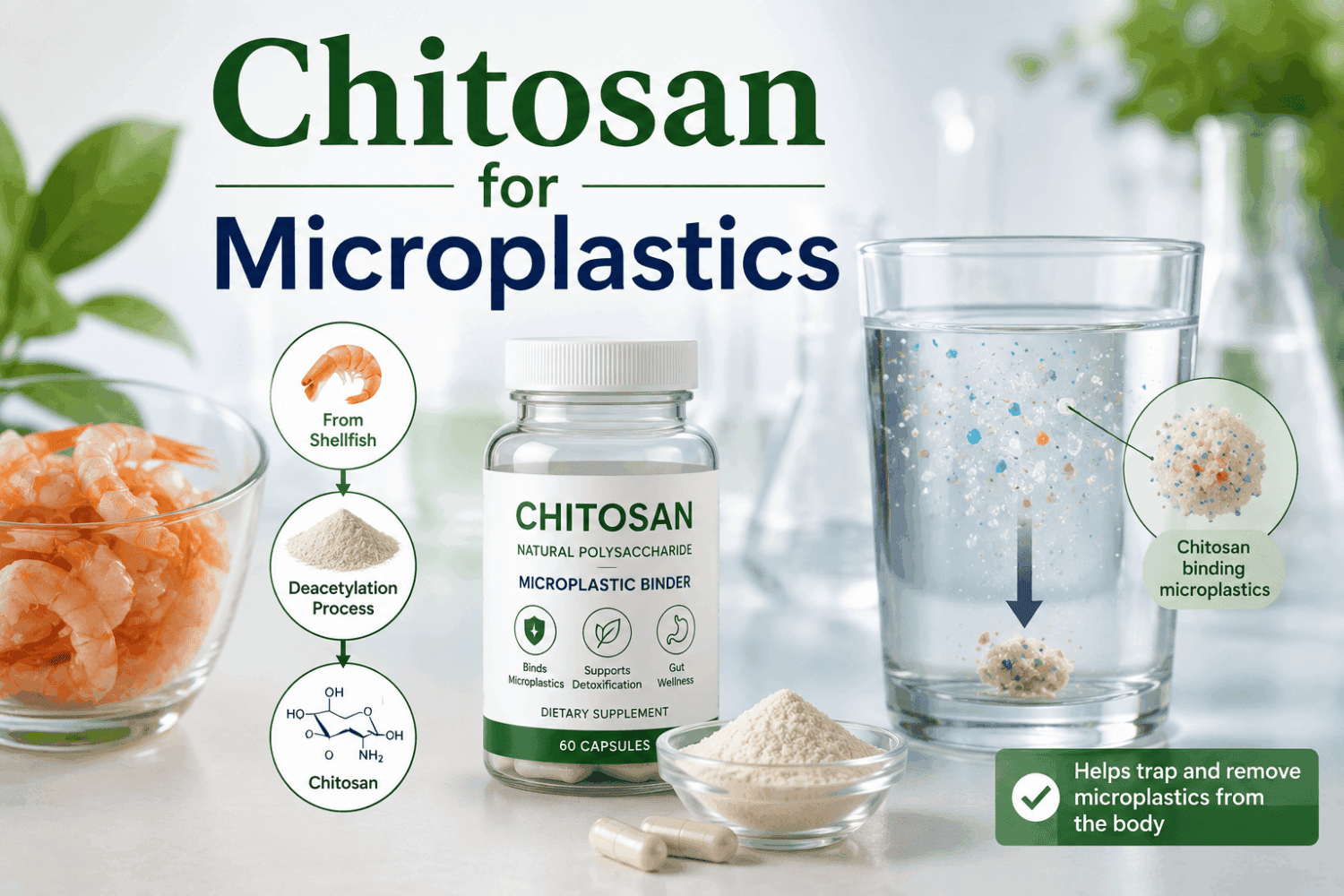
Chitosan for Microplastics: I’ve spent more time in the supplemental index of scientific journals than I care to admit over the past eight months. When I started researching microplastics seriously, after that Nature Health study on brain tissue landed in my feed and refused to leave. I wanted to know what the evidence actually supported in terms of internal response. Not what the supplement brands said. Not what wellness influencers claimed. What the studies actually showed.
The chitosan research surprised me. Not because it’s definitive, it isn’t, and no honest review of early-stage research should pretend otherwise, but because it’s genuinely rigorous for a supplement category that usually relies on borrowed credentials and vague mechanism claims. Four peer-reviewed publications in two years. Two human studies. One animal study with head-to-head fiber comparisons. One in vitro materials chemistry study that identified the specific molecular properties required for effective binding.
This article covers all four studies in detail, explains what each one measured and what it proved, and situates the evidence within an honest assessment of what remains unknown.
TL;DR
- Four peer-reviewed studies on chitosan and microplastics were published between 2025 and 2026
- The 2025 human crossover study (PMID: 40646942) showed 45% more microplastic particles in stool within 12 hours of a chitosan dose
- The 2025 animal study (PMID: 40268980) showed reduced gastrointestinal microplastic retention from 12.1% to 6.1% in the chitosan group
- The 2026 blood study (Cornelli et al.) showed 26.3% reduction in blood microplastic concentration after 15 days of daily chitosan use
- The 2026 in vitro study (Journal of Materials Chemistry B) showed up to 87% topological entrapment of common plastic types under simulated gastric conditions
- Long-term human outcomes data does not yet exist for this category
- Not all chitosan is equally effective, molecular weight and degree of deacetylation matter
What Is Chitosan? A Foundation Before the Research
Before evaluating the studies, it helps to have a clear picture of what chitosan is chemically and why it would plausibly interact with microplastic particles.
Chitosan is a polysaccharide produced by the chemical modification of chitin. Chitin is the structural polymer that makes up the exoskeletons of crustaceans (shrimp, crab, lobster), the cell walls of many fungi, and the wings of insects. In its natural form, chitin is insoluble and relatively inert. When treated with a strongly alkaline solution (typically sodium hydroxide) at high temperature, a process called deacetylation, the acetyl groups (-COCH3) are removed from the chitin polymer backbone, converting it into chitosan.
The extent to which these acetyl groups are removed is called the degree of deacetylation (DD), and it ranges from 0% (pure chitin) to 100% (fully deacetylated chitosan). Practically, commercial chitosan products range from 60% to 95% deacetylation. Sifts Daily specifies at least 85% DD, which is in the range associated with strong positive charge at physiological pH and good biological activity.
The degree of deacetylation matters because it determines the density of free amino groups (-NH2) in the chitosan polymer. These amino groups become protonated (-NH3+) in acidic conditions, gaining a positive charge. At stomach pH (1.5 to 3.5) and upper small intestine pH (5 to 7), most of the chitosan amino groups are protonated, giving the molecule a substantial positive charge.
The molecular weight of chitosan (typically expressed in kilodaltons, kDa) affects how chitosan behaves in solution. Low-MW chitosan (below 50 kDa) remains in solution and doesn’t form extensive networks. Medium-MW chitosan (50 to 300 kDa) forms gels and networks in solution. High-MW chitosan (above 300 kDa) forms very viscous solutions and dense networks. The 2026 materials chemistry study established that microplastic entrapment requires chitosan above a specific viscosity threshold, which corresponds to medium-to-high molecular weight.
The Electrostatic Binding Mechanism: Physical Chemistry
The fundamental reason chitosan interacts with microplastic particles is electrostatic attraction between opposite charges.
Most synthetic plastic polymer surfaces develop a net negative charge when suspended in water. This occurs for several reasons: the adsorption of negatively charged ions and organic molecules from the surrounding aqueous environment, the presence of functional groups on the polymer surface that deprotonate at neutral to alkaline pH, and the effects of UV degradation and weathering that introduce carboxyl and hydroxyl groups with negative charge at physiological pH.
When positively charged chitosan (protonated at digestive pH) encounters a negatively charged microplastic particle in the gut, Coulombic attraction occurs: the positive charge is drawn toward the negative charge, creating a physical association between the chitosan polymer and the particle surface.
This is the same electrostatic principle that governs many biological processes, and it’s also the same principle behind chitosan’s well-documented ability to bind bile acids (which are negatively charged), the mechanism behind chitosan’s use in cholesterol-lowering applications for decades.
The difference between chitosan and activated charcoal at this mechanistic level is important: chitosan’s binding is charge-mediated and relatively selective for particles that match its electrostatic profile. Activated charcoal’s binding is surface-area-mediated through Van der Waals forces, which are essentially non-selective. This selectivity difference is one of the primary reasons chitosan is appropriate for daily use while activated charcoal is not.
Study 1: Human Crossover Study. The Direct Human Evidence
Full Citation: Casella C, Cornelli U, Ballaz S, et al. Preliminary Study on PCC-Chitosan’s Ability to Enhance Microplastic Excretion in Human Stools from Healthy Volunteers. Foods. 2025;14(13):2190. PMID: 40646942. Published June 23, 2025.
Study Design
This was a crossover study design, meaning each participant served as their own control, the same person consumed both conditions (chitosan and placebo) in a randomized order, with a washout period between them. Crossover designs are generally more statistically powerful than parallel-group designs because they control for between-person variability in baseline microplastic exposure and fecal output.
Healthy adult volunteers consumed a standardized meal containing a known quantity of microplastic contamination. This standardization was critical: without controlling for microplastic input, differences in fecal particle counts could reflect different ingestion rather than different elimination.
One condition included 0.8 grams of PCC-Chitosan (a specifically processed chitosan formulation) alongside the standardized meal. The other condition was the same meal without chitosan. Stool samples were collected from each participant within 12 hours and analyzed for microplastic particle content using established detection methods.
Results
The chitosan condition produced approximately 45% more microplastic particles in stool compared to the placebo condition:
- Control condition: mean 654 microplastic particles per 5 grams of stool
- Chitosan condition: mean 965 microplastic particles per 5 grams of stool
- Difference: approximately 311 additional particles per 5g stool, a 47.5% increase
This is a statistically significant difference representing a meaningful increase in fecal microplastic excretion within a 12-hour window following a single chitosan dose.
What This Study Proves
This study provides direct human evidence that a single dose of chitosan increases fecal microplastic excretion within 12 hours of ingestion with a microplastic-containing meal. It is the most directly relevant human evidence for the core claim behind Sifts Daily.
What This Study Does Not Prove
This was a short-duration study measuring a single dose’s effect over 12 hours. It did not:
- Measure long-term effects of daily supplementation
- Measure changes in blood or tissue microplastic levels
- Establish clinical health outcomes linked to increased fecal excretion
- Test the finished Sifts Daily product formulation specifically (it tested PCC-Chitosan, a processed form of chitosan)
The authors correctly label it as a “preliminary study” in the title, this is an important characterization that should not be stripped away by supplement marketing.
Study 2: Animal Feeding Study. Head-to-Head Fiber Comparison
Full Citation: Liu D, Shimizu M. Ingesting chitosan can promote excretion of microplastics. Scientific Reports. 2025;15:14041. DOI: 10.1038/s41598-025-96393-w. PMID: 40268980. Published April 22, 2025.
Study Design and Rationale
This animal study at Tokai University in Japan was specifically designed to test whether non-digestible dietary fibers could promote microplastic excretion, and to compare four fiber types head-to-head to identify which (if any) was most effective.
The four fibers tested were:
- Indigestible dextrin (a soluble prebiotic fiber)
- Lactosucrose (a prebiotic disaccharide)
- Eggshell membrane proteins (a natural fiber-like material)
- Chitosan
Rats were fed a standardized diet containing polyethylene microplastics (200-micrometer mean particle size) plus one of the four test materials, for a defined feeding period. Control animals received the microplastic-containing diet without any fiber supplement. Fecal samples were collected and analyzed for microplastic content, and gastrointestinal tissue was examined for retained microplastic particles.
Results
Chitosan produced the most significant effects of all four tested materials:
Fecal excretion: The chitosan group showed a significantly higher rate of microplastic excretion in feces compared to the control group and compared to all three other fiber groups.
Gastrointestinal retention: Microplastic retention in gastrointestinal tissue decreased from approximately 12.1% in the control group to 6.1% in the chitosan group, a 50% reduction in retained particles.
Comparison to other fibers: Indigestible dextrin showed some improvement over control but significantly less than chitosan. Lactosucrose and eggshell membrane proteins showed minimal differences from control.
The study also noted changes in fecal characteristics (increased fecal weight in the chitosan group) consistent with increased fiber-mediated transit.
Why the Head-to-Head Design Matters
The comparative design of this study is scientifically important because it answers a question that general fiber advocates often raise: couldn’t any fiber produce the same effect through transit time improvement?
The answer, based on this study, is no. Four fiber types were tested. Three of them produced minimal effects. Chitosan produced substantially better results. This suggests that chitosan’s specific electrostatic mechanism is doing something that general fiber activity cannot replicate, consistent with the mechanistic prediction from the physical chemistry.
What This Study Proves
Chitosan supplementation significantly increases fecal microplastic excretion in living digestive systems and reduces gastrointestinal particle retention. Chitosan outperforms other tested dietary fiber types for this specific purpose.
What This Study Does Not Prove
Animal studies don’t always translate to human physiology. The particle size used (200 micrometers) may not represent the full range of particle sizes in the human food supply. The specific polymer type (polyethylene) may behave differently from other plastics in the gut environment. Results need validation in human trials with varied particle types and sizes.
Study 3: Human Blood Study. Systemic Effects
Full Citation: Cornelli U, et al. Chitosan and blood microplastic concentration in human subjects. Journal of Xenobiotics. 2026. DOI: 10.3390/jox16030092.
Study Design
This human study moved beyond fecal excretion to examine whether daily chitosan supplementation affects measured blood microplastic concentration, a more direct marker of systemic microplastic burden.
The study enrolled human subjects and measured blood microplastic concentration at baseline, then divided participants into a daily chitosan supplementation group and a placebo control group. Blood microplastic concentrations were measured again after 15 days.
Results
After 15 days of daily chitosan supplementation:
- The chitosan group showed a 26.3% decrease in measured blood microplastic concentration compared to baseline
- The placebo group showed no significant change in blood microplastic concentration over the same period
Significance of This Finding
This is the most clinically meaningful of the four studies because it measures a systemic outcome, blood microplastic level, rather than a gut-level output (fecal excretion). A reduction in circulating microplastic concentration could occur through two non-exclusive mechanisms:
- Reduced gut-to-blood transfer: by binding microplastics in the gut and increasing fecal excretion, chitosan reduces the fraction of ingested particles that cross the gut barrier into the bloodstream, reducing the ongoing daily “reloading” of circulating particles.
- Possible direct effect on circulating particles: less likely as a primary mechanism but theoretically possible if chitosan affects mucosal immune cell trafficking or other indirect systemic pathways.
The 26.3% reduction in 15 days is a meaningful effect size for a dietary supplement intervention. For context, pharmaceutical interventions targeting specific biomarkers often achieve 20-30% reductions in placebo-controlled trials and are considered clinically significant.
Limitations
This is one study. Blood microplastic measurement methodology is not yet fully standardized across laboratories, and different analytical techniques produce different absolute values. The study period is relatively short (15 days). Independent replication by separate research groups would significantly strengthen this finding.
Study 4: In Vitro Materials Chemistry. The Mechanism Characterized
Full Citation: Popa RP, Tabaran AF, et al. Chitosan with defined intrinsic viscosity enables physicochemical entrapment of microplastics under in vitro gastric conditions. Journal of Materials Chemistry B. 2026. DOI: 10.1039/D6TB00654J.
Study Design
This was an in vitro (laboratory) study conducted by materials chemists, not a clinical trial. It was designed to characterize the specific chitosan properties required for effective microplastic entrapment under conditions that simulate the stomach environment (pH 3, 37°C, appropriate ionic conditions).
The researchers tested multiple chitosan preparations with different intrinsic viscosities (a measure related to molecular weight and chain length) against three different plastic polymer types: high-density polyethylene (HDPE), polyvinyl chloride (PVC), and polyethylene terephthalate (PET).
Results
The study identified a threshold behavior: chitosan below a critical intrinsic viscosity (~90 cP) showed poor microplastic entrapment. Chitosan at or above this threshold formed what the researchers described as “semi-dilute entangled polymer networks”, complex three-dimensional structures that physically encase microplastic particles through a combination of electrostatic attraction and topological entrapment.
At or above the threshold:
- HDPE entrapment: up to 87%
- PVC entrapment: comparable high levels
- PET entrapment: comparable high levels
The Practical Implication: Not All Chitosan Is Equal
This study has an important practical implication that is rarely acknowledged in supplement marketing: the microplastic-binding efficacy of chitosan depends on its specific molecular properties, not just on whether “chitosan” appears on the ingredient label.
A supplement that contains low-MW chitosan at 60% deacetylation will perform very differently from medium-to-high MW chitosan at 85%+ deacetylation. The ingredient label may say “chitosan” in both cases. The molecular properties, and therefore the binding performance, may be completely different.
This is one reason why supplement specification transparency matters for this category. Sifts Daily specifies at least 85% degree of deacetylation and medium molecular weight, which is consistent with the threshold identified in the 2026 materials study. Generic chitosan supplements that don’t specify these parameters may or may not perform comparably.
How the Four Studies Form a Coherent Evidence Base
Individually, each of these studies has limitations. Together, they form a coherent evidence progression that builds scientific credibility through convergent evidence from different experimental approaches.
Step 1. The chemistry works (Study 4): In vitro evidence establishes that correctly formulated chitosan physically entraps microplastic particles under stomach-like conditions. The mechanism is characterized at a molecular level, and the specific chitosan properties required are identified.
Step 2. It works in a living digestive system (Study 2): The animal feeding study confirms that chitosan increases microplastic excretion in a living digestive environment with all the biological complexity that entails (digestive enzymes, gut microbiome, peristalsis, bile acids, and competing substrates). It also establishes that chitosan outperforms other dietary fibers for this purpose.
Step 3. It works in human digestion (Study 1): The human crossover study confirms measurable increased microplastic excretion in human stool within 12 hours of a chitosan dose, the first direct human evidence for this mechanism.
Step 4. It affects systemic levels (Study 3): The blood study extends the evidence from gut excretion to systemic microplastic burden, showing 26.3% reduction in blood particle concentration after 15 days.
Each study addresses a limitation of the previous one. This is exactly the kind of convergent, multi-method evidence base that builds scientific credibility for a new mechanism. It is not conclusive long-term evidence, that would require years of prospective study, but it is meaningfully better than the evidence base for any alternative approach currently on the market.
What the Evidence Does NOT Support Chitosan for Microplastics
Honest science communication requires being equally precise about what the evidence does not show as what it does.
No long-term human data: The longest human study is 15 days. No study has measured whether daily chitosan use over months or years maintains the excretion benefit, whether tolerance develops, or what happens to body burden over longer periods.
No clinical health outcome data: No study has shown that chitosan supplementation reduces the rate of any microplastic-associated disease in humans. The path from “reduces blood microplastic concentration” to “prevents cardiovascular events” is a biological plausibility argument, not a demonstrated clinical link.
No finished-product trial for Sifts Daily specifically: The human studies used chitosan formulations, not the specific five-ingredient Sifts Daily formulation. The supporting ingredients (apple pectin, baobab, slippery elm, magnesium glycinate) have not been tested in combination with chitosan for microplastic excretion.
No dose-response characterization: What is the minimum effective daily chitosan dose? Does taking twice as much produce twice the effect? These questions are not answered by the current evidence.
No polymer-type specificity data for all major plastics: The in vitro study tested HDPE, PVC, and PET. The animal study used polyethylene. The most common human exposure plastics include polypropylene, polystyrene, and various co-polymers. Whether chitosan performs comparably across all major polymer types in human gut conditions has not been fully characterized.
Chitosan vs Other Dietary Fibers: What Makes It Specifically Effective?
The 2025 animal study is definitive on this question within its tested range: chitosan outperformed indigestible dextrin, lactosucrose, and eggshell membrane proteins for microplastic excretion. But why?
The difference lies in the mechanism. General dietary fibers increase stool bulk, accelerate gut transit, and feed beneficial bacteria, all of which have indirect relevance to microplastic residence time in the gut. But they don’t have a specific affinity for microplastic particle surfaces.
Chitosan’s positive charge creates a specific electrochemical affinity for the negatively charged surfaces of most plastic polymers. This is not a general “speeds things up” effect, it is a specific “attracts and holds this particular type of particle” effect that increases the probability of particle entrainment in the fecal matrix and decreases the probability of prolonged particle-wall contact.
The analogy would be the difference between a general-purpose cleaning cloth (picks up whatever it contacts) and a specific magnetic collector (attracts metal particles specifically). Both clean, but the second is specifically effective for one type of target.
Implications for Supplement Selection
This analysis has practical implications for how to evaluate any supplement claiming chitosan-based microplastic support:
1. Molecular weight and deacetylation must be specified. Any chitosan product that does not disclose these parameters cannot be evaluated for binding efficacy. The 2026 materials study established that these parameters determine performance.
2. Human evidence is the gold standard. Of the four studies reviewed, Studies 1 and 3 are the most directly relevant because they measured effects in humans. Animal and in vitro studies are supportive but not sufficient on their own.
3. Single-ingredient chitosan vs full-formula products. The Sifts Daily formulation includes supporting ingredients (apple pectin, baobab, slippery elm, magnesium glycinate) that address gut health more broadly than chitosan alone. These have not been specifically studied for microplastic effects but have sound mechanistic rationale for inclusion.
4. Third-party testing matters. In a category where ingredient quality (specifically MW and DD) is critical for efficacy, third-party verification of ingredient specifications provides meaningful assurance.
Frequently Asked Questions
Is the chitosan research on microplastics peer-reviewed?
Yes. All four studies discussed in this article are published in peer-reviewed scientific journals: Foods (MDPI), Scientific Reports (Nature Portfolio), Journal of Xenobiotics (MDPI), and Journal of Materials Chemistry B (Royal Society of Chemistry). These are legitimate academic publications.
How does chitosan’s molecular weight affect microplastic binding?
The 2026 materials study established that chitosan must exceed a critical intrinsic viscosity threshold (approximately 90 cP, corresponding to medium-to-high molecular weight) to form the entangled polymer networks that achieve effective microplastic entrapment. Below this threshold, binding efficiency drops significantly.
Does chitosan work for all types of microplastics?
The research has tested HDPE, PVC, PET, and polyethylene specifically. These cover several major plastic types. Whether the binding efficiency is equal across all plastic polymer types found in the human gut has not been fully characterized.
How quickly does chitosan increase microplastic excretion?
The 2025 human crossover study measured a 45% increase in fecal microplastic particle counts within 12 hours of a single chitosan dose taken with a meal. The effect is measurable within a single digestive cycle.
Does chitosan reduce microplastics in blood?
The 2026 Cornelli et al. blood study found a 26.3% reduction in measured blood microplastic concentration after 15 days of daily chitosan supplementation, compared to no change in the placebo group.
Is chitosan safe for daily use?
For healthy adults without shellfish allergy, chitosan at supplement doses is classified as a dietary fiber with a well-established safety profile. The European Food Safety Authority has reviewed dietary chitosan and found it safe for supplementation. The primary safety contraindication is shellfish allergy.
Can I get enough chitosan from eating shellfish?
No. The chitin in crustacean shells requires processing (deacetylation) to become chitosan. Eating shrimp provides some chitin from the shells if consumed, but the amount and form is completely different from processed supplemental chitosan. Meaningful chitosan intake for microplastic binding purposes requires supplementation.
Does the degree of deacetylation matter for microplastic binding?
Yes. Higher deacetylation produces more free amino groups that become positively charged at digestive pH, increasing the charge density available for electrostatic interaction with negatively charged microplastic surfaces. Sifts Daily specifies at least 85% DD, which is in the range associated with strong electrostatic binding activity.
How does chitosan compare to psyllium husk for gut health?
Psyllium husk is an excellent general soluble fiber for constipation relief, blood sugar management, and cholesterol reduction. It does not have the specific positive charge that drives chitosan’s microplastic binding mechanism. The 2025 animal study didn’t test psyllium specifically, but the general fiber comparators (indigestible dextrin, lactosucrose) performed significantly less well than chitosan, suggesting general fiber activity is not equivalent to chitosan’s specific mechanism.
Are there any studies showing chitosan causes harm?
No significant safety concerns have been identified in the research literature for chitosan at supplement doses in adults without shellfish allergy. The European Food Safety Authority’s review of dietary chitosan found no concerning safety signals. The primary documented adverse effects are mild (fiber adjustment in the first week, potential fat-soluble vitamin binding if not spaced appropriately).
What would make the chitosan-microplastics evidence stronger?
Longer-term human studies (at least 12 weeks), larger sample sizes, randomized placebo-controlled trial design for the blood study, independent replication of the blood finding by separate research groups, testing across more plastic polymer types, and ultimately studies linking chitosan supplementation to clinical health outcomes rather than just biomarker changes.
Final Assessment
The chitosan research base for microplastic elimination is the most credible scientific foundation in the supplement category addressing this problem. Four peer-reviewed studies from 2025 and 2026 provide convergent evidence: in vitro mechanism characterization, animal head-to-head comparison, human fecal excretion measurement, and human blood concentration measurement.
This is early-stage science. The category is new, the research methods for measuring microplastics in biological samples are still being standardized, and the clinical implications of reducing blood microplastic concentration are not yet established. These are honest limitations of where the field stands.
But “early-stage” does not mean “without credibility.” For a dietary supplement addressing a newly recognized environmental health concern, four peer-reviewed publications including two human studies in two years is a more rigorous evidence development than most supplement categories achieve.
For the product that applies this research daily, see our full Sifts Daily Review.

