






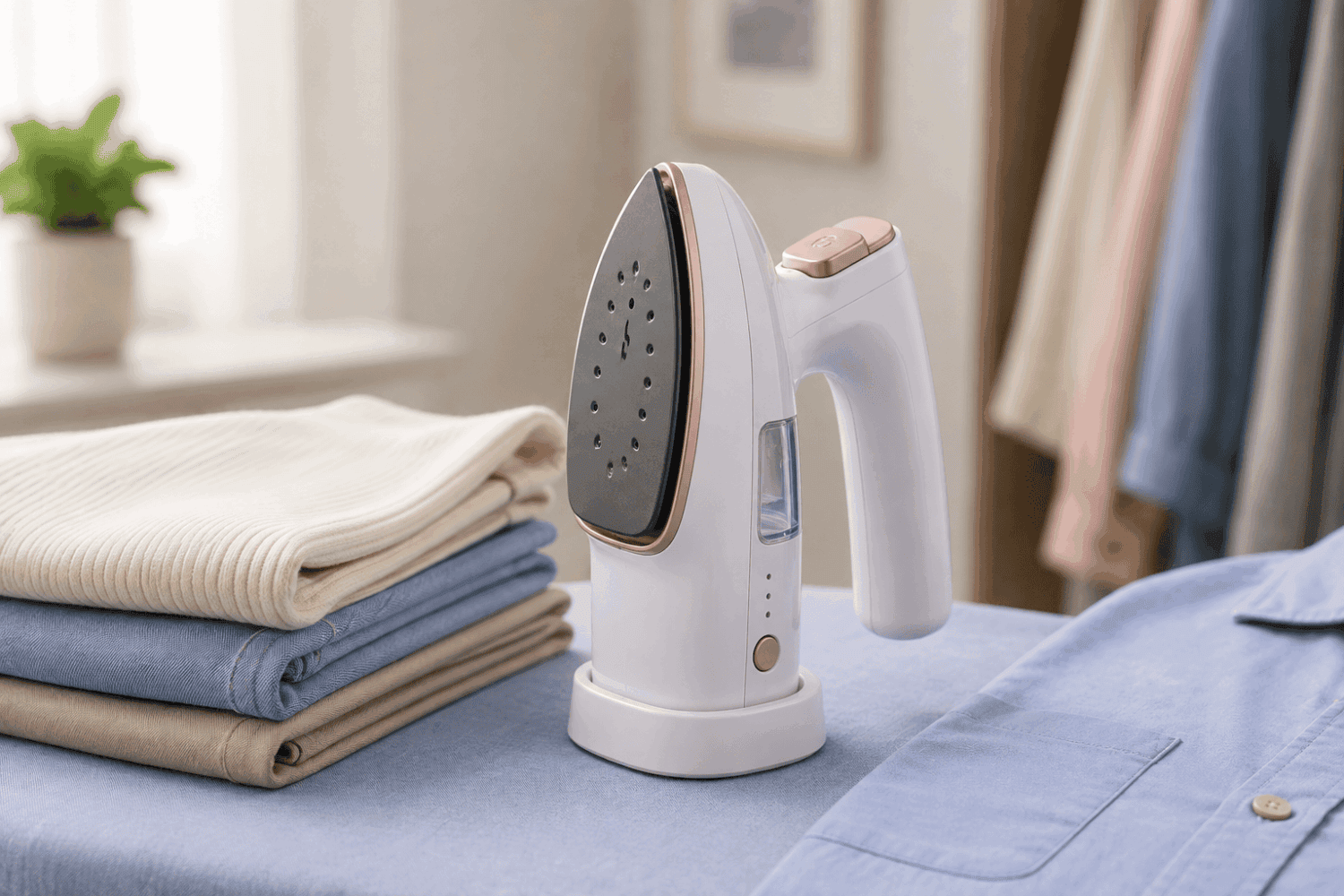
Pocket-sized, cordless mini irons keep going viral, marketed as heating in seconds and de-wrinkling clothes anywhere with no cord and no water. So do they actually work? The honest answer: within narrow limits, and much less than the ads imply. This guide explains what a cordless mini iron can realistically do, the physics and battery constraints that hold it back, and how to judge one, using riddiaPress (which we graded C-) as the worked example. See the full riddiaPress review for the deep dive.
Three things limit every cordless mini iron
1. Dry heat is only half the tool
Most pocket mini irons are dry (no steam). But moisture, as steam, is what relaxes fabric fibers so wrinkles release. Dry heat alone can lightly smooth wrinkle-resistant synthetics, but it is weak on cotton, linen and stubborn wrinkles. So a “no water” mini iron removes the very mechanism that does most of the work. (More on this in our dry iron vs steam explainer.)
2. A tiny plate covers a tiny area
Palm-sized means a heated surface of only a few square inches. That is fine for dabbing at a single small crease, a collar tip, a cuff, a lapel, but hopeless for pressing a whole garment, which would take forever inch by inch. So a mini iron is a spot tool, not a substitute for an iron or steamer.
3. Battery heat is hard to sustain
Real ironing needs high, steady heat (often 300-400 F). Delivering and holding that from a small rechargeable battery is physically demanding, so “full power in 60 seconds” claims deserve scrutiny. A cordless device that only gets warm, or loses heat quickly, removes wrinkles even less effectively. Because these figures are almost always brand-stated and untested, treat them skeptically.
So what CAN a cordless mini iron do?
Realistically, one narrow job: a quick touch-up on a small area of wrinkle-resistant synthetic fabric, flattening a minor crease before a meeting. Used with that expectation, and ideally with a light spritz of water or wrinkle spray to add the missing moisture, it can help a little.
What it cannot do: press a shirt, tackle cotton or linen, or deliver “pro results on any fabric in seconds” as the marketing claims.
How to judge a cordless mini iron before buying
- Does it steam, or is it dry? Dry-only is a real limitation.
- How big is the plate? Smaller means touch-ups only.
- Are the heat/battery figures verified? Usually not, treat brand claims as unproven.
- Who sells it? Many are dropship gadgets sold through affiliate funnels with self-hosted “5-star” ratings, which warrant skepticism (see our dropship red flags guide).
- Is there a money-back guarantee? Use it; test immediately.
The honest recommendation
For genuine wrinkle removal on the go, a compact travel steamer beats a cordless mini iron decisively, because it uses steam and handles whole garments and cotton. If you only ever want to flatten a tiny synthetic crease and love the no-cord, no-water form factor, a mini iron is a low-stakes novelty, but go in with low expectations and your return window in mind.
riddiaPress is a representative example: a plausible touch-up concept undercut by dry-only heat, a tiny plate, unproven specs and dropship signals, which is why it earned a C-. Read the full riddiaPress review, and see the other travel gadgets we have graded.
Frequently Asked Question
Do cordless mini irons really work?
Only in a narrow way. A cordless mini iron can lightly flatten a small crease on wrinkle-resistant synthetic fabric, but it cannot press whole garments, struggles with cotton (no steam), and its heat and battery claims are usually unverified. So it works for tiny touch-ups, far short of the marketing, and a travel steamer does far more.
Can a mini iron press a whole shirt?
No. Its heated plate is only a few square inches, so covering an entire shirt would mean dabbing inch by inch, impractically slow. It is a spot tool for small creases, not a replacement for a full iron or a steamer.
Are cordless mini irons worth buying?
For most people, no. A compact travel steamer removes wrinkles far better for similar money. A cordless mini iron is only worth it as a low-expectation novelty for tiny synthetic touch-ups, and even then you should verify the specs skeptically and rely on a money-back guarantee.

