






We may receive a commission for purchases made through the links provided here. Learn More Learn More.
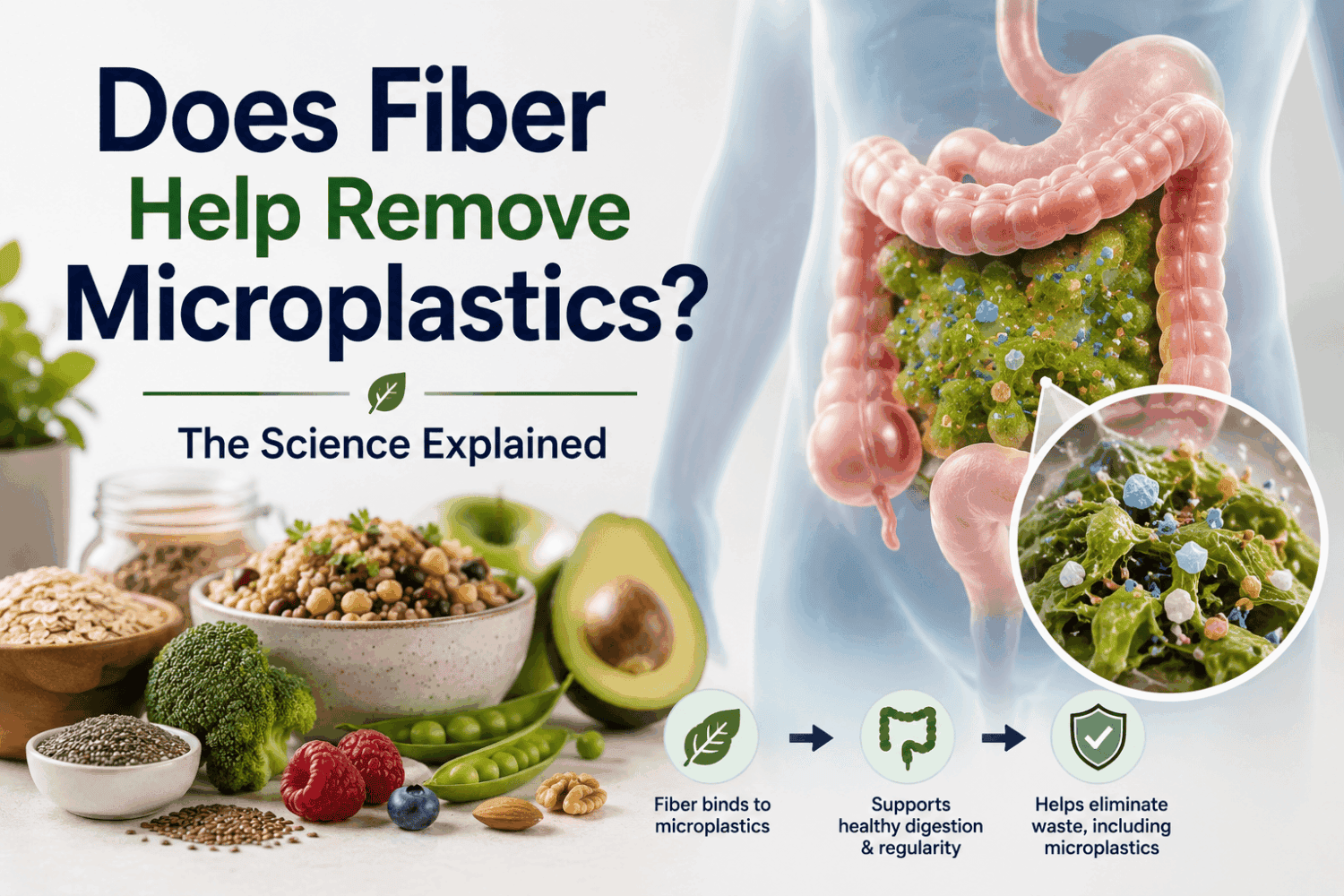
Among the many approaches that have been suggested for reducing microplastic burden in the gut, dietary fiber gets recommended frequently. The logic seems intuitive: fiber speeds things up in the gut, faster transit means less time for particles to interact with the intestinal wall, and many fiber types support healthy microbiome function that maintains gut barrier integrity.
But intuitive logic and evidence don’t always agree, and in this case the research has produced a nuanced and important finding: not all fibers are equal, and the type of fiber matters enormously for how effective it is at supporting microplastic elimination.
This article covers what the research actually shows, why chitosan (a fiber with unusual properties) outperforms conventional dietary fibers for this specific purpose, what conventional fiber does and doesn’t contribute, and how to think about fiber in the context of a broader microplastic management strategy.
TL;DR
- The 2025 Liu and Shimizu animal study directly tested four fiber types for microplastic excretion, chitosan significantly outperformed all three others
- General dietary fiber (psyllium, pectin, inulin) supports gut transit and microbiome health, which have indirect relevance to microplastic management
- Chitosan’s specific positive charge at digestive pH creates electrostatic attraction to negatively charged microplastic surfaces, a mechanism general fibers don’t have
- Simply increasing dietary fiber does not replicate chitosan’s specific microplastic-binding effect
- Chitosan and general dietary fiber are complementary, not equivalent
- Apple pectin has the most plausible mechanism of conventional fibers for microplastic support, but evidence remains indirect
The Question: Can Any Fiber Remove Microplastics?
The short answer is: fiber of any kind supports the conditions under which microplastics are more efficiently eliminated, but most fibers do this indirectly through transit and microbiome effects rather than through direct binding of particles.
Chitosan occupies a special position in the fiber category because its unique electrostatic charge creates a specific affinity for microplastic surfaces, a mechanism that conventional dietary fibers don’t possess. This distinction between mechanism-specific binding and general fiber transit support is the central finding of the most relevant research, and it’s why the answer to “does fiber remove microplastics?” requires careful nuance.
The Key Study: Head-to-Head Fiber Comparison (2025)
The most directly relevant research on this question is the 2025 animal study by Liu and Shimizu published in Scientific Reports (PMID: 40268980).
This study was specifically designed to test whether non-digestible dietary fibers could promote microplastic excretion, and critically, to compare multiple fiber types head-to-head rather than testing only one fiber against a no-fiber control. This comparison design is what makes it so valuable for answering the “does any fiber work?” question.
The Study Design
Rats were fed a standardized diet containing polyethylene microplastics (200-micrometer mean particle size) plus one of four non-digestible dietary materials:
- Indigestible dextrin: A soluble dietary fiber made from corn starch, commonly added to functional foods as a prebiotic
- Lactosucrose: A prebiotic trisaccharide derived from lactose and sucrose, with strong Bifidobacterium-stimulating activity
- Eggshell membrane proteins: A natural fiber-like material containing various proteins including collagen, fibronectin, and glucosamine
- Chitosan: The positively charged polysaccharide derived from crustacean shells
A fifth group served as control, receiving the microplastic-containing diet without any fiber supplement.
The Results
Chitosan group: Significantly higher fecal microplastic excretion rate than all other groups. Gastrointestinal microplastic retention decreased from approximately 12.1% (control) to 6.1%, a 50% reduction in retained particles.
Indigestible dextrin group: Some improvement over control in fecal excretion, but significantly less than chitosan. This suggests that general prebiotic fiber does provide some benefit, but through a weaker mechanism.
Lactosucrose group: Results similar to control. This is notable because lactosucrose has strong prebiotic activity and stimulates beneficial bacteria effectively, yet this did not translate into meaningfully higher microplastic excretion. Transit and microbiome improvements from prebiotic activity alone are not sufficient to replicate chitosan’s effect.
Eggshell membrane proteins group: Results similar to control. Despite being a natural material with fiber-like properties, eggshell membrane proteins did not significantly affect microplastic excretion.
What This Tells Us
Chitosan’s superior performance is specifically due to its electrostatic binding mechanism, not simply to its fiber properties. Indigestible dextrin (a genuine dietary fiber with prebiotic activity) showed some benefit but far less than chitosan. Lactosucrose (which has stronger prebiotic activity than indigestible dextrin) showed essentially no benefit despite its microbiome-stimulating effects.
This pattern strongly suggests that the mechanism driving chitosan’s superiority is its positive charge and electrostatic interaction with negatively charged microplastic surfaces, not general fiber effects on transit time or microbiome composition.
Understanding Why Chitosan Is Different
The Electrostatic Mechanism
Most synthetic plastic polymers (polyethylene, PET, polypropylene, PVC, polystyrene) carry a net negative surface charge when suspended in the aqueous environment of the digestive tract. This negative charge develops from the adsorption of negatively charged ions and organic molecules from the gut environment, plus the effects of surface degradation and chemical modification.
Chitosan, processed to a high degree of deacetylation (meaning most acetyl groups have been removed from the polymer backbone), has free amino groups (-NH2) that become protonated (-NH3+) in the acidic conditions of the stomach and upper small intestine. This protonation gives chitosan a substantial net positive charge at digestive pH values.
When positively charged chitosan encounters negatively charged microplastic particles in the gut, electrostatic attraction draws them together, forming a physical complex that travels together through the remaining digestive system and exits in feces rather than remaining free to interact with intestinal surfaces.
Chitosan with intrinsic viscosity at or above 90 cP forms semi-dilute entangled polymer networks that achieve up to 87% topological entrapment of common plastic polymer types including HDPE, PVC, and PET under simulated gastric conditions.
What Conventional Fibers Do Instead
Conventional dietary fibers (psyllium, pectin, inulin, cellulose, beta-glucan) support microplastic management through different, less specific mechanisms:
Transit acceleration: Fiber increases stool bulk and supports bowel regularity, reducing the time that microplastics spend in contact with the gut wall. Less contact time means fewer opportunities for smaller particles to interact with the intestinal epithelium.
Gel formation (pectin, beta-glucan): Soluble fibers that form viscous gels create a physical matrix in the gut that may physically trap some particles. This is a real effect but is less specific and efficient than chitosan’s electrostatic binding.
Microbiome support: Prebiotic fibers feed beneficial bacteria that produce short-chain fatty acids, support tight junction protein expression, and maintain gut barrier integrity. A healthy gut barrier reduces the fraction of microplastics and nanoplastics that cross from the gut lumen into the bloodstream.
Mucus production: Some fiber types stimulate mucus production by goblet cells in the gut lining. The mucus layer provides a physical barrier between luminal contents (including microplastics) and the epithelial surface.
All of these mechanisms are valuable for gut health generally and have indirect relevance to microplastic management. None of them replicates chitosan’s direct electrostatic binding to particle surfaces.
Apple Pectin: The Most Relevant Conventional Fiber
Among conventional dietary fibers, apple pectin deserves separate consideration because its gel-forming properties in the gut provide the most plausible physical trapping mechanism for microplastic particles.
Apple pectin is a high-DE (degree of esterification) soluble fiber that dissolves in water and forms viscous gels under the ionic conditions of the gut. This gel formation creates increased intestinal viscosity, a more gel-like, sticky gut environment, that can physically entrap suspended particles more effectively than a watery, low-viscosity environment.
This mechanism is included in Sifts Daily’s design, apple pectin is one of the five ingredients precisely because it complements chitosan’s electrostatic binding with physical gel-trapping. When both mechanisms operate together (chitosan attracting particles electrostatically, pectin creating a gel matrix that physically holds the complex), the overall retention in the fecal mass may be higher than either mechanism alone.
No peer-reviewed study has directly measured apple pectin’s effect on fecal microplastic excretion independently. The 2025 Liu and Shimizu study did not test pectin specifically. The evidence for pectin is mechanistically plausible but not directly experimentally established for this application.
What Increasing General Fiber Intake Does and Doesn’t Do
What It Does
Increasing general dietary fiber intake (from food or supplements) produces genuine health benefits that have indirect relevance to microplastic management:
Improved gut transit: Adequate fiber intake is associated with faster colonic transit, which reduces microplastic residence time in the gut.
Better microbiome diversity: High-fiber diets support more diverse and robust gut bacterial populations, which maintain gut barrier integrity more effectively.
Better barrier function: The short-chain fatty acids (particularly butyrate) produced by bacterial fermentation of fiber directly support intestinal epithelial cell health and tight junction expression, which limits particle permeability.
General gut health: The combination of improved transit, better microbiome, and better barrier function creates a gut environment that is less permissive of microplastic-associated harm.
What It Doesn’t Do
Increasing general dietary fiber does not replicate chitosan’s electrostatic microplastic binding. The 2025 animal study showed that fiber types with strong prebiotic activity (lactosucrose) did not significantly improve microplastic excretion over control. General fiber-driven improvements in transit and microbiome health are real but are not equivalent to the direct particle-binding mechanism that chitosan provides.
If you eat a high-fiber diet already, you are doing something meaningfully good for your gut and probably for your microplastic management compared to a low-fiber diet. You are not, however, replicating what chitosan-based supplementation provides.
Fiber and Microplastics: A Framework
Here is a practical framework for understanding how different fiber approaches relate to microplastic management:
| Fiber Type | Mechanism | Microplastic-Specific Evidence | Daily Safety | Best For |
|---|---|---|---|---|
| Chitosan | Direct electrostatic binding | Strong (2 human studies, 1 animal, 1 in vitro, 2025-2026) | Good (except shellfish allergy) | Specific microplastic gut support |
| Apple Pectin | Gel-formation physical trapping | Indirect/plausible, not directly tested | Excellent | Complementary support; shellfish-allergic individuals |
| Psyllium Husk | Transit support, bulk formation | Not studied | Excellent | General gut health, transit support |
| Inulin/FOS | Prebiotic, microbiome support | Modest (indigestible dextrin showed some benefit) | Excellent | Microbiome health, indirect support |
| Beta-Glucan | Gel-formation, prebiotic | Not studied | Excellent | General gut health |
| Cellulose | Bulk/transit | Not studied | Excellent | Basic fiber support |
How Much Fiber Do You Need for Gut Health Generally?
The USDA Dietary Guidelines recommend 25 to 38 grams of total dietary fiber per day for adults (25g for women, 38g for men). Most Americans consume approximately 10 to 15 grams per day, well below recommendations.
For microplastic management specifically, increasing fiber intake toward recommended levels is a reasonable baseline improvement even without specific chitosan supplementation. The transit and microbiome benefits alone are meaningful.
For people who want to go beyond general fiber benefits and specifically target microplastic binding, chitosan supplementation (Sifts Daily) is the only option currently backed by human study evidence for this specific purpose.
Practical Recommendations
For People Who Can Use Chitosan (No Shellfish Allergy)
Sifts Daily provides the specific chitosan mechanism supported by peer-reviewed human evidence, plus the complementary fiber matrix (apple pectin, slippery elm) and gut protective support (baobab antioxidants, magnesium glycinate for tight junction support). This is the complete, specifically formulated option.
If budget is a concern, standalone chitosan supplements are available at lower prices. The key parameters to verify: degree of deacetylation (at least 85%), molecular weight (medium-to-high). See our full Sifts Daily Review for complete product analysis.
For People Who Cannot Use Chitosan (Shellfish Allergy)
Apple pectin at 1 to 3g daily is the closest available substitute with some mechanistic relevance.
General high-fiber diet or prebiotic fiber supplementation (psyllium, inulin) provides the general gut health benefits that support microplastic management indirectly.
Source reduction becomes proportionally more important when specific binding supplementation is unavailable.
For Everyone
Increasing total dietary fiber intake toward the recommended 25 to 38g per day from whole food sources (vegetables, legumes, whole grains, fruits) provides a meaningful foundation for gut health that supports all of the above approaches.
Frequently Asked Questions
Does eating more fiber reduce microplastic exposure?
Increasing fiber intake supports faster gut transit and better gut barrier function, both of which have indirect relevance to microplastic management. It does not replicate chitosan’s specific electrostatic binding mechanism. The 2025 animal study showed that strong prebiotic fibers (lactosucrose) did not significantly improve microplastic excretion, while chitosan did.
Is psyllium husk as good as chitosan for microplastics?
No. Psyllium husk was not tested in the 2025 head-to-head fiber comparison, but the evidence framework suggests it would not match chitosan’s performance for microplastic excretion. Psyllium’s bulk-forming and transit-supporting properties are valuable for general gut health but lack the specific electrostatic binding mechanism.
What fiber is in Sifts Daily?
Sifts Daily contains chitosan (primary active ingredient), apple pectin, baobab fruit extract, slippery elm, and magnesium glycinate. Apple pectin and slippery elm are the fiber-type components that support and complement chitosan’s binding mechanism.
Can I just eat more apples to get enough pectin for microplastic support?
An apple contains approximately 1 to 1.5g of pectin. Consuming 2 to 3 apples per day provides 2 to 4g of dietary pectin. This is a meaningful dietary fiber contribution with prebiotic benefits, and it is a reasonable food-first approach. It does not provide chitosan’s electrostatic binding mechanism.
Does green tea or black tea help with microplastics?
Tea contains polyphenols with antioxidant activity that may reduce oxidative stress from plastic-associated chemicals. There is no evidence that tea specifically increases microplastic fecal excretion. Tea is a healthy beverage choice with multiple benefits, but microplastic elimination is not among its documented functions.
Does fermented food help with microplastics?
Fermented foods (yogurt, kefir, kimchi, sauerkraut) support gut microbiome diversity, which supports gut barrier integrity, which has indirect relevance to microplastic management. No study has directly measured whether fermented food consumption reduces microplastic excretion or blood levels.
Is there a plant-based alternative to chitosan for microplastic binding?
Research on plant-derived alternatives is ongoing but has not yet produced a human-tested equivalent. Wheat bran insoluble fiber has been characterized for microplastic adsorption in simulated intestinal fluid (2026), and plant-derived cellulose modifications are being studied. No finished consumer supplement with human evidence currently exists as a plant-based chitosan equivalent.
Should I take fiber supplements if I eat a high-fiber diet?
If you already eat 25 to 38g of fiber per day from food sources, additional fiber supplementation provides marginal additional gut health benefit. For microplastic-specific benefit beyond general fiber effects, chitosan supplementation adds the specific electrostatic binding mechanism regardless of baseline dietary fiber intake.
Final Thoughts
The relationship between dietary fiber and microplastic elimination is real but nuanced. All dietary fiber contributes something to the conditions that support microplastic management, transit speed, microbiome diversity, gut barrier integrity. But not all fibers are equivalent, and no conventional dietary fiber replicates the specific mechanism that makes chitosan the most evidence-backed option for direct microplastic binding.
The 2025 head-to-head comparison study is the most important piece of evidence here: it directly tested multiple fiber types and found chitosan significantly outperforming all others for fecal microplastic excretion. That finding shapes everything that follows in terms of supplement selection and strategy.
For the complete analysis of the product applying this research: Sifts Daily Review.

