
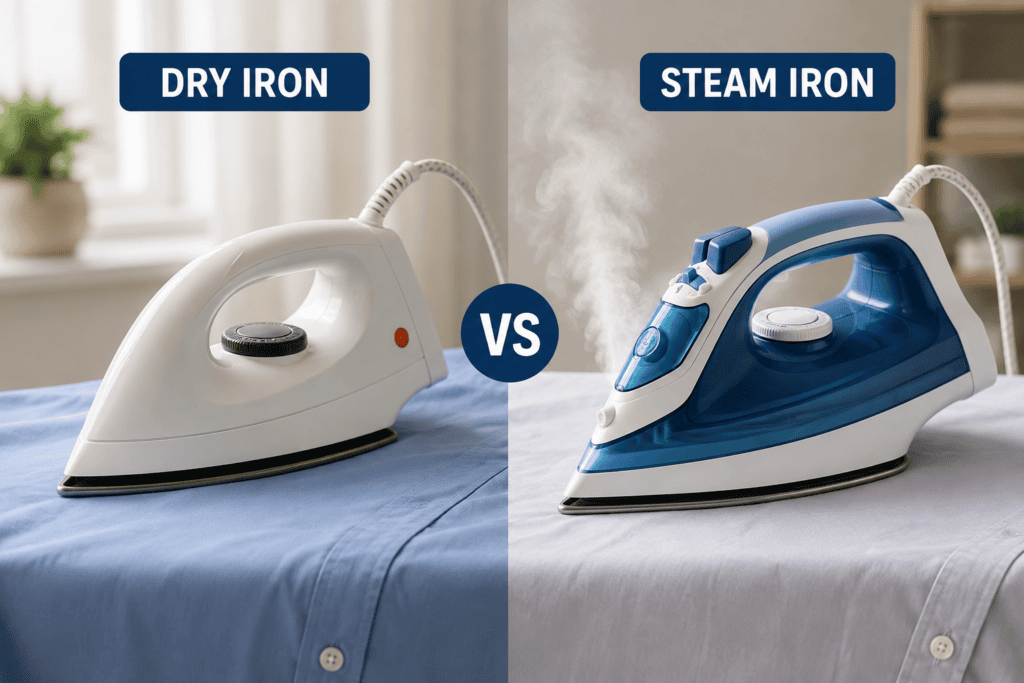

Every “no water needed” garment gadget rests on a hopeful idea: that you can skip the steam and still get wrinkle-free clothes. The physics say otherwise. This explainer covers why steam does the real work, when dry heat is enough, and what that means for pocket dry-presses like riddiaPress, which we graded C- in our full riddiaPress review largely for this reason.
Why wrinkles happen (and how they release)
Fabric fibers hold whatever shape they are pressed or folded into. A wrinkle is just fibers locked into a bent position. To release them, you need to loosen the fibers so they can relax flat again, and that is where heat and moisture come in.
- Moisture (steam) penetrates the fibers and relaxes the bonds holding the wrinkle, letting the fabric fall smooth.
- Heat then sets the relaxed, smooth shape in place.
Together they release wrinkles efficiently. This is why steam is the headline feature of essentially every serious garment tool, from home steam irons to standing steamers to travel steamers.
What dry heat can (and cannot) do
Dry heat alone, an iron or press with no steam, can still smooth fabric to a degree. Pressing with heat flattens fibers physically, so on light wrinkles and wrinkle-resistant synthetics (polyester, blends), a dry press can produce acceptable results.
But without moisture, dry heat cannot properly relax stubborn wrinkles, and it is noticeably weaker on natural fibers:
- Cotton and linen are the hardest to de-wrinkle dry. They practically demand steam or dampening; dry-ironing them well usually means using a spray bottle or a damp cloth to add the missing moisture.
- Set-in or deep wrinkles resist dry heat and often need steam to fully release.
So dry heat is a partial tool: fine for light touch-ups on synthetics, poor for cotton and stubborn creases.
Dry vs steam at a glance
| Dry heat only | Steam (heat + moisture) | |
|---|---|---|
| Light wrinkles, synthetics | OK | Great |
| Cotton / linen | Poor | Great |
| Deep / set-in wrinkles | Weak | Strong |
| Whole garments | Slow | Efficient |
| Needs water | No | Yes (the benefit) |
What this means for pocket “dry-press” gadgets
Devices marketed as “no water needed” mini irons, including riddiaPress, are dry heat only. That framing sells the absence of a water tank as convenience, but the honest reading is the opposite: by removing the water, they remove the mechanism that does most of the wrinkle-releasing work. Add a palm-sized heated plate (too small for whole garments) and the result is a tool suited, at best, to flattening a tiny synthetic crease, not to de-wrinkling clothes.
That is exactly why our riddiaPress review grades it low: not because it does nothing, but because its central selling point works against the goal.
The practical takeaway
- For cotton, linen, or real wrinkles, use steam: a steam iron at home, or a garment/travel steamer on the go.
- For light touch-ups on synthetics, a dry press or a quick pass with a dry iron can be enough, and adding a little moisture (a spritz of water or wrinkle spray) dramatically improves dry-heat results.
- For free, hang clothes in a steamy bathroom during a hot shower, the steam relaxes wrinkles with no device at all.
So if a gadget’s big pitch is “no water,” read that as a limitation for wrinkle removal, and choose a steam-based tool when you actually need clothes to look pressed.
See the full riddiaPress review and the other travel gadgets we have graded.
Does an iron work without steam?
Partly. Dry heat can flatten light wrinkles, especially on wrinkle-resistant synthetics, but it works poorly on cotton, linen and deep wrinkles, which need moisture to release. Adding a little water (a spray or damp cloth) greatly improves dry-ironing results, which shows how central moisture is.
Is steam better than dry heat for wrinkles?
Yes, for most fabrics and real wrinkles. Steam combines moisture and heat, so it relaxes fibers and releases wrinkles far more effectively than dry heat alone, particularly on cotton and linen. Dry heat is only adequate for light touch-ups on synthetics.
Why do “no water” mini irons struggle?
Because water, as steam, is what does most of the wrinkle-releasing work. A dry, no-water press removes that mechanism, so it can only lightly smooth small areas and performs poorly on cotton and stubborn creases, no matter how convenient the no-tank design sounds.