
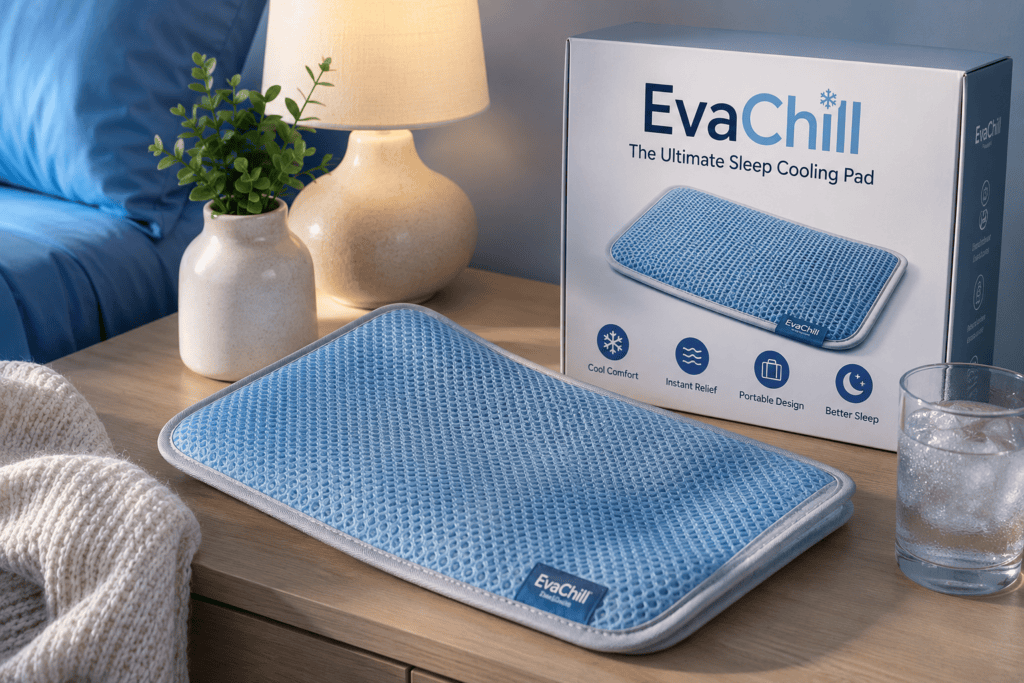

Two summers ago the fan budget got out of hand. First a clip fan for the desk, then a taller tower fan for the corner, then a second one because the first only pushed the same warm air from one side of the room to the other. None of them made the air cooler. They moved it faster. By August the office was a wind tunnel at body temperature, and the search history had turned into a string of increasingly hopeful queries about small coolers that plug into a laptop and actually chill the air instead of just stirring it.
That search is where most people meet the EvaChill. It is a personal evaporative cooler the size of a tissue box, it costs around a hundred dollars, and the ads promise it will drop the temperature by 25 degrees and run like an air conditioner on the power of a lightbulb. That is a big claim for a small box, and this review exists to check it against what the device can physically do and what the people who own one actually report.
This site earns a commission if you buy through the links here. It does not change the recommendation, and it did not change this one. Here is how the affiliate side of this site works.
The short version
The EvaChill is a genuinely clever little evaporative cooler that cools a small, close zone of air in a dry room and does almost nothing useful in a humid one. It is quiet, sips power, and sits neatly on a desk, but it is not an air conditioner, it will not cool a room, and at roughly $99 it costs three to five times what a comparable personal cooler does.
Bottom line: it is worth buying only if you live somewhere dry, you will keep it within arm’s reach, and you understand you are paying a design premium for a fan that adds a few degrees of real cooling, not for a tiny AC.
The verdict, in plain terms
The rolled format for this review is a conditional call rather than a score, because a number would hide the one thing that decides everything here, which is your local humidity.
Buy it if: you live in a dry climate or a dry season, you want quiet personal cooling right at your face or bedside, and you would rather have a well-made, silent, low-power box than a cheap rattly one. In dry air, pointed at you, from a couple of feet away, it does what people want.
Skip it if: you live somewhere humid, you want to cool a room rather than yourself, or you are price-sensitive. Above roughly 55 to 60 percent relative humidity an evaporative cooler cannot drop the temperature much, and at that point you have paid $99 for a quiet fan with a water tank to refill and a cartridge to replace.
Wait, and buy something else, if: you just want the cheapest version of this idea to try it out. An Arctic Air Ultra does the same evaporative trick for around $39, and if you actually need to cool a room, a real portable or window air conditioner is the honest answer no evaporative cooler will match.
Check the current EvaChill price on the official offer page
What EvaChill actually is

EvaChill is a personal evaporative air cooler: a small USB-powered box that draws warm air across a water-soaked cartridge, so the air gives up heat as the water evaporates and comes out the front cooler and more humid. It cools the person sitting in front of it, not the room, and it sells for around $99 through the brand’s offer page.
If the name is confusing, here is the untangling. The product marketed on the offer page as EvaChill is the Evapolar evaCHILL, model EV-500, made by Evapolar. So an evapolar evachill review and an EvaChill review are the same review, and the EV-500 you see on retail listings at Walmart, Lowe’s, Home Depot and Newegg is the same unit. The offer page you land on from an ad is a GiddyUp-run funnel for the same hardware, which matters mainly because it governs your price, your return window and your warranty, and those are not identical to what the Evapolar storefront offers.
There is no compressor in this thing. That is the whole point and the whole limitation. A window air conditioner uses a refrigeration cycle to pump heat out of a room and dump it outside. An evachill air cooler has no refrigerant, no exhaust hose, and nowhere to send heat. It uses evaporation, the same physics that makes you feel cold stepping out of a pool. Warm dry air hits wet material, the water turns to vapor, and turning liquid water into vapor takes energy, which it pulls out of the air as heat. The air that comes out is cooler and wetter than the air that went in.
That mechanism is real and it is old. Evaporative coolers, also called swamp coolers, have cooled desert homes for a century. What Evapolar did was shrink one to desk size, wrap it in a Red Dot Design Award winning shell, and run it off USB. The clever part is genuine. The marketing built on top of it is where an honest review has to slow down.
How it cools, and the catch nobody advertises
The EvaChill evaporative cooler works by pulling air through a cartridge that holds water, so the air loses heat to evaporation on its way through. The physics caps how much it can cool: the drier the air, the bigger the drop, and the more humid the air, the smaller it gets. In dry conditions owners and testers report a real drop of roughly 6 to 12 degrees Fahrenheit in the stream close to the unit. In humid conditions the drop shrinks toward nothing and it behaves like a plain fan.
This is the single most important paragraph in the review, so it comes before the features rather than after them.
Evaporative cooling is limited by something called the wet-bulb temperature, which is a fancy way of saying that air can only be cooled by evaporation until it gets too wet to absorb more water. Dry air has a lot of room to absorb water, so a lot of heat gets pulled out and the cooling is strong. Humid air is already close to saturated, so little water evaporates, little heat is pulled out, and the cooling is weak.
The numbers make it concrete. Independent explainers of the category put the useful drop at roughly 5 to 12 degrees near the unit when relative humidity is under about 40 percent. Above 50 to 55 percent humidity the effectiveness falls off a cliff, and in genuinely humid air, think a coastal summer or a Gulf state in July, the real temperature drop lands around 0 to 3 degrees. That is inside the margin where you cannot tell the cooler apart from a fan.
There is a second, sneakier catch. An evaporative cooler adds moisture to the air. In a small closed room it slowly raises the humidity of the very air it is trying to cool, which means it gradually reduces its own effectiveness the longer it runs with the door shut. The category works best with a cracked window or some airflow, which is the opposite of how people instinctively use a cooler on a hot day.
So the honest one-line answer to evachill vs air conditioner is that they are not the same class of device and the comparison flatters the wrong one. An air conditioner removes heat and moisture from a room regardless of outdoor humidity. An evaporative cooler adds moisture and only cools when the air is dry. If your problem is a hot, humid room, the EvaChill is the wrong tool no matter how good the reviews sound.
The specs, claimed against observed
| Attribute | Brand claim | What we could observe | Checked |
|---|---|---|---|
| Product type | Personal air conditioner / 3-in-1 cooler | Personal evaporative cooler and humidifier. Not a refrigerant AC | 30 Jul 2026 |
| Model | EvaChill | Evapolar evaCHILL EV-500 | 30 Jul 2026 |
| Cooling technology | Patented evaBREEZE volcanic nano-membrane fiber | Confirmed as the wet cartridge material. Evaporative, not refrigerant | 30 Jul 2026 |
| Temperature drop | “Up to 25F” | Brand help center cites 18-19F. Independent tests report 6-9F near the unit in favourable conditions | 30 Jul 2026 |
| Efficiency claim | “100x more efficient vs traditional AC” | Not a like-for-like metric. It uses less power because it cools a person, not a room | 30 Jul 2026 |
| Coverage area | Personal space | Retail listings state 21 to 26 sq ft. Effective zone is closer to a few feet in front of it | 30 Jul 2026 |
| Power draw | 7.5W | Confirmed across listings. Genuinely low, less than most lightbulbs | 30 Jul 2026 |
| Power source | USB (wall, laptop, power bank) | Confirmed. USB-C. No internal battery, so “cordless” it is not | 30 Jul 2026 |
| Runtime per tank | “Up to 9 hours” | Brand help center cites 3 to 8 hours. Retail listings state up to 8 | 30 Jul 2026 |
| Water tank | Fill and go | Confirmed. Roughly 800 ml class on this model. Must be refilled by hand | 30 Jul 2026 |
| Noise | “Quiet as rainfall, under 50dB” | Independent measurements report roughly 25 to 40 dB. Genuinely quiet | 30 Jul 2026 |
| Weight | 750 g | Offer page states 750 g. Some retail listings state about 1.7 lb (770 g). Broadly consistent | 30 Jul 2026 |
| Dimensions | Compact, about 7 inches | Roughly 170 to 172 mm on each side. A cube a little bigger than a tissue box | 30 Jul 2026 |
| Cartridge life | 3 to 6 months | Confirmed by brand. Some owners and guides say 2 to 4 months depending on water and air | 30 Jul 2026 |
| Cartridge cost | Not stated on offer page | About $32 per replacement at Amazon and Office Depot. A recurring cost | 30 Jul 2026 |
| Awards | Red Dot Design Award, Product of the Year | Red Dot is a design award. It rewards the industrial design, not cooling output | 30 Jul 2026 |
| Guarantee | 30-day money back | Stated on the offer page | 30 Jul 2026 |
| Warranty | 1 year | Stated on the offer page | 30 Jul 2026 |
| Price | “Save 50%” | Offer page shows no dollar figure before checkout. List runs about $99 at Evapolar, up to $119 elsewhere | 30 Jul 2026 |
| Sold by | Brand describes itself as the inventor | Evapolar via GiddyUp offer page, plus Walmart, Lowe’s, Home Depot, Newegg, Amazon | 30 Jul 2026 |
Three of the four headline numbers on the offer page (25 degrees, 9 hours, 100x) sit above what the brand’s own support documentation states and well above what independent tests measure. That gap between the ad and the help center is the most useful thing on this page, and it is the reason the verdict is conditional rather than enthusiastic.
Setup, the first fifteen minutes
The good news for anyone short on patience: there is almost nothing to set up. No installation, no window bracket, no exhaust hose, no app to pair. Owner reports are unanimous that getting started takes minutes, and that is a real point in its favour against a portable AC that needs a window kit and a drain.
The sequence is short. Fill the tank with water through the top. Plug the USB-C cable into a wall adapter, a laptop, or a power bank. Press the button and pick a fan speed. Point it at yourself. That is the entire process, and the first stream of cooler air arrives within a minute or two once the cartridge is wet.
Two setup details owners learn the hard way are worth front-loading. First, a brand-new cartridge needs to soak. If you fill the tank and expect instant cold, the dry cartridge has not wicked water yet, and the first few minutes underwhelm. Let it sit wet for ten minutes before you judge it. Second, there is no battery inside. The word portable does a lot of work in the marketing, but this is a plug-in device. It is portable in the sense that it is small and light, not in the sense that it runs untethered. If you want it truly cordless on a patio or in a tent, you need to run it off a power bank instead, and a decent one is a separate purchase.
The first hour
Does the EvaChill really work in the first hour? In dry air, yes, in a narrow way. Owners consistently describe a noticeable stream of cool, slightly damp air when the unit is within a couple of feet and pointed at the face, neck or arms. The cooling is local and directional, not a change you feel across the room.
The pattern in first-impression reports is remarkably consistent. People sit the box on the desk, aim it at themselves, and describe the output as pleasant and cooler than a fan, especially on the skin. The damp coolness on the face is the thing repeat buyers mention most, and it is genuine. Close range, dry air, aimed at you, this is the sweet spot the whole product is built around.
The disappointment in the first hour is just as consistent, and it comes from expectation rather than defect. People who set it in the middle of a warm room and wait for the room to cool feel nothing, because that is not what the device does. The effective zone is small. Move more than three or four feet away and the cooled stream has mixed back into room air and the effect fades. This is the moment a lot of one-star reviews are born, and most of them are describing a real product being used for a job it was never able to do.
Fan noise in the first hour draws quiet approval. Independent measurements put it around 25 to 40 decibels depending on speed, which is genuinely quiet, quieter than most tower fans and far quieter than any compressor AC. On the low setting it is a soft rush people compare to light rain. On the high setting it is louder but still nowhere near disruptive. For a bedside or a shared office, the silence is one of its best real features.
The first week
By the first week the novelty settles and the daily rhythm shows up, and this is where the refill reality lands. The tank does not last a working day at full tilt. Against the brand’s up-to-9-hours headline, the help center says 3 to 8 hours and owners running it on higher speeds in warm rooms report the lower end of that. In practice, heavy users refill it once or twice during a hot day.
Refilling is easy, but it is a chore that a fan does not have and an air conditioner does not have. You notice it in the first week because the airflow weakens as the cartridge dries, which is the cue to top up the water. People who like the device build a habit around it, a jug of water kept nearby, a refill at lunch. People who resent it are usually the ones who expected set-and-forget cooling and got a small appliance that needs tending.
The first-week humidity lesson also arrives now, especially for anyone in a damp climate. Owners in dry states describe a real, repeatable cooling effect. Owners in humid states describe something closer to a fan that makes the air feel muggier, which is exactly what the physics predicts. The same product earns a delighted review in Arizona and a scathing one in Florida, and both reviewers are being honest. This is the clearest example in the whole category of a product whose rating depends on the buyer’s postcode more than on the hardware.
The first month
The first month is where the running costs and the maintenance become visible, and where the community-sourced complaints start to cluster.
The recurring one is smell. A number of owners report that after several weeks to a few months, the air coming off the unit develops a faintly musty or funky odor. Evapolar’s position is that the inorganic nano-fiber cartridge is designed not to feed mold or bacteria, and that a darkened cartridge is stained by mineral impurities rather than colonised by mold. Both things can be true at once: the material may resist mold better than a sponge, and standing water plus organic dust from the air can still produce an odor over time. The practical fix owners land on is to run the unit dry for a while before storing it, empty the tank when not in use, and replace the cartridge on schedule rather than stretching it.
The cartridge is the running cost the offer page does not mention. It is a consumable. Evapolar and retailers price replacements around $32, and the recommended life is 3 to 6 months, with some guides suggesting 2 to 4 months in dusty air or hard water. Budget for it. Over three years that is somewhere between roughly $95 and $190 in cartridges alone, on top of the $99 device, and that changes the value calculation in a way the sticker price hides.
Water quality also shows up in month one. Hard tap water leaves mineral deposits that shorten cartridge life and can worsen odor. Owners who use filtered or distilled water report cleaner performance and longer cartridge life, which is a small ongoing hassle that a fan does not impose.
The first summer, and the long haul
Over a full season, the reports split cleanly along the lines the physics drew at the start.
In dry climates the long-term verdict is warm. People keep the EvaChill on the desk, refill it without complaint, swap the cartridge a couple of times a year, and consider it a genuine quality-of-life upgrade for personal cooling. The low power draw means running it all summer costs almost nothing on the electricity bill, which is a real and honest advantage: at 7.5 watts it uses less power than the fan you were going to buy anyway, never mind an air conditioner.
In humid climates the long-term verdict is cool at best. The device works when it works and disappoints when the air is heavy, and owners either relocate it to the one dry room they have or quietly retire it. Nothing about the build fails. The mismatch is environmental, and it was baked in before the box was opened.
Durability reports over the longer term are mostly steady. The fan is simple, the shell is well made, and there are few moving parts to break. The failure points people mention are not mechanical: a dried-out cartridge left unreplaced, a smell from a neglected tank, or a leak on the models with removable tanks, which is more an evaSMART complaint than an evaCHILL one. Treated as what it is, a simple wet-cartridge fan, it holds up.
The honest long-haul summary is that the EvaChill does not break its promise so much as the ad oversells it. As a quiet, low-power personal cooler for dry air at close range, it delivers for years. As the room-cooling, AC-replacing miracle the offer page implies, it disappoints in week one and never recovers.
The claims, audited one at a time
The offer page makes six specific claims. Here they are with a ruling on each, because this evachill personal air conditioner is sold mostly on these lines and most of them need qualifying.
| # | Claim | Ruling |
|---|---|---|
| 1 | Uses evaporation to cool the air around you | Supported |
| 2 | Cools the air by up to 25F | Overstated |
| 3 | 100x more efficient than a traditional AC | Misleading as framed |
| 4 | Cools, humidifies and purifies at once | Partly supported |
| 5 | Up to 9 hours of runtime per fill | Overstated |
| 6 | Save 50 percent | Unverifiable as presented |
Claim 1: it cools by evaporation. Supported. This is the real mechanism and it works. Air passing through the wet evaBREEZE cartridge gives up heat to evaporation and comes out cooler in dry conditions. No dispute here.
Claim 2: up to 25 degrees. Overstated. The words “up to” are doing heroic work. Evapolar’s own help center cites a drop closer to 18 to 19 degrees, and every independent test that puts a probe in front of the unit reports a real-world drop nearer 6 to 9 degrees in the cooled stream, in favourable dry conditions, close to the outlet. A 25-degree figure may be achievable in a laboratory at very low humidity right at the membrane, but it is not the number you will live with. Treat 6 to 12 degrees near the unit in dry air as the honest range, and less as humidity rises.
Claim 3: 100x more efficient than AC. Misleading as framed. This compares two different jobs. An air conditioner cools an entire room and fights the outdoor climate. The EvaChill cools the air right in front of one person. Of course it uses a fraction of the power, because it is doing a fraction of the work. The 7.5-watt draw is real and genuinely low, and that is worth praising on its own terms. But “100x more efficient” invites you to read it as “100x the value,” and it is not that. It is a small job done with a small amount of energy.
Claim 4: cools, humidifies and purifies. Partly supported. It cools in dry air, established above. It humidifies by definition, since evaporation adds moisture, which is a benefit in dry air and a drawback in humid air. The purify claim is the weakest: the cartridge and grille trap some dust from the airflow, which is a coarse filtration effect, but this is not an air purifier and should not be bought as one. There is no HEPA filter and no medical air-cleaning claim that stands up. Read “purifies” as “catches some dust.”
Claim 5: up to 9 hours. Overstated. Same “up to” pattern. The brand help center says 3 to 8 hours, retail listings say up to 8, and real use on higher speeds in warm rooms lands lower. Plan for one or two refills across a hot day rather than a single all-day fill.
Claim 6: save 50 percent. Unverifiable as presented. The offer page advertises a discount but shows no dollar figure and no reference price before checkout. A confirmed total appears only in the cart. Holding price until checkout is common in direct-response funnels and is not proof of anything shady, but it means the headline percentage is not something you can act on. Click through, read the actual total, and compare it against the roughly $99 you can see on the Evapolar storefront and the up-to-$119 at other retailers.
What impressed
Read as a narrative rather than a checklist, the genuine strengths cluster around design, quiet and efficiency.
The thing that wins people over first is the silence. For anyone who has tried to sleep next to a window AC or a box fan, a cooling device that runs at 25 to 40 decibels feels like a small luxury. Owners put it on the nightstand and forget it is on. In a shared office it does not intrude on a call. This is the feature that turns skeptics into keepers, and it is real.
The design earns its Red Dot reputation. It is a compact, tidy cube that looks at home on a desk, the controls are obvious, and there is nothing to assemble. For a time-poor buyer, the total absence of setup friction is worth a lot: no window kit, no hose, no app, no pairing, no manual worth reading. Fill, plug, press, done.
The efficiency is honestly impressive on its own terms. At 7.5 watts it costs almost nothing to run, which means guilt-free all-day use in a dry room. If your goal is to cool yourself rather than a space, spending pennies to do it is a legitimate win, and it is the one place where the “cheaper than AC” framing is fair.
And in the right conditions, the core job is done well. Dry air, close range, aimed at the skin, the cool damp stream is pleasant and repeatable. People in Arizona, Nevada and dry European summers are not imagining the relief. For them the product delivers exactly what it says on the desk, if not exactly what it says in the ad.
What frustrated
The frustrations cluster just as tightly, and every one of them traces back to the gap between the marketing and the machine.
The humidity dependence is the big one. A cooling product whose cooling vanishes in humid weather is going to disappoint a large share of the people who buy it, because a lot of hot places are also humid places. Nothing in the ad warns you that your climate decides whether this works, and that omission produces most of the angriest reviews.
The room-cooling myth is the second. The device cannot cool a room and is not designed to, but the marketing leans on air-conditioner language hard enough that people expect it to. When it does not, they feel misled, and they are not entirely wrong to.
The running costs annoy people who were not warned. The cartridge is a consumable at around $32 every few months, the tank needs refilling once or twice a day in heavy use, and hard water shortens cartridge life. None of that appears on the offer page, and all of it is the difference between a $99 gadget and a $99 gadget that keeps asking for more.
The price itself is the quiet frustration underneath all the others. At roughly $99, the EvaChill costs two to three times an Arctic Air Ultra that uses the same evaporative trick, and you are paying for the design, the brand and the build rather than for more cooling. In a category where the physics caps everyone’s performance at roughly the same ceiling, paying a large premium buys you a nicer object, not colder air.
EvaChill against the alternatives
Anyone shopping for an evachill alternative is really choosing between four different answers to the same hot afternoon. The matrix lays them side by side, and the head-to-head notes explain what the table cannot.
| Feature | EvaChill (evaCHILL EV-500) | Arctic Air Ultra | Evapolar evaLIGHT Plus | Honeywell CS10XE | Tower fan |
|---|---|---|---|---|---|
| Type | Personal evaporative cooler | Personal evaporative cooler | Personal evaporative cooler | Small evaporative cooler | Fan (no cooling) |
| Typical price | ~$99 | ~$39 | ~$125 to $209 | ~$89 | ~$40 to $100 |
| Real cooling (dry air, near unit) | ~6 to 12F | ~5 to 10F | ~6 to 12F | Larger air volume, similar drop | 0F, air movement only |
| Works in humidity | Poorly | Poorly | Poorly | Poorly | It was always just a fan |
| Coverage | Personal, a few feet | Personal, a few feet | Personal, a few feet | Small area, larger tank | Whole room airflow |
| Power draw | 7.5W | Low (USB) | ~12.5W | Higher (mains) | 30 to 60W |
| Noise | ~25 to 40 dB | Louder, rattly | ~25 to 40 dB | Moderate | Low to moderate |
| Water tank | ~800 ml, fixed | Small | 1000 ml, removable | Large, ~1.2 L class | None |
| Runtime per fill | 3 to 8 hrs | Short | 3 to 8 hrs | Longer | Unlimited |
| Consumable | Cartridge ~$32 / few months | Filter, cheaper | Cartridge, similar | Filter | None |
| Build and design | Excellent, Red Dot | Cheap, plasticky | Excellent, adds lighting | Functional, utilitarian | Varies |
| Best for | Dry-climate desk, quiet, premium | Trying the idea cheaply | Dry-climate desk plus mood lighting | A bit more air, dry rooms | Moving air anywhere |
EvaChill against Arctic Air Ultra
This is the comparison that decides most purchases, and it is uncomfortable for the EvaChill. The Arctic Air Ultra is the same category of device, a small personal evaporative cooler, at roughly $39. It uses the same physics, so it hits the same humidity wall and the same close-range limit. What you get for the extra $60 on the EvaChill is a far nicer object: quieter operation, a Red Dot shell, better materials, and a brand with real support. What you do not get is meaningfully colder air, because the physics caps both. If you want to find out whether personal evaporative cooling suits your climate at all, the Arctic Air is the cheaper way to learn the lesson. If you already know it suits you and you want the good version, the EvaChill is the upgrade. Round winner on value: Arctic Air Ultra. Round winner on quality: EvaChill.
EvaChill against a plain fan
The evachill vs fan question is the one the marketing least wants you to ask, because in humid air the honest answer is that they are the same thing and the fan is a quarter of the price. In dry air the EvaChill genuinely beats a fan, adding real degrees of cooling a fan cannot, plus welcome humidity. In humid air the EvaChill’s cooling collapses and you are left with a quiet, water-hungry fan that cost $99. So the fan comparison is really the humidity test in disguise. Dry climate, the cooler wins clearly. Humid climate, buy the fan and save the money. Round winner: depends entirely on your humidity, which is the whole story of this product.
EvaChill against its Evapolar siblings
If you are set on the Evapolar family, the ladder runs evaCHILL, then evapolar evalight plus, then evapolar evasmart. The evaLIGHT Plus, around $125 to $209, adds a larger 1000 ml removable tank, full-spectrum mood lighting, a night mode and a sleep timer, at a slightly higher 12.5-watt draw. The evaSMART, around $195 to $325, adds a touchscreen, a mobile app and Alexa voice control on a bigger 1300 ml tank. Here is the catch: none of the extra money buys more cooling. The cooling physics is the same across the line. You are paying for lights, tank size and smart features, and independent reviews are lukewarm on the smart layer, with the app on the higher models widely described as neglected. For pure cooling per dollar, the evaCHILL is the sensible rung. Round winner for cooling value within the family: evaCHILL.
EvaChill against the Honeywell CS10XE
The Honeywell CS10XE, around $89, is a slightly larger evaporative cooler with a bigger tank and more airflow. It moves more air than the EvaChill and can take the edge off a small area a little more convincingly, at the cost of size, looks and a bit more noise. It still cannot beat humidity, because nothing in this category can. If you want maximum evaporative effect for a small room in a dry climate and you do not care about desk aesthetics, the Honeywell is the more practical machine. If you want the tidy, silent, USB desk object, the EvaChill wins on form. Round winner: Honeywell for output, EvaChill for form and quiet.
Reading the field as a whole
Across the alternatives, the EvaChill never wins on price and never wins on raw output. It wins on design, quiet and efficiency, and it loses to its own marketing. That is a fair summary of the product: the best-built member of a category whose ceiling is set by physics, sold as if it had broken through that ceiling.
Price and value, counted honestly
Whether the EvaChill is worth it, and whether is evachill worth it is even the right question, depends on how you count, and the offer page would prefer you counted only once.
The sticker. The evachill price runs about $99 on the Evapolar storefront and up to roughly $119 at other retailers. The offer page advertises “save 50 percent” without showing a figure, so the real number appears at checkout. Against a $39 Arctic Air Ultra doing the same evaporative job, that is a premium of $60 or more for design, quiet and build.
The true first-year cost. Add the consumable. One or two cartridges a year at about $32 each brings year one to somewhere around $130 to $165 depending on how hard you run it and how hard your water is. That is the number to compare against alternatives, not the sticker alone, because the cartridge is not optional.
Cost against the job it actually does. If you frame it as personal cooling for a dry desk, running at 7.5 watts costs almost nothing in electricity, and a device you use for hundreds of hours a summer works out to pennies per hour. On that framing the running cost is trivial and the only real spend is the cartridge. If you frame it as room cooling, the value is zero, because it cannot do that job at any price.
Where the price is defensible. Two situations. You live somewhere dry, you value silence and design, and you want the good version of a personal cooler rather than a rattly cheap one. Or you specifically want a low-power, no-installation device for a desk or bedside where a window AC is impossible and a fan is not enough. In both, the premium buys something real.
Where it is not. You live somewhere humid, or you want to cool a room, or you are buying your first one just to test the idea. In the humid case it will not cool, in the room case it cannot, and in the test case an Arctic Air answers the same question for a third of the money.
See the current EvaChill total at checkout
Who it fits
The dry-climate desk worker. You are in Arizona, Nevada, inland California, a dry European summer, anywhere the air is thin on moisture. You sit at a desk for hours and want a quiet, cool stream on your face without freezing a whole room. This is the single best-fit buyer, and a usb air cooler for desk use is exactly what you are shopping for.
The silent-cooling sleeper. You cannot stand the noise or the dryness of an AC at night, and a fan is not enough. In a dry bedroom the EvaChill adds cooling and moisture at a whisper. On a nightstand, aimed at the bed, it earns its keep.
The low-power, no-installation renter. You cannot fit a window AC, or your lease forbids it, or you move often. A device that needs only a USB port and a jug of water, with nothing to mount and nothing to drain, solves a real constraint.
The van-lifer and small-space cooler. Off a power bank in a van, a tent, or a tiny cabin in dry country, it provides personal cooling where no mains AC is available. If you are already kitting out the front seat as a workspace, a silent USB cooler fits the same setup, provided you accept the humidity limit and the battery caveat.
The design-led desk buyer. You want your desk to look good and your gadgets to be quiet and tidy. The Red Dot shell and near-silent operation are worth a premium to you on their own, separate from the cooling.
Who should skip it
Anyone in a humid climate. This is the hard line. Above roughly 55 to 60 percent relative humidity the cooling largely disappears and you have bought a quiet, thirsty fan. Gulf states, the humid Southeast, tropical and coastal summers: skip it, and read [what that means for the EvaChill specifically] in a dedicated humidity explainer before you spend.
Anyone who wants to cool a room. The device cools a person, not a space, and no amount of runtime changes that. If your goal is a comfortable room, a portable or window air conditioner is the honest answer and this is not a substitute.
The value-first buyer. An Arctic Air Ultra does the same evaporative trick for around $39. If you just want to try personal evaporative cooling, buy the cheap one, learn whether your climate cooperates, and upgrade later only if it does.
Anyone expecting cordless portability. There is no battery. It is small and light but it must be plugged in, so “take it anywhere” means “anywhere with a USB port or a power bank you bought separately.”
The maintenance-averse. If refilling a tank once or twice a day, swapping a $32 cartridge a few times a year, and emptying the tank to avoid odor sounds like too much fuss, this is not your device. A fan asks nothing. This asks a little, every day.
Anyone hoping it treats dry-air symptoms as a medical device. It humidifies, which can feel nicer than an AC’s dry output, but it is a comfort appliance, not a medical humidifier, and it makes no health claim that should factor into a decision.
Getting the most out of it
Soak the cartridge before you judge it. A dry cartridge cools poorly. Fill the tank and give it ten minutes to wick before you decide whether it works. Half the disappointed first impressions are really impatient ones.
Keep it close and aimed at skin. The cooled stream is local. Within two to three feet, pointed at your face, neck or forearms, is where the effect is real. Set across the room, it does nothing you can feel.
Crack a window. Because it adds moisture, it slowly humidifies a sealed room and undercuts itself. A little airflow keeps the incoming air drier and the cooling stronger, which is counterintuitive but correct for evaporative coolers.
Use filtered or distilled water. Hard tap water leaves mineral scale that shortens cartridge life and feeds odor. Softer water means cleaner air and longer gaps between cartridges.
Empty it when you are done for the day. Standing water is what turns into a smell over weeks. Pour out the tank, run the fan dry for a few minutes, and store it dry. This one habit prevents most odor complaints.
Replace the cartridge on schedule, not when it fails. Every 3 to 6 months, sooner in dusty air or hard water. A tired cartridge cools less and smells more, and stretching it to save $32 is a false economy on a device you bought for comfort.
Power it from a power bank for true portability. If you want it on a patio or in a tent, a USB power bank frees it from the wall. Match the bank’s output to the 7.5-watt draw and it will run for hours.
Common mistakes
Mistake 1: expecting it to cool a room. The fix: treat it as a personal cooler and keep it within arm’s reach. It was never a room device. Pointed at you, close, it delivers. Set in a corner, it does not.
Mistake 2: buying it for a humid climate. The fix: check your average summer humidity first. If it sits above 55 to 60 percent, this category is the wrong tool and no model in it will fix that. A [dedicated troubleshooting guide for when EvaChill is not cooling] usually ends at this same diagnosis.
Mistake 3: judging it dry, in the first two minutes. The fix: let the cartridge soak. Cold air needs a wet membrane, and a fresh cartridge takes a few minutes to get there.
Mistake 4: running it in a sealed room all day. The fix: crack a window. It humidifies the air it cools, so a closed room slowly defeats it.
Mistake 5: ignoring the cartridge and the tank. The fix: empty the tank daily, use soft water, and change the cartridge on time. Skip these and you get the musty smell owners complain about, then blame the device for a maintenance gap.
Mistake 6: treating “portable” as “cordless.” The fix: remember there is no battery. Plan for a USB source wherever you want to use it.
How to shop the category
If you are choosing a personal air cooler rather than specifically weighing this one, these seven checks predict satisfaction better than any ad. For the wider set of gear we have put through this lens, see the rest of the portable gear we have looked at.
1. Your local humidity, first. This is not a product spec, it is the deciding factor. Under 40 percent, evaporative coolers shine. Over 55 to 60 percent, they barely cool. Check this before you compare a single model.
2. Real temperature drop, not “up to” numbers. Look for independent measurements in the cooled stream, which land around 6 to 12 degrees in dry air for this class. Ignore laboratory maximums with “up to” in front of them.
3. Coverage honesty. Personal coolers cool a few feet of air, not the square footage on the box. Match that to how close you will actually sit.
4. Runtime and tank size. Bigger tanks mean fewer refills. Expect real runtimes of 3 to 8 hours, below the headline, and plan refills into your day.
5. Consumable cost and cadence. Find the cartridge or filter price and its lifespan before buying. A cheap cooler with a costly, short-lived cartridge can beat a pricier one over three years, or lose to it.
6. Noise, measured in decibels. The best of this category runs 25 to 40 decibels. If quiet matters, this is where the EvaChill genuinely leads.
7. Power and portability truth. Check the wattage and whether there is a battery. Low wattage is a real running-cost win. No battery means “portable” needs a power source in your plans.
Questions buyers ask before they commit
Each answer below tackles the objection behind the question, because these are the doubts that decide the purchase.
Does the EvaChill really work?
How cold does the EvaChill get?
Is EvaChill worth the money?
Do evaporative coolers work in humidity?
How long does an EvaChill run on one tank?
How often do you replace the EvaChill cartridge?
Does the EvaChill use a lot of electricity?
Can EvaChill cool a whole room?
How do you clean an EvaChill?
Is EvaChill the same as Evapolar?
Is EvaChill a scam?
What is the difference between EvaChill, evaLIGHT Plus and evaSMART?
The verdict
Skip it if your summers are humid, or buy it only for a dry-climate desk or bedside where you will keep it close and understand what it is.
The EvaChill is the best-designed, quietest, most efficient member of the personal evaporative cooler category, and none of that rescues it from the category’s ceiling. In dry air, up close, aimed at you, it delivers a real few degrees of cooling in near silence for almost no electricity, and dry-climate owners keep it for years and like it. That version of the product is a modest, honest win.
The problem is the distance between that product and the one the offer page sells. The ad promises a 25-degree drop, nine hours of runtime, and 100x the efficiency of an air conditioner, and the brand’s own help center quietly walks two of those numbers back while every independent test walks them back further. It cannot cool a room, its cooling collapses in humidity, and at $99 plus a $32 cartridge habit it costs several times what an equivalent does. Buyers who read it as a tiny air conditioner feel misled, and the marketing earns that reaction.
So the recommendation is conditional and it is firm. Buy it if you live somewhere dry, you want quiet personal cooling, and you value the build enough to pay for it. Wait and buy an Arctic Air Ultra if you just want to test whether personal evaporative cooling works in your climate. Skip it entirely if you live somewhere humid or you want to cool a space rather than a person. Those last two describe a large share of the people the ad is aimed at, which is exactly why the honest answer here is not a number but a set of conditions.
Where to buy it
The EvaChill is sold through the brand’s direct offer page, which is a GiddyUp funnel, and through mainstream retailers including Walmart, Lowe’s, Home Depot, Newegg and Amazon, where the same EV-500 and its replacement cartridges are listed.
What comes with it: a 30-day money-back guarantee and a 1-year warranty, per the offer page.
Before you order, do three things. Read the actual dollar total at checkout rather than trusting the “50 percent off” headline, since no price shows earlier in the funnel. Confirm the return window and who pays return shipping, because those terms differ between the offer page and retail listings. And factor in a cartridge at around $32 every few months, since the sticker price is not the real cost of ownership.
Whichever page you buy from sets your price, your guarantee and your warranty, so keep the confirmation email from the one you actually used.
Check the current EvaChill price and offer
If you buy through that link we earn a commission. It costs you nothing extra, and it did not shape the skip-in-humidity verdict, the overstated-claims audit, or the recommendation that many buyers should spend less or buy nothing.