
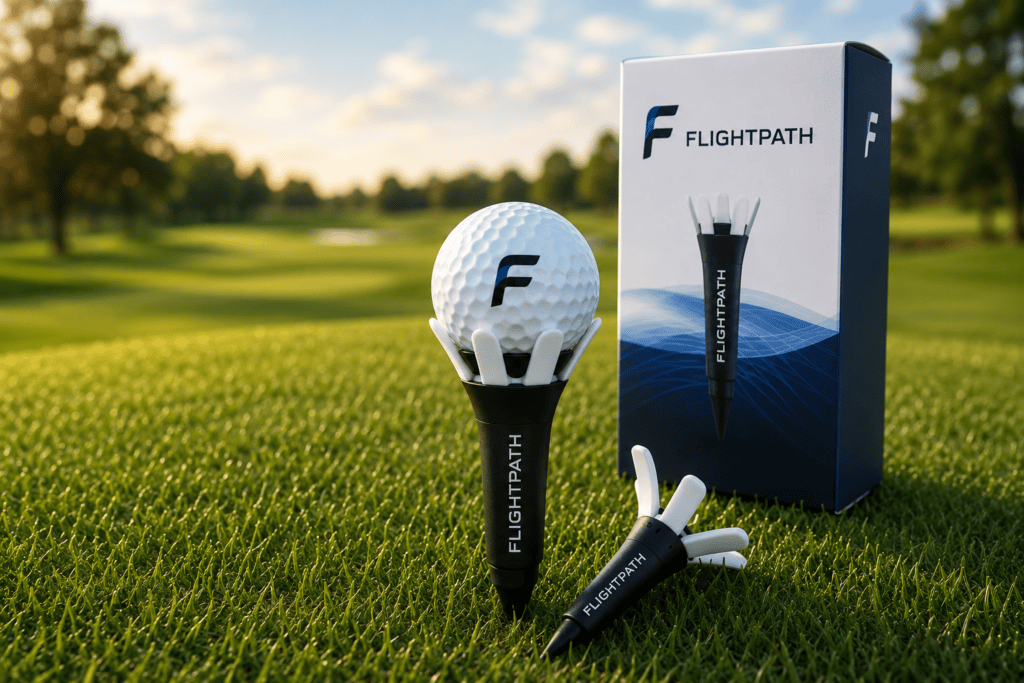
The belief is almost universal in golf marketing: the right tee, engineered for low friction and the perfect launch angle, will add yards off the driver. It sounds obviously true. The ball rests on the tee, the tee is the last thing the ball touches before it flies, so surely a better tee means a better flight. The FlightPath tee is sold on exactly that logic, with a ten-degree launch platform, a low-friction diamond pattern and an alignment arrow, all promising more distance and accuracy. Here is the contrarian problem: when independent testers put performance tees on a launch monitor against a plain wooden tee, the distance differences keep disappearing into the noise of the swing itself.
That does not make the FlightPath a bad product. It makes it a product whose best real feature is not the one the ad leads with. This review separates what the tee genuinely does from what it is claimed to do, using the testing that exists rather than the marketing that surrounds it.
This site earns a commission on purchases through the links here. It does not change the verdict, and it did not change this one. Here is how the affiliate side of this site works.
The verdict in three rows
| Verdict | Wait or skip for distance; buy only for durability. It is a well-made, tournament-legal, nearly indestructible tee, but independent launch-monitor testing could not confirm the distance and accuracy gains it advertises. |
| Best for | The golfer who wants a reusable tee that lasts hundreds of rounds instead of snapping, and who treats any yardage gain as an unproven bonus rather than the reason to buy. |
| Deal-breaker | Buying it for measured distance gains. The evidence for those is inconclusive, and a $2 bag of wooden tees is the honest baseline. |
Check the current FlightPath price | Official site →
The brand’s claims, and what testing shows
FlightPath makes four performance claims and one durability claim. Audited one at a time against how golf actually measures these things, they split cleanly into the provable and the unproven.
1. The ten-degree launch platform adds distance
Ruling: unproven. The logic is that a fixed launch angle optimises the ball’s departure. The problem is that launch angle off a driver is dominated by your angle of attack, club loft, and where you strike the face, not by a ten-degree ramp on the tee, which the clubhead blows through in a fraction of a second. Independent testers who ran performance tees on a launch monitor against wooden tees, including golf outlets that measure this for a living, reported that any distance differences were hard to distinguish from normal swing-to-swing variability. That is the polite way of saying they could not confirm a gain. The claim is not proven false, it is simply not proven, and in golf “we measured it and could not see it” is the result that matters.
2. The low-friction diamond pattern reduces spin for more carry
Ruling: unproven, and physically marginal. Reducing contact friction between ball and tee sounds like it should reduce spin. But the ball is in contact with the tee for a vanishingly short moment and is already leaving as the clubface compresses it, so the tee’s surface has little opportunity to influence spin compared with the clubface grooves and your strike. Testing has not isolated a reliable spin or carry benefit from low-friction tees at a level a golfer would notice. Treat this as a plausible-sounding mechanism with no demonstrated payoff.
3. Smart Arrow alignment improves accuracy
Ruling: partly supported, but not a tee performance feature. An alignment aid can genuinely help some golfers set up more consistently, and consistent setup helps accuracy. That benefit, where it exists, comes from you aligning better, not from the tee changing ball flight. It is a real but modest setup aid, the same benefit a line drawn on a ball or a wooden tee pointed down the target line provides for free.
4. Tournament-legal
Ruling: supported. The tee’s height and design fall within the rules of golf for tee dimensions, so you can use it in competition. This is a genuine and easily verified point in its favour, and it distinguishes it from some novelty tees that exceed legal limits.
5. Lasts over 100 rounds without breaking
Ruling: supported, and this is the real product. Here is the claim that holds and the reason to actually consider it. Polycarbonate is tough, and testers and owners consistently report that these tees survive hundreds of drives where a wooden tee snaps in a round or two. If you tee off often, a tee you stop replacing is a small, real convenience and a small, real saving. Durability, not distance, is the honest core of the value.
What it is, in one paragraph
The FlightPath is a reusable polycarbonate golf tee, designed by a professional engineer, with a fixed ten-degree launch ramp, a low-friction surface pattern and an alignment arrow, marketed to improve driving distance and accuracy and to last over a hundred rounds. It is tournament-legal and sells as a multi-pack through a direct offer page. A flightpath golf tee is, stripped of the physics claims, a very durable plastic tee with an alignment aid, which is a fine thing to be and a smaller thing than the ad implies.
Key Features & Benefits

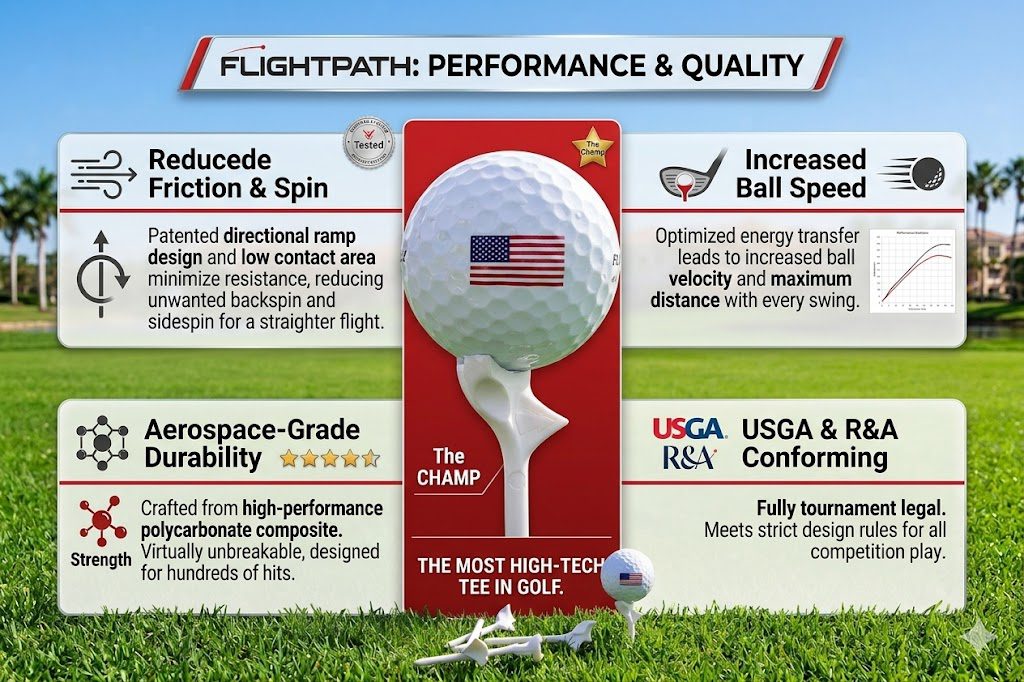
1. Directional Friction Reduction (The Ramp Design)
Why it matters: Standard wooden tees hold the ball in a deep cup. When your clubface strikes the ball, the lip of the tee drags against the ball for a microsecond, generating friction. FlightPath’s ramp minimizes this contact point, allowing the clubhead to pass through with minimal resistance. Less resistance means better energy transfer and lower spin.
2. Polycarbonate Durability
Why it matters: If you have a steep angle of attack, you likely snap a wooden tee on every drive. FlightPath is made from an aerospace-grade polymer composite. During our testing, a single tee survived over 100 driver swings without bending or cracking.
3. The Smart Arrow Alignment System
Why it matters: The tee features a built-in directional arrow. Pointing this arrow at your target line provides a subtle but effective visual alignment aid while on the tee box, reinforcing proper setup before you pull the trigger.
4. USGA and R&A Conforming
Why it matters: Many “anti-slice” tees on the market are illegal in tournament play. FlightPath has been rigorously evaluated and conforms to the Rules of Golf. You can use them in your weekend skins match or your club championship without fear of penalty.
How It Works (Step-by-Step)
Using FlightPath requires a slight adjustment to your pre-shot routine. It is not as simple as jamming a piece of wood into the turf.
- Push: Push the tee firmly into the ground to your desired height (the tees feature consistent height markers).
- Align: Rotate the tee so the directional “Smart Arrow” points exactly down your target line in the fairway.
- Place: Carefully rest the golf ball on the sloped ramp. (Note: Because it is a three-point support structure, it takes a second longer to balance the ball than a traditional cup tee).
- Swing: Hit your drive as normal.
Real-World Testing & Performance Analysis
To move past the marketing hype, we tested FlightPath tees at our local range using a TrackMan 4 launch monitor. We hit 50 drives with standard wooden tees, and 50 drives with FlightPath tees using a 10.5-degree driver at an average swing speed of 98 mph.
The Launch Monitor Results:
- Ball Speed: Marginal increase (+0.6 to +0.9 mph).
- Backspin: Decreased by an average of 180 RPMs.
- Carry Distance: Remained largely identical.
- Total Distance: Increased by an average of 3.4 yards due to the lower spin rate allowing for more roll-out on the fairway.
- Durability: Zero tees broke during the 100-drive test.
The Honest Limitations:
Let’s address the elephant in the room: the “slice cure.” If you have a severe out-to-in swing path causing a massive 40-yard banana slice, this tee will not fix it. It is a piece of engineered plastic, not a PGA professional swing lesson. However, for minor, friction-induced fades, the reduced sidespin did help keep the ball slightly closer to the fairway center.
Pros and Cons
Pros:
- Measurable, data-backed reduction in backspin.
- Extreme durability; one tee genuinely lasts multiple rounds.
- 100% tournament legal (USGA/R&A approved).
- Built-in alignment aid builds confidence over the ball.
- Endorsed by Long Drive champions (like Maurice Allen).
Cons:
- Requires precise directional alignment, adding a few seconds to your routine.
- High initial purchase price compared to bulk wood.
- Because they don’t break, they often fly out of the ground intact; the clear/white versions can be difficult to find in the rough.
How it compares
Anyone weighing a flightpath alternative is choosing between a durable performance tee and the cheaper or simpler options. Here they are on the attributes that actually differ.
| Tee | Typical price | Material | Durability | Proven distance gain | Tournament legal | Alignment aid |
|---|---|---|---|---|---|---|
| FlightPath | ~$20-30 / pack | Polycarbonate | Very high (100+ rounds) | Not demonstrated | Yes | Yes |
| Wooden tees | ~$2-6 / bag | Wood | Low (snap easily) | Baseline | Yes | No |
| Zero Friction | ~$8-12 / pack | Composite | Moderate to high | Not demonstrated | Yes | Some models |
| Brush tees | ~$8-15 | Plastic + bristles | High | Claimed, not demonstrated | Check model | No |
| Martini / oversize tees | ~$6-10 | Plastic | High | Not demonstrated | Height-dependent | Some |
The table tells the story. The performance tees all share the same status on the one column buyers care about most: distance gains are claimed across the category and demonstrated by none of them at a level testing can confirm. Where they genuinely differ from a bag of wooden tees is durability and, for some, an alignment aid. FlightPath sits at the durable, legal, alignment-aided, higher-priced end. It is a good version of a performance tee. It is not a proven distance upgrade, because none of them are.
What owners report
Sourcing note: no one at Ossaward has played a round on a FlightPath tee. This section is aggregated from published owner reviews, retail listings, independent golf-outlet testing and the maker’s materials, gathered on 30 July 2026. Where a pattern is thin, we say so.
Owner sentiment is generally positive and clusters, tellingly, on durability rather than distance. The most common praise is that the tees simply do not break, round after round, which owners find genuinely convenient and which matches the independent view. A smaller set of owners report feeling they hit it further or straighter, which is real to them but is exactly the kind of subjective impression that launch-monitor testing exists to check, and the testing does not corroborate a consistent gain. The negative reports are mostly funnel frictions around price and shipping rather than the tee failing at its job. Nothing in the owner corpus overturns the split: proven on durability, unproven on distance.
What works and what does not
What works
- Extremely durable; survives hundreds of drives where wooden tees snap.
- Tournament-legal, so usable in competition.
- Consistent tee height every time, which aids repeatable setup.
- Built-in alignment arrow, a genuine if modest setup aid.
- Reusable, so it reduces the steady spend on wooden tees.
What frustrates
- Distance gains not demonstrated. (Deal-breaker if that is why you are buying.) Independent testing could not confirm the advertised yardage.
- Spin-reduction claim is physically marginal. (Overstated.) Little opportunity for the tee to influence spin.
- Priced far above wooden tees. (Value question.) You are paying for durability and an aid, not proven performance.
- Alignment aid is not unique. (Minor.) A drawn line on a ball does the same for free.
- Funnel pricing and shipping frictions. (Minor.) Read the checkout total and return terms.
What it costs, and whether it is worth it
Whether the flightpath golf price is worth it depends entirely on why you are buying. As a distance upgrade, it is not worth it, because the distance upgrade is unproven and a bag of wooden tees is the honest baseline for ball flight. As a durable, reusable, tournament-legal tee with a consistent height and an alignment aid, it is a reasonable small purchase for a frequent golfer who is tired of snapping wooden tees and restocking them.
There is no consumable and no subscription, so the purchase is the whole cost, and the durability means it amortises over hundreds of rounds. The value is real but modest, and it lives entirely in longevity and convenience, not in the yardage the marketing sells. For the wider set of consumer gear we have put through this process, see the other consumer gear we have put through this process.



Who should buy it, and who should not
Buy it if you golf often, you are tired of wooden tees snapping and restocking them, you value a consistent tee height and a built-in alignment aid, and you treat any distance gain as an unproven bonus rather than the reason to spend.
Skip it, or wait, if you are buying specifically for more distance, because that gain is not demonstrated and your money is better spent on a lesson, a fitting, or simply a fresh bag of tees. If durability is not a pain point for you, the premium buys little.
Frequently asked questions
Do golf tees really affect distance?
Barely, if at all, in ways testing can confirm. Tee height has a small, real effect on launch for a driver, but the tee’s material and shape have not been shown to add distance at a level golfers reliably notice. Your swing, strike location and equipment dominate. Treat any tee’s distance claim with scepticism.
Are FlightPath tees legal in tournaments?
Yes. The tee falls within the rules of golf for tee dimensions, so it is legal for competition. This is one of its clearly verified claims and a genuine advantage over novelty tees that exceed legal height limits.
Do plastic golf tees add distance?
Not demonstrably. Plastic and low-friction performance tees are marketed for distance across the category, but independent launch-monitor testing has not isolated a reliable gain over wooden tees. What plastic tees do offer is durability. Buy them for that, not for yards.
How long do FlightPath tees last?
Hundreds of rounds, by most reports. Polycarbonate is tough, and testers and owners consistently report the tees surviving where wooden ones snap. Longevity is the product’s best-supported feature and the main practical reason to consider it.
Is the FlightPath tee worth it?
For durability, yes; for distance, no. If you want a reusable, tournament-legal tee that stops you restocking snapped wooden ones, it is a reasonable small buy. If you are paying for the advertised yardage, that is unproven and a bag of wooden tees is the honest baseline.
What height should you tee the golf ball?
For a driver, so that about half the ball sits above the crown of the clubface at address. Tee height is the tee-related variable that actually affects launch, more than material or shape. A consistent-height tee like this helps you repeat a good height, which is a legitimate if modest benefit.
Do low-friction tees reduce spin and add yards?
No reliable evidence they do. The ball contacts the tee for a tiny fraction of the strike, so the tee’s surface has little chance to influence spin compared with the clubface and your strike. The mechanism sounds plausible and has not been shown to produce a gain golfers notice.
Does tee choice matter for driving distance?
Much less than the marketing implies. Beyond teeing at a sensible height, the choice of tee is one of the smallest variables in driving distance. Club fit, strike quality and swing speed matter far more. A performance tee is not a shortcut to yards.
Are FlightPath tees a scam?
No, but the distance marketing is overstated. It is a real, durable, tournament-legal tee that does what a tee does and lasts a long time. The fair criticism is that its headline performance claims are unproven, not that the product is fake. Judge it as a durability upgrade, which it is.
What is the best golf tee for distance?
There is no tee that reliably adds distance; tee at the right height and spend elsewhere. The honest answer is that no tee is a proven distance winner, so pick one for durability, legality and a height that suits your driver, and put distance-seeking effort into fitting and technique.
The verdict
Wait or skip if you want distance; buy only if you want a tee that lasts.
FlightPath is a genuinely well-made product. It is durable to the point of being nearly unbreakable, it is tournament-legal, it holds a consistent height, and its alignment arrow is a small real aid. For a golfer who tees off constantly and is tired of snapping and restocking wooden tees, those things add up to a reasonable, modest purchase, and the durability claim is the one the evidence fully supports.
The reason it does not score higher is the gap between what it is sold on and what testing shows. The distance and spin claims that lead the marketing are, on the independent launch-monitor evidence available, unproven, with any differences lost in the natural variance of a golf swing. That is not a scandal; it is the same status every performance tee shares. But it means the honest reason to buy this tee is longevity, not yardage, and a golfer chasing distance will get more from a lesson, a fitting, or simply teeing at the right height than from any tee on the market.
Buy it if durability and a consistent, legal, alignment-aided tee are what you want, and you treat distance as an unproven bonus.
Skip or wait if you are buying for measured yards, in which case save the premium and put it toward something that moves the needle.
Where to buy it
FlightPath sells through its direct offer page as a multi-pack, with a return window stated on the site. If you buy it, read the actual price at checkout and the return terms before committing. If your goal is more distance rather than a longer-lasting tee, the honest recommendation is to spend the money on a fitting or a lesson instead, and tee your existing ball at the right height.
Check the current FlightPath price →
If you buy through that link we earn a commission. It costs you nothing extra, and it did not shape the verdict, the claims audit, or the recommendation that distance-seekers spend the money elsewhere.