






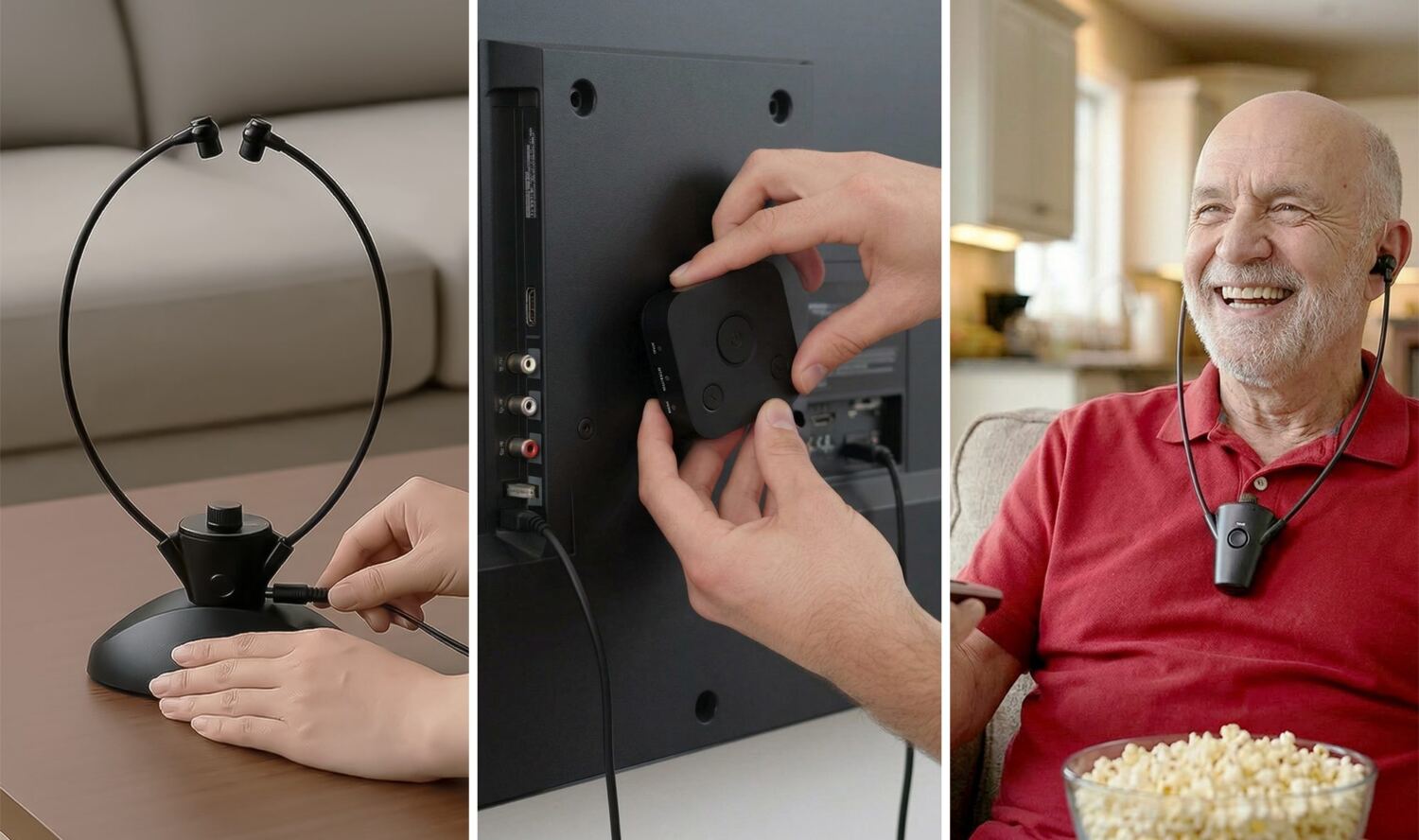
Almost every household with a TV has had this argument. One person needs it loud enough to catch the dialogue; the other finds that volume genuinely uncomfortable. Subtitles get switched on and off. The remote becomes a tug-of-war. Someone retreats to another room. It’s a small, daily friction that wears on couples and families — and it gets worse as hearing naturally changes with age.
The Hear Direct Wireless TV Headset is built to end exactly that argument. It’s a wireless headset that connects to your TV and lets you set your own personal volume, as loud as you like, while the TV speakers stay at whatever level works for everyone else in the room – or stay off entirely. Simple idea, real problem.
But there’s something important I need to address right at the top, because the way this product is marketed and searched for creates genuine confusion: the Hear Direct TV headset is not a hearing aid. It’s easy to assume it is – “Hear Direct” sounds medical, it’s marketed partly to people who are hard of hearing, and the brand confusingly sells a separate hearing aid product too. But the device at this offer is a TV headset, a consumer electronics product, not a medical hearing device. That distinction matters enormously, and I’ll explain exactly why below.
Here’s the honest review.
TL;DR — Hear Direct Review Summary
- ✅ It solves a real, common problem – the “TV volume war” is genuine, and a personal-volume wireless headset addresses it directly: you set your level, everyone else sets theirs
- ✅ No audio lag – dedicated wireless TV headphones (unlike most Bluetooth headphones) keep lips and dialogue in sync, which is the single biggest advantage over using AirPods or generic Bluetooth headphones with a TV
- ✅ Dialogue enhancement genuinely helps – voice-clarity processing makes speech easier to follow, a real benefit for anyone who struggles with mumbled TV dialogue or muddy sound mixes
- ✅ Dual output – the headset and TV speakers can run at the same time, independently, so one person can use the headset while others listen to the speakers at their own level
- ✅ Simple setup + works with ~99% of TVs – plugs into standard TV audio outputs, no Bluetooth pairing headaches, works with older TVs too
- ✅ 100-day money-back guarantee – unusually generous for electronics (most offer 30 days), genuinely lets you test it for months
- ❌ THE KEY DISTINCTION: it is NOT a hearing aid – this is the most important thing to understand. It amplifies and clarifies your TV’s audio in a headset; it does not correct hearing loss the way a medical hearing aid does, and it does nothing for hearing in conversations, on the phone, or anywhere but in front of your TV. If you have hearing loss, see an audiologist — don’t buy a TV headset as a hearing-aid substitute.
- ⚠️ Premium price for the category – the headset runs ~$129 and the headphones version ~$149; established brands (Sennheiser, Avantree, Sony) and $99 Amazon options exist; you’re paying mid-to-premium, not budget
- ⚠️ Brand sells both a TV headset AND a separate “Nova” hearing aid – easy to confuse; make sure you’re buying the product you actually want
- ⚠️ The “reviews” you’ll find are mostly paid – much of the Hear Direct coverage in search (Newswire, AccessNewswire) is sponsored affiliate content, not independent testing
- Bottom line: The Hear Direct Wireless TV Headset is a legitimate, well-conceived solution to the genuine problem of TV volume disagreements. The no-lag wireless tech, dialogue clarity, and dual-output are real, useful features, and the 100-day guarantee makes it low-risk to try. The two honest caveats: it’s priced at the premium end of a category with capable cheaper and established-brand alternatives, and – critically – it is not a hearing aid and shouldn’t be bought as one. If you want a personal-volume TV listening solution and you understand it’s a TV accessory (not a medical device), it’s a reasonable buy. If you have actual hearing loss, see an audiologist first.
Quick Verdict
| Overall Rating | 4.2 / 5 |
| Best For | Households with TV volume disagreements, people who find TV dialogue hard to follow, gift-givers (e.g. for a parent), anyone wanting lag-free personal TV volume |
| Avoid If | You have hearing loss and need a hearing aid (see an audiologist), you want the cheapest option, or you need hearing help beyond the TV |
| Product type | Wireless TV headset (consumer electronics) |
| NOT | A hearing aid or medical hearing device |
| Connection | Plugs into TV audio output (works ~99% of TVs) |
| Audio sync | No lag (dedicated wireless, not Bluetooth) |
| Key features | Personal volume, dialogue enhancement, dual output, noise cancellation |
| Battery | 8+ hours per charge |
| Price | Headset ~$129 / Headphones ~$149 (verify current offer) |
| Guarantee | 100-day money-back |
| Brand | Hear Direct Club, USA |
| The catch | It’s a TV accessory, not a hearing aid |
| Verdict | Recommended for personal TV volume — not as a hearing-aid substitute |
Check Hear Direct TV Headset Price →
The Most Important Thing: This Is Not a Hearing Aid
Before anything else, the single most important point – because misunderstanding it could cost someone their hearing health, not just their money.
The Hear Direct Wireless TV Headset is a TV accessory, not a hearing aid. Even honest independent reviewers of this exact product state it plainly: it is not a medical hearing device, and for clinical hearing support you should consult an audiologist.
Here’s the difference, and why it matters:
A hearing aid is a regulated medical device, fitted (or OTC-configured) to your specific hearing loss, that you wear throughout the day to amplify and process the specific frequencies you’ve lost – so you can hear conversations, the doorbell, the phone, traffic, and everything else in your daily life. It corrects your hearing across all situations.
The Hear Direct TV headset is a pair of wireless headphones that takes the audio signal from your television and plays it into your ears at your chosen volume, with some clarity processing. It works only when you’re sitting in front of your TV wearing it. It does nothing for hearing your spouse across the dinner table, hearing on the phone, or hearing anything else. It doesn’t correct hearing loss – it just gives you a personal, louder, clearer feed of your TV’s audio.
Why this distinction is critical: if you (or a parent you’re buying for) have genuine hearing loss, a TV headset is not the solution and buying one as a hearing-aid substitute can delay getting real help. Untreated hearing loss is linked to social isolation, depression, and even cognitive decline – it’s a health issue that warrants a professional hearing test and, if needed, actual hearing aids (which are now available over-the-counter as well as through audiologists). A TV headset solves one specific situation (the TV); it is not hearing care.
Adding to the confusion: the brand, Hear Direct Club, actually sells both a TV headset and a separate product called the “Nova hearing aid.” The “as seen on” press logos on the TV headset’s own page link to press releases about the hearing aid, not the headset. So even the brand’s marketing blurs the line. Be clear about which product you’re buying – the offer reviewed here is the TV headset, not the hearing aid.
With that essential distinction established, here’s an honest look at the TV headset for what it actually is – a genuinely useful TV accessory.
What Is Hear Direct? The Product Explained
The Hear Direct Wireless TV Headset is a dedicated wireless over-ear headphone system designed specifically for watching television – it connects to your TV’s audio output and lets you set your own personal listening volume, independently of (or alongside) the TV’s speakers, with dialogue-enhancement processing to make speech clearer.
Sold by Hear Direct Club (a US-based company) through its offer pages via the GiddyUp platform, the device addresses the “TV volume war” – the common household conflict where one person needs the volume higher than others find comfortable. With Hear Direct, the TV speakers can stay at a level the room is happy with (or off entirely), while the headset wearer hears at whatever volume works for them.
The system uses a dedicated wireless connection (not standard Bluetooth) between a transmitter that plugs into your TV and the headset – which is the key to its no-lag, always-synced audio. It’s designed to work with roughly 99% of TVs via standard audio outputs, sets up in about three steps, runs 8+ hours per charge, and includes dialogue/voice enhancement, background noise reduction, and dual-output capability (headset and TV speakers simultaneously).
The brand’s own store lists two related TV products: a “Wireless TV Headset” (~$129, regular $189) and a “Wireless TV Headphones” (~$149, regular $249). The offer reviewed here corresponds to the TV headset/headphones line. Every order includes a 100-day money-back guarantee and free US shipping.
An honest note for researchers: much of the Hear Direct “review” content ranking in Google (on Newswire, AccessNewswire, and similar – note the “Don’t Buy… Before Reading This First” headline pattern) is explicitly labeled sponsored affiliate content in its own fine print. The brand also cites “as seen on” Fox/CBS/NBC/ABC logos that link to paid press-release distribution (EIN Presswire), not editorial coverage. Treat both as marketing, not independent verification. This review is independent.
Product Overview Table
| Feature | Details |
|---|---|
| Product | Hear Direct Wireless TV Headset |
| Category | Dedicated wireless TV headphones (consumer electronics) |
| NOT | A hearing aid / medical hearing device |
| Connection | Transmitter into TV audio output; dedicated wireless to headset |
| TV compatibility | ~99% of TVs (standard audio outputs, incl. older TVs) |
| Audio sync | No lag — always synchronized (not Bluetooth) |
| Personal volume | Yes — independent of TV speaker volume |
| Dual output | Yes — headset + TV speakers simultaneously |
| Dialogue enhancement | Yes — voice-clarity processing |
| Noise handling | Background noise reduction |
| Battery | 8+ hours per charge |
| Comfort | Lightweight, soft breathable ear pads |
| Volume limiter | Safe-volume limiting (per brand) |
| Price | Headset ~$129 / Headphones ~$149 (verify) |
| Guarantee | 100-day money-back |
| Shipping | Free US; international available |
| Brand | Hear Direct Club, USA |
| Sold via | getheardirect.com / heardirectclub.com / GiddyUp |
Key Features and Benefits
1. Personal Volume Control – The Core Benefit
The whole point of the product, and it delivers on the central promise. The headset wearer sets their own volume, entirely independently of what the TV speakers are doing. One person can have the audio loud and crystal clear in the headset while the TV speakers stay at a comfortable room level — or are muted entirely so the wearer enjoys total immersion while the room stays quiet.
This is a genuine, structural solution to the volume-war problem rather than a compromise. Nobody has to tolerate a volume they dislike. For couples and families where TV volume is a recurring friction point, this single feature is the reason to buy.
2. No Audio Lag – The RF Advantage Over Bluetooth
This is the most underrated feature and the biggest technical advantage over the obvious alternative (just using Bluetooth headphones with your TV). Dedicated wireless TV headphone systems like Hear Direct use a direct transmitter-to-headset connection that keeps audio perfectly synced with the picture. Standard Bluetooth, by contrast, often introduces a lag where the sound trails the lip movements – subtle but genuinely distracting once you notice it, and a common complaint with AirPods or generic Bluetooth headphones used for TV.
Hear Direct’s dedicated wireless keeps lips and dialogue in sync. For anyone who’s been annoyed by Bluetooth audio delay on their TV, this alone is a meaningful upgrade. It’s also why dedicated TV headphones (Sennheiser, Avantree, Sony, and Hear Direct) exist as a category separate from regular Bluetooth headphones.
3. Dialogue Enhancement – Genuinely Useful
Modern TV sound mixes are notorious for burying dialogue under music and effects, and many people — not just those with hearing changes – struggle to follow speech without subtitles. Hear Direct’s voice-enhancement processing boosts and clarifies the dialogue frequencies, making speech noticeably easier to follow.
Independent reviewers of this product confirm the voice enhancement “actually works” – dialogue is clearer. This is a real benefit and one of the stronger reasons to choose a dialogue-focused TV headset over generic headphones. It’s worth being precise about what this is, though: it’s enhancing the clarity of the TV’s audio feed, not correcting your hearing. It helps everyone follow mumbled TV dialogue better; it’s especially helpful for people with mild hearing changes – but it’s still a TV-audio feature, not hearing correction.
4. Dual Output – Headset and Speakers Together
A genuinely thoughtful feature: the headset and the TV speakers can play simultaneously and independently. This means one person can wear the headset at their preferred (louder) volume while others in the room listen to the TV speakers at a comfortable level. It’s the “split the audio” capability that ordinary Bluetooth headphones can’t do – with Bluetooth, the TV speakers typically cut out when headphones connect.
For a household where one person needs more volume but others still want to hear the TV normally, this is the feature that makes everyone happy at once.
5. Simple Setup and Universal Compatibility
The system plugs into standard TV audio outputs (typically optical/digital or RCA analog – cables usually included in this category) and works with roughly 99% of TVs, including older models that don’t support Bluetooth. Setup is a simple three-step process with no Bluetooth pairing to fuss over and no technical expertise required. For the older or less tech-comfortable users this product is often aimed at, the plug-and-go simplicity is a real advantage over fiddly Bluetooth.
6. Comfort, Battery, and Safe Volume
The headset is lightweight with soft, breathable ear pads designed for hours of comfortable wear, runs 8+ hours per charge (enough for a full evening or more of viewing), and includes a safe-volume limiter so that even when you push the volume up for clarity, it stays within hearing-safe levels. That safe-volume feature is a genuinely responsible inclusion for a product whose users may be inclined to turn things up.
7. The 100-Day Money-Back Guarantee
A real standout: 100 days is far more generous than the 30-day return window typical of electronics. It effectively lets you test the headset across three months of real-world use – plenty of time to know whether it genuinely solves your household’s volume problem – before committing. For a product whose value is personal and situational, that long, risk-free trial is a meaningful reason to feel comfortable trying it.
What Real Users Say
The independent (non-sponsored) reviews of the Hear Direct TV headset are generally positive on the core function, with consistent themes worth relaying honestly.
The positives people report: it solves the volume disagreement as promised; the no-lag sync is noticeably better than Bluetooth; the dialogue enhancement makes speech clearer; setup is genuinely simple; and the dual-output is appreciated by households where one person needs more volume. The brand’s own (self-reported) stats claim 96% say dialogue is clearer, 98% turned the TV down without missing words, and 99% say their household is happier with the volume – treat the exact percentages as marketing, but the direction matches independent feedback.
The honest caveats that come up: the price is on the higher side for the category; and the recurring, important clarification — reinforced by honest reviewers – that this is a TV accessory, not a hearing aid, and shouldn’t be bought by someone who actually needs hearing correction.
The sponsored noise: as flagged, much of the glowing “review” content is paid placement. Weight the independent feedback and your own 100-day trial over the advertorials.
Hear Direct vs The Alternatives
| Feature | Hear Direct | Sennheiser / Avantree / Sony (dedicated TV headphones) | Bluetooth Headphones (AirPods etc.) | Budget Amazon TV Headphones | A Hearing Aid |
|---|---|---|---|---|---|
| Designed for TV | Yes | Yes | No (general) | Yes | No (all-day hearing) |
| No audio lag | Yes (dedicated wireless) | Yes (RF/dedicated) | Often lags | Usually yes | N/A |
| Personal volume | Yes | Yes | Yes | Yes | N/A |
| Dual output | Yes | Varies | No (cuts speakers) | Varies | N/A |
| Dialogue enhancement | Yes | Premium models | No | Some | Yes (medical) |
| Corrects hearing loss | No | No | No | No | Yes |
| Price | ~$129–$149 | ~$150–$400 | ~$80–$550 | ~$40–$100 | $200–$6,000+ |
| Best for | Volume-war households | Audio quality + brand trust | Existing earbud owners | Budget buyers | Actual hearing loss |
Hear Direct vs established TV-headphone brands (Sennheiser, Avantree, Sony)
These are the real competitors. Sennheiser, Avantree, and Sony are the established names in dedicated TV headphones, with proven RF/dedicated-wireless tech, strong audio quality, and brand track records. Their pricing ranges from comparable to Hear Direct (Avantree’s value models) up to premium (Sennheiser’s audiophile RS series at $300–$400). Hear Direct sits in the middle. If brand pedigree and proven audio quality matter most, an Avantree or Sennheiser is a safe, well-reviewed choice; Hear Direct’s pitch is simplicity and the volume-war framing at a mid-market price. Worth comparing directly.
Hear Direct vs Bluetooth headphones you already own
If you already own AirPods or Bluetooth headphones, you can use them with many TVs — but you’ll likely hit the two problems Hear Direct solves: audio lag (sound trailing the picture) and the loss of TV speaker sound for others in the room (Bluetooth usually can’t split audio). If those issues don’t bother you, your existing headphones may be “good enough” and free. If the lag drives you crazy or you need others to still hear the TV, a dedicated system like Hear Direct is the upgrade.
Hear Direct vs budget Amazon TV headphones
Budget dedicated TV headphones exist for $40–$100 (often marketed “for seniors hard of hearing”) with similar core features — personal volume, no lag, long battery. They can be a genuine value alternative. Hear Direct’s premium over these buys the simpler marketing-led setup, the dialogue-enhancement framing, and the 100-day guarantee — but a careful shopper should compare the budget options, which often have strong reviews and longer battery life, before paying the premium.
Hear Direct vs an actual hearing aid
Not a real comparison — different products for different needs. If your problem is only TV volume, a TV headset is the right, far cheaper tool. If your problem is hearing loss affecting your whole life, a hearing aid (now available OTC for $200–$1,000+ as well as prescription) is the right tool, and a TV headset won’t address it. The deciding question: is your difficulty only with the TV, or with hearing generally? Be honest about which, because the answers point to completely different products.
Pricing and Value Analysis
Current pricing (verify at checkout – promotional):
| Product | Sale Price | Regular |
|---|---|---|
| Wireless TV Headset | ~$129 | ~$189 |
| Wireless TV Headphones | ~$149 | ~$249 |
| Shipping | Free (US, qualifying) | |
| Guarantee | 100-day money-back |
Note the brand offers two related products at different prices – confirm which one you’re buying and the current price at checkout, as promotions change.
The honest value read: at ~$129–$149, Hear Direct is priced at the mid-to-premium end of the dedicated TV-headphone category. That’s not unreasonable for what it does — it’s a real, capable solution to a real problem with a class-leading 100-day guarantee — but it’s not a bargain either. The crucial framing: don’t compare this to hearing aids “costing thousands” (a comparison the hearing-adjacent marketing invites). It’s a TV headset, and the honest comparison is against other TV headphones: established brands like Avantree and Sennheiser (some comparable, some pricier but with stronger pedigree) and budget Amazon options ($40–$100) with similar core features.
The value verdict: if the simplicity, the dialogue-enhancement framing, and especially the 100-day risk-free trial appeal to you, Hear Direct’s price is fair. If you’re a value-focused shopper willing to compare specs, capable cheaper alternatives exist and are worth a look before paying the premium.
Check Current Hear Direct Price →
Who Should Buy Hear Direct
Hear Direct is a reasonable choice if:
- Your household has TV volume disagreements – this is the core use case, and the personal-volume plus dual-output design solves it directly and well
- You find TV dialogue hard to follow – the voice enhancement genuinely makes mumbled or buried dialogue clearer, letting you ditch subtitles
- You’re frustrated by Bluetooth audio lag – the no-lag dedicated wireless is a real upgrade over using AirPods or generic Bluetooth headphones with your TV
- You want simple, plug-and-go setup – no Bluetooth pairing, works with ~99% of TVs including older ones; good for less tech-comfortable users
- You’re buying a practical gift – for a parent, spouse, or anyone whose TV volume is a running household issue (a common Father’s Day / gift purchase); the 100-day guarantee makes it low-risk
- You value a long, risk-free trial – the 100-day money-back window is genuinely generous and lets you test it thoroughly
- You understand it’s a TV accessory – you’re buying it for TV listening, not as a hearing-loss solution
Who Should Avoid Hear Direct
Be honest about your actual need:
- You have hearing loss and need a hearing aid – the most important one. If you struggle to hear in conversations, on the phone, or in daily life — not just at the TV – a TV headset won’t help. See an audiologist; untreated hearing loss is a genuine health issue. Don’t buy this as a hearing-aid substitute.
- You want the cheapest option – capable budget TV headphones exist for $40–$100; if price is the priority, compare those first
- You want established-brand pedigree – Sennheiser, Sony, and Avantree have longer track records and extensive independent reviews; if proven audio quality matters most, consider them
- You need hearing help beyond the TV – this device only works in front of your television; it does nothing for any other listening situation
- You’re confusing it with the brand’s hearing aid – Hear Direct Club sells a separate “Nova hearing aid”; if that’s what you want, make sure you’re buying that product, not the TV headset
- Your TV setup is unusual – while it works with ~99% of TVs, confirm your TV’s audio outputs are compatible if you have a very old or very unusual setup
Expert Tips for Getting the Most From a TV Headset
Tip 1: Be honest about whether your problem is the TV or your hearing. If you only struggle with the TV, a headset is the right tool. If you struggle to hear conversations, the phone, or daily life, get a hearing test first – a TV headset would leave the real issue unaddressed. This is the most important decision before buying.
Tip 2: Use the dual-output feature. Don’t mute the TV speakers out of habit. The headset and speakers can run together independently – so set the TV speakers to a level the room likes and your headset to your level. That’s the feature that actually ends the volume war.
Tip 3: Check your TV’s audio outputs before ordering. Confirm your TV has a standard audio output (optical/digital or RCA) that the transmitter connects to. It works with ~99% of TVs, but a 30-second check of your TV’s ports avoids any surprise.
Tip 4: Take advantage of the full 100-day trial. Don’t judge it in one evening. Use it across different content — sports, dialogue-heavy dramas, movies – and over several weeks. The generous return window exists precisely so you can be sure before committing.
Tip 5: Use the dialogue enhancement, then dial it in. Turn on the voice-enhancement feature and adjust your volume to where speech is clear without being uncomfortably loud. The goal is clarity, not maximum volume – let the enhancement do the work rather than just cranking it up.
Tip 6: Keep it charged on a routine. With 8+ hours per charge, charging it overnight or between viewing sessions means it’s always ready. A dead headset mid-show is the main avoidable annoyance.
Tip 7: Compare against alternatives during your trial window. Since the guarantee is 100 days, it’s reasonable to compare Hear Direct against a budget or established-brand alternative before the window closes, and keep whichever genuinely works best for your household.
Common Mistakes Buyers Make
Mistake 1: Buying it as a hearing aid. The single most consequential mistake. It’s a TV accessory, not a medical hearing device. If you have hearing loss, this won’t fix it and may delay you getting real help. See an audiologist.
Mistake 2: Confusing it with the brand’s “Nova” hearing aid. Hear Direct Club sells both. Make sure you’re ordering the product you actually want – the TV headset or the separate hearing aid.
Mistake 3: Not comparing against cheaper or established-brand alternatives. Capable TV headphones exist at lower prices (Amazon budget options) and from proven brands (Avantree, Sennheiser). Compare before paying the premium.
Mistake 4: Muting the TV speakers unnecessarily. The dual-output feature lets others keep hearing the TV. Use it – that’s the whole point of solving the volume war rather than just retreating into headphones.
Mistake 5: Believing the “as seen on” logos are endorsements. Those Fox/CBS/NBC/ABC logos link to paid press-release distribution, not editorial reviews. They’re marketing, not independent validation.
Mistake 6: Not using the 100-day guarantee. It’s one of the most generous in electronics. If the headset doesn’t genuinely solve your problem, return it within the window – don’t let it gather dust.
TV Headphone Buying Guide: What to Look For
If you’re shopping for TV headphones for the first time, here’s what actually matters.
TV-only or all-day hearing? The first and most important question. Dedicated TV headphones solve TV listening. If you need help hearing in general, that’s a hearing aid (OTC or prescription), not a TV headset. Be clear which problem you’re solving before spending anything.
Dedicated wireless vs Bluetooth. Dedicated/RF TV headphone systems (Hear Direct, Avantree, Sennheiser) stay perfectly synced with the picture – no lag – and connect to nearly any TV including older ones. Bluetooth can lag and may not let others keep hearing the TV speakers. For TV specifically, dedicated wireless is usually the better choice.
Dual-output (audio splitting). If anyone else watches with you, look for the ability to run the headset and TV speakers simultaneously and independently. This is what actually ends the volume war, versus just isolating the headphone wearer.
Dialogue enhancement. If following speech is your main issue, voice-clarity processing is a genuinely useful feature. Many dedicated TV headphones offer it; it helps with muddy TV sound mixes regardless of hearing ability.
Battery life and comfort. Look for enough battery for your typical viewing (8+ hours is plenty for most), lightweight build, and comfortable ear pads for long sessions. Some budget models actually exceed premium ones on battery (50-hour models exist).
Return policy. Because whether it works is personal, a generous return window matters. Hear Direct’s 100 days is class-leading; even 30 days from others is workable. Prioritize a real trial period.
Price in context. Dedicated TV headphones range from ~$40 (budget) to ~$400 (premium Sennheiser). More expensive isn’t always better for your needs – match features to your actual problem, and don’t pay hearing-aid-comparison prices for a TV accessory.
Image SEO Suggestions
- Hero:
hear-direct-wireless-tv-headset-review-2026.jpg— alt: “Hear Direct wireless TV headset review 2026 — personal volume TV headphones” - How it works:
hear-direct-tv-headset-transmitter-setup.jpg— alt: “How Hear Direct works — transmitter connects to TV for wireless personal-volume headset” - Comparison:
hear-direct-vs-sennheiser-avantree-tv-headphones.jpg— alt: “Hear Direct vs Sennheiser vs Avantree dedicated TV headphones comparison 2026” - Not-a-hearing-aid graphic:
tv-headset-vs-hearing-aid-difference.jpg— alt: “TV headset vs hearing aid — the difference every buyer should know” - All images: under 200KB, WebP format
Frequently Asked Questions
Is Hear Direct a hearing aid?
No. The Hear Direct Wireless TV Headset is a TV accessory – a pair of wireless headphones that plays your TV’s audio at your own chosen volume with clarity enhancement. It is not a hearing aid or medical hearing device. It only works in front of your TV and does nothing for hearing conversations, the phone, or daily life. Even honest independent reviewers of this product state it is not a medical hearing device and that for clinical hearing support you should consult an audiologist. Note: the brand, Hear Direct Club, separately sells a “Nova” hearing aid – a different product. If you have hearing loss, see an audiologist rather than buying a TV headset.
Does Hear Direct actually work?
Yes, for what it is – a TV listening solution. It delivers personal volume control independent of the TV speakers, no-lag audio that stays synced with the picture (a real advantage over Bluetooth headphones), dialogue enhancement that makes speech clearer, and dual-output so others can still hear the TV speakers. Independent reviewers confirm the core features work as described, particularly the no-lag sync and the dialogue clarity. It genuinely solves the “TV volume war” problem it’s designed for.
How much does Hear Direct cost?
The brand offers two related products: a Wireless TV Headset at approximately $129 (regular $189) and Wireless TV Headphones at approximately $149 (regular $249), both with free US shipping and a 100-day money-back guarantee. Promotional pricing changes, so verify the current price and confirm which product you’re buying at checkout. At this price, it’s mid-to-premium for the TV-headphone category — not a budget option, but backed by an unusually long return window.
How is Hear Direct different from regular Bluetooth headphones?
Two key differences. First, no audio lag: Hear Direct uses a dedicated wireless connection that keeps sound perfectly synced with the picture, while Bluetooth headphones often lag, with sound trailing the lip movements. Second, dual output: Hear Direct lets the TV speakers keep playing for others while you use the headset, whereas Bluetooth typically cuts the TV speakers when headphones connect. It also works with virtually any TV including older ones without Bluetooth. If you’ve found Bluetooth headphones laggy or antisocial for TV, that’s what the dedicated system fixes.
Will Hear Direct help me hear the TV better?
Yes, in two ways: you can set your own volume as loud as you comfortably want (independent of the room), and the dialogue-enhancement processing makes speech clearer and easier to follow. For people who struggle with mumbled or buried TV dialogue, this genuinely helps. Important caveat: it improves your TV listening, but it does not correct hearing loss. If you have difficulty hearing generally — not just at the TV — that’s a sign to get a hearing test, because a TV headset won’t address hearing loss in other situations.
Does Hear Direct work with my TV?
It’s designed to work with approximately 99% of TVs by connecting a transmitter to your TV’s standard audio output (typically optical/digital or RCA analog), including older TVs that don’t support Bluetooth. Setup is a simple three-step process. To be sure, check that your TV has a standard audio output port before ordering. If you have a very old or unusual setup, confirm compatibility with the brand first — the 100-day guarantee covers you if it doesn’t work with your TV.
How long does the Hear Direct battery last?
The headset runs 8+ hours per charge, which is enough for a full evening or more of TV viewing. Charging it overnight or between sessions keeps it ready. Note that some budget competitor models advertise longer battery life (up to 50 hours), so if marathon all-day battery is a priority, it’s worth comparing — but 8+ hours covers typical daily use comfortably.
Is Hear Direct good for seniors?
It can be well-suited to seniors specifically because of its simplicity — plug-and-go setup with no Bluetooth pairing, works with older TVs, lightweight comfortable design, and clearer dialogue. It’s a common gift for an older parent whose TV volume has become a household issue. The crucial caveat: if the senior has actual hearing loss (struggling to hear conversations, not just the TV), a TV headset is not a substitute for a hearing test and hearing aids. Use it for the TV-specific problem; address general hearing loss with an audiologist.
Are the “as seen on” media logos real endorsements?
No. The Fox, CBS, NBC, and ABC logos on the product page link to paid press-release distribution (via EIN Presswire syndicated to local-station websites), not editorial coverage or endorsements. This is a common marketing practice — paying to distribute a press release that appears on news-affiliate sites. Treat the logos as brand awareness, not independent validation. Similarly, much of the “review” content for Hear Direct online is sponsored affiliate content. Rely on independent reviews and your own 100-day trial instead.
Is Hear Direct worth it?
For the right buyer, yes. If your household has TV volume disagreements, you find TV dialogue hard to follow, or you’re frustrated by Bluetooth lag, Hear Direct solves those problems well, and the 100-day guarantee makes it low-risk to try. The honest caveats: it’s priced at the premium end of the category (capable alternatives from Avantree, Sennheiser, and budget brands exist), and it’s not a hearing aid. If you want a personal-volume TV solution and understand what it is, it’s a reasonable buy. If you have hearing loss, see an audiologist instead.
Final Verdict
Hear Direct: 4.2 / 5
After researching the product, the dedicated-TV-headphone category, and cutting through the sponsored “reviews,” here’s my honest verdict.
The Hear Direct Wireless TV Headset is a legitimate, well-conceived solution to a genuinely common problem. The TV volume war is real, and Hear Direct addresses it directly: personal volume control, no-lag audio that stays synced with the picture, dialogue enhancement that genuinely makes speech clearer, and dual-output so the rest of the household can still hear the TV. The setup is simple, it works with nearly any TV, and the 100-day money-back guarantee is one of the most generous in electronics. For what it is — a dedicated TV listening device — it does the job well.
The two honest caveats define who should and shouldn’t buy it. First, it’s priced at the mid-to-premium end of the category. Capable budget TV headphones exist for half the price, and established brands like Avantree and Sennheiser offer proven alternatives worth comparing. You’re paying for simplicity and a long guarantee, not a unique technology, so a value-focused shopper should compare before buying.
Second, and most importantly: it is not a hearing aid. This is the point I’ve emphasized throughout because it matters most. Hear Direct improves your TV listening; it does not correct hearing loss, and it does nothing for hearing in any situation other than in front of your television. If you — or the parent you’re buying for — struggle to hear in conversations, on the phone, or in daily life, that’s hearing loss, and the right response is a hearing test and, if needed, actual hearing aids (now available over the counter as well as through audiologists). Buying a TV headset as a hearing-aid substitute leaves a real health issue unaddressed. The brand’s separate “Nova hearing aid” and the hearing-adjacent marketing make this confusion easy — so be clear about what you’re buying and what problem you’re solving.
Within those honest limits, Hear Direct is a reasonable buy. It’s a capable, simple, well-guaranteed TV listening solution for households tired of the volume war — sold at a premium, with marketing that flirts with the hearing-aid association it shouldn’t. Buy it for the TV, understand it’s not hearing care, and it does exactly what it promises.
Buy it if: your household fights over TV volume, you find dialogue hard to follow, you want lag-free personal TV audio, and you understand it’s a TV accessory — and you’ll use the 100-day trial.
Skip it (or see an audiologist) if: you have hearing loss needing correction, you want the cheapest option, you want established-brand pedigree, or you need hearing help beyond the TV.
The volume war is real, and Hear Direct genuinely ends it. Just buy it for what it is — a quality TV headset — and get a hearing test instead if the real issue is your hearing.
Check Hear Direct TV Headset Price →
100-day money-back guarantee. Free US shipping. Works with ~99% of TVs. Not a hearing aid — consult an audiologist for hearing loss.
We earn a small commission if you purchase through our link at no extra cost to you. This review was conducted independently — Hear Direct did not pay for or sponsor it. This content is informational and not medical or audiological advice. Last reviewed June 2026.

