






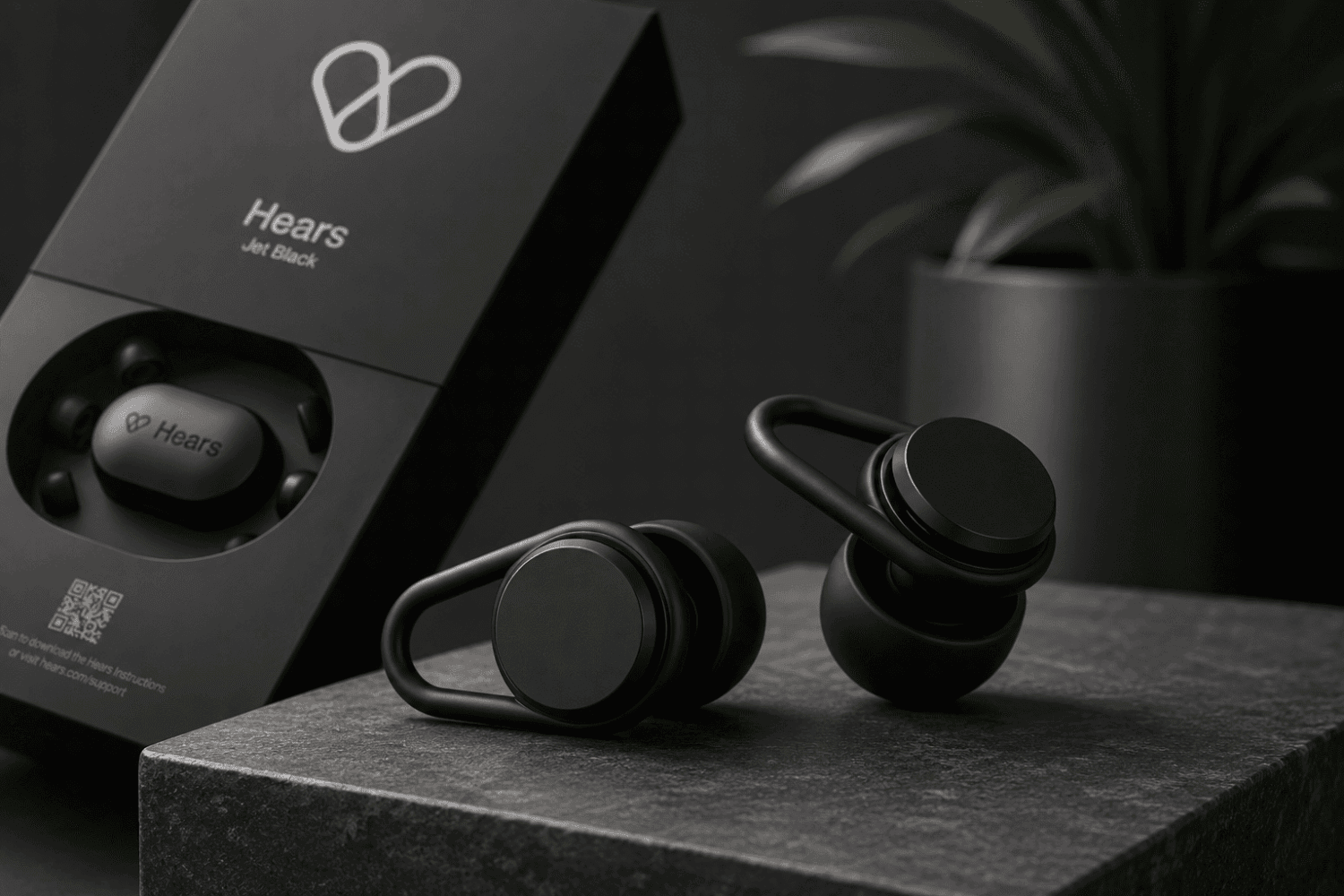
Hears is a pair of reusable, high-fidelity earplugs designed to protect your hearing by lowering the volume of the world around you evenly, by up to 20 decibels, while keeping sound clear instead of muffled. The pitch is appealing and, refreshingly, mostly grounded: rather than the cotton-wool muffling of foam plugs, Hears promises to work “like a volume knob, not a mute button,” so you can wear them at concerts, at work, while sleeping, or in daily life and still hear music, voices, and conversation clearly, just at a safer level. The real question is whether they live up to it, and whether this particular brand is the one to buy.
If you have ever left a concert with ringing ears, or found foam earplugs useless because they muffle everything into mush, you already understand the problem Hears is trying to solve, and it is a real, worthwhile one. Here is our honest position up front: high-fidelity earplugs are a genuinely useful, beneficial product category, and Hears appears to be a competent example, reusable, comfortable, multi-use, and even carrying a real design award. Protecting your hearing while still enjoying clear sound is a smart thing to do. But some of the marketing overstates what these are (they are passive filters, not “automatic” smart devices), the protection level is not independently certified, and this is a generic direct-to-consumer brand competing against well-established, independently tested high-fidelity earplugs. This review separates the genuine value from the salesmanship.
We analyzed the product and how high-fidelity earplugs actually work. Here is the complete, balanced picture.
Summary
- What they are: Reusable, high-fidelity (flat-attenuation) earplugs that lower volume evenly while preserving sound clarity, with multiple ear-tip sizes and a case.
- The core idea is genuinely good: Unlike foam plugs that muffle, these reduce volume while keeping music and voices clear, real, useful hearing protection.
- Reusable and versatile: Suitable for concerts, daily noise, sleep, focus, travel, and noise sensitivity, and they last for years, better value than disposable foam.
- But they are passive, not “automatic”: The “automatically tune sounds” wording overstates it. These are passive acoustic filters with a roughly fixed reduction, not electronic or adaptive.
- No certified rating: “Up to 20dB” is the brand’s figure, not a certified Noise Reduction Rating, and 20dB is moderate, fine for concerts and daily life, not maximum protection.
- Brand-cited stats: The “93% sound preserved,” “4.9/5,” “200,000+ users,” and “developed by leading audiologists” claims are the seller’s own. The Red Dot design award appears genuine (but it is a design award, not proof of protection).
- Generic brand, proven rivals: Established high-fidelity earplugs (Loop, Etymotic, EarPeace) have certified ratings and independent reviews, often at similar prices.
- Best for: Concertgoers, commuters, light sleepers, the noise-sensitive, and anyone wanting clear-sounding everyday hearing protection.
- Skip it if: You need maximum, certified protection for very loud industrial or firearm noise, or you prefer a proven brand.
Quick Verdict Box
Ossaward Rating: 3.5 / 5
One-line summary: A genuinely useful, comfortable, reusable high-fidelity earplug that delivers the real benefit of its category, clear sound at a safer volume, lightly oversold with “automatic” smart-sounding language it does not earn, sold without a certified rating by a generic brand that faces strong, proven competition.
| Best for | Concerts, daily noise, sleep, focus, travel, noise sensitivity |
| Avoid if | You need maximum, certified protection (industrial, firearms) |
| Type | Reusable high-fidelity (flat-attenuation) earplugs |
| Reduction | Up to 20dB (brand figure; not a certified NRR) |
| Mechanism | Passive acoustic filter (not electronic or adaptive) |
| Includes | 4 ear-tip sizes, carrying case |
| Recognition | Red Dot Design Award (design, not protection rating) |
| Guarantee | 100-day money-back |
Reviewed by Olliver Peck, Ossaward portable-tech and audio reviewer. Approach: assessing Hears against how high-fidelity earplugs actually work and against established competitors, and being clear about the difference between marketing language and certified performance.
Product Overview Table
| Specification | Detail |
|---|---|
| Product | Hears high-fidelity earplugs |
| Type | Reusable, passive flat-attenuation filter earplugs |
| Noise reduction | Up to 20dB (manufacturer figure) |
| Sound goal | Even reduction that preserves clarity (not muffling) |
| Fit | 4 ear-tip sizes; low-profile, secure design |
| Materials | Hypoallergenic, sweat-resistant, body-safe |
| Reusable | Yes; designed to last for years |
| Includes | Earplugs, 4 tip sizes, premium carrying case |
| Recognition | Red Dot Design Award; some press mentions |
| Brand | Hears (sold via GiddyUp funnel) |
| Guarantee | 100-day money-back; price shown at checkout |
What Are Hears Earplugs?
Hears are reusable, high-fidelity earplugs that use a passive acoustic filter to lower the volume of sound evenly across frequencies, so the world gets quieter and safer without becoming muffled. You pick one of four included ear-tip sizes, insert them like any earplug, and they reduce incoming sound by a stated figure of up to 20 decibels while letting you still hear music, conversation, and your surroundings clearly. A carrying case is included, and the materials are designed to be comfortable, hypoallergenic, and durable enough to last for years.
The category they belong to is genuinely worthwhile, and worth understanding because it is the key to why these are a sensible product. Ordinary foam earplugs reduce volume by blocking sound indiscriminately, which is why everything sounds muffled, dull, and underwater through them, you lose clarity along with the loudness. High-fidelity earplugs (also called flat-attenuation or musician’s earplugs) use a small engineered filter to bring the volume down more evenly across the frequency range, so music keeps its detail and speech stays intelligible, just at a safer level. This is the established technology behind well-known brands used by musicians and concertgoers, and it is a real, effective approach. Hears is a direct-to-consumer entry in this category, and on the evidence of its design and the category it sits in, the basic product concept is sound.
The Genuine Benefit: Clear Sound at a Safer Volume
The main thing Hears promises, reducing harmful volume while preserving sound clarity, is a real and valuable benefit, and it is the honest heart of the product. This is where it earns its keep.
Protecting your hearing matters more than many people realize. Sustained or repeated exposure to loud sound, concerts, power tools, loud workplaces, even prolonged city noise, can cause gradual, permanent hearing damage and tinnitus, and once that damage is done it does not come back. The problem with traditional foam plugs is that they work, but they make everything sound muffled, so people hate wearing them and often skip them at exactly the moments they need them. High-fidelity earplugs like Hears solve that behavioral problem: because they keep sound clear and natural while lowering the volume, people are far more willing to actually wear them. For a concert, you still hear the music properly, just safely; for a noisy restaurant or office, you take the edge off without feeling cut off; for sleep, you dull the snoring or street noise; for noise sensitivity, you reduce overwhelming input while staying connected to your environment. That versatility from a single reusable pair, with multiple tip sizes for a good fit, is genuinely useful and good value compared with constantly buying disposable foam. On its core promise, this category, and apparently this product, delivers.
Who Are Hears Earplugs For?
Hears works best for people who want protection without isolation. Based on how owners describe using them, here is who fits:
- Concert and festival fans — You want to enjoy the show, hear your friends, and skip the next-day ear ringing. This is Hears’ core use case and where positive reviews cluster.
- Musicians and sound-adjacent pros — You need volume down but speech and instrument clarity intact. High-fidelity plugs exist for exactly this.
- Light sleepers — Helpful for snoring partners and street noise, as long as you understand they reduce rather than fully block sound.
- Noise-sensitive people — Useful for taking the edge off overwhelming environments without feeling cut off.
- Travelers — Planes, trains, and long road trips where you still want to hear announcements.
- Parents and busy-workplace folks — Restaurants, bars, open offices, and the general chaos of a loud household.
Who should think twice: If your goal is total silence to sleep through anything, a dedicated sleep plug with a higher rating will serve you better. If you need certified protection for industrial noise, power tools, or firearms, you need rated occupational protection, not a lifestyle earplug. And if you want the cheapest possible option, foam or budget filtered plugs cost a fraction of the price.
Key Features, and What They Actually Mean
Noise reduction up to 20dB
Hears advertises up to 20dB of reduction. That figure is a best-case lab number. In the real world, the reduction you get depends almost entirely on how well the tip seals your ear canal, and independent guidance is clear that rated values overstate everyday performance. The practical takeaway from owner reports is that Hears meaningfully takes the dangerous edge off a loud room or show, but treat “20dB” as a ceiling, not a guarantee.
93% natural sound preserved
This is the high-fidelity promise: lower the volume evenly so music does not turn into mud. Owners who like Hears consistently mention this. The honest nuance is that every passive earplug colors sound at least a little. Owners describe Hears as clearer than foam, and a minority still notice a slight change to the audio. That is normal for the category, not a Hears-specific flaw.
Membrane filter technology
The filter is what separates a high-fidelity plug from a foam one. Sound passes through a tuned channel rather than being smothered. This is a real and meaningful design difference, and it is why Hears can keep speech intelligible while cutting volume.
Four ear tip sizes and fit
Fit is the single biggest factor in whether any earplug works, full stop. Including four tip sizes is a genuine plus, because a plug that does not seal protects almost nothing. Some owners still needed to experiment to find their size, and a few reported a tip missing from the box, which is a quality-control miss worth flagging.
Low-profile, near-invisible design
The clear, flush design is a frequently praised detail. People like that the plugs do not stick out in photos and do not announce themselves. This is a comfort-and-confidence feature more than a performance one, but it is a real reason people reach for them instead of leaving them at home.
Sweat resistance and durability
Made to survive activity, sweat, and repeated use, and reusable for the long term, which is the value argument against single-use foam. Most owners report they hold up. The carrying case is meant to extend their life, though some buyers were unimpressed with the case quality.
Where the Marketing Overstates Things
The product is good, but several claims dress it up as more advanced or more proven than it is. Knowing the difference helps you buy wisely.
“Automatically tune sounds” and “a second set of eardrums.” This is the most misleading framing. Hears are passive acoustic filters, there is no electronics, no battery, no sensing, and nothing that “automatically” adjusts to your environment. The filter simply reduces sound by a roughly fixed amount whenever you wear it. That is exactly how good high-fidelity earplugs work, and it is fine, but the “automatically tune” and “acts as a second set of eardrums by actively diminishing sound vibration energy” language implies smart, adaptive technology the product does not have. Read it as a well-designed passive filter, not an electronic device.
“Up to 20dB” with no certified rating. Real hearing protection is usually graded with a certified Noise Reduction Rating (NRR) under a recognized standard, which tells you how much protection you are actually getting. Hears advertises “up to 20dB” but does not appear to publish a certified NRR. “Up to 20dB” is a manufacturer figure, and 20dB is a moderate reduction, ideal for concerts, daily life, and sleep, but not maximum protection. For genuinely hazardous noise, such as industrial machinery or firearms, you want protection with a clearly certified rating, often higher than 20dB. The lack of a published certification is a meaningful gap for anyone relying on these for serious protection.
The statistics and endorsements. Claims like “93% of natural sound preserved,” “rated 4.9/5 with 3,400+ reviews,” “200,000+ users,” “developed by the world’s leading audiologists,” and “trusted by touring musicians” are brand-provided and unverified. They may well be broadly true of the category, but treat the specific figures as marketing. The Red Dot Design Award does appear to be genuine, which is a nice signal of design quality, but it is a design award, recognizing aesthetics and concept, not an independent test of hearing-protection performance.
None of this means Hears do not work. It means the product is a solid passive high-fidelity earplug wearing some smart-sounding, lab-sounding language it has not fully earned.
Comfort, Fit, and Everyday Use
On the practical side, the design choices are sensible. Including four ear-tip sizes is genuinely important, because fit determines both comfort and how well any earplug actually seals and protects, so having options to match your ear is a real plus. The low-profile, clear design sits relatively flush with the ear, which makes them discreet, and the hypoallergenic, sweat-resistant materials suit extended wear and active use. Being reusable and washable, with a carrying case, makes them convenient and better value over time than disposables.
The honest, individual caveat is that comfort and seal vary from person to person with any in-ear product, and the quality of protection depends on getting a proper seal with the right tip size. Some people find any earplug uncomfortable for very long sessions or while lying on their side to sleep. The 100-day money-back guarantee is genuinely helpful here, since it lets you confirm the fit and comfort work for your ears with little risk, which is the smart way to buy any earplug.
Pros and Cons
Pros
- Real, useful benefit. Lowers harmful volume while keeping sound clear, not muffled.
- Genuinely versatile. Concerts, daily noise, sleep, focus, travel, noise sensitivity.
- Reusable and good value. Lasts for years versus disposable foam.
- Multiple tip sizes and a case. Better fit, comfort, and convenience.
- Comfortable, discreet, body-safe materials. Suitable for extended and active wear.
- Red Dot Design Award and a generous 100-day guarantee.
Cons
- Passive, not “automatic.” No electronics or adaptive tuning, despite the wording.
- No certified NRR. “Up to 20dB” is a brand figure, not a certified rating.
- Moderate protection. 20dB is fine for concerts and daily life, not maximum.
- Brand-cited stats. The percentages, ratings, and endorsements are unverified.
- Generic funnel brand. Faces proven, independently tested competitors.
- Opaque pricing. “40% off” urgency rather than a clear price.
Who Should Buy Hears
They are a sensible choice for concertgoers and music lovers who want to protect their ears without ruining the sound, commuters and city dwellers dealing with constant noise, light sleepers bothered by snoring or street noise, people with noise sensitivity who feel overwhelmed in loud environments, and anyone who wants one comfortable, reusable, discreet pair of earplugs that works across daily life. If you value clear sound over maximum muffling, want better comfort and value than disposable foam, and like the safety net of the 100-day guarantee to dial in the fit, Hears fit that need well, and protecting your hearing is genuinely worthwhile.
Who Should Skip Them
Skip them, or choose differently, if you need maximum, certified hearing protection for genuinely hazardous noise such as industrial machinery, firearms, or aviation, where a product with a clearly certified rating (often higher than 20dB) is the responsible choice. Skip the marketing if you are buying on the “automatic” or “second eardrum” language, since these are passive filters. And consider a proven brand if a track record matters to you, because established high-fidelity earplugs offer certified ratings and extensive independent reviews, often at a similar price, which we cover next.
How Hears Compares to Proven Alternatives
High-fidelity earplugs are an established category with several well-reviewed, certified brands, which is the main reason to comparison shop before choosing a generic one.
Loop: Hugely popular reusable filter earplugs with multiple models for different uses (events, sleep, focus, noise sensitivity), widely reviewed, stylish, with published reduction figures and a strong track record.
Etymotic ER20XS: A long-trusted high-fidelity earplug from an audio company with serious acoustic credentials, known for clear, even attenuation and a published, certified rating, usually inexpensive.
EarPeace and Eargasm: Established concert and musician earplug brands offering interchangeable filters at different protection levels and certified ratings, so you can match the reduction to the situation.
Alpine and Vibes: Other well-reviewed options with certified ratings and use-specific designs (music, sleep, motorsport).
Hears vs Loop vs Eargasm vs Etymotic
Here is how Hears stacks up against the three high-fidelity plugs people most often cross-shop. Figures are drawn from each brand’s published ratings and independent testing, and remember that NRR is a lab figure, not a real-world promise.
| Feature | Hears | Loop (Experience 2) | Eargasm High Fidelity | Etymotic ER20XS |
|---|---|---|---|---|
| Type | Passive high-fidelity | Passive high-fidelity | Passive high-fidelity | Passive high-fidelity |
| Claimed reduction | Up to 20dB | ~12dB NRR (+5 with Mute) | ~16dB NRR | ~13dB NRR |
| Independent lab | HearAdvisor B | HearAdvisor tested | Widely praised for fidelity | Long-standing fidelity benchmark |
| Fit options | 4 tip sizes | 4 tip sizes (7 on Plus) | Two shell sizes, runs large | Multiple tips, deeper fit |
| Sound character | Natural, clear | Good, slightly less flat | Among the most natural | Very natural, open highs |
| Approx. price | ~$44 (40% off offer) | ~$25 to $60 | ~$46 | ~$25 |
| Guarantee | 100-day (conditional) | Standard returns | Standard returns | Standard returns |
| Best for | Comfort + clarity, all-rounder | Style, fit, range of options | Musicians chasing fidelity | Value + sound quality |
How to read this. Loop wins on style, color options, and a snug fit, but reviewers often find it slightly less natural-sounding. Eargasm is the fidelity favorite for musicians, with a metal case and a higher rated reduction, though its shell runs large for some ears. Etymotic ER20XS is the value-and-clarity pick, fitting deeper for those who tolerate it. Hears lands in the middle as a comfortable, good-sounding all-rounder with a strong design and an independent B grade. Where it genuinely separates from the pack is comfort and the near-invisible look, and where it loses ground is the buying-and-returns experience compared to brands you can grab anywhere.
If you already own and love a flatter-sounding plug like Eargasm or Etymotic, Hears will not be a revelation on pure sound. If you bounced off Loop because it muffled the music for you, Hears is worth a try.
The honest summary: Hears appears to be a competent high-fidelity earplug, but it competes in a field full of proven brands that publish certified ratings, offer model or filter choices, and carry extensive independent reviews, frequently at comparable prices. Unless Hears is clearly cheaper or fits you better, those established options are a safer bet for the same benefit. For another audio product we have reviewed honestly, see our Groovz Audio review, and browse our other portable device reviews.
Tips to Get the Most From Hears
- Find your size. Try the included tip sizes to get a comfortable, proper seal, which is essential for real protection.
- Use the guarantee. Test comfort and fit (including for sleep) within the 100-day window before committing.
- Match expectations to the task. Great for concerts, daily noise, and sleep; for hazardous noise, use certified, higher-rated protection.
- Keep them clean. Wash them and use the case to extend their life and maintain hygiene.
- Wear them early. At loud events, put them in before the noise starts, not after your ears are already ringing.
- Compare before buying. Weigh the price against proven brands like Loop or Etymotic with certified ratings.
Expert Tips to Get the Most From Hears
- Nail the seal first. Try all four tip sizes in a quiet room. If voices suddenly sound muffled and your own voice booms, that is a good seal. A loose plug protects almost nothing.
- Insert before the noise, remove after. Put them in before you walk into the loud room, not once your ears are already ringing.
- Do not expect silence. These lower volume, they do not mute the world. If you can still hear the music clearly but comfortably, they are working as designed.
- Stay aware on the road. If you ride or cycle, make sure you can still hear traffic and sirens. If you cannot, you have too much attenuation for that activity.
- Clean them. Wipe the tips regularly. Non-foam tips can be cleaned, which is part of the long-term hygiene advantage.
- Use the case. Keeping them protected between uses is the easiest way to make them last.
Common Mistakes Buyers Make
- Skipping the fit test and then blaming the plug for poor performance. Fix: try every tip size.
- Treating the dB number as a promise. Fix: assume real-world reduction is lower than the headline figure.
- Buying a multi-pack before testing one. Fix: order a single set first, especially given the returns friction.
- Expecting instant silence for sleep. Fix: if total quiet is the goal, choose a dedicated high-reduction sleep plug instead.
- Ignoring the return terms. Fix: read them before purchase so the conditional guarantee is not a surprise.
Buying Guide: What to Look For in High-Fidelity Earplugs
If you are shopping this category in general, judge any plug on five things. First, sound quality, meaning how flat and natural the reduction is, which is what separates high-fidelity from foam. Second, fit and tip options, because the seal determines everything and ears vary enormously. Third, real reduction versus rated reduction, remembering to mentally derate lab numbers. Fourth, comfort over hours, since the best plug is the one you will actually keep in. Fifth, the boring stuff: price, case, durability, and how painless returns are if it does not work out. Hears scores well on the first four and is let down mainly by the fifth.
Frequently Asked Questions
Do Hears earplugs actually work?
Yes, in the way high-fidelity earplugs work: they lower the volume of sound fairly evenly while keeping it clear, so you get protection without the muffled feeling of foam plugs. That core benefit is real and useful. Just understand they are passive filters offering a moderate reduction, not an electronic or maximum-protection device.
Are Hears the same as noise-cancelling earbuds?
No. They are passive earplugs with no electronics, battery, or active noise cancellation. They physically reduce incoming sound through an acoustic filter, rather than electronically generating anti-noise like ANC earbuds.
How much noise do they block?
The manufacturer states up to 20 decibels of reduction, which is a moderate, sensible amount for concerts, daily life, and sleep. Note that this is a brand figure, not a certified Noise Reduction Rating, so for hazardous noise you should choose protection with a clearly certified rating.
Do they really preserve sound quality?
High-fidelity filters do preserve clarity much better than foam plugs, so music and voices sound natural, just quieter. The specific “93% preserved” figure is the brand’s own, but the general benefit is real for this category.
Can I use them for concerts and for sleeping?
Yes, that versatility is a key selling point. A single reusable pair can cover concerts, commuting, sleep, focus, and noise-sensitive situations. For side-sleeping, check that the fit is comfortable, which the 100-day guarantee lets you test.
Are they comfortable and do they stay in?
They are designed to be comfortable and secure, with four ear-tip sizes and a low-profile shape, and most people find quality filter earplugs far more comfortable than foam. Comfort is individual, so use the guarantee to confirm they suit your ears.
Is Hears a reputable brand?
Hears is a direct-to-consumer brand sold through a funnel. It has a genuine Red Dot Design Award and some press mentions, but its performance statistics and endorsements are brand-provided, and it lacks the long independent-review track record of established high-fidelity earplug brands.
How much do Hears cost?
The price is shown at checkout behind a “40% off” promotion rather than stated openly. Because proven competitors are often inexpensive, confirm the price and compare it against brands like Loop or Etymotic before buying.
Are they good for hazardous noise like firearms or machinery?
For genuinely hazardous noise, choose hearing protection with a clearly certified rating (often higher than 20dB), since Hears advertises a moderate, uncertified figure. For everyday and concert use, they are well suited.
What is the return policy?
There is a 100-day money-back guarantee, which is generous and ideal for testing fit and comfort. Keep your order confirmation and confirm return details at checkout.
Final Verdict
Hears earns a 3.8 out of 5 in this review. It is a genuinely good high-fidelity earplug: comfortable enough to forget, clear enough to enjoy live music, near-invisible, reusable, and backed by a real independent lab grade rather than marketing alone. For concert and festival fans, musicians who need speech clarity, and noise-sensitive people who want to take the edge off without feeling cut off, it does the job well.
The reason it is not scoring higher is the buying experience, not the product. The 100-day guarantee is more conditional than the marketing suggests, and the returns and support process frustrates a meaningful share of buyers. So my recommendation comes with a plan: if you are on the fence, order a single set, test the fit properly, and treat it as a real trial rather than assuming a painless refund.
If you want comfortable, good-sounding hearing protection and you are comfortable ordering directly from the brand, Hears is an easy product to recommend. If you want maximum silence, the lowest price, or a frictionless return, one of the alternatives above will fit you better.
Ready to protect your hearing without muffling the music? Get Hears at 40% off →

