
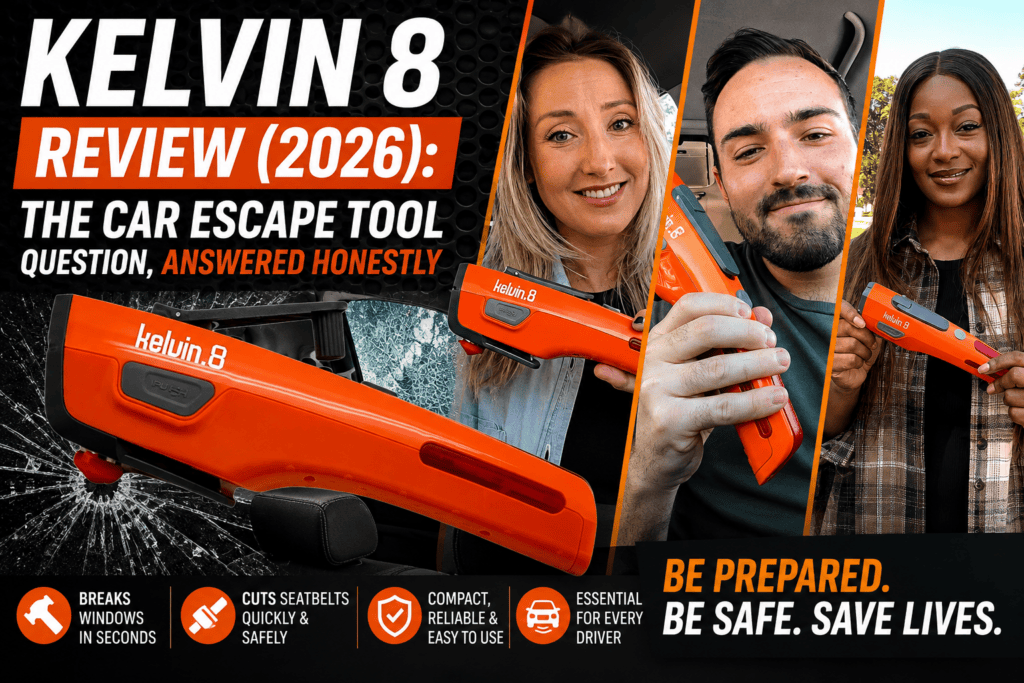
We may receive a commission for purchases made through the links provided here. Learn More Learn More.
Picture the scenario the Kelvin 8 is built for: a crash, a jammed door, a seatbelt that will not release, and seconds that matter. In that moment, two simple tools save lives, a point that shatters a side window and a hooked blade that cuts a seatbelt, and the whole value of any car emergency tool comes down to whether those two things work and whether you can reach them. The Kelvin 8 wraps those escape functions together with a power bank, a flashlight, an SOS beacon and a hand crank into one glovebox-sized device, and the honest question it raises is a buyer’s dilemma: do you want a do-everything gadget, or a dedicated escape tool that does the one critical job more reliably?
This review answers that directly, because a life-safety product deserves it. The short version is that everyone should have a reachable window breaker and seatbelt cutter in their car, that the Kelvin 8 provides those plus genuinely useful extras, and that for the actual emergency, a cheap dedicated tool is more reliable and the smarter primary choice.
This site earns a commission on purchases through the links here. It does not change the verdict, and it did not change this one. Here is how the affiliate side of this site works.
The verdict in three rows
| Verdict | Buy a dedicated escape tool for the life-safety job; the Kelvin 8 is a reasonable Wait/optional extra if you want the power bank, light and crank in one device and you keep it reachable and test it. |
| Best for | Someone who wants a single glovebox device combining escape tools with a power bank, flashlight, SOS beacon and hand crank, and who understands the escape tool’s limits. |
| Deal-breaker | Relying on it as your only escape plan when it is buried in a glovebox, its battery is dead, or your car has laminated side windows a point breaker cannot shatter. |
Check the current Kelvin 8 price | Official site →
What you actually Kelvin 8

The Kelvin 8 is an 8-in-1 car emergency multi-tool combining a window breaker and seatbelt cutter with a rechargeable power bank, an LED flashlight, an SOS signal and a hand-crank charger in a flashlight-sized body that fits in a glovebox or door pocket. It sells through a direct offer page and mainstream retail. A kelvin 8 car tool is, in engineering terms, a generic emergency multi-tool: proven individual functions packaged together, of the same class as several similarly-named products.
The value of any such tool is not the number of functions but the reliability of the two that matter in a crash and whether they are to hand. The rest, the power bank, the light, the crank, the beacon, are genuinely useful roadside conveniences, but they are not the reason to own it. The following sections judge the escape core first, then the extras, then the trade-off between them.
Key Features & Real-World Benefits


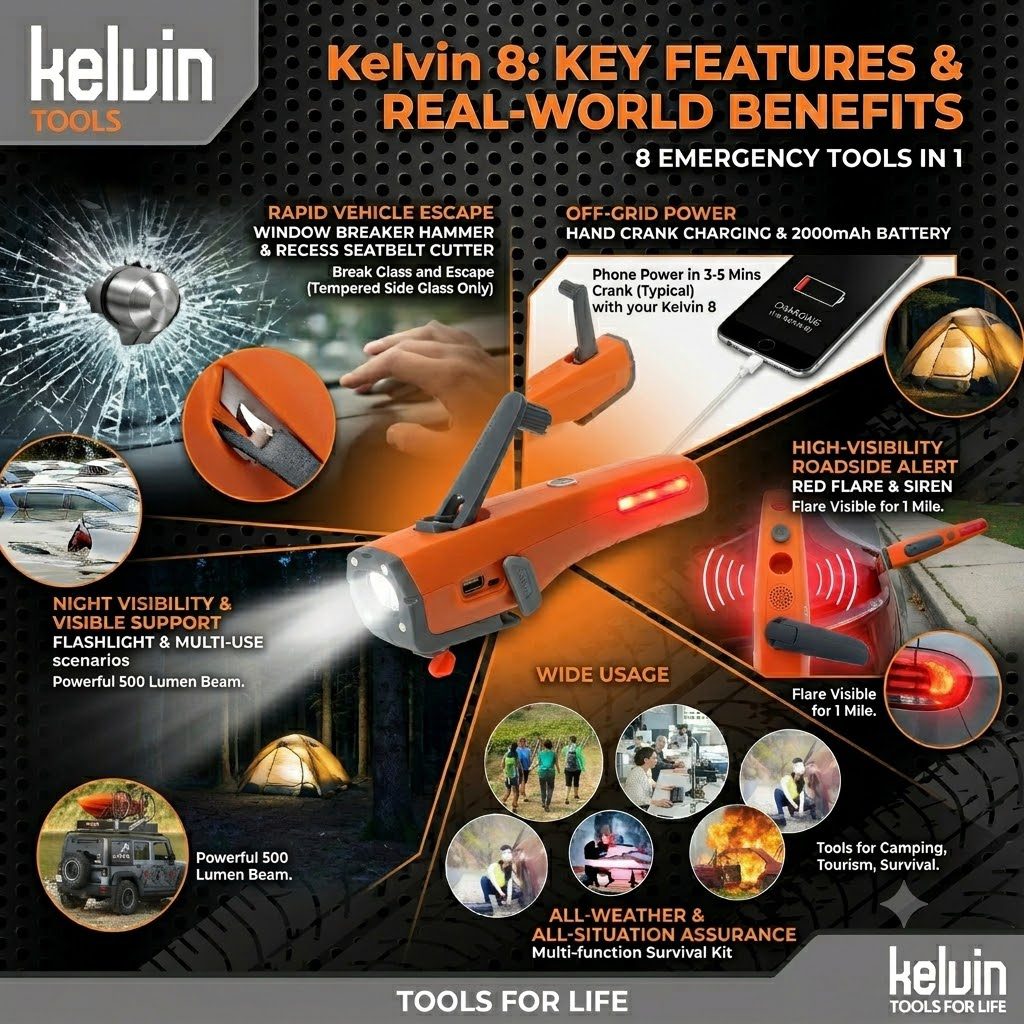
Hand-Crank Power Generator & USB Power Bank
The standout feature of the Kelvin 8 is its self-sustaining power. It houses a 2000 mAh lithium battery. If that battery dies, a smooth fold-out hand crank allows you to generate electricity mechanically.
The Benefit: You are never entirely without power. If your car battery dies and your phone is at 1%, a few minutes of aggressive cranking will give you enough juice to dial 911.
Carbon Steel Window Breaker & Razor Seatbelt Cutter
Enclosed safely under protective covers, these two tools are for worst-case scenarios (like a sinking vehicle or a jammed door post-collision).
The Benefit: The sharp carbon steel shatters tempered side windows instantly, while the recessed blade slices through tough nylon seatbelts without risking cuts to your own skin.
Electronic Strobe with Magnetic Base & 100dB Siren
The device features four heavy-duty alloy magnets. You can snap it onto the roof or trunk of your car, activate the red SOS strobe, and trigger the 100-decibel siren.
The Benefit: It replaces hazardous chemical flares, ensuring you are visible to tow trucks, passing drivers, and emergency responders in the dead of night.
How It Works
Using the Kelvin 8 requires zero technical skill.
- To charge a phone: Plug your standard USB charging cable into the output port and connect your phone.
- To use the hand-crank: Fold out the handle and rotate it at a steady, brisk pace. One minute of cranking yields roughly 2 minutes of flashlight use.
- To break a window: Remove the safety cap, grip the handle firmly, and strike the corner of a side window (do not strike the center, as the glass flexes).
Real-World Testing & Performance Analysis
We don’t just read the box; we look at how these tools actually perform.
- The Power Bank Test: A standard iPhone 15 has a battery capacity of around 3,349 mAh. The Kelvin 8’s 2000 mAh battery will realistically charge a modern smartphone from 0% to about 40-50% before dying (accounting for energy loss during transfer). This is strictly an emergency lifeline, not a daily charger.
- The Hand-Crank Test: The crank is impressively smooth, avoiding the jerky, grinding feel of cheaper knock-offs. However, it is a workout. Generating meaningful phone battery power via the crank takes continuous effort.
- The Siren Test: At 100 dB, the siren is about as loud as a motorcycle engine or a jackhammer. It is piercing and highly effective at drawing attention in a deserted parking lot or off-grid trail.
The Hidden Limitation
The window breaker is designed for tempered glass (standard on side and rear car windows). It will not break a front windshield, which is made of laminated glass designed to spiderweb rather than shatter.
What the escape tools do, and their real limits
The window breaker and seatbelt cutter are the heart of the product, and they work on well-understood physics, with one limit that is critical to state plainly.
A spring-loaded or hardened-point window breaker shatters tempered glass instantly by concentrating force on a tiny point, which cracks the whole pane at once. Most car side windows are tempered, so on those it works, and it works far better than trying to smash a window with your fist or a blunt object. The seatbelt cutter is a recessed hooked blade that slices a jammed belt without risking your hand, and it is reliable and simple.
The limit is glass type, and it is the single most important safety fact here. Point breakers do not reliably shatter laminated glass, the layered glass used in every windshield and, increasingly, in the side windows of newer vehicles. If your car has laminated side windows, a point breaker, on the Kelvin 8 or any tool, may not get you out through them, and you should know that before you rely on one. Check what glass your car uses. This is not a flaw specific to the Kelvin 8; it is a limit of the entire escape-tool category that responsible buyers need to understand.
What the extras add
Beyond escape, the Kelvin 8 bundles conveniences that are useful but secondary. The power bank can top up a phone, the LED flashlight is handy on a dark roadside, the SOS beacon can attract attention, and the hand crank provides a trickle of emergency power if the battery is flat. These are legitimate roadside features and part of what makes a single device appealing to keep in the car.
The engineering caution is that combining functions dilutes reliability of the one that matters. If the Kelvin 8 is also your phone power bank, it may be depleted or borrowed when an emergency strikes, and a dead multi-tool still breaks glass mechanically but cannot signal or light. A dedicated escape tool has no battery to go flat and one job to do. The extras are a plus for convenience and a minor risk for single-job dependability, which is exactly why the verdict separates the two.
Where it can let you down
The failure modes are worth naming, because for a safety device they decide everything. First, reachability: a tool in the glovebox or trunk is useless if a crash leaves you unable to reach it, so it must be mounted or kept within arm’s reach of the driver. Second, glass type, covered above: laminated windows defeat point breakers. Third, unfamiliarity: a tool you have never handled is slower to use under stress, so you should test the cutter on an old belt and know how the breaker deploys before you ever need it. Fourth, battery dependence for the electronic features. None of these are reasons not to own an escape tool; they are reasons to choose and place it wisely, and to treat the dedicated function as primary.
How it compares
Anyone weighing a kelvin 8 alternative is choosing between a do-everything tool and dedicated gear. Here they are on the attributes that matter for the emergency and the extras.
| Option | Typical price | Window breaker | Seatbelt cutter | Extras | Reliability for the one job |
|---|---|---|---|---|---|
| Kelvin 8 | ~$50 | Yes | Yes | Power bank, light, SOS, crank | Good, but battery-dependent for extras |
| resqme / dedicated tool | ~$10-15 | Yes (spring-loaded) | Yes | None | Highest; no battery, one job, keychain-small |
| Emergency hammer | ~$8-15 | Yes (swing) | Often yes | None | Good, but needs a swing and space |
| Jump-starter power bank | ~$50-80 | No | No | Jump-start, charging, light | n/a (different job) |
| React by ChargeHub | ~$50 | Yes | Yes | Power bank, light, siren | Similar multi-tool trade-offs |
The comparison settles the verdict. For the life-safety job, a dedicated resqme-style tool at around ten dollars is the most reliable and reachable option: no battery, one function, small enough to clip within reach. The honest read of kelvin 8 vs resqme is that the resqme is the better primary escape tool, and the Kelvin 8 adds conveniences the resqme lacks. If you want a proper jump starter, a dedicated jump-starter power bank does that far better than the Kelvin 8’s charging feature. The Kelvin 8’s case is consolidation: one device for several roadside needs, at the cost of being the best at none.
What owners report
Sourcing note: no one at Ossaward has used a Kelvin 8. This section is aggregated from published owner reviews, retail listings and the maker’s materials, gathered on 30 July 2026. Where a pattern is thin, we say so.
Owner sentiment is generally positive and practical, with a modest review pool. People value the reassurance of having escape tools plus a power bank and light in one glovebox device, and the flashlight and charging draw routine praise. The reservations are the ones an engineer would predict: notes about wanting to keep it reachable rather than buried, and the sense that the escape function, while present, is one job among many. The kelvin 8 reviews and complaints corpus also carries the usual funnel frictions around price and shipping. Nothing contradicts the safety-led picture: a useful, convenient tool whose escape core is real but is best backed by a dedicated, reachable option.
What works and what does not
What works
- Real window breaker and seatbelt cutter, the two tools that matter in a crash.
- Consolidates power bank, flashlight, SOS and hand crank into one glovebox device.
- Flashlight and charging are genuinely useful roadside conveniences.
- No installation; keep it in reach and it is ready.
What does not
- Only works on tempered glass. (Critical limit.) Laminated windshields and newer laminated side windows resist point breakers.
- Battery-dependent extras. (Reliability.) As your power bank, it may be flat when needed; the light and SOS depend on charge.
- Reachability is everything. (Safety.) Useless if buried in a glovebox or trunk after a crash.
- Jack of all trades. (Value.) A $10 dedicated tool is more reliable for escape; a dedicated jump starter charges better.
- Small review pool. (Uncertainty.) Less long-term reliability data than established safety brands.
What it costs, and whether it is worth it
Whether the kelvin 8 price is worth it depends on what you are buying it for. There is no consumable, so the purchase is the whole cost, and at around fifty dollars it is priced as a multi-tool. For the life-safety job alone, that is poor value, because a ten-dollar dedicated escape tool is more reliable and more reachable. For the convenience of one device that also charges your phone, lights the roadside and signals for help, it is reasonable, provided you treat the escape function as a backup to a dedicated one and keep it reachable. For the wider set of car and portable gear we have rated, see the other car and portable gear we have rated. The honest value verdict: buy the ten-dollar dedicated tool regardless, and add the Kelvin 8 only if you want the extras consolidated.
Check the current Kelvin 8 total →
Who should buy it, and who should skip it
Buy it if you want a single glovebox device combining escape tools with a power bank, flashlight, SOS and hand crank, you will keep it reachable and test it, and you treat it as a convenient complement to a dedicated escape tool.
Skip it if you only want the most reliable escape tool, where a dedicated resqme-style tool wins for a fraction of the price, if your car has laminated side windows a point breaker cannot shatter, or if you want a proper jump starter, where a dedicated one is better. Whatever you choose, do not bury it in the glovebox.
Frequently asked questions
Does the Kelvin 8 really work?
Yes, with the category’s limits. The window breaker shatters tempered glass and the seatbelt cutter slices a belt, the two functions that matter in a crash, and the power bank, light and other features work as roadside conveniences. The important caveats are that point breakers do not reliably break laminated glass, and that the tool must be reachable to be useful. Within those limits, it functions.
Is the Kelvin 8 worth it?
For the escape job alone, no; for the bundle, maybe. A ten-dollar dedicated escape tool is more reliable and reachable for the life-safety function. The Kelvin 8’s value is consolidating that with a power bank, flashlight, SOS and crank in one device. Buy the dedicated tool regardless, and add the Kelvin 8 if you want the extras together and will keep it reachable.
Do car window breakers actually work?
Yes, on tempered glass, which is most side windows. A spring-loaded or hardened point concentrates force to shatter tempered glass instantly, far more effectively than hitting it with a fist or blunt object. They do not reliably break laminated glass, so the effectiveness depends on your car’s glass type. Knowing which glass your windows use is part of relying on one safely.
Will a window breaker break a windshield?
No. Windshields are laminated glass and resist point breakers. Laminated glass is layered with a plastic interlayer that holds it together and defeats the point-impact method that shatters tempered glass. Escape tools are meant for side windows, most of which are tempered. Never plan to escape through the windshield with a point breaker.
Is the Kelvin 8 a scam?
No. It is a real, functioning emergency multi-tool, not a con. The escape tools and extras work as described. The fair criticisms are that it is priced as a multi-tool while a dedicated escape tool is cheaper and more reliable, that its extras are battery-dependent, and that it only works on tempered glass. Those are value-and-limitation issues, not fraud.
Where should you keep a car emergency tool?
Within arm’s reach of the driver, not in the glovebox or trunk. In a crash you may be unable to reach across the cabin or into the trunk, so the tool must be mounted or kept in a door pocket, on the visor, or clipped nearby. A reachable ten-dollar tool beats a better one you cannot get to. Placement is as important as the tool itself.
Does the Kelvin 8 work as a jump starter?
It has charging features, but a dedicated jump starter does that job far better. The Kelvin 8’s power bank can top up a phone and provide emergency power, but jump-starting a car battery reliably is the specialty of dedicated jump-starter power banks with the right output. If jump-starting is a priority, buy a dedicated one; treat the Kelvin 8’s charging as a convenience.
How does the seatbelt cutter work?
A recessed hooked blade slices the belt when you pull the tool across it. The blade is set inside a channel so it cuts webbing without exposing an edge that could injure you, and it works quickly on a jammed belt. It is a simple, reliable mechanism shared by dedicated escape tools, and it is one of the two functions genuinely worth having in every car.
How is the Kelvin 8 different from a dedicated window breaker?
It bundles the breaker and cutter with electronics, where a dedicated tool does only the escape job. A resqme-style tool is tiny, battery-free and single-purpose, which makes it maximally reliable and reachable for an emergency. The Kelvin 8 adds a power bank, light, SOS and crank, gaining convenience and giving up the simplicity and battery-free dependability of the dedicated tool.
Can the Kelvin 8 break laminated glass?
Not reliably; point breakers are made for tempered glass. Laminated glass, used in windshields and some newer side windows, holds together under point impact and is not the target of escape tools. If your car has laminated side windows, a point breaker may not get you out through them, so check your glass type and plan accordingly rather than assuming any tool defeats laminated glass.
The verdict
Buy a dedicated escape tool for the life-safety job; the Kelvin 8 is a reasonable optional extra if you want the electronics in one reachable device.
Start with what is genuinely right about it. Every car should carry a window breaker and a seatbelt cutter, and the Kelvin 8 provides both, plus a power bank, flashlight, SOS beacon and hand crank that are useful on any roadside. As a consolidation of car conveniences, it is a fair, functional product, and owners appreciate having it all in one glovebox device.
The reason the verdict is measured rather than enthusiastic is that this is a life-safety category, and for the one job that saves lives, a dedicated tool is more reliable. A ten-dollar resqme-style breaker has no battery to go flat, one function to perform, and a size that clips within reach, which is exactly what you want when seconds count. The Kelvin 8’s escape tools work on tempered glass but not laminated, its extras depend on a charge that may be gone, and its value proposition is convenience, not best-in-class safety. None of that makes it a bad buy; it makes it a nice-to-have that should sit alongside, not replace, a dedicated, reachable escape tool.
Buy it if you want the escape tools plus electronics in one device and will keep it reachable and tested.
Skip it, or treat it as secondary, if you want maximum escape reliability, your car has laminated side windows, or you would rather buy a dedicated tool and a dedicated jump starter.
Where to buy it
The Kelvin 8 sells through its direct offer page and mainstream retail, with a warranty and money-back window stated on the site. If you buy it, keep it within reach of the driver rather than in the glovebox, test the cutter and learn the breaker before you need them, and check whether your car has tempered or laminated side windows. And regardless of the Kelvin 8, a ten-dollar dedicated escape tool clipped within reach is cheap insurance worth having.
Check the current Kelvin 8 price →
If you buy through that link we earn a commission. It costs you nothing extra, and it did not shape the verdict, the tempered-versus-laminated caveat, or the advice to keep a dedicated escape tool within reach.