







It is the absolute worst nightmare of any parent, grandparent, or caregiver.
You are sitting at the dinner table. Suddenly, the room goes dead silent. The person across from you—maybe your spouse, maybe your toddler—grabs their throat. Their eyes go wide with pure, primal panic.
They can’t breathe. They can’t cough. They are choking.
You jump up and perform the Heimlich maneuver exactly like you were taught. But what happens if it doesn’t work? What happens when you thrust and thrust, and the food doesn’t budge? Standard medical guidelines say to call emergency services, but brain damage from lack of oxygen begins in just 4 to 6 minutes.
An ambulance will almost never get there in time.
This terrifying reality is exactly why Airway Clearance Devices (ACDs) were invented. Right now, two names completely dominate the market: LifeVac and DeChoker.
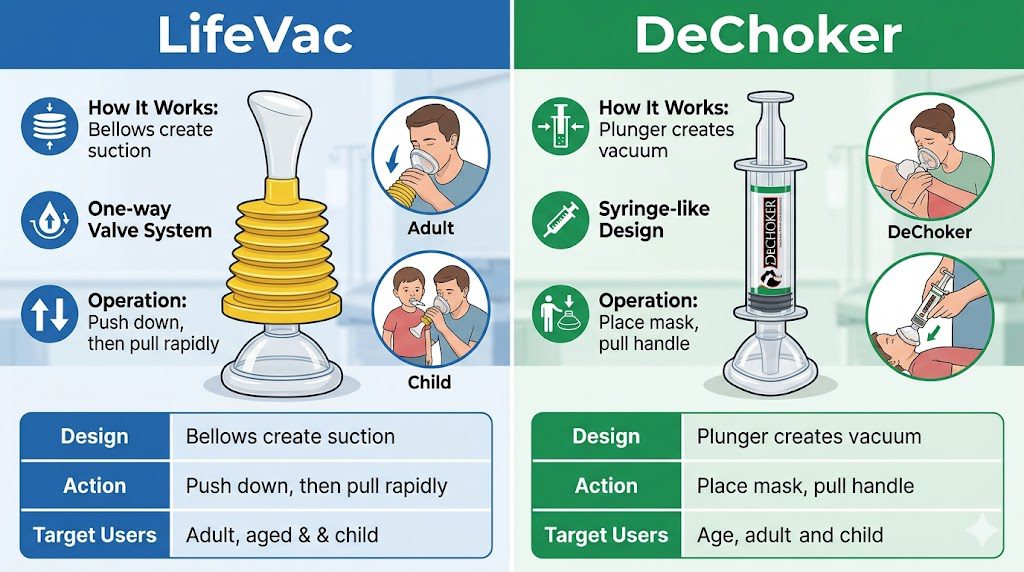
Both of these devices promise to do one thing: suck the obstruction out of the throat and save a life when standard first aid fails. But in a life-or-death emergency, you don’t have time to read an instruction manual. You need a device that is foolproof, safe, and clinically proven.
We rigorously evaluated the clinical data, device mechanics, and real-world usability of both devices. Here is the brutally honest, no-fluff comparison of LifeVac vs DeChoker.
⏳ The Quick Verdict: Which Device is Superior?
Don’t have time to read the medical deep dive? Here is the bottom line:
Both devices have saved lives, but LifeVac is the undisputed superior choice for homes, schools, and everyday people.
- Why LifeVac Wins: It is 100% non-invasive. It acts like a specialized plunger that goes over the mouth and nose. There is nothing to stick inside the victim’s throat. It is intuitive, heavily backed by peer-reviewed medical journals, and can easily be used on a thrashing, panicking child.
- The DeChoker Reality: DeChoker works on the same suction principle, but it is invasive. To use it, you must force a rigid plastic breathing tube inside the victim’s mouth to hold their tongue down before pulling the suction plunger. In a high-panic situation with a terrified child, forcing a tube into their mouth is incredibly difficult and carries a risk of pushing the food further down.
Our Advice: When seconds count and your adrenaline is through the roof, simplicity is survival. LifeVac’s simple “place, push, pull” non-invasive design makes it the ultimate failsafe.
🚨 URGENT SCAM WARNING: Because of LifeVac’s viral success in saving lives, incredibly dangerous, cheap counterfeits are flooding Amazon and third-party sites. These fakes often break under pressure or lack the patented one-way valve, pushing air into the lungs. You must only buy through the official, verified manufacturer links below.
👉 Click Here to Get the Official LifeVac (Check for Current Family Bundle Discounts)
🧬 The Science: How Do Airway Clearance Devices Work?
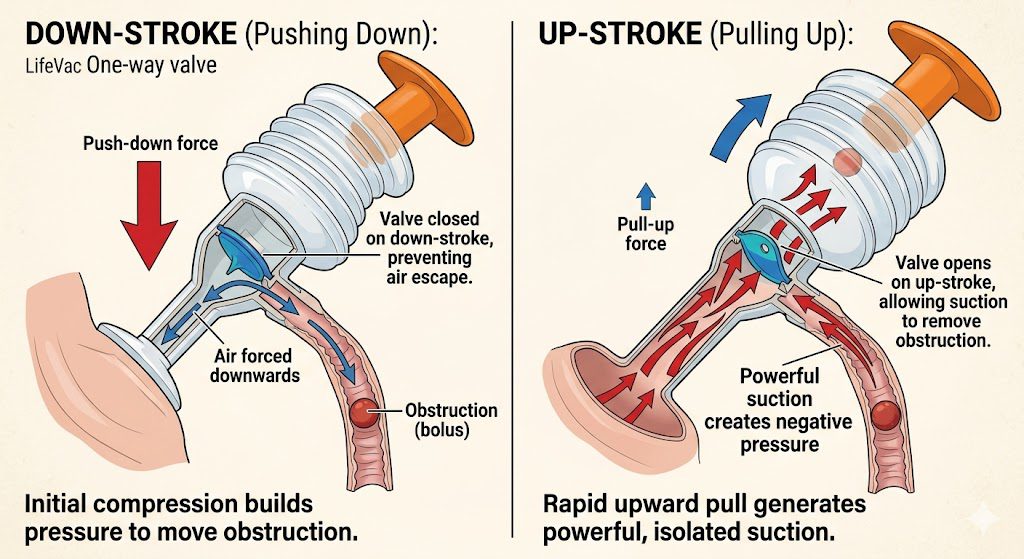
Before we compare them, let’s understand the life-saving physics.
When an object—a grape, a piece of hotdog, a small toy—gets lodged in the trachea (windpipe), it creates a seal.
If the Heimlich maneuver (abdominal thrusts) fails to push enough air up from the lungs to pop the object out, you must use negative pressure.
Both LifeVac and DeChoker are manual vacuum devices. They are designed to create an airtight seal around the victim’s airway. When you engage the device, it creates a powerful, localized vacuum (negative pressure) that forcefully pulls the lodged object up and out of the throat.
It is a brilliant, simple application of physics. But how they apply that physics is where they become wildly different.
🏆 LifeVac Review
What is LifeVac?
LifeVac is a patented, non-invasive airway clearance device. It looks very similar to a small, medical-grade plunger with a soft silicone mask attached to the end.
How to Use LifeVac
Because it sits entirely on the outside of the mouth, LifeVac is incredibly intuitive.
- Place the Mask: Lie the choking victim flat on their back. Take the LifeVac (with the appropriate adult or child mask attached) and place it over their nose and mouth. Hold the mask down firmly with one hand to create an airtight seal.
- Push Down: With your other hand, push the plunger handle straight down. Note: Because of LifeVac’s patented one-way valve, no air is pushed into the victim’s lungs. The air vents out the sides.
- Pull Up: Yank the handle straight up quickly and aggressively. This single, rapid motion creates a massive vacuum that pulls the obstruction out of the airway.
- Repeat if Necessary: If the object does not come up on the first pull, immediately push down and pull up again.
The Pros of LifeVac:
- 100% Non-Invasive: Nothing goes inside the mouth. This is critical when dealing with a panicked, fighting child or an adult clenching their jaw.
- Massive Clinical Backing: LifeVac is supported by numerous peer-reviewed medical studies and boasts thousands of documented, verified saves globally.
- Self-Rescue: Because it is non-invasive, you can actually use LifeVac on yourself if you live alone and begin choking.
- Never Expires: The device itself has no expiration date (though the masks should be replaced every few years if the silicone degrades).
The Cons of LifeVac:
- Requires a Good Seal: If you have a thick, heavy beard, getting an airtight seal with the mask can be slightly more difficult in a panic.
🥈 DeChoker Review
What is DeChoker?
DeChoker is an alternative ACD that resembles a large medical syringe attached to a face mask and an oral tube.
How to Use DeChoker
The DeChoker requires a bit more precision because it is an invasive device.
- Tilt the Head: Lie the victim on their back and tilt their head up slightly to open the airway.
- Insert the Tube: Open the victim’s mouth. Carefully insert the rigid plastic tube into their mouth. This tube must go over the tongue to hold it down and prevent it from blocking the airway.
- Seal the Mask: Once the tube is in place, press the attached mask firmly over the victim’s nose and mouth to create a vacuum seal.
- Pull the Plunger: Grip the device with one hand, and with the other, pull the syringe plunger back forcefully to suction the object out.
(Our Note: Inserting a rigid tube into a struggling, panicked child’s mouth is the primary reason many parents and professionals prefer the non-invasive LifeVac.)
The Pros of DeChoker:
- Strong Suction: When properly applied, the syringe mechanism creates a very powerful vacuum.
- Overcomes the Tongue: If a victim is unconscious and their tongue has fallen back to block the airway, the DeChoker’s tube specifically addresses this by depressing the tongue.
The Cons of DeChoker (Why We Hesitate):
- It is Invasive: Sticking a rigid plastic tube into the mouth of someone who is actively choking and panicking is incredibly difficult. They will likely be thrashing, biting, or clenching their jaw.
- Risk of Complications: If inserted incorrectly during the chaos of an emergency, the tube risks pushing the obstruction further down into the airway, or injuring the soft palate.
- Not Ideal for Self-Use: Trying to maneuver a tube into your own mouth while suffocating is highly impractical.
📊 The Head-to-Head Comparison
Let’s look at the raw data side-by-side.
| Feature | LifeVac 🏆 | DeChoker |
| Design | Plunger + Mask | Syringe + Mask & Tube |
| Application Type | Non-Invasive (Outside mouth) | Invasive (Tube inside mouth) |
| Ease of Use in Panic | Extremely High | Moderate to Low |
| Risk of Pushing Object Down | Zero (One-way valve) | Moderate (Tube insertion risk) |
| Self-Administer Possible? | Yes | Very Difficult |
| Documented Lives Saved | Thousands (Highly publicized) | Hundreds |
🚨 Real-World Use Cases: When Will You Actually Need This?
It is easy to look at plastic devices on a screen and think, “I’ll just do the Heimlich.” But real life is messy, chaotic, and doesn’t always go according to a first-aid textbook.
Here are the four most common real-world scenarios where having an Airway Clearance Device (ACD) becomes the difference between life and death.
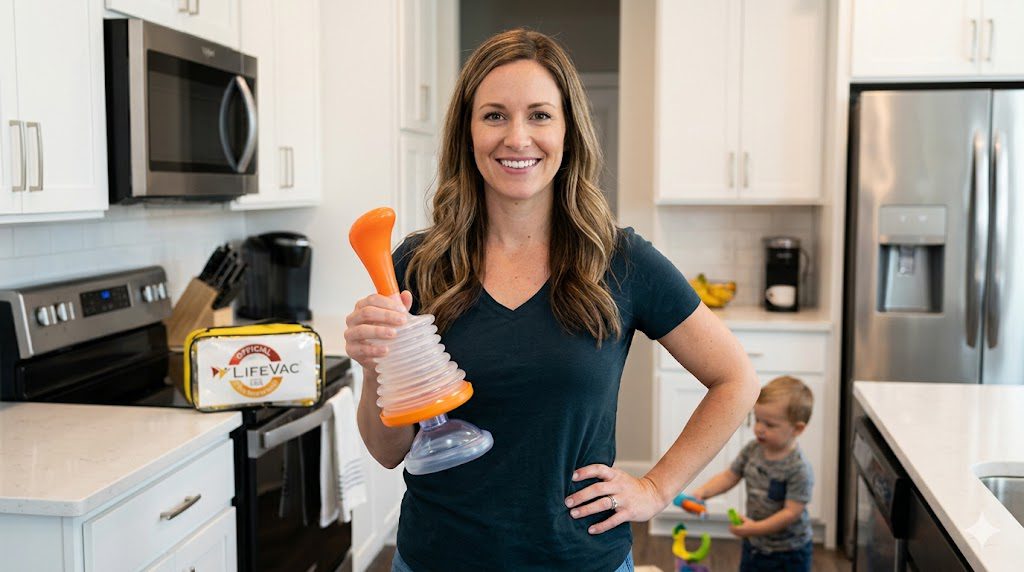
Use Case 1: The Panicking Toddler (The “Silent” Choke)
- The Scenario: You turn your back for five seconds, and your two-year-old swallows a whole grape, a piece of a hotdog, or a small Lego. They aren’t making a sound. Their face is turning red, then blue. They are thrashing wildly in pure terror.
- The Problem with Standard First Aid: Performing back blows on a squirming, fighting toddler is incredibly difficult. If they are clenching their teeth, you cannot sweep the mouth.
- LifeVac vs DeChoker: LifeVac wins. Trying to force DeChoker’s rigid plastic tube into the mouth of a fighting, biting toddler is nearly impossible and wastes precious seconds. With LifeVac, you just pin them on their back, place the mask over their face, and pull.
Use Case 2: Wheelchair Users & The Elderly
- The Scenario: An elderly parent with dysphagia (difficulty swallowing) chokes on a piece of dry meat at the dinner table. They are confined to a wheelchair, or they are too frail for aggressive abdominal thrusts.
- The Problem with Standard First Aid: You cannot effectively perform the Heimlich maneuver on someone sitting in a wheelchair—the back of the chair blocks you from getting your arms around their waist. Furthermore, aggressive abdominal thrusts on a frail 85-year-old can easily break their ribs or puncture internal organs.
- LifeVac vs DeChoker: LifeVac wins. You don’t need to move the person out of their chair. You simply recline them slightly, place the LifeVac over their mouth and nose, and engage the suction. DeChoker also works seated, but LifeVac remains the gentler, less invasive option for seniors with dentures or fragile oral tissue.
Use Case 3: Living Alone (The Solo Choking Emergency)
- The Scenario: You live alone, or your spouse is out of the house. You are eating dinner in front of the TV and suddenly inhale a piece of steak. You can’t breathe. There is no one to call for help, and you are losing consciousness.
- The Problem with Standard First Aid: The self-administered Heimlich (throwing your abdomen over the back of a rigid chair) is incredibly painful, difficult to position correctly in a panic, and frequently fails.
- LifeVac vs DeChoker: LifeVac is the clear winner. You can self-administer LifeVac. Even while sitting on your couch or laying on the floor, you can press the mask to your own face, push down, and pull the handle to save your own life. Navigating a DeChoker tube into your own airway while suffocating is highly impractical.
Use Case 4: Special Needs & Neurological Conditions
- The Scenario: You are caring for someone with Cerebral Palsy, MS, ALS, or Down Syndrome. They experience a sudden muscle spasm while eating, causing their airway to clamp shut around a piece of food.
- The Problem with Standard First Aid: Neurological conditions often cause the jaw muscles to lock tight (trismus) during a choking episode.
- LifeVac vs DeChoker: LifeVac wins. Because the jaw is locked shut, it is physically impossible to insert the DeChoker’s tongue-depressing tube. LifeVac does not require the mouth to be open. It seals completely over the outside of the lips and nose, using sheer negative pressure to pull the object up to the back of the throat where it can be cleared.
🛑 Important Medical Disclaimer: Do NOT Throw Away Your First Aid Training
We must be absolutely clear: Neither LifeVac nor DeChoker replaces traditional Basic Life Support (BLS).
If someone is choking, the protocol remains the same:
- Encourage them to cough.
- Call Emergency Services (911/999).
- Perform back blows and the Heimlich maneuver (abdominal thrusts).
You reach for the LifeVac only when standard protocols have failed. Think of it as your ultimate Plan B. It is the fire extinguisher sitting under your sink. You hope to God you never have to use it, but if the fire gets out of control, it is the only thing that will save your house.
💡 The Final Verdict: Do Not Compromise on Survival
When you compare LifeVac vs DeChoker, you are comparing two devices with noble intentions. But in an emergency, intentions don’t matter. Execution matters.
DeChoker’s invasive tube design introduces a massive margin for error during the most stressful, chaotic moments of your life.
LifeVac is the undisputed champion.
Its brilliant, non-invasive, one-way valve design removes the guesswork. You don’t have to pry a panicking child’s mouth open. You don’t have to worry about pushing the food deeper. You just place it over the face, push, and pull.
It is the single most important $70 you will ever spend. Buy one for your kitchen. Buy one for your car. Buy one for your child’s grandparents.
Don’t wait until tragedy strikes to realize you were unprepared.
✅ Secure Your Authentic LifeVac from the Official Store Here (Protect Your Family Today)
Frequently Asked Question
Here are the most common questions parents and caregivers ask when deciding between these two life-saving tools.
Do LifeVac and DeChoker replace the Heimlich maneuver?
Absolutely not. You should always attempt standard Basic Life Support (BLS) first. This includes back blows and abdominal thrusts (the Heimlich). These devices are your “Plan B.” You use them immediately when standard first aid fails and the victim still cannot breathe.
Are there fake LifeVac devices sold on Amazon?
Yes, and they are incredibly dangerous. Counterfeiters manufacture cheap knockoffs that look identical but lack the patented one-way valve. If you use a fake, you risk blowing air directly into the victim’s airway, pushing the food deeper into their lungs. Always buy directly from the official manufacturer’s website.
Is LifeVac FDA Approved?
LifeVac is FDA Registered as a Class II medical device. (The FDA does not typically “approve” Class I or Class II devices, they register them). It is also registered with regulatory bodies in Europe, Canada, and Australia.
Can you use LifeVac on yourself if you live alone?
Yes. This is one of LifeVac’s biggest advantages. Because it is non-invasive and requires no oral insertion, you can place it over your own face, push, and pull if you begin choking while alone. Using the DeChoker on yourself is much more difficult.
What age or weight can LifeVac be used on?
LifeVac is safe for anyone weighing over 22 pounds (10 kg). The standard home kit comes with both an adult mask and a pediatric mask to ensure a proper seal regardless of the victim’s face size.
Will the DeChoker tube hurt the victim?
If used incorrectly during a panic, there is a risk that the rigid plastic tube could injure the soft palate or push the obstruction further down. This is the inherent risk of any invasive oral device during an emergency.
Do these anti-choking devices expire?
The main suction units (the plunger/syringe) do not expire. However, the silicone face masks attached to them can degrade, crack, or lose their seal over time. It is highly recommended to replace the masks every 2 to 3 years.
Can LifeVac pull up liquids or vomit?
Yes. If someone is choking on mucus, liquids, or vomit, the powerful negative pressure generated by the LifeVac will pull those fluids out of the airway and into the mask.
Do I need special medical training to use them?
No. Both devices are designed specifically for untrained civilians to use in a panic. However, LifeVac’s non-invasive “plunger” design is widely considered more intuitive for someone with zero medical background.
Which device is better for toddlers and small children?
We strongly recommend LifeVac for children. Toddlers will almost certainly panic, thrash, and clench their teeth when choking. Trying to pry a toddler’s mouth open to insert the DeChoker tube is incredibly difficult and wastes precious seconds. LifeVac simply goes over the face, making it the safer, faster option.
Is LifeVac or DeChoker better?
LifeVac is generally considered better and safer for untrained individuals because it is 100% non-invasive. It uses a mask over the face, whereas DeChoker requires inserting a rigid tube into the choking victim’s mouth, which can be dangerous during a panic.
Does LifeVac actually work?
Yes. LifeVac is backed by peer-reviewed medical studies and has thousands of documented, verified saves worldwide. It uses a patented one-way valve to create a powerful vacuum that pulls obstructions out of the airway when the Heimlich maneuver fails.
Can I use LifeVac on myself?
Yes, one of the major benefits of LifeVac’s non-invasive design is that it can be self-administered if you live alone and begin choking. This is much harder to do with the DeChoker.

