






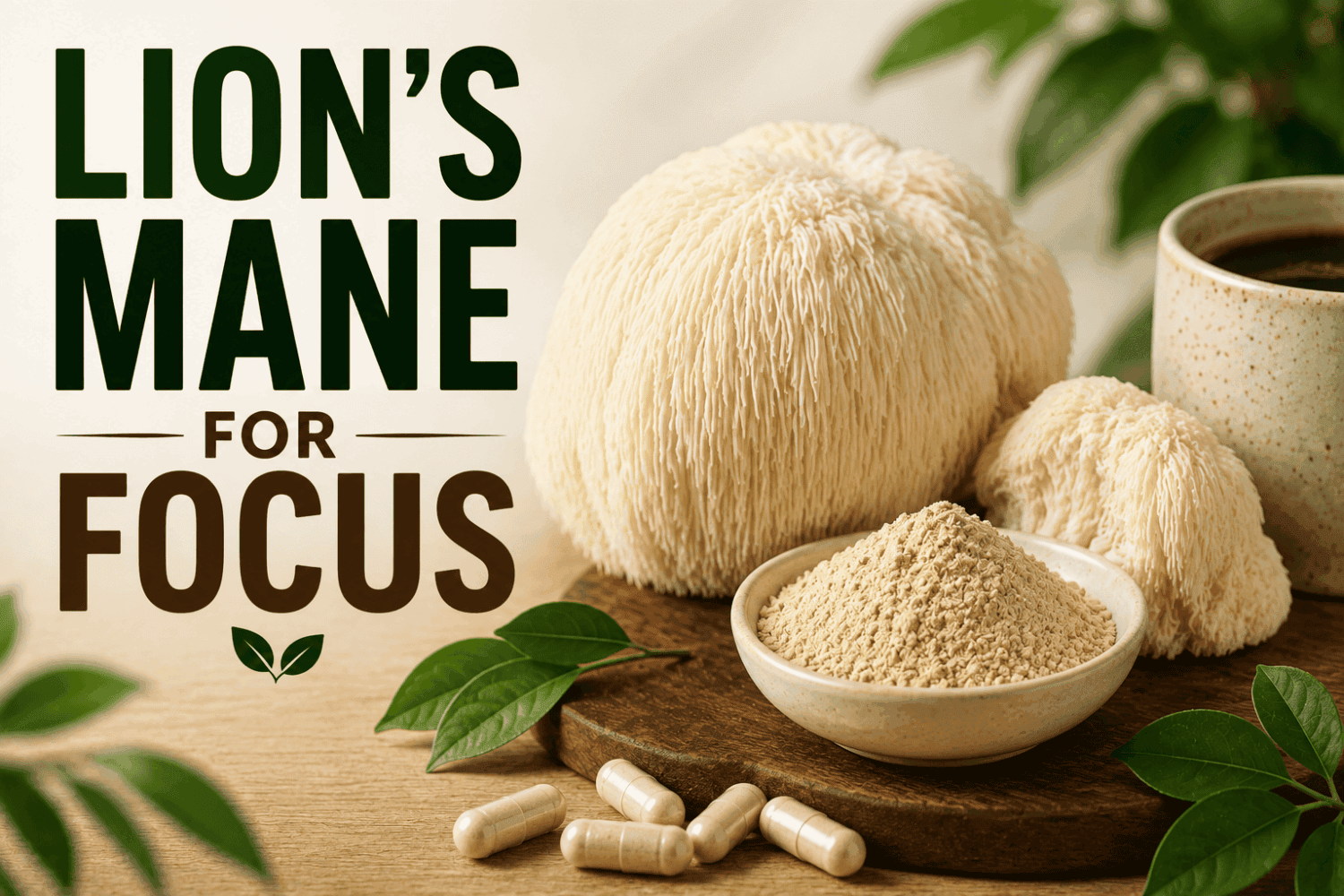
Lion’s Mane has become one of the most popular nootropic ingredients in the functional supplement market. It appears in Yerba Magic, in mushroom coffees, in dedicated nootropic stacks, in gummies, in powders, and on recommendation lists from wellness influencers who often have exactly no neuroscience training.
Whether it deserves this prominence depends on the evidence, and the evidence in 2025 and 2026 is more nuanced than either the enthusiasts or the skeptics tend to acknowledge. There are genuinely positive findings, particularly in older adults and in one recent study in younger adults. There are also significant methodological limitations in the existing research and important questions about dose, form, and duration that remain unanswered.
This article covers the complete evidence picture: what Lion’s Mane is, the biological mechanism, every relevant human trial through June 2026, what the evidence supports and doesn’t, and what you should realistically expect if you start supplementing.
TL;DR
- Lion’s Mane (Hericium erinaceus) contains hericenones and erinacines that promote Nerve Growth Factor (NGF) production in preclinical research
- A 2025 double-blind placebo-controlled study found acute cognitive improvements in healthy younger adults
- A 2024 systematic review found mixed results in human trials, with most positive findings in older adults with mild cognitive impairment
- Effects are cumulative and neurotrophin-mediated, not immediate like caffeine
- 500mg to 1,500mg per day is the most commonly studied effective dose range
- Fruiting body vs mycelium matters for hericenone vs erinacine content respectively
- Yerba Magic includes 1,000mg per serving, which is in the research-supported range
What Is Lion’s Mane?
Lion’s Mane (Hericium erinaceus) is an edible mushroom with a long medicinal history in East Asian and Native American traditions. Mechanistic studies show that Lion’s Mane’s bioactive compounds, hericenones and erinacines, promote the synthesis and secretion of nerve growth factor.
Hericium erinaceus is a white, globular mushroom with distinctive cascading spines that give it the “lion’s mane” appearance. It grows on dead or dying hardwood trees in North America, Europe, and Asia, and has been consumed as a food and medicinal mushroom in East Asian traditions for centuries.
The scientific interest in Lion’s Mane from a neuroscience perspective centers on two groups of bioactive compounds found in different parts of the mushroom:
Hericenones: Found in the fruiting body (the visible mushroom). These are cyathane diterpenes that have been shown in research to stimulate NGF secretion from astrocytes (brain support cells) and other cell types.
Erinacines: Found in the mycelium (the root-like fungal network). These are a different class of diterpenes that also promote NGF synthesis and can cross the blood-brain barrier more readily than larger molecules.
Erinacines can enter the brain because the molecules are smaller than those of neurotrophic factors themselves. This makes Lion’s Mane extracts a potential source of compounds that could support neuron maintenance and potentially slow age-related cognitive decline.
The NGF Mechanism: Why This Matters
Nerve Growth Factor (NGF) is a neurotrophin, a protein that supports the growth, maintenance, and survival of neurons. It is particularly relevant for:
Cholinergic neurons: The neurons that use acetylcholine as their primary neurotransmitter, which are heavily involved in learning, memory, and attention. These neurons are among those most affected in Alzheimer’s disease.
Neuroplasticity: NGF supports the ability of neurons to form new connections (synaptic plasticity), which underlies learning and memory consolidation.
Neuroprotection: NGF helps neurons survive under conditions of stress and oxidative damage.
The challenge with NGF as a therapeutic target is that NGF itself is a large protein that cannot cross the blood-brain barrier when administered externally. This is where small-molecule NGF inducers like hericenones and erinacines become relevant, they can potentially enter the brain and stimulate the brain’s own NGF production from within.
BDNF (Brain-Derived Neurotrophic Factor) is a related neurotrophin that Lion’s Mane has also been shown to influence in some research. BDNF is perhaps the most important of the neurotrophins for adult neuroplasticity and is often discussed in the context of exercise’s cognitive benefits.
The Research: Every Significant Human Study Through June 2026
2025 Acute Cognitive Effects Study in Younger Healthy Adults
Citation: Surendran G et al. Acute effects of a standardised Hericium erinaceus extract on cognition and mood in healthy younger adults. Frontiers in Nutrition. April 2025. doi: 10.3389/fnut.2025.1405796.
Study design: Double-blind, randomized, placebo-controlled crossover study in healthy younger adults (not elderly, not patients). This design, the highest quality for establishing efficacy, and the population (healthy younger adults, not cognitively impaired elderly) are both significant.
What they found: The study found improvements in certain cognitive measures in the Lion’s Mane condition compared to placebo, with researchers noting that bioactive compounds hericenones and erinacines can promote nerve growth factor synthesis and potentially support neuroplasticity. The findings suggest acute beneficial effects on cognition and mood in healthy younger adults.
Why it matters: Most prior research on Lion’s Mane and cognition used elderly subjects with mild cognitive impairment. This is one of the first well-designed studies to show benefits in the younger, healthier population that most supplement buyers belong to. Acute effects (from a single dose session) are distinct from longer-term effects, but the existence of acute measurable effects in a placebo-controlled design is meaningful.
Limitations: Single study. Exact effect sizes are described as present but modest. The specific cognitive domains showing improvement would benefit from replication.
2024 Systematic Review of Mushrooms and Neurocognition
Citation: Bell C et al. Mushrooms and human cognition: a systematic review of human trials. Neuroscience and Biobehavioral Reviews. 2024.
What they analyzed: A 2024 systematic review analyzed 34 human studies on mushrooms and neurocognition. Results from intervention studies (n=10) were mixed, with studies mainly investigating Lion’s Mane showing some enhancement of mood and cognitive function in middle-aged and older adults.
What “mixed results” actually means: The mixed finding doesn’t mean Lion’s Mane doesn’t work, it means that results varied across studies, populations, doses, and preparation methods. The studies that showed benefits tended to be in older adults with mild cognitive complaints. Studies in younger adults with no cognitive complaints showed smaller or less consistent effects.
The dose issue: Doses across studies ranged from 500mg to 3,000mg per day. Studies using lower doses sometimes found smaller effects. This dose variability is a major source of the “mixed” characterization, it’s difficult to conclude definitively about an ingredient when studies are using doses that span a 6-fold range.
Earlier Landmark Studies (Pre-2024)
Mori K et al. 2009 (PMID: 18844328): The first significant human trial on Lion’s Mane and cognitive function. 30 elderly subjects with mild cognitive impairment received 1,000mg Lion’s Mane daily for 16 weeks. The treatment group showed significantly improved cognitive scores compared to placebo. Scores declined after supplementation stopped, suggesting the benefit requires ongoing supplementation.
Nagano M et al. 2010: Found significant reduction in depression and anxiety scores in women supplemented with Lion’s Mane. Mood effects are observed alongside cognitive effects in multiple studies.
2020 Australian study (University of Queensland): Found Lion’s Mane significantly enhanced the connectivity and growth of neurons in culture. Isolated a specific compound (hericene A) responsible for enhanced neurite outgrowth. Led to subsequent research on the specific molecular targets.
What the Evidence Supports vs What It Doesn’t
Supported with Reasonable Evidence
In middle-aged and older adults with mild cognitive complaints: Multiple human trials show cognitive function improvements, particularly on memory and executive function measures. The 2009 Mori study remains influential. The systematic review finding that the most consistent positive results appear in this population is robust.
Mood and anxiety effects: Multiple studies, including both elderly and some younger populations, show reduced anxiety and depression scores. This may reflect a different mechanism from the purely neurotrophin-focused pathway.
Neurotrophin promotion in vitro and in animal models: The fundamental mechanism (hericenones and erinacines promoting NGF and BDNF) is consistently demonstrated in laboratory research. This is strong mechanistic evidence.
Acute effects in healthy younger adults (emerging): The 2025 Surendran et al. study is the most recent evidence for acute effects in the healthy young adult population. This is a single study and requires replication, but the design quality is high.
Requires More Evidence
Long-term effects in healthy younger adults: No study has followed younger healthy adults on Lion’s Mane supplementation for 6-12 months to characterize the long-term cognitive trajectory.
Dose-response relationship: The optimal dose for different populations and cognitive goals is not clearly characterized. The 500mg to 1,500mg range covers most positive studies, but the sweet spot is not established.
Fruiting body vs mycelium: Hericenones are in the fruiting body; erinacines are in the mycelium. Both have research support, but the relative efficacy of fruiting-body extracts vs mycelial extracts vs combinations is not definitively established.
Not Currently Supported
As a treatment or prevention of dementia or Alzheimer’s disease in humans: The research base is insufficient to support clinical claims for neurodegenerative disease treatment. Mechanistic plausibility exists, but human clinical trial evidence is not at the level required for disease treatment claims.
Immediate, noticeable effects like caffeine: Lion’s Mane works through neurotrophin pathways that require consistent supplementation over weeks to months to build cumulative effects. Expecting immediate clarity or focus after a single dose is inconsistent with the mechanism.
The Fruiting Body vs Mycelium Debate
Many Lion’s Mane products use mycelium grown on grain substrate rather than pure fruiting body. The quality concern:
Mycelium grown on grain substrate (rice, oats) contains the mycelial material mixed with significant amounts of grain starch. When labeled as “Lion’s Mane mycelium,” the product may be predominantly grain starch rather than active fungal material. This is a legitimate industry quality concern.
Quality markers to look for:
- Fruiting body extraction (generally cleaner and more concentrated in active compounds)
- Beta-glucan content (a marker of mushroom material vs grain starch, if disclosed)
- Hot water extraction or dual extraction (for optimal bioactive compound release)
- Third-party testing for active compound verification
Yerba Magic discloses “Lion’s Mane Extract” at 1,000mg per serving. The extraction specification is not explicitly provided. For the most accurate picture of what any product provides, seek products that specify fruiting body vs mycelium and provide beta-glucan percentage.
Realistic Expectations If You Start Supplementing
The most common mistake Lion’s Mane buyers make is expecting stimulant-like immediate effects. Lion’s Mane does not work like caffeine. There’s no acute “feel it working” moment within an hour of taking it.
If Lion’s Mane is working, the benefits are likely to manifest as:
- Gradually improved recall and word retrieval over weeks
- Somewhat easier mental task switching
- Potentially improved mood stability
- Better neurological maintenance over the long term (the least visible but potentially most significant benefit)
The timeframe for perceivable effects in published studies ranges from four weeks (some mood studies) to sixteen weeks (the Mori cognitive study). Evaluating Lion’s Mane after one week is not a fair test.
The practical approach: Take it consistently for at least four to eight weeks before assessing. Note subjective changes to memory, mood, and cognitive clarity (or lack thereof). Don’t expect the same kind of before-after contrast you’d notice with caffeine.
Lion’s Mane in Yerba Magic: Is 1,000mg a Meaningful Dose?
Yerba Magic includes 1,000mg of Lion’s Mane extract per serving. This is at the lower end of the range used in positive studies (500mg to 3,000mg), but meaningfully within it. The 2009 Mori study used 1,000mg/day. Other positive studies have used 500mg (on the low end) and 3,000mg (on the high end).
1,000mg per serving from a daily-use product like Yerba Magic is a meaningful inclusion. It’s not the maximum dose used in research, but it’s within the range that has shown effects. Combined with the energy and focus effects of 100mg caffeine + 100mg L-theanine from the same serving, the cognitive support profile of Yerba Magic is substantially more complete than a simple caffeinated drink.
See the complete Yerba Magic analysis: Yerba Magic Review.
Frequently Asked Questions
Does Lion’s Mane actually work for focus?
Yes, based on the available research, with important nuances. Effects are cumulative over weeks rather than immediate like caffeine. The 2025 double-blind study found acute cognitive improvements in healthy younger adults. Multiple earlier studies found improvements in older adults with mild cognitive complaints. “Working” means gradual improvement in specific cognitive domains, not dramatic immediate mental clarity.
How long does Lion’s Mane take to work?
Studies showing cognitive benefits use supplementation periods of 4 to 16 weeks. Some mood effects may appear earlier (4-6 weeks). Expecting effects within the first week is inconsistent with the NGF-promotion mechanism, which requires time for neurotrophin changes to translate into functional improvements.
What dose of Lion’s Mane should I take?
Research uses 500mg to 3,000mg per day, with most positive studies using 1,000mg to 1,500mg. Yerba Magic provides 1,000mg per serving, which is in the middle of the researched range.
Is Lion’s Mane safe?
Lion’s Mane has a long history as a culinary mushroom in East Asian cuisine. No significant adverse effects have been documented in the published literature at supplement doses. People with mushroom allergies should exercise caution.
What is the difference between Lion’s Mane fruiting body and mycelium?
Fruiting body (the visible mushroom) contains hericenones. Mycelium (the fungal network) contains erinacines. Both have NGF-promoting activity. Products using mycelium grown on grain may contain significant grain starch if not properly processed. Fruiting body extracts are generally considered more standardized for active compound content.
Does Lion’s Mane help with ADHD?
Lion’s Mane’s NGF-promoting effects may support attention and executive function, both of which are affected in ADHD. However, no clinical trial has specifically studied Lion’s Mane for ADHD. It should be considered a complementary support approach, not a primary ADHD intervention.
Can Lion’s Mane cause anxiety?
Lion’s Mane is generally associated with reduced anxiety in published studies, not increased anxiety. Rare reports of mild digestive discomfort exist but are not the typical response. If you experience any adverse effects, discontinue and consult a healthcare provider.

