

We may receive a commission for purchases made through the links provided here. Learn More Learn More.
The email arrived three weeks after my aunt bought my grandmother a StoryWorth subscription for Christmas.
It was a prompt: “What was your favorite subject in school?” My grandmother opened it, stared at the screen, and closed the laptop. Not because she didn’t have an answer — she has vivid memories of her school years, a story about a particular teacher that makes the whole family laugh every time she tells it. She closed the laptop because at 84, she types with two fingers, a blank email box feels like homework, and nobody was there to help her.
That StoryWorth subscription cost $99. After that first email, she never opened another one. The year came and went. The book never happened.
This is not an unusual story. It’s the most common failure mode in the legacy book category, and understanding it is the most important thing to know before you spend money on either Memorygram or StoryWorth.
Both services help families turn a loved one’s memories into a printed hardcover book. Both have genuinely good products. The difference — the one that determines whether you end up with a book or with a subscription that quietly expires — comes down to a single design choice: how does the storyteller actually submit their stories?
StoryWorth sends a weekly email. Memorygram can call them on the phone.
For some families, that distinction is everything.
TL;DR — Memorygram vs StoryWorth
- ✅ Memorygram wins for tech-averse storytellers — phone interview removes the keyboard barrier that kills most email-based memoir projects with seniors
- ✅ StoryWorth wins for writers — lower price ($59 vs $99), more prompts (52/year vs up to 60 total), and more creative control for storytellers who enjoy writing
- ✅ Memorygram is the only service with voice recordings — QR codes in every chapter link to the storyteller’s actual voice; StoryWorth base plan has no audio
- ✅ Memorygram is a one-time payment; StoryWorth is an annual subscription — no renewal, no billing recurrence, no access risk with Memorygram
- ⚠️ Memorygram phone interviews are US-only — international families can use voice-to-text or typed input but not the human interviewer
- ⚠️ StoryWorth has a documented completion problem with seniors — multiple independent sources confirm high abandonment rates for non-writers and tech-averse older adults
- Bottom line for most families: If your storyteller would pick up a phone but struggle with weekly emails, Memorygram is worth the extra $40. If they genuinely love writing and check email daily, StoryWorth is a capable product at a lower price.
Quick Verdict
| Winner for most families | Memorygram |
| Winner for budget-conscious writers | StoryWorth |
| Memorygram best for | Tech-averse seniors, US-based families, buyers who want voice recordings |
| StoryWorth best for | Confident writers, tech-comfortable adults, budget-first buyers |
| Memorygram price | ~$99 sale / $123.50 full — one-time payment |
| StoryWorth price | $59–$199/year — annual subscription |
| Our rating — Memorygram | 4.6 / 5 |
| Our rating — StoryWorth | 4.1 / 5 |
Start a Memorygram Book Today → Visit StoryWorth →
Memorygram vs StoryWorth at a Glance
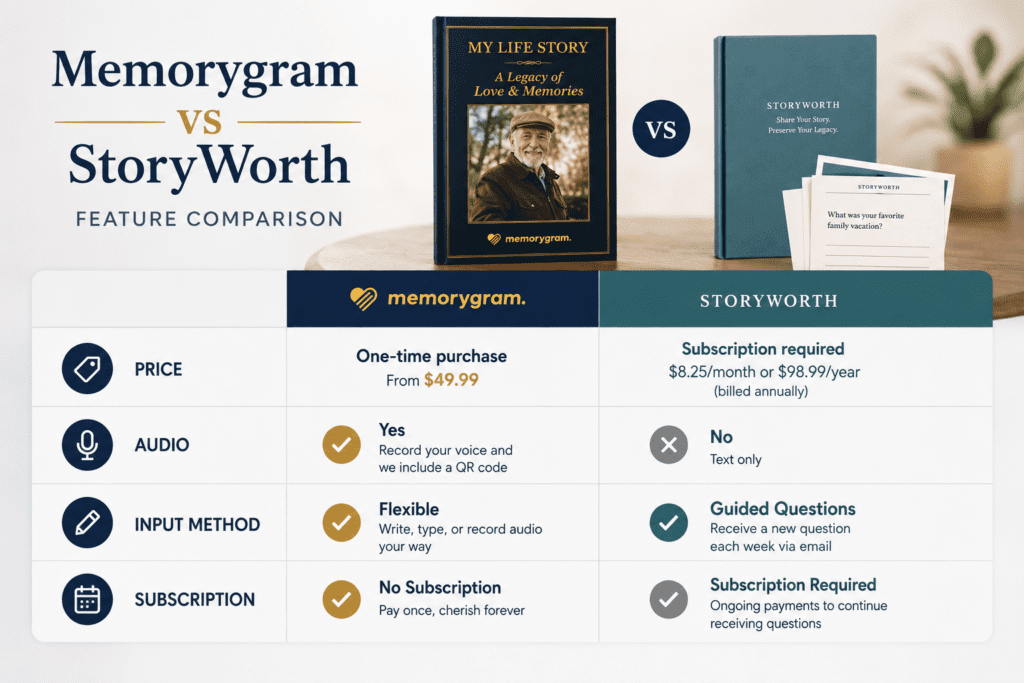
The core difference between Memorygram and StoryWorth is input method. Memorygram calls the storyteller on the phone. StoryWorth emails them and expects a typed response. Everything else — book quality, pricing, features — flows downstream from that single design decision.
| Feature | Memorygram | StoryWorth |
|---|---|---|
| Price model | One-time payment | Annual subscription |
| Base price | ~$99 (sale) / $123.50 (full) | $59 (B&W) / $109 (color) / $199 (unlimited) |
| Primary input method | Phone interview, voice-to-text, or typing | Email prompt — typing only |
| Human interviewer | Yes (US only, phone) | No |
| Voice/audio recordings | Yes — QR code in every printed chapter | No (base plan) |
| Book color interior | Full color (base) | B&W (base) / Color ($109 plan) |
| Questions / prompts | Up to 60 | 52/year (one per week) |
| Multiple storytellers | Unlimited contributors free; $50 for 2nd primary | Single (base); $199 plan for unlimited |
| Subscription required | No | Yes — annual |
| Spanish language | Yes | No |
| Money-back guarantee | Before book printing | 30 days from purchase |
| BBB accreditation | A+ | Not listed |
| Extra physical copy | ~$67 (sale) | Varies by order |
| Digital copy | $19.99 add-on | Included in some plans |
| Best for | Tech-averse seniors, voice preservation, one-time buyers | Writers, tech-comfortable users, budget buyers |
What Is Memorygram?
Memorygram is a legacy preservation service that turns a person’s spoken or written memories into a full-color hardcover book — using phone interviews, voice-to-text, or typed responses to capture stories, with QR-linked audio recordings printed in every chapter of the finished book.
Founded in Austin, Texas, Memorygram has served over 100,000 families and holds a BBB A+ accreditation. Their flagship product is the Legacy Book: a guided memoir built around curated questions, professional transcription, and a finished hardcover that families keep for generations. The company’s defining feature is the phone interview — a human Memorygram interviewer calls the storyteller at a scheduled time, asks the questions, and handles everything from recording to transcription to chapter formatting.
For a complete breakdown of how the product works, see our full Memorygram review.
Check Current Memorygram Price →
What Is StoryWorth?
StoryWorth is the category pioneer in email-based family memoir services — a San Francisco company founded in 2012 that sends weekly question prompts to a storyteller’s email inbox, expects a typed response, and compiles all responses into a printed hardcover book at the end of the year.
StoryWorth has a larger customer base than Memorygram and a longer market history. Their service is elegantly simple: one email per week, one question, one text box to type a response into. After 52 weeks, you have a book. They offer three pricing tiers in 2026: Basic at $59/year (black-and-white interior), Color at $109/year, and Unlimited at $199/year for families with multiple storytellers.
StoryWorth is the right product for the right person. The honest question this comparison answers is whether your specific storyteller is that person.
Price Comparison: Memorygram vs StoryWorth
At face value, StoryWorth is cheaper. The complete value picture is more complicated.
Memorygram pricing
Memorygram charges once, not annually. The current pricing structure:
- Legacy Book (one copy): ~$99 sale price / $123.50 full price
- Additional physical copy: ~$67 (sale) / $79 (full)
- Digital eBook add-on: $19.99
- Second primary storyteller: $50 add-on
- No subscription, no renewal, no annual billing
One important transparency note: Memorygram’s product page displays a “limited time” sale banner that rotates through holiday themes (Father’s Day, Mother’s Day, Christmas). Based on observations across multiple independent review sites and our own monitoring, this banner appears to be evergreen — the ~$99 price is effectively the real, permanent price. The $123.50 “full price” functions as an anchored reference, not an actual price most buyers pay. This is a common DTC pricing practice; it’s not fraud, but it’s worth knowing so the artificial urgency doesn’t pressure your decision.
StoryWorth pricing (2026 verified)
StoryWorth operates on an annual subscription model with three tiers:
- Basic — $59/year: One storyteller, 52 weekly email prompts, black-and-white hardcover book at year end
- Color — $109/year: Same as Basic, plus a full-color interior book
- Unlimited — $199/year: Multiple storytellers, extra features, priority customer support
Critical detail most buyers miss: StoryWorth is a subscription. If you stop paying, your access to the digital platform ends. The printed book is yours permanently — but unprinted stories, the digital archive, and any ongoing functionality are tied to an active subscription. This is standard for subscription services but worth understanding before you buy.
Which offers better value?
The simple math: StoryWorth Basic at $59 is $40 cheaper than Memorygram at $99.
The complete math requires one more variable: completion rate.
A $59 StoryWorth subscription where the storyteller stops opening emails after six weeks costs $59 and produces a book with six chapters, or nothing if not enough stories were captured to print. A $99 Memorygram book where the storyteller answers the phone every Tuesday and tells a story for 40 minutes costs $99 and produces a finished family heirloom.
For families with a storyteller who genuinely writes weekly emails, StoryWorth delivers solid value at a lower price. For families where the storyteller struggles with technology, the real cost of choosing StoryWorth over Memorygram isn’t $40 saved – it’s the risk of paying for something that never gets done.
Input Method Comparison — The Decision That Actually Matters
The most important feature in a legacy book service isn’t the book quality, the number of prompts, or even the price. It’s whether the storyteller will actually use it. Every other feature comparison is secondary to this one.
How StoryWorth works
StoryWorth’s model is simple and elegant for the right user. Each week, an email arrives with a question – “Where did you grow up?”, “What was your first job?”, “What do you wish you’d known at 30?” The storyteller reads it, clicks reply or opens the StoryWorth platform, and types their answer. At the end of the year, StoryWorth compiles all responses into a printed book.
Who this works beautifully for: Someone who already uses email daily, enjoys writing, and has the discipline to respond consistently. Think of the retired professional who writes long emails to family, or the parent who keeps a journal, or the grandparent who prints out emails and reads them at the kitchen table every morning. For this person, StoryWorth is a well-designed, affordable memoir tool.
Where it breaks down: The model requires consistent email engagement, comfortable typing ability, and weekly self-motivation — week after week, for 52 weeks. For seniors who’ve stopped checking email regularly, struggle to type due to arthritic hands or poor vision, find blank email boxes intimidating, or simply forget amid the rhythm of daily life – the dropout rate is high. This isn’t speculation: gadgetshall.com, multiple Reddit threads in r/Mommit and r/AskElderCare, and Amazon review threads for StoryWorth consistently surface abandonment as the most common complaint from buyers who gifted it to older relatives.
The subscription keeps billing. The book never gets finished.
How Memorygram works
Memorygram offers three input methods, and the phone interview is the one that changes the game for a specific audience.
Phone interview (US only): Memorygram schedules a weekly or bi-weekly call with the storyteller. At the agreed time, their regular phone rings. They pick up. A warm, trained interviewer asks a single question and listens. If the answer is short, the interviewer gently asks a follow-up. If the story goes long and wonderful, the interviewer knows when to let it run. The call is recorded, professionally transcribed with human editorial review, and formatted into a chapter. The storyteller just talks.
Voice-to-text (international available): The storyteller speaks their stories into a phone or device without a live interviewer. Memorygram’s transcription process converts speech to readable text. Available worldwide.
Typed responses: Identical in concept to StoryWorth — email prompts, typed replies. For storytellers who prefer writing, this option keeps the familiarity while adding Memorygram’s other features (QR audio, one-time pricing, collaborative portal).
The structural advantage: Answering a phone call is a fundamentally different cognitive and motivational ask than opening an email, reading a question, and producing written text. The phone call creates a scheduled appointment with another person — a social commitment that’s significantly harder to ignore than a passive email. The interviewer does the conversational heavy lifting. The storyteller just shows up and talks.
This is not a small difference for the audience most families are buying this product for.
Who does each service work best for?
Choose Memorygram if your storyteller:
- Hasn’t opened emails consistently in years, or never used email much
- Types slowly or with difficulty — arthritic hands, vision issues, or simply never learned to type fast
- Has great stories but freezes up when asked to write them down
- Is in the US (for the live phone interview feature specifically)
- Benefits from the social accountability of a scheduled call with another person
- Has started and abandoned memoir projects before due to the blank-page problem
Choose StoryWorth if your storyteller:
- Reads and responds to email reliably, multiple times per week
- Genuinely enjoys writing and sees it as creative expression rather than a chore
- Wants up to 480 pages of content — more than Memorygram’s standard format allows
- Prefers complete creative control over the prose of their own stories
- Is comfortable with technology and would find the typing-based model natural
- Needs the lower entry price ($59 vs $99) as a real constraint
Book Quality: What You Actually Get
Both services produce a professionally formatted hardcover book. The differences are meaningful but secondary to the input method question.
Memorygram’s book
Memorygram’s Legacy Book is a full-color hardcover with archival-quality paper, professional layout, and a customizable cover. Each chapter includes the storyteller’s story formatted in a readable serif typeface with family photos placed naturally in the flow of text. At the bottom of every chapter is a unique printed QR code.
The book is physically larger than StoryWorth’s standard 6×9-inch format — reported to be closer to a coffee table book format that looks and feels like a published memoir rather than a personal print-on-demand project. Multiple independent reviewers and customer testimonials describe it as the kind of object that stays on a coffee table rather than a shelf, that visitors pick up and read.
It is not infinitely long. Memorygram’s format caps at a set number of questions rather than pages, which means very prolific storytellers who want a 400-page autobiography may find the format constraining.
StoryWorth’s book
StoryWorth’s base plan produces a black-and-white hardcover with up to 480 pages — significantly more pages than Memorygram’s standard offering. The format is 6×9 inches, a standard memoir size. Photo inclusion depends on the storyteller uploading images alongside their story responses.
The Color plan at $109 upgrades the interior to full color, matching Memorygram’s standard book quality on color printing. The layout is clean and readable. For high-volume writers who want to capture a larger life story, the 480-page capacity and one-prompt-per-week for 52 weeks structure gives StoryWorth a depth advantage for prolific storytellers.
The audio recording difference
Here’s the most emotionally significant feature difference between the two products, and it deserves to be stated plainly: Memorygram prints a QR code in every story chapter. Scan it with any smartphone and you hear the storyteller’s voice — the original audio recording of them telling that story.
StoryWorth’s base plan has no voice recording equivalent. You get the text. You don’t get the voice.
For many families — particularly those who have lost a parent or grandparent and replay old voicemails just to hear their voice — this distinction is the entire purchase decision. A transcript is valuable. A voice is irreplaceable. Fifty years from now, a great-grandchild can scan a QR code in a printed book and hear someone they never met tell a story from their childhood.
The Completion Rate Problem – Why This Is the Hidden Metric
The single most important metric in the legacy book category is not features, not book quality, and not price. It is completion rate – whether the book actually gets finished.
No memoir service publishes their completion rate data. Neither Memorygram nor StoryWorth releases figures on what percentage of purchases result in a finished, printed book versus an abandoned project. What we have instead are the patterns in independent reviews, Reddit threads, and customer feedback that tell a consistent story.
For email-based services used by seniors and non-writers, abandonment is common. The pattern appears repeatedly:
- The gift recipient opens the first email, writes something short or nothing at all, and the emails continue arriving unanswered
- The subscription charges again at the annual renewal, whether or not anything was submitted
- The family discovers months later that the book is nowhere near complete, with some prompts answered and most not
This isn’t a criticism unique to StoryWorth – it’s a structural feature of the email-prompt model when applied to the wrong audience. An email prompt is passive. It arrives, sits in an inbox, competes with other emails, and waits for the recipient to initiate a typed response. For a motivated writer with reliable email habits, this works. For most seniors buying a memoir service who have the stories but not the typing habit, it fails quietly.
Memorygram’s phone interview model changes this dynamic. A phone call is not passive. It creates a social commitment — someone is calling at an agreed time, expecting to speak with you. The barrier to answering is dramatically lower than the barrier to opening an email and typing a 300-word response. The interviewer provides the structure, the follow-up questions, and the conversational momentum. The storyteller just has to be home when the phone rings.
This structural difference is, for many families, the only difference that matters.
Pros and Cons
Memorygram ✅ Pros
- Phone interview eliminates the keyboard barrier — the #1 reason memoir projects fail with seniors
- QR-linked voice recordings in every chapter — future generations can hear the storyteller’s actual voice
- One-time payment — no annual renewal, no subscription risk, no access expiry
- Human editorial review of transcripts — sounds like the storyteller, not generic AI text
- Full-color book included at base price — no upgrade needed for color interior
- Unlimited family contributors at no extra cost — siblings, grandchildren can all add photos
- Flexible input methods — phone, voice-to-text, or typing; use what works
- BBB A+ accreditation — independent, verified customer service accountability
- Works as a last-minute gift — digital delivery on any date, book produced later
- Spanish-language version available
Memorygram ⚠️ Cons
- Phone interviews are US-only — international families lose the flagship feature
- ~$40 more expensive than StoryWorth Basic at entry level
- Photo uploads require a family member to manage the portal — not self-service for the storyteller
- No refund after book is sent to print — the pre-print review window is the last opportunity
- 60-question cap — very prolific storytellers wanting a 400+ page autobiography will hit limits
- No dedicated mobile app as of June 2026 — fully web-based
- QR audio links depend on Memorygram’s servers — a long-term dependency worth noting
- Perpetual sale pricing creates artificial urgency (the “limited time” banner appears evergreen)
StoryWorth ✅ Pros
- Lower entry price — $59/year vs $99 one-time for Memorygram
- Up to 480 pages — significantly more capacity for prolific writers
- One prompt per week for 52 weeks — consistent rhythm for disciplined writers
- More creative control — storytellers write in their own words with no interviewer shaping the narrative
- Established brand with a large customer base and longer market history (founded 2012)
- Simpler digital experience for tech-comfortable users
- Color plan at $109 matches Memorygram’s book quality on interior printing
StoryWorth ⚠️ Cons
- Email-only input — no phone interview, no voice capture, no voice-to-text option
- High abandonment risk for tech-averse seniors and non-writers
- Annual subscription — billing continues whether or not stories are being submitted
- Black-and-white book on base plan — full color costs $109
- No voice recordings in base plan — text only, no audio preservation
- Single storyteller on base plan — multiple family members require the $199 plan
- No Spanish-language version
- Not BBB accredited
Memorygram vs StoryWorth vs Remento — Three-Way Comparison
For completeness, here’s how Remento — the third major player in the category — fits into this comparison.
Remento is an app-based memoir service that focuses on voice capture via smartphone. The storyteller records voice answers on their phone; Remento transcribes and produces a book. It’s closer to Memorygram in approach (voice-first) but different in execution (app-based, no live human interviewer).
| Feature | Memorygram | StoryWorth | Remento |
|---|---|---|---|
| Input method | Phone call / voice-to-text / typing | Email / typing | App-based voice recording |
| Human interviewer | Yes (US) | No | No |
| Subscription required | No | Yes | Yes |
| Base price | ~$99 one-time | $59/year | ~$96/year |
| Voice recordings in book | Yes — QR codes | No (base) | Yes |
| Smartphone required for storyteller | No | No | Yes |
| Best for | Tech-averse seniors, US families | Writers, budget buyers | Tech-comfortable voice users |
Remento is a strong product for families where the storyteller is comfortable with a smartphone but doesn’t like typing. It’s a weaker choice for seniors who don’t use smartphones or who need the human connection of a live interviewer.
Pricing and Value Analysis
Running the numbers across a realistic multi-year scenario:
Scenario A: StoryWorth Color plan, book completed in Year 1
- Year 1 cost: $109
- Book produced: 1 full-color hardcover
- Total: $109 for one finished book
Scenario B: Memorygram, book completed with one extra copy
- One-time cost: $99 + $67 (extra copy) = $166
- Book produced: 2 full-color hardcover copies
- Total: $83 per book
Scenario C: StoryWorth, storyteller abandons after 3 months
- Year 1 cost: $109 (Color plan)
- Book produced: partial or none
- Total: $109 for an unfinished project
Scenario D: Memorygram, phone interview model, book completed
- One-time cost: $99
- Book produced: 1 full-color hardcover with QR voice archive
- Total: $99 for a finished heirloom with permanent voice recordings
The value calculation depends almost entirely on whether your family completes the project. For guaranteed completion with a tech-averse storyteller, Memorygram’s higher price is the cheaper real-world outcome.
Who Should Buy Memorygram
Memorygram is the right choice when:
- The storyteller is 70+ and has reduced their technology use in recent years
- Previous attempts to get them to type stories, respond to emails, or use apps have failed
- You want voice recordings preserved alongside the written stories — the QR audio feature is unique to Memorygram in this comparison
- You prefer a one-time payment with no renewal anxiety or billing risk
- The storyteller is in the US and can benefit from the live phone interview feature
- You’re giving this as a gift and want to maximize the chance it actually produces a book
- The family is geographically scattered and multiple people want to contribute photos and memories
- You want a full-color book at the base price without upgrading to a higher tier
Who Should Buy StoryWorth
StoryWorth is the right choice when:
- The storyteller actively uses email and would genuinely enjoy weekly writing prompts
- They see writing as a creative outlet and want full control over the words of their own memoir
- Budget is a real constraint and the $59 entry price matters
- You want more than 60 questions — StoryWorth’s 52 prompts per year with no cap on responses allows for much longer books (up to 480 pages)
- The storyteller is international and would need phone interview access — StoryWorth’s email model works worldwide equally
- You’re gifting to a confident writer who has mentioned wanting to write their memoirs before
- The storyteller is comfortable with technology and checks email reliably
Who Should Avoid Both Services
Both services share one important limitation: they depend on the storyteller’s ongoing participation. If the storyteller is in significantly declining health, has moderate to advanced dementia, or is in a situation where consistent weekly engagement isn’t realistic — neither service will produce a completed book without substantial family intervention.
For families in this situation, consider: a professional biography service (expensive but handled entirely by the service), a family-run voice recording project using a simple recording app, or a professional oral history organization. Both Memorygram and StoryWorth are designed for storytellers who are engaged and capable of participating — they’re not solutions for capturing stories after the window has narrowed significantly.
Expert Tips for Either Service
Tip 1: Make the first interaction easy. For Memorygram, sit with the storyteller for the first phone call — not to take over, but to provide familiar presence that helps them relax. For StoryWorth, help them open and respond to the first email together in person. A successful first interaction builds the habit pattern for all subsequent ones.
Tip 2: Set the pace deliberately. Both services allow you to control the question frequency. Start slower than you think you need — one question per week is manageable; two can feel like pressure for some storytellers. You can always increase the pace once the rhythm is established.
Tip 3: Write custom questions. Both services allow you to add your own questions alongside the library of standard prompts. The most irreplaceable stories come from family-specific questions — specific trips, relationships, moments — that no generic library captures. Write at least 3–5 custom questions before the service starts.
Tip 4: Appoint a family “portal manager.” Both Memorygram and StoryWorth have a family portal or platform where photos are uploaded, stories can be reviewed, and book production is managed. Assign this role to one family member explicitly, before the service starts. Don’t leave photo uploads as a shared responsibility — they won’t happen.
Tip 5: Order extra copies before printing. Both services charge less per additional copy when ordered at the time of the original print run versus ordering separately later. Decide upfront how many copies the family needs — for children, grandchildren, or sibling households — and order them all together.
Tip 6: Read the transcripts with the storyteller before approving. For Memorygram specifically, the pre-print review window is an opportunity to read each chapter together with the storyteller. They’ll often add details, correct small things, and sometimes tell a follow-up story that becomes its own chapter. Don’t skip this step.
Tip 7: Start 6–8 months before any hard deadline. If you want to present a finished book at a specific birthday, anniversary, or holiday, work backward from the print and delivery timeline. Both services require time for question completion and print production. A book started in June 2026 with two questions per week would realistically be ready for Christmas 2026.
Common Mistakes Buyers Make
Mistake 1: Buying the wrong service for the wrong storyteller. This is the most common and most expensive mistake. The product doesn’t fail — the fit fails. Buying StoryWorth for a storyteller who doesn’t use email, or buying Memorygram for someone who specifically wanted to write their stories, wastes money and misses the purpose. Assess the storyteller first, then choose the service.
Mistake 2: Treating it as a self-service product. Neither service is fully hands-off. Memorygram requires photo uploads and call scheduling management. StoryWorth requires someone to follow up if the storyteller stops responding. The family member who buys the service should plan to be the project manager, not just the buyer.
Mistake 3: Starting too close to a deadline. The combination of question completion time plus print and delivery time means rushed timelines produce stress, not books. Start 6 months before any hard deadline you’re working toward.
Mistake 4: Using only the default question library. Generic questions produce generic stories. The most memorable chapters in any memoir come from specific, family-tailored questions that open stories only that family knows to ask about. Both services support custom questions. Use them.
Mistake 5: Not verifying pricing before purchase. Both Memorygram and StoryWorth update their pricing periodically. Memorygram’s “sale” pricing appears evergreen but could change. StoryWorth’s tier structure shifted in 2026. Verify current pricing on their respective checkout pages before purchasing — don’t rely solely on third-party review articles (including this one) for price accuracy.
Legacy Book Buying Guide: What to Look for in This Category
If you’re evaluating memoir services for the first time, here’s what actually matters when making the decision — and what you can safely weigh less.
Input method accessibility is the most important factor, by far. No other feature matters if the storyteller doesn’t complete the project. Before evaluating book quality, pricing, or features, answer one question: how does this specific person prefer to communicate their stories? If they write — choose an email-based service. If they talk — choose a phone-based service. This one criterion should drive most of your decision.
One-time payment versus subscription has practical implications. Subscriptions create ongoing cost exposure and access risk if circumstances change. One-time payments produce permanent ownership. For a project meant to produce a family heirloom, permanent ownership is inherently preferable. The subscription model is justifiable when the price difference is large enough to matter — and for some families, StoryWorth’s lower entry price at $59 vs $99 is a real consideration.
Voice preservation is the feature most buyers regret not having. Ask any family that has lost a parent or grandparent what they would most value having. Overwhelmingly, it’s their voice. Not more photos. Not longer written accounts. Their voice. Services that capture and preserve audio — and make it accessible via the printed book itself, as Memorygram does with QR codes — provide something that text-only services fundamentally cannot.
Completion support matters more than completion rate data (which you won’t get). Neither service publishes completion rate figures. What you can evaluate: does the service structure reduce or increase the barriers to completion for your specific storyteller? Phone call scheduling, human interviewers, and social commitment structures reduce barriers. Passive email prompts increase them for certain audiences.
Book quality should be verified, not assumed. Both services produce professional-quality books, but there are differences in format, page capacity, color options, and binding that matter for different family needs. StoryWorth’s 480-page capacity matters for prolific writers. Memorygram’s full-color standard matters for families with rich photo archives. Verify what the base plan includes before committing.
Frequently Asked Questions
Is Memorygram more expensive than StoryWorth?
Yes, at the entry level. Memorygram’s base price is approximately $99 (one-time payment), while StoryWorth Basic starts at $59 per year. However, Memorygram is a single, permanent purchase with no annual renewal, while StoryWorth bills yearly. For families who complete the book within one year, StoryWorth Basic is cheaper. For projects that take longer, or for families who want the phone interview and voice recording features Memorygram offers, the price difference narrows or reverses.
Which is better for seniors – Memorygram or StoryWorth?
Memorygram, for most seniors. The phone interview removes the keyboard barrier that causes most email-based memoir projects to fail with older adults who don’t type regularly or use email consistently. If the senior in your family checks email daily and genuinely enjoys writing, StoryWorth is a capable and cheaper alternative. If they’re more comfortable on the phone than at a computer, Memorygram is the practical choice.
Does StoryWorth have phone interviews like Memorygram?
No. StoryWorth is exclusively email-based. It sends a weekly prompt to the storyteller’s email inbox and expects a typed response. Phone interviews are Memorygram’s differentiating feature and are not available from StoryWorth as of June 2026. This is the most important functional difference between the two services.
Can you get a full-color book with StoryWorth?
Yes, but not on the base plan. StoryWorth’s $59 Basic plan produces a black-and-white hardcover. Full-color interior printing requires upgrading to the $109 Color plan. Memorygram’s standard Legacy Book includes full-color interior printing at the base price with no upgrade required.
Does Memorygram or StoryWorth include voice recordings?
Only Memorygram. Every story chapter in a Memorygram Legacy Book includes a unique printed QR code. Scan it with any smartphone and you hear the original audio of that story in the storyteller’s own voice. StoryWorth’s base plan produces text only, with no audio recording or preservation feature. This is the single most emotionally significant feature difference between the two services.
What happens to my StoryWorth book if I cancel my subscription?
The physical printed book is yours permanently – it’s shipped and you own it. However, access to the StoryWorth digital platform, the online story archive, and any unprinted stories may be affected if your annual subscription is not renewed. Memorygram is a one-time purchase: once you’ve paid, there is no subscription to cancel and no access risk.
Is there a free trial for Memorygram or StoryWorth?
Neither service offers a free trial as of June 2026. Both provide money-back guarantees: Memorygram’s applies before the book is sent to print (the pre-print review window is your last opportunity to request changes or a refund); StoryWorth’s applies within 30 days of purchase. Both guarantees are reasonable for services that require weeks to months to produce their core deliverable.
Which legacy book service has better customer support?
Memorygram holds a BBB A+ accreditation as of June 2026, which is independently awarded and requires verified responsiveness to customer complaints and inquiries. StoryWorth does not appear in BBB listings. Both services have generally positive customer reviews for responsiveness. Memorygram is specifically noted in multiple reviews for flexibility in rescheduling missed phone interview calls — a practical customer service strength given that their core product depends on scheduled calls.
Can Memorygram be used outside the United States?
Partially. The Legacy Book, typed response option, and voice-to-text input are available internationally. The phone interview feature – where a Memorygram human interviewer calls the storyteller – is currently US-only. International families can still use the service effectively via typed or voice-to-text responses, but lose the flagship feature that most distinguishes Memorygram from StoryWorth.
How many questions does each service offer?
StoryWorth sends one question per week for 52 weeks – 52 prompts per year, with no cap on response length or page count, up to 480 pages per book. Memorygram offers up to 60 guided questions total, with flexible pacing (weekly, bi-weekly, or faster). For prolific writers wanting a very long memoir, StoryWorth’s higher page capacity may be an advantage. For most families capturing a complete life story, 60 well-answered questions produces a comprehensive, meaningful book.
Which service do we recommend?
Memorygram, for most families. The completion rate advantage created by the phone interview model makes it the higher-reliability choice for the most common use case: families with a tech-averse senior who has extraordinary stories and no inclination to type weekly emails. If your storyteller is a confident writer who uses email daily, StoryWorth at $59 is a capable, cheaper alternative. The right answer depends on who your storyteller is – not which service has better marketing.
Final Verdict — Memorygram vs StoryWorth
Memorygram: 4.6/5. StoryWorth: 4.1/5. Memorygram wins for most families.
The most important sentence in this entire comparison is one that doesn’t appear anywhere in either brand’s marketing: the best memoir service is the one your storyteller will actually finish.
StoryWorth is a genuinely good product. The book quality is solid, the question library is thoughtful, the price is fair, and for the right person — someone who genuinely enjoys writing and checks email daily — it delivers what it promises. There are families where StoryWorth is the correct choice, and pretending otherwise would be dishonest.
But Memorygram has solved a problem that StoryWorth hasn’t fully addressed: what happens when the storyteller is a natural talker who would never, in any realistic scenario, sit down every Tuesday and type a 400-word essay about their childhood? The phone interview isn’t just a feature. It’s a completion mechanism. It turns a passive, self-motivated process into a scheduled human interaction with another person who is calling specifically to hear your stories.
That changes the project from “something my family bought me” into something the storyteller looks forward to. Multiple families across independent reviews describe the interview calls becoming a weekly highlight for the senior — a time when someone calls specifically to be interested in their life. That’s not a feature you can put in a comparison table.
At $99 versus $59, Memorygram costs $40 more at the entry level. Given what it produces — a full-color hardcover book with QR-linked voice recordings, a permanent one-time payment, and a structural completion advantage over every email-based alternative — it’s one of the more defensible $40 premiums in the category.
Choose Memorygram if: your storyteller would pick up a phone before they’d open a computer, you want their actual voice preserved alongside their stories, and you want a one-time payment with no renewal risk.
Choose StoryWorth if: your storyteller actively enjoys writing, uses email consistently, needs the lower entry price, or wants more than 60 questions worth of content in a longer-format book.
Get Started
Memorygram — Our Top Pick for Most Families
→ START A MEMORYGRAM BOOK TODAY
One-time payment. Full-color hardcover. QR voice recordings in every chapter. Money-back guarantee before printing.
StoryWorth — Best for Writers and Budget-First Buyers
$59–$199/year. Black-and-white or color hardcover. 52 weekly prompts. 30-day money-back guarantee.
We earn a small commission if you purchase Memorygram through our link, at no extra cost to you. We researched both products independently. StoryWorth is linked without affiliate compensation. Last reviewed June 2026.