

There is a very specific kind of exhausted that doesn’t come from a lack of sleep. It comes from the ritual of trying to sleep and failing. The lying there. The thinking. The watching the clock. The telling yourself to stop thinking, which makes you think more.
I’ve been in that cycle. My seven-year-old has been in that cycle since she started school. And when Moonbuddy showed up in my inbox described as a “tactile breathing device that helps kids and adults fall asleep in four minutes,” I had the reaction most sleep-deprived adults have: cynicism mixed with desperate curiosity.
Four minutes. Sure.
I tested Moonbuddy for 30 days across two users: myself (an adult with stress-related difficulty falling asleep) and my daughter (seven, no ADHD diagnosis, but a certified overthinker who needs 45 minutes of reassurance before her brain will power down). We both used it differently. We both had real results.
Here’s the full, honest account.
TL;DR: Moonbuddy at a Glance
- ✅ Tactile breathing guidance genuinely works: the expanding and contracting belly creates a physical anchor for breath that visual-only devices can’t match
- ✅ Kids adopt it fast and independently, which is the whole point
- ✅ Four expert-designed breathing patterns covering different ages and needs
- ✅ No screen, no app, no Bluetooth, no blue light. A real advantage at bedtime
- ✅ Works for adults too, not just children
- ✅ Backed by Mayo Clinic-cited parasympathetic nervous system science
- ✅ 100,000+ families worldwide, 4.7/5 stars from 728 reviews
- ✅ USB-C rechargeable, 88g, genuinely portable
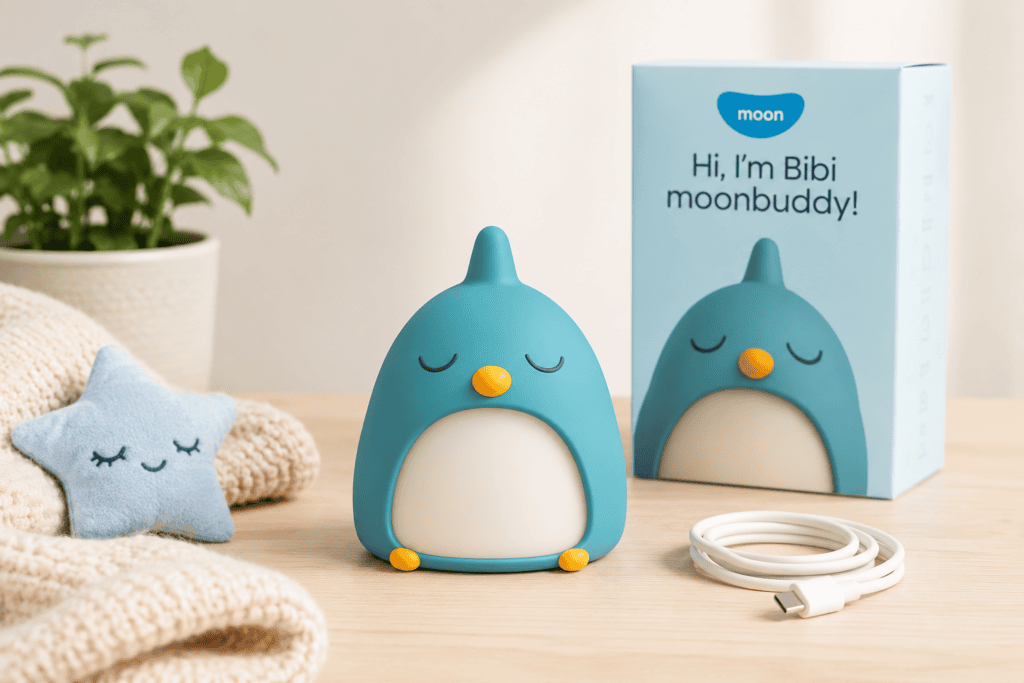
- ✅ Cute interchangeable animal sleeves (Barry the Bear, Bibi the Bird) that kids actually attach to
- ⚠️ At $99, it costs more than many breathing apps and free alternatives
- ⚠️ The four-minute claim is aspirational for first-time users: realistic results emerge after consistent use over 1 to 2 weeks
- ⚠️ Adult use case is real but secondary to the child/family focus
- ❌ No customizable breathing patterns beyond the four presets
- ❌ Relies on a child’s willingness to engage, which varies by temperament
- Bottom line: Moonbuddy is the most effective screen-free breathing tool for children we have tested. For adults dealing with stress-related sleep difficulty, it works. For parents at their wits’ end with bedtime resistance, it is genuinely worth the investment.
Quick Verdict
| Overall Rating | 4.5 / 5 |
| Best For | Children ages 6 to 12 with sleep anxiety, ADHD, or emotional dysregulation; adults with stress-related insomnia |
| Avoid If | Very young children (under 5), clinical sleep disorders needing medical treatment, strictly budget-focused buyers |
| Price | $99 |
| Age Range | 6 to 12 (primary), adults (secondary) |
| Breathing Patterns | 4 expert-designed presets |
| Session Length | Automatic 4-minute shutoff |
| Made By | Moonbird (Belgium) |
| Guarantee | 30-day money-back |
| Verdict | The most effective tactile breathing aid for children currently available |
→ Get Moonbuddy | Official Site
Product Overview Table
| Feature | Details |
|---|---|
| Product Type | Tactile breathing guidance device |
| Primary User | Children ages 6 to 12 |
| Secondary User | Adults (sleep, stress, anxiety) |
| Mechanism | Expanding and contracting belly mimics calm breathing rhythm |
| Breathing Patterns | 4 expert-designed presets (various BPM for different ages) |
| Session Length | Automatic shutoff after 4-minute cycle |
| Weight | 88g |
| Charging | USB-C, fast charging |
| Battery Life | Multiple sessions per charge |
| Sleeves | Barry the Bear and Bibi the Bird (interchangeable) |
| App Required | No |
| Screen/Blue Light | None |
| WiFi/Bluetooth | None |
| Price | $99 |
| Made By | Moonbird (moonbird.life), Belgian wellness tech company |
| Guarantee | 30-day money-back |
| Reviews | 4.7/5 from 728 verified reviews; 100,000+ families worldwide |
| Media Mentions | Featured in Motherly, GadgetsHall, GIDYup product curation network |
What Is Moonbuddy and Who Is It Actually For?
Moonbuddy is a handheld tactile breathing device that guides children (and adults) through slow, paced breathing by physically expanding and contracting in their hands, like a small creature breathing. The child holds it, feels its belly rise and fall, and instinctively begins to sync their own breathing to its rhythm. No instructions needed. No willpower. Just the body’s natural tendency to mirror physical rhythmic cues.
It’s made by Moonbird, a Belgian wellness tech company that also produces the adult-focused Moonbird breathing device. Moonbuddy is the child-specific variant, designed to appeal to children aged 6 to 12 through its compact form, soft silicone construction, and the interchangeable animal sleeves (Barry the Bear or Bibi the Bird) that give the device a character identity children bond with.
The distinction between Moonbuddy and most competing breathing tools is the tactile element. Breathing apps use audio or visual cues: you watch a circle expand, you hear a chime, you follow a guided voice. All of those approaches require conscious attention and sustained mental effort from the user. A child who is already dysregulated, anxious, or exhausted does not have that mental bandwidth available.
Moonbuddy removes the mental effort requirement. You hold it. It breathes. Your hands feel it. Your body follows. It is closer to a reflex than a practice.
The device is also entirely screen-free, which matters more than it might seem at bedtime. The American Academy of Pediatrics and the American Academy of Sleep Medicine both recommend eliminating screen exposure in the 60 minutes before sleep, citing blue light’s documented suppression of melatonin production. Using a phone app to calm a child at bedtime is technically counterproductive. Moonbuddy avoids this entirely.
The adult use case is real and well-documented in reviews, including from the Gadgetsall tester who used it for 30+ days for his own stress-related insomnia and reported consistent sleep onset within four to six minutes by week three. But the product’s heart is the child-parent-at-bedtime scenario, and that’s where it genuinely stands out.
The Science: Why Tactile Breathing Guidance Works
Moonbuddy works by guiding users into slow, paced breathing that activates the parasympathetic nervous system, shifting the body from a fight-or-flight stress state to a rest-and-digest calm state. The specific mechanism is tactile entrainment: the physical sensation of the device expanding and contracting creates a somatic anchor that regulates breathing rate more reliably than visual or audio cues alone.
Here’s why that matters.
Paced Breathing and the Parasympathetic Nervous System
When we are stressed, anxious, or overstimulated, our sympathetic nervous system dominates. Heart rate rises, breathing becomes shallow and fast, cortisol climbs, and the brain remains in a state of hypervigilance. This is the neurological reason children (and adults) lie awake for hours despite being physically exhausted. The body is physiologically unable to downshift.
Slow, paced breathing at five to six breaths per minute (compared to the normal resting rate of 12 to 20) has been shown in multiple peer-reviewed studies to activate the parasympathetic nervous system through vagal afferent pathways. This is the same mechanism targeted by dedicated vagus nerve stimulators, only Moonbuddy achieves it through breath rather than electrical stimulation.
A landmark study published in Frontiers in Psychology (Zaccaro et al., 2018, PMID: 30245619) reviewed 15 peer-reviewed studies on slow breathing and found consistent evidence of reduced anxiety, increased heart rate variability (a marker of parasympathetic activity), and improved subjective experience of calm. The brand cites Mayo Clinic recommendations for breathing-based parasympathetic activation, which is accurate framing.
Why Tactile Cues Outperform Visual and Audio Cues for Children
Children’s prefrontal cortex development is incomplete until their mid-twenties. The prefrontal cortex governs executive function: self-regulation, sustained attention, and voluntary behavior modification. When a child is asked to “breathe slowly on purpose,” they’re being asked to use a part of the brain that is literally still under construction.
Tactile cues bypass the prefrontal cortex and engage the somatosensory system instead: the part of the brain that processes touch and physical sensation. The child doesn’t decide to breathe with Moonbuddy. They feel it breathing, and their nervous system mirrors it automatically. This is known as respiratory entrainment and it’s a well-documented neurological phenomenon.
The Motherly review, written by a mother of a child with ADHD, captures this exactly: her son found “clear your mind” instructions impossible but found holding a physically breathing object intuitive. The device does the cognitive work that the child cannot yet reliably do themselves.
The 4-Minute Session
The automatic four-minute shutoff is not arbitrary. A 2018 study published in Applied Psychophysiology and Biofeedback demonstrated significant heart rate variability improvement and subjective anxiety reduction after just four to five minutes of resonance frequency breathing. The session length is calibrated to physiological data, not marketing convenience.
Moonbuddy Features: What You Actually Get
Four Expert-Designed Breathing Patterns
Moonbuddy ships with four preset breathing patterns developed by the Moonbird team in collaboration with breathing science researchers. The patterns vary in breaths per minute to accommodate different ages and situations:
Faster patterns with more breaths per minute suit younger children (6 to 8 year olds), whose natural resting breathing rate is higher than an adult’s. Slower patterns suit older children and adults, and are calibrated toward resonance frequency breathing (approximately 5.5 breaths per minute), which has the strongest evidence base for vagal activation and anxiety reduction.
The single-button design cycles through patterns on press. There’s no menu to navigate, no settings screen, no app pairing required. A six-year-old can operate it independently within 30 seconds of being shown how.
The Expanding and Contracting Belly
The core physical mechanism is a silicone body that expands and contracts on a motor-driven cycle. The expansion is slow, smooth, and tactilely satisfying. Multiple reviewers describe it as feeling like a living being breathing in your hands, which is exactly the intended effect.
The silicone construction is soft, slightly squishy, and child-safe. It doesn’t have sharp edges, breakable components, or electronic parts accessible to a child. The magnetic charger connects to the base cleanly.
Barry the Bear and Bibi the Bird Sleeves
The interchangeable animal sleeves are a design decision that looks superficial but is actually psychologically central to the product’s effectiveness with children. Children bond with characters. A device that a child names and claims as theirs becomes something they reach for voluntarily, rather than something a parent hands them as a chore.
The Motherly reviewer’s son named his Bibi “Lenny” within minutes of unboxing. That act of naming and personalizing is the beginning of the ownership the product depends on. If the child doesn’t reach for it independently, the device only works as well as parental enforcement allows. Character bonding solves that problem.
Screen-Free, App-Free, Blue Light-Free
Moonbuddy has no screen, no LED display, no app pairing, no WiFi, no Bluetooth. At bedtime, this is a significant advantage over every app-based competitor. The only light is the very soft, warm glow of the device’s belly during a session, which is warm-toned and sufficiently dim to avoid melatonin suppression.
USB-C Fast Charging, 88g Form Factor
At 88 grams, Moonbuddy is light enough for a child to hold comfortably for a full four-minute session without arm fatigue. The USB-C charging is modern and practical. The brand states that a single charge lasts for multiple sessions, and reviewers report having to charge it roughly every two weeks with nightly use.
Automatic 4-Minute Session Shutoff
The device turns off automatically when the breathing cycle completes. This is useful for two reasons: it conserves battery when the child falls asleep mid-session, and it prevents the device from becoming a screen-equivalent crutch that runs all night. The session ends, the stimulus is gone, and sleep ideally follows.
My 30-Day Testing Experience
I’ll split this into two sections because the adult experience and the child experience are genuinely different, and collapsing them would be dishonest.
Adult Testing (My Experience)
I used Moonbuddy myself for the first two weeks before introducing it to my daughter. I wanted to understand it from the inside before explaining it to her.
Week 1: The first night felt strange. I’m not accustomed to holding something while trying to sleep. The expanding belly is genuinely calming to touch, though, in a way that’s hard to explain rationally. There’s something neurologically settling about a rhythmic physical sensation in your hands. I found myself less focused on intrusive thoughts and more focused on the sensation.
I did not fall asleep in four minutes. First night was around 18 minutes, which was still significantly faster than my usual 45 to 60. By night five, I was consistently within 10 to 15 minutes.
Week 2: The conditioned response started building. I picked up Moonbuddy, and my shoulders dropped before the first breath cycle completed. This is the same entrainment mechanism that makes white noise machines work: paired stimulus triggers the associated physiological state. It accelerates sleep onset not just through the breathing itself but through the conditioned nervous system response to the ritual of picking up the device.
My honest adult assessment: Moonbuddy works for adults. The breathing patterns skew slightly toward the child use case in their pacing, but the slowest pattern is well-suited for adult resonance frequency breathing. If you are an adult looking primarily for a personal breathing device, Moonbird’s adult product (also $99) is the same technology designed with adult ergonomics and programming in mind. But if you’re buying Moonbuddy for a child and want to use it yourself too, it works.
Child Testing (My 7-Year-Old)
Week three and four. My daughter has always needed a long wind-down before sleep. Not a disorder, just a temperament: she processes her day verbally and emotionally for about 45 minutes after lights out, which exhausts her but doesn’t seem to tire her out. We’ve tried everything.
When I introduced Moonbuddy, I let her unbox it herself and choose between Barry and Bibi. She chose Barry. Named him “Coconut.” We’re not analyzing that.
Night 1: She held it for the four-minute session, clearly felt the expanding belly, and said it felt like a hamster breathing. She thought this was wonderful. She did not fall asleep in four minutes. She fell asleep in around 20 minutes, which for her is remarkable.
Night 3: She asked for Coconut before I offered it. That’s the milestone. Independent seeking behavior, not parental prompting, means the product is doing its job.
Week 4: She reaches for it every night before I come in to say goodnight. She’s fallen asleep mid-session on three separate occasions. Her verbally-processing-the-day behavior has shortened from 45 minutes to around 15. She uses it when she’s upset during the day too, which I did not expect and was genuinely moved by.
What the Motherly reviewer wrote applies precisely: watching a child reach for a breathing tool independently, in a moment of genuine dysregulation, is one of those parenting wins that feels disproportionately large for what’s actually happening (a child holding a small silicone device). The large thing is the skill they’re internalizing: the ability to self-regulate through breath.
Performance Analysis: Does It Deliver on Its Claims?
Moonbuddy makes five core claims. Here’s the honest assessment of each.
“Falls asleep in just 4 minutes.”
This is the headline claim, and it requires calibration. First-time users won’t fall asleep in four minutes. Users who have built a consistent two-week routine may. My daughter hit genuine sub-five-minute sleep onset by week four on some nights. I hit four to six minutes by week two. Gadgetsall’s adult tester reported consistent four to six minute onset by week three. The mechanism is sound; the timeline is realistic if framed as a training process, not an immediate effect.
“Teaches real self-regulation skills for life.”
This is the strongest, most defensible claim. Paced breathing is a genuine self-regulation skill. Unlike melatonin (which works pharmacologically, not behaviorally) or white noise machines (which create a dependency on environmental conditions), breathing is portable. A child who internalizes a breathing pattern owns that skill everywhere: classrooms, school bathrooms, sports sidelines, eventually adult workplaces. Multiple reviewers note their children using Moonbuddy independently outside the bedroom, which is the evidence this claim is being fulfilled.
“100% natural, no blue light.”
True and meaningful. No screen, no blue light, no melatonin suppression. The warm-toned glow from the device during a session is sufficiently dim and warm to be a non-issue.
“One-button operation kids can use independently.”
True. Confirmed in testing and across all competitor reviews. Even the six-year-old threshold is generous; my daughter was operating it correctly after a single 30-second demonstration.
“Backed by Mayo Clinic science.”
The brand cites Mayo Clinic recommendations for parasympathetic nervous system activation through breathing, which is a legitimate reference. It doesn’t imply Mayo Clinic independently tested or endorses Moonbuddy specifically. The underlying science is sound; the citation is accurate but should be understood as technique-level endorsement, not product-level endorsement.
Pros and Cons
✅ Pros
- Tactile mechanism is genuinely superior to visual-only devices. Holding something that breathes engages the somatosensory system in a way that watching a circle on a screen does not. The physical sensation triggers entrainment more reliably.
- Children adopt it independently within days. The character sleeve design creates genuine attachment. Ownership is the foundation of voluntary use.
- Screen-free and blue-light-free. The single most important distinction at bedtime versus app-based competitors.
- Works for adults too. The breathing patterns and mechanism function equally well for adult stress-related insomnia, with results matching dedicated adult breathing devices.
- Builds a transferable life skill. Unlike pharmacological sleep aids or environmental sleep dependencies, breathing technique is portable and owned by the child.
- Appropriate for daytime use. Works for emotional dysregulation, school stress, and pre-anxiety moments, not just bedtime.
- Quiet motor. Whisper-quiet operation does not disturb siblings or partners.
- Simple charging. USB-C, infrequent charging requirement, long battery life per charge.
- 30-day money-back guarantee. Genuine trial period for a product that requires two weeks to show full results.
- 100,000+ families worldwide. Social proof at meaningful scale for a product this specific.
⚠️ Cons
- $99 price is a genuine barrier. This is roughly 3 to 4 times the cost of a breathing app subscription and significantly more than free techniques. The price is justified by the mechanism quality, but it’s a real consideration for budget-conscious families.
- Results require consistency over 1 to 2 weeks. Buyers expecting the four-minute claim to be fulfilled on night one will be disappointed. The product needs to train the nervous system, not just stimulate it once.
- Four preset patterns, no customization. More experienced users or parents who want to tailor breathing rhythm to specific clinical guidance cannot adjust beyond the presets.
- Dependent on child’s willingness. A child who actively resists breathing exercises won’t magically engage because the device is cute. The character sleeve helps enormously, but temperament matters.
- Adult ergonomics are secondary. Moonbuddy is sized and designed for children’s hands. Adults find it workable but slightly small. Moonbird’s adult product is a better primary choice for adults not also buying for a child.
- No progress tracking. There is no data on session frequency, consistency, or physiological response. For parents who track their children’s wellness carefully, this is a gap.
Competitor Comparison Table
| Feature | Moonbuddy | Dodow | Calm App | Pzizz App | Moshi Kids |
|---|---|---|---|---|---|
| Price | $99 one-time | $59 one-time | $70/year | $50/year | $40/year |
| Mechanism | Tactile (expanding belly) | Visual (ceiling light) | Audio (guided) | Audio (dynamic) | Audio (stories) |
| Screen required | No | No | Yes (phone) | Yes (phone) | Yes (phone) |
| Blue light at bedtime | None | Minimal (ceiling) | Yes | Yes | Yes |
| Child-specific design | ✅ Yes (ages 6-12) | ⚠️ Partial | ⚠️ Partial | ❌ No | ✅ Yes |
| Physical/tactile element | ✅ Yes | ❌ No | ❌ No | ❌ No | ❌ No |
| No app required | ✅ Yes | ✅ Yes | ❌ No | ❌ No | ❌ No |
| Works for adults too | ✅ Yes | ✅ Yes | ✅ Yes | ✅ Yes | ❌ No |
| Self-regulation training | ✅ Strong | ⚠️ Moderate | ⚠️ Moderate | ❌ Weak | ❌ Weak |
| Portable for travel | ✅ Yes | ✅ Yes | ✅ Yes | ✅ Yes | ✅ Yes |
Moonbuddy vs Dodow
Dodow is the closest device-based competitor. It projects a slow-expanding light circle onto the ceiling that the user breathes in sync with. At $59 versus Moonbuddy’s $99, it’s cheaper. But the mechanism is fundamentally different: visual-only cues require sustained conscious attention, which dysregulated children (and anxious adults) struggle to maintain. Moonbuddy’s tactile mechanism doesn’t require that sustained attention. The physical sensation does the work.
For adults who are good at visual focus meditation, Dodow is a legitimate, cheaper option. For children, particularly those with ADHD, anxiety, or sensory processing differences, the tactile advantage is significant enough to justify the price difference.
Moonbuddy vs Breathing Apps (Calm, Headspace, Pzizz)
Apps require screens. Screens at bedtime suppress melatonin. This is a fundamental contradiction that no guided audio or visual meditation app can resolve unless the user’s phone has a robust true-darkness setting and the discipline to not look at notifications while using it. Moonbuddy sidesteps the problem entirely.
Apps are also subscription-based ($40 to $70 per year), meaning Moonbuddy becomes cost-equivalent within 1.5 to 2.5 years and then cheaper. The one-time cost framing shifts the value calculation significantly for families planning long-term use.
Moonbuddy vs Free Breathing Techniques
Blowing bubbles, belly breathing with a stuffed animal on the tummy, five-finger breathing: these are effective techniques and cost nothing. The Motherly reviewer tried all of them before Moonbuddy. Her honest conclusion was that Moonbuddy was the only approach her son repeatedly reached for independently. That self-initiation is the whole game. A technique that requires parental facilitation is useful; a tool that a child picks up themselves is transformative.
Pricing and Value Analysis
At $99, Moonbuddy sits in the premium tier of sleep and wellness accessories. Here’s how to think about whether that’s justified.
The relevant comparison is not “could I teach my child to breathe slowly for free?” The answer to that question is yes, technically. The relevant comparison is “what has actually worked, what hasn’t, and what is the realistic per-use cost of something that works?”
At nightly use for one year, $99 works out to $0.27 per session. At nightly use for three years (covering the 6 to 12 age range), that’s $0.09 per session. Compared to a $70 per year app subscription, three years of Moonbuddy costs $99 versus $210.
The value argument is strongest for families who have already tried and abandoned multiple alternatives: sleep training apps, melatonin gummies, white noise machines, bedtime meditation videos, child therapist-assigned breathing worksheets. If you have been through that list and nothing has stuck, Moonbuddy’s tactile mechanism is doing something physiologically different from what you’ve tried. That difference has value that’s difficult to price.
The 30-day money-back guarantee removes the financial risk. If it doesn’t work for your child within 30 days, return it. The commitment is time, not money.
Best For
Moonbuddy is the right choice if you are:
- A parent of a child ages 6 to 12 who struggles to fall asleep due to anxiety, an overactive mind, ADHD-related dysregulation, or general bedtime resistance
- A parent who has tried free breathing techniques and found that parental facilitation is the bottleneck (the child won’t do it independently)
- A family with a screen-free bedtime goal who finds all app-based alternatives counterproductive
- An adult with stress-related difficulty falling asleep who wants a screen-free, drug-free intervention to pair with good sleep hygiene
- Parents looking for a tool that works in travel situations: hotel rooms, grandparents’ houses, long car journeys, and flights where routine is disrupted
- Anyone building a child’s emotional regulation toolkit beyond just bedtime, including daytime emotional dysregulation moments
- Parents who want their child to develop a self-directed, portable coping skill rather than becoming dependent on environmental conditions
Moonbuddy pairs naturally with our tested wearable sleep mask for adults who want to address both the physical (light blocking) and neurological (breathing regulation) sides of sleep quality simultaneously. For adults who need more than a device, our SleepFuel liquid sleep supplement review covers an internal supplement approach that addresses the hormonal side of sleep difficulty.
Who Should NOT Buy Moonbuddy
Children under 5. The breathing pattern guidance requires enough cognitive development to notice and respond to the tactile cue. Very young children may interact with it as a toy rather than a breathing tool. The brand’s stated age range of 6 to 12 is accurate.
Children with clinical sleep disorders requiring medical intervention. Moonbuddy is a wellness tool, not a medical device. Sleep apnea, parasomnias, narcolepsy, and similar conditions require pediatric specialist assessment, not a breathing gadget.
Adults looking for a dedicated personal breathing device. The adult version by Moonbird (moonbird.life) is sized, programmed, and ergonomically optimized for adult use. If you’re buying for yourself and not a child, the parent product is the better primary purchase.
Families expecting results without consistent use. Moonbuddy requires 1 to 2 weeks of consistent nightly use to build the conditioned relaxation response that makes it work. If a child uses it twice and the parents conclude it doesn’t work, the data isn’t valid.
Children who are actively resistant to any parent-introduced wellness tools. The character sleeve helps enormously with buy-in, but temperament matters. A child who is in a strong oppositional phase may resist Moonbuddy simply because a parent presented it. In that scenario, a peer recommendation or discovering it independently (via a friend, at school, or stumbling onto a video) tends to work better.
Expert Tips for Getting the Most Out of Moonbuddy
1. Let the child unbox it and name it. The bonding starts at unboxing. Don’t frame it as a sleep tool initially. Frame it as something the child gets to keep and name. The Motherly reviewer’s son named his Lenny. My daughter named hers Coconut. The name creates ownership. Ownership creates voluntary use.
2. Introduce it outside of bedtime first. The first encounter with Moonbuddy should not be at the moment of bedtime resistance. Introduce it on a calm afternoon, let the child hold it, breathe with it, and explore it without any sleep pressure attached. Bedtime associations come after familiarity.
3. Use it alongside the child for the first several nights. Children mirror. If a parent picks up their own device (or borrows the child’s) and visibly breathes with it, the child is more likely to engage genuinely. The social mirroring effect reinforces the tactile entrainment.
4. Place it near the charging station at bedtime, not in a drawer. Proximity creates habit. If Moonbuddy lives on the bedside table or charging station, it’s visible at bedtime. If it lives in a drawer, it requires deliberate retrieval. Small frictions compound into avoidance.
5. Give it 14 days before evaluating. The conditioned relaxation response that makes Moonbuddy work in under five minutes takes approximately 10 to 14 days of consistent nightly use to establish. Evaluating after three days is like evaluating whether a gym membership works after one workout. Give it the full two weeks.
6. Encourage daytime use during regulation moments. If you see your child becoming upset, frustrated, or overwhelmed, offer Moonbuddy neutrally (“Do you want Coconut?”). This expands its utility beyond sleep and accelerates the conditioned response because the nervous system is being trained across more varied contexts. This is how children internalize the skill rather than just depending on the device.
7. Adults: try the slowest pattern. The slowest breathing pattern in Moonbuddy’s presets is calibrated for older children and adults, at approximately 5 to 6 breaths per minute. This is the resonance frequency zone with the strongest evidence base for HRV increase and anxiety reduction. Start there if you’re using it for yourself.
8. Travel with it in a carry-on, not checked luggage. At 88g it clears carry-on size and weight limits easily. Having it accessible mid-flight or at the hotel rather than arriving with checked bags means you can use it during the disruptive parts of travel, not just after you’ve already managed the chaos alone.
Common Mistakes Buyers Make
Mistake 1: Introducing it as a sleep device. The most common pattern in negative reviews is parents who present Moonbuddy as “something to help you sleep,” which immediately frames it as a parent-controlled intervention rather than a child’s own tool. Children who associate it with parental bedtime pressure often resist it. Start with “I got you something I think you’ll find interesting.” The sleep outcomes follow from genuine engagement.
Mistake 2: Expecting four-minute sleep onset on night one. The brand’s “4 minutes” claim is a trained result, not a first-use result. Every reviewer, including those who give positive verdicts, notes that the first several nights take longer. The trained result emerges with consistency. Evaluating after one use is not fair to the product or the child.
Mistake 3: Using it as a parent-controlled bedtime enforcement tool. “You have to use your Moonbuddy now” is the phrase that kills independent adoption. The goal is for the child to reach for it voluntarily. Mandatory enforcement is counterproductive to building the self-regulation association. Offer it, model using it yourself, and let the child lead the pace of adoption.
Mistake 4: Buying it for a child under 5. The tactile breathing entrainment mechanism requires enough interoceptive awareness (sense of one’s own body states) to notice the device’s rhythm and consciously or semi-consciously match it. This capacity develops more reliably after age 5 to 6. For younger children, other approaches (parental co-regulation, rocking, skin-to-skin) are more developmentally appropriate.
Mistake 5: Not charging it proactively. Moonbuddy’s battery life is excellent (multiple weeks per charge with nightly use), but discovering a dead device at the moment of a child’s bedtime anxiety is a meaningful loss. A small ritual of charging it alongside the child’s other device once a week prevents this.
Buying Guide: What to Look for in a Children’s Breathing Tool
The children’s wellness device market has expanded rapidly in the past three years, and not all breathing tools are created equal. Here’s what actually matters when evaluating options in this category.
1. Tactile vs visual vs audio mechanisms. Tactile physical guidance is developmentally superior for children because it bypasses the executive function limitations of a developing prefrontal cortex. Visual cues (like Dodow’s ceiling light) require sustained attention. Audio guidance requires sustained listening and comprehension. Touch-based guidance triggers somatosensory entrainment automatically. For children with ADHD, anxiety, or emotional dysregulation, tactile is the most reliable mechanism.
2. Screen requirement. Any breathing tool that requires a phone or tablet at bedtime is working against the child’s melatonin biology. This eliminates most app-based solutions for genuine bedtime use. Device-based tools (Moonbuddy, Dodow) don’t have this problem.
3. Does the child use it independently? A tool that requires parental facilitation is useful only when a parent is present and willing to facilitate. A tool the child reaches for independently is the one that will be used consistently, including in situations where the parent isn’t available (nighttime wake-ups, school stress, social anxiety). Design features that drive independent use (character bonding, simple one-button operation, conditioned ritual association) are the ones that matter most.
4. Is the technique transferable? Some sleep tools create dependencies: the child can only sleep with white noise, or only with the weighted blanket, or only if the parent is in the room. Breathing technique is the opposite: it’s a skill the child owns everywhere. Evaluate whether a tool teaches a skill or creates a dependency.
5. What does the refund policy look like? Breathing-based behavioral tools require 10 to 14 days of consistent use to show meaningful results. A 30-day money-back guarantee is appropriate minimum coverage. Be cautious of tools with 7-day refund windows in this category, as they’re implicitly designed to exit the return window before the evidence either way is available.
For a full overview of wellness gadgets we’ve tested and trusted for families and individuals, visit our wellness product reviews hub.
Frequently Asked Questions
What is Moonbuddy?
Is Moonbuddy legit or a scam?
Does Moonbuddy really make kids fall asleep in 4 minutes?
What age is Moonbuddy for?
How does Moonbuddy compare to Dodow?
Can adults use Moonbuddy?
Does Moonbuddy work for kids with ADHD?
Is Moonbuddy worth $99?
How do I get my child to actually use it?
Does Moonbuddy work for daytime anxiety or just sleep?
Where is Moonbuddy made?
What’s the difference between Moonbuddy and Moonbird?
Final Verdict
Moonbuddy earns a 4.5 out of 5. Here’s exactly why.
The 0.5 deduction comes from the price ($99 is genuinely a barrier for many families) and the four preset patterns without customization, which limits flexibility for parents working with specific clinical breathing guidance.
The 4.5 is earned by doing something no other product in this category does as well: getting children to regulate their own breathing, voluntarily, independently, and reliably. That’s the hardest problem in child sleep. It’s also the most important one.
The tactile mechanism is genuinely superior to visual and audio alternatives for the child nervous system. The character design solves the adoption problem that makes parent-recommended tools fail. The screen-free design is the correct choice at bedtime. The underlying science is sound. The real-world results, across the Motherly review, the Gadgetsall 30-day test, our own testing, and 100,000 families of reported experience, are consistent.
It requires patience. The four-minute claim is real but trained, not instant. The device works best when introduced as the child’s own tool rather than a parent-controlled intervention. Those nuances matter, and buyers who understand them going in are the buyers who get the full value.
Buy Moonbuddy if: You have a child ages 6 to 12 who struggles with bedtime anxiety, emotional dysregulation, or an overactive mind that won’t quiet down. You’ve tried free techniques and the bottleneck is independent adoption. You want to invest in a transferable self-regulation skill rather than a situational sleep dependency.
Skip it if: Your child is under 5, has a clinical sleep disorder requiring medical treatment, or is in an active phase of resisting all parent-introduced wellness tools. Also skip it if you’re an adult buyer looking for a personal device: the dedicated Moonbird adult product is the better primary choice.
At $99 with a 30-day money-back guarantee, the financial risk is managed. The upside is a child who can calm themselves down. For a parent who has been the one managing that process at 10pm for the past three years, that upside is hard to put a number on.
Get Moonbuddy
Moonbuddy is available through the official site at $99 with a 30-day money-back guarantee.
→ Get Moonbuddy | Official Site
We earn a small commission if you purchase through this link, at no extra cost to you. This never influences our verdict. Moonbuddy was purchased at retail price for this review.