






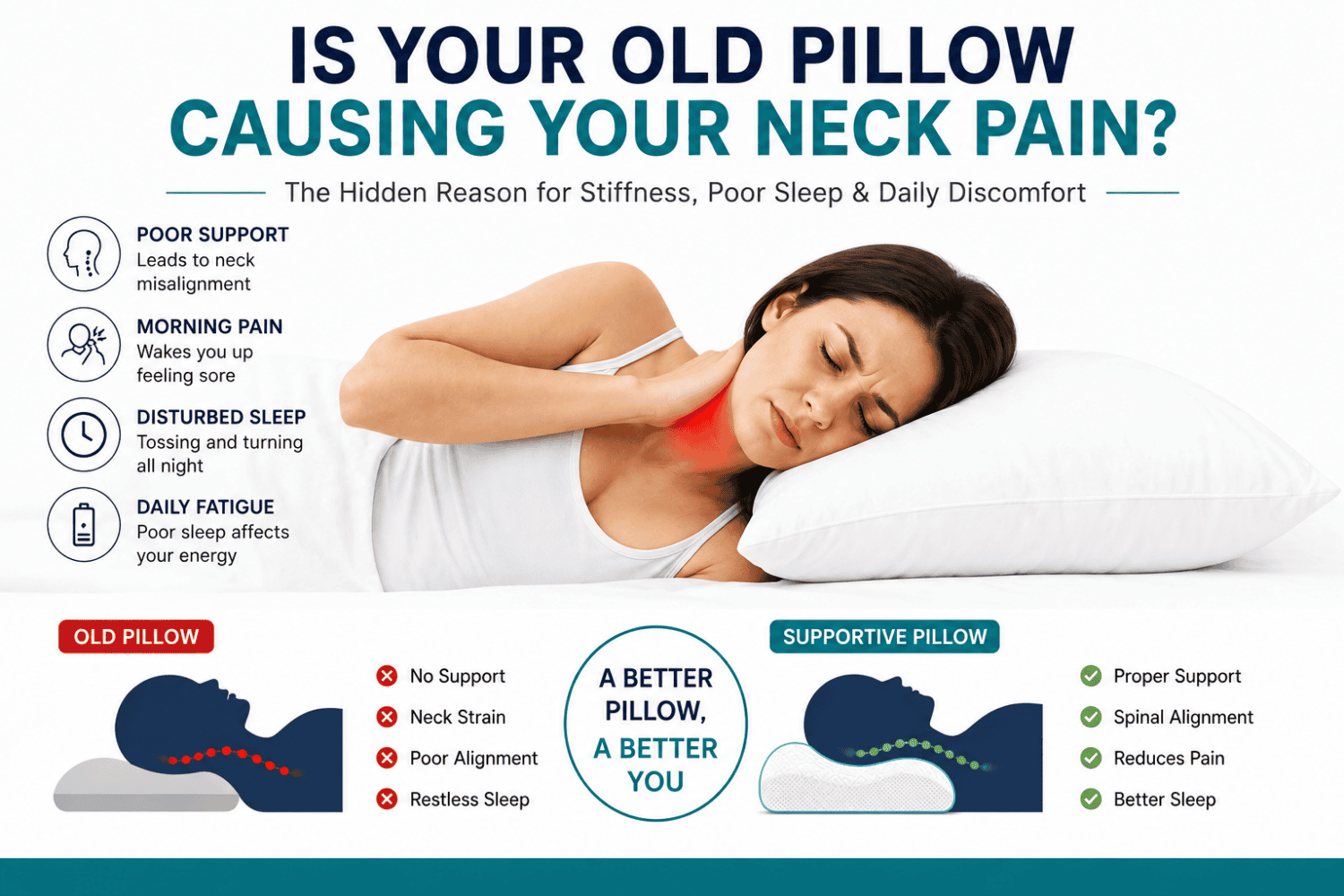
More than 1 in 7 adults deal with regular neck pain, and a meaningful share of them are sleeping on the actual cause of it every night without realizing it. Not a mattress. Not stress. The pillow.
A pillow that’s flattened, lumpy, or simply too old for its material type is one of the most common and most overlooked causes of morning neck pain. If your neck feels worst right after waking and loosens up as the day goes on, your pillow is a genuine suspect worth checking before you look anywhere else.
Here’s how to actually tell, rather than guess.
Why a Worn-Out Pillow Hurts Your Neck
Your cervical spine, the neck section, has a natural inward curve. A pillow’s entire job while you sleep is to fill the gap between your head and the mattress so that curve stays supported instead of collapsing or overextending for six to eight hours straight.
A new pillow, whatever it’s made of, does this reasonably well. The problem is that every pillow material degrades, and the degradation is often invisible from the outside. Foam loses density and stops springing back. Feather and down clump and redistribute unevenly. Polyester fill compresses permanently and stops lofting back up after a wash. From the outside, a pillow that’s lost most of its functional support can still look like a normal pillow, which is exactly why people keep sleeping on one for years past its useful life.
Once a pillow can no longer fill that head-to-mattress gap correctly, your neck spends the night either overextended (pillow too flat) or pushed too far forward (pillow too high, or lumpy in a way that props your head unevenly). Muscles and ligaments that are supposed to rest overnight instead hold tension the entire time. That’s the mechanical reason morning neck pain from an old pillow has such a distinctive pattern: worst on waking, easing as you move through the day and your muscles start working normally again.
7 Signs Your Pillow Is the Actual Problem
1. Your neck pain is worst first thing in the morning and improves within an hour or two. This specific timing pattern, bad on waking, better by mid-morning, is the single most consistent signal across every source that discusses pillow-related neck pain, because it points directly at something happening during sleep rather than during your day.
2. Your pillow is more than one to two years old. This is the general replacement window most sources converge on, though it varies by material: memory foam and quality latex can sometimes last longer if genuinely high-density, while cheaper polyester and down alternatives often need replacing sooner.
3. It doesn’t spring back after you fold or squeeze it. Fold your pillow in half. A pillow with real support left will unfold itself within a few seconds. One that stays folded, or unfolds slowly and unevenly, has lost the structural integrity it needs to support your neck overnight.
4. You’ve started stacking, folding, or refolding it during the night. If you regularly wake up adjusting, doubling, or refluffing your pillow to get comfortable, that’s your body compensating in real time for support the pillow isn’t providing anymore.
5. It looks visibly flatter, lumpier, or uneven compared to when it was new. Obvious, but frequently ignored, because the change happens gradually enough that you stop noticing it day to day. Pull out an old photo or compare it to a pillow you bought recently if you’re not sure.
6. You sleep noticeably better away from home, on a different pillow. A hotel bed or a friend’s guest room isn’t inherently better than your own bed. If you consistently wake up less stiff somewhere else, the variable that changed is very often the pillow, not the mattress or the environment.
7. You’ve developed new or worsening allergy-type symptoms at night. Old pillows accumulate dust mites, skin cells, and moisture over time regardless of material. A pillow contributing to nighttime sneezing, congestion, or itchy eyes is doing double duty as both a support problem and a hygiene one.
If several of these apply to you, the pillow is a legitimate, checkable first suspect, and one of the cheaper problems to rule out compared to a new mattress or a medical workup.
What Happens to Different Pillow Materials Over Time
Not all pillows fail the same way, and knowing which failure pattern applies to yours helps you judge how urgently it needs replacing.
Polyester and down-alternative fill compresses permanently under repeated weight and rarely recovers, even with regular fluffing. These typically show the shortest useful life, often needing replacement well within two years of regular use.
Feather and down redistributes unevenly rather than compressing uniformly, which is why these pillows often develop lumps and thin spots rather than going uniformly flat. They can last longer in raw material terms, but the uneven support they develop is arguably worse for neck alignment than a uniformly flat pillow, since it tilts your head to one side rather than just letting it sink.
Standard memory foam loses density gradually and can develop permanent body impressions, especially in the exact spot your head rests every night. Cheaper, lower-density foam flattens faster than higher-density foam, which is one of the genuine (non-marketing) reasons foam density is worth checking when buying a replacement.
Latex generally holds its shape longest of the common fill types, resisting both permanent compression and the uneven redistribution that affects feather and down. It’s also usually the most expensive material for that reason.
Water and adjustable-fill pillows degrade differently again: water pillows are more about seal integrity over time, while adjustable shredded-fill pillows can be topped up or removed as the fill settles, which is a genuine practical advantage over a fixed-fill pillow that can only get worse, never be corrected.
Who This Actually Applies To
This is a reasonable, likely explanation for you if your neck pain follows the morning-worst pattern described above, your pillow is past its typical lifespan for its material, and you don’t have other red-flag symptoms. It’s also worth checking if you’ve recently changed your sleep setup (new mattress, different bed height) in a way that might have changed how well your existing pillow fits your new sleeping position, even if the pillow itself isn’t old.
Who Should Look Elsewhere First
Pillow age is not the likely explanation, and shouldn’t be treated as the first thing to fix, if your neck pain is severe, persists or worsens throughout the day rather than easing, radiates into your arm or hand, or comes with numbness, tingling, or weakness. Those patterns point toward something a pillow can’t cause or fix, and are worth a doctor’s evaluation rather than a pillow swap. The same goes for neck pain following any kind of injury, fall, or accident, regardless of how old your pillow happens to be.
Common Misconceptions About Old Pillows and Neck Pain
“If it still looks fine, it’s fine.” The most common and most costly misconception here. Internal support loss in foam, fill compression, and structural fatigue all happen well before a pillow looks visibly worn from the outside. Looking fine and functioning correctly are two different things.
“Fluffing it every day will keep it working.” Fluffing redistributes fill and can extend a pillow’s useful life somewhat, particularly for down and feather, but it cannot restore foam density that’s genuinely broken down, and it can’t fix fill that’s permanently compressed rather than just displaced.
“A more expensive pillow will never need replacing.” Higher-density materials generally last longer, which is a real and defensible reason to pay more, but “longer” is not “forever.” Every pillow material has a functional lifespan, premium ones included.
“If my neck hurts, it must be my mattress, not my pillow.” Mattresses matter, but they support your whole body over a much larger surface area and degrade more slowly and more uniformly than a pillow does. A pillow is smaller, cheaper, sits directly against a much more mechanically sensitive part of your body, and typically needs replacing far more often than the mattress underneath it.
What to Actually Do About It
If several of the seven signs above sound familiar, the practical next step is straightforward: test the theory before spending money. Try a different pillow for a few nights, a spare from another room, a hotel pillow if you happen to be traveling, anything different from your current one, and pay attention to whether your morning symptoms change. This costs nothing and either confirms or rules out the pillow as the cause before you commit to a purchase.
If that informal test points toward the pillow, the next decision is what kind of replacement actually fits your sleep position and body, which is a longer conversation than this piece can cover on its own. For one specific, honestly-assessed option built around exactly this kind of posture-support need, our VelaSleep review breaks down what a contoured support pillow can and can’t realistically do for you, including where its own marketing oversells the claim.
The Question People Ask Most About Old Pillows and Neck Pain
How do I know if it’s my pillow or my mattress causing neck pain?
Test one variable at a time. Sleep on a different pillow with your current mattress for a few nights. If your symptoms improve, the pillow was a significant factor. Mattresses degrade far more slowly and evenly than pillows, so they’re less often the primary cause of a specific, morning-focused neck pain pattern.
How often should I actually replace my pillow?
Most sources converge on roughly one to two years for standard fill types, longer for high-density foam or genuine latex if it’s still passing the fold-and-spring-back test described above. Age alone isn’t the only signal, condition matters as much as the calendar.
Can an old pillow cause headaches, not just neck pain?
Yes, this is a commonly reported pattern. Poor neck alignment overnight can contribute to tension-type headaches that show up alongside or instead of neck stiffness, particularly on waking.
Is it normal for neck pain to get better as the day goes on?
That specific pattern, worse on waking and improving with movement, is one of the more reliable signals pointing toward a sleep-setup cause rather than a structural or medical one, though it’s not a diagnosis by itself.
Should I just buy a cervical or contour pillow instead of a regular one?
Not automatically. A contoured support pillow can genuinely help people whose issue is alignment-related, but the shape isn’t a fix for every cause of neck pain, and fit varies enormously by body and sleep position. It’s worth understanding what these pillows actually do, and don’t do, before assuming the shape itself is the solution.
Can a pillow that’s too high cause the same problem as one that’s too flat?
Yes. Both directions push your neck out of its natural alignment, just in opposite ways. A pillow that’s too high tips your chin toward your chest all night; one that’s too flat lets your head drop back. Either extreme produces the same kind of overnight strain.
I wash my pillow regularly. Does that reset its lifespan?
No. Washing addresses hygiene, dust mites, sweat, allergens, but it doesn’t restore lost foam density or reverse permanently compressed fill. A clean pillow and a supportive pillow are two different, only loosely related things.
My neck pain started suddenly. Could it still be the pillow?
Possibly, if you recently switched pillows, changed sleep positions, or your existing pillow crossed some threshold of wear you hadn’t noticed. But a genuinely sudden onset, especially with any injury history, radiating pain, or numbness, deserves a doctor’s evaluation rather than an assumption either way.
Do side sleepers wear out pillows faster than back sleepers?
Generally yes, since side sleeping concentrates more consistent weight and pressure on a smaller area of the pillow, particularly in fill types like down or polyester that compress under sustained pressure rather than springing back evenly.
Is there a way to extend a pillow’s life instead of replacing it?
Regular fluffing and rotation help somewhat, particularly for feather and down. Beyond that, the fold-and-spring-back test described earlier is the honest way to check whether a pillow still has functional support left or whether fluffing is just rearranging fill that’s already lost its job.

