

We may receive a commission for purchases made through the links provided here. Learn More Learn More.
Sifts Daily vs Activated Charcoal for Microplastics: There is a particular kind of frustration that comes from researching microplastic supplements. You start with genuine curiosity about a real problem, and within twenty minutes you’re buried in marketing copy, contradictory claims, and wellness influencers comparing activated charcoal to Ozempic. The signal-to-noise ratio is terrible.
So let’s cut through it.
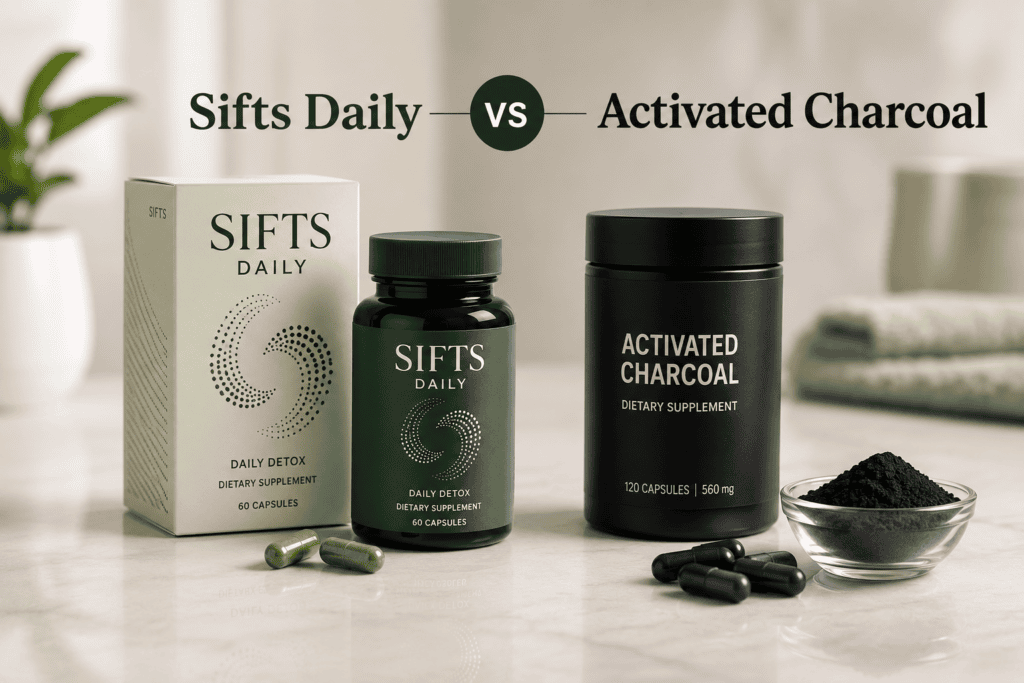
Two products come up repeatedly when people search for microplastic gut support: Sifts Daily, which uses chitosan as its primary ingredient, and activated charcoal, which has been positioned as a “natural detox” solution for years. Both claim to clear unwanted substances from your gut. Both are taken as capsules. Both are available without a prescription.
The similarities end there. Their mechanisms are fundamentally different, their daily-use safety profiles diverge significantly, and the research supporting them is not remotely comparable. This article covers every dimension that matters: how each works, what the science actually shows, who can use what safely, and who wins when stacked head to head for this specific purpose.
TL;DR
- Sifts Daily uses chitosan, which has four peer-reviewed studies (2025-2026) showing increased microplastic fecal excretion and reduced blood microplastic concentration in humans
- Activated charcoal has zero published human studies specifically on microplastic elimination
- Chitosan is selective in its binding mechanism; activated charcoal is completely non-selective and binds nutrients and medications alongside any target substances
- Medical consensus (NHS, FDA, Mayo Clinic) does not support daily activated charcoal use
- For daily microplastic gut support, Sifts Daily is clearly the better-evidenced, safer choice
- Neither can remove microplastics already deposited in blood or organ tissue
What Is Sifts Daily?
Sifts Daily is a daily supplement manufactured by Gevy Labs LLC, based in Emmett, Idaho. It comes in capsule form, two capsules per day, and is formulated around a five-ingredient stack designed to support the body’s natural fecal elimination of ingested microplastic particles.
The primary active ingredient is chitosan, a positively charged dietary fiber derived from the outer shells of crustaceans (shrimp and crab). The supporting ingredients are apple pectin, baobab fruit extract, slippery elm, and magnesium glycinate. Together, the brand describes these as operating through a “Binder-Barrier Method,” covering three sequential gut-level actions: binding microplastic particles through electrostatic attraction, buffering transit through fiber gel formation, and protecting the gut lining through mucilaginous coating and tight-junction protein support.
The product retails at $65 for a one-time 30-day supply, dropping to $49 per month on monthly autoship and $42 per month on a three-month autoship plan. It is third-party tested for heavy metals, contaminants, potency, and purity, and manufactured in a GMP-certified, FDA-registered facility.
For the complete product breakdown, ingredient analysis, and 30-day testing experience, see our Sifts Daily Review.
What Is Activated Charcoal?
Activated charcoal is a fine black powder produced by taking carbon-rich organic materials, typically coconut shells, wood, or coal, and heating them to high temperatures in the presence of a gas that causes the material to develop a vast network of internal pores. This process dramatically increases the material’s surface area: a single gram of activated charcoal can have a surface area exceeding 500 square meters, which is larger than a full basketball court.
This enormous surface area gives activated charcoal its core property: adsorption. When activated charcoal encounters other molecules in solution, those molecules are attracted to and held against its porous surface through Van der Waals forces and electrostatic interactions. This non-specific binding is what makes activated charcoal so effective in emergency medical applications, and also what makes it problematic for routine daily supplementation.
In emergency medicine, activated charcoal is administered within an hour of ingesting certain toxic substances or overdoses of certain drugs. It adsorbs the toxic molecules before they can be fully absorbed from the gut into the bloodstream, effectively trapping them for elimination. This is a genuinely life-saving application, and it depends on precisely the same property that creates problems with daily use: the indiscriminate, non-selective adsorption of almost everything it encounters.
Activated charcoal is also sold widely as a “detox” wellness product, appearing in capsules, powders, lemonades, face masks, and toothpastes. The wellness applications are where the evidence thins considerably.
The Core Mechanism Comparison
Understanding why these two products produce such different outcomes for daily use requires understanding how their binding mechanisms differ at a chemical level.
Chitosan: Selective Electrostatic Binding
Chitosan is a natural polysaccharide derived from chitin that effectively binds microplastics and promotes their removal from the body through a mechanism rooted in electrostatic attraction.
Most common synthetic plastic polymers, polyethylene (PE), polypropylene (PP), polyethylene terephthalate (PET), polyvinyl chloride (PVC), polystyrene (PS), develop a net negative surface charge when suspended in aqueous environments at digestive pH values. This negative charge comes from the adsorption of negatively charged ions and organic molecules onto the polymer surface.
Chitosan, when processed to a high degree of deacetylation (Sifts Daily specifies at least 85%), carries a strong positive charge at the pH levels of the stomach (pH 1.5 to 3.5) and upper small intestine (pH 5 to 7). When chitosan and microplastic particles are co-present in the digestive tract, the positive charge of chitosan and the negative charge of most microplastic surfaces attract each other through electrostatic interaction, forming a physical complex.
This complex then travels together through the digestive system as part of the fiber matrix, reaching the colon and ultimately being excreted in feces rather than remaining in the gut where extended contact with the intestinal wall could facilitate particle uptake.
A 2026 materials chemistry study published in the Journal of Materials Chemistry B found that chitosan with sufficient intrinsic viscosity forms semi-dilute entangled polymer networks capable of achieving up to 87% topological entrapment of common plastic polymer types including HDPE, PVC, and PET under simulated gastric conditions at pH 3 and 37 degrees Celsius.
The selectivity of this mechanism is critical for daily use. Chitosan preferentially targets particles that match its electrostatic binding profile. It does not broadly adsorb all molecules indiscriminately. While some fat-binding and bile acid-binding activity is documented for chitosan (the basis for its historical use in cholesterol-lowering applications), this activity is fundamentally different from the broad non-selective surface adsorption of activated charcoal.
Activated Charcoal: Non-Selective Surface Adsorption
Activated charcoal works through a completely different mechanism. Its enormous porous surface creates what chemists call a Van der Waals force field: weak but cumulative attractive forces that pull nearby molecules of almost any kind onto the charcoal surface and hold them there.
The molecule being adsorbed could be a toxic drug, a pesticide, a heavy metal, or your vitamin D supplement, your warfarin, the iron from your morning spinach, the probiotics in your yogurt, or the antioxidants from your blueberries. Activated charcoal does not discriminate.
This is why emergency medicine uses activated charcoal specifically: in a poisoning scenario, losing some vitamins is an acceptable trade-off for preventing the absorption of a lethal substance. But in a daily supplementation scenario, this trade-off becomes a serious concern. Every day you take activated charcoal, you are reducing the bioavailability of fat-soluble vitamins (A, D, E, K), certain medications (particularly lipid-soluble drugs), and various nutrients from food.
The clinical bodies that address this are consistent: the NHS recommends against routine daily activated charcoal use, the FDA has not approved it for daily detox applications, and the Mayo Clinic’s own information on activated charcoal specifically addresses the nutrient depletion risk of daily use.
Could activated charcoal also adsorb microplastic particles? Yes, in principle. Its large surface area would attract and hold microplastic particles alongside everything else. But “in principle” is not the same as “clinically studied.” There are no published human studies showing activated charcoal increases fecal microplastic excretion or reduces blood microplastic concentration. The research simply doesn’t exist.
The Research Evidence: Side by Side
This is the most important section of this comparison, because the research gap between these two products is enormous and almost never acknowledged in general wellness coverage.
Sifts Daily / Chitosan Research Base (2025-2026)
Study 1: Human Crossover Study, Foods Journal, 2025
Citation: Casella C, Cornelli U, Ballaz S, et al. Preliminary Study on PCC-Chitosan’s Ability to Enhance Microplastic Excretion in Human Stools from Healthy Volunteers. Foods. 2025;14(13):2190. PMID: 40646942.
This was a human crossover study in which healthy volunteers consumed a standardized meal containing known microplastic contamination, either with or without a chitosan formulation. Stool samples collected within 12 hours showed approximately 45% more microplastic particles per 5 grams of stool in the chitosan group compared to the placebo condition (965 particles versus 654 particles). This is the first human study directly measuring fecal microplastic excretion response to chitosan supplementation.
Study 2: Animal Feeding Study, Scientific Reports, 2025
Citation: Liu D, Shimizu M. Ingesting chitosan can promote excretion of microplastics. Sci Rep. 2025;15:14041. PMID: 40268980.
Researchers at Tokai University fed rats a diet containing polyethylene microplastics alongside one of four non-digestible fiber materials: indigestible dextrin, lactosucrose, eggshell membrane proteins, or chitosan. The chitosan group showed significantly higher fecal microplastic excretion rates and lower gastrointestinal retention rates than all other groups. Gastrointestinal microplastic retention dropped from approximately 12.1% to 6.1% in the chitosan group. Critically, chitosan outperformed all other tested fiber materials, providing evidence for mechanism-specific activity rather than general fiber effects.
Study 3: Human Blood Study, Journal of Xenobiotics, 2026
Citation: Cornelli U et al. Chitosan and blood microplastic concentration in human subjects. Journal of Xenobiotics. 2026. DOI: 10.3390/jox16030092.
This study moved beyond fecal excretion to measure whether daily chitosan supplementation affects systemic microplastic burden. After 15 days of daily supplementation, measured blood microplastic concentration decreased by 26.3% in the chitosan group. The placebo group showed no significant change over the same period. This is the first human study showing a systemic reduction in microplastic burden associated with daily chitosan use.
Study 4: In Vitro Materials Chemistry, Journal of Materials Chemistry B, 2026
Citation: Popa RP, Tabaran AF et al. Chitosan with defined intrinsic viscosity enables physicochemical entrapment of microplastics under in vitro gastric conditions. J Mater Chem B. 2026. DOI: 10.1039/D6TB00654J.
This mechanistic study characterized the specific chitosan properties required for effective microplastic entrapment. Chitosan at or above a threshold intrinsic viscosity (approximately 90 cP) forms entangled polymer networks that achieve up to 87% topological entrapment of HDPE, PVC, and PET microplastics under simulated gastric conditions. This study is important because it establishes that not all chitosan is equally effective, the molecular weight and degree of deacetylation matter significantly.
Activated Charcoal Research Base for Microplastics
There are no published peer-reviewed human clinical studies examining activated charcoal’s effects on fecal microplastic excretion or blood microplastic concentration. Zero.
Some laboratory research has shown that activated charcoal can adsorb microplastic particles in aqueous solution, this is not surprising given its enormous surface area and non-selective binding. But laboratory adsorption in solution does not translate directly to in vivo gut performance, where the activated charcoal surface is competing with bile acids, food particles, medication molecules, vitamins, minerals, and a vast array of other compounds for binding capacity.
No animal feeding study has measured whether activated charcoal supplementation increases fecal microplastic excretion. No human study has measured blood microplastic levels before and after activated charcoal supplementation. The evidence gap is not a technicality, it is the absence of the entire research foundation that would be required to support activated charcoal as a microplastic supplement.
Daily Use Safety: A Critical Distinction
For a supplement to be a practical daily microplastic support tool, it needs to be safe for daily, ongoing consumption without producing harmful side effects through its mechanism. This is where the comparison becomes particularly one-sided.
Chitosan Daily Use Safety
Chitosan is classified as a dietary fiber and has been used in multiple approved medical applications globally, including wound dressings, hemostatic agents, and food-grade applications. The European Food Safety Authority has reviewed chitosan’s safety profile for dietary supplementation and concluded it is safe for general use.
At the label dose in Sifts Daily (two capsules delivering approximately 0.5 to 1g of chitosan per day), the primary documented side effects are:
- Mild fiber adjustment in the first week (bloating, gas) as the gut microbiome adapts to increased fiber intake, affects a minority of users and resolves within 5 to 7 days
- Potential binding of fat-soluble medications and vitamins at the same time as the supplement, managed by spacing Sifts Daily at least two hours from fat-soluble vitamins or lipid-soluble medications
- Shellfish allergen, a hard contraindication for anyone with shellfish allergy
There are no documented concerns about chitosan depleting essential nutrients through daily use at supplement doses in healthy adults. Its selective electrostatic mechanism means it does not broadly adsorb the range of nutrients that activated charcoal does.
Activated Charcoal Daily Use Safety
The clinical literature and regulatory guidance is consistent: activated charcoal is not appropriate for daily supplementation in healthy adults.
The concern is the non-selective nutrient binding. Studies in clinical settings have documented that activated charcoal reduces the bioavailability of:
- Fat-soluble vitamins: A, D, E, and K absorption is reduced
- Medications: both prescription and over-the-counter drugs have reduced bioavailability when taken around the same time as activated charcoal
- Minerals: iron, calcium, magnesium, and zinc absorption can be affected
- Antioxidants and beneficial compounds from food: polyphenols, flavonoids, and other bioactive nutrients are adsorbed alongside target substances
When taken occasionally, these effects are minor, the body recalibrates. But daily use creates chronic nutrient depletion risk, medication inefficacy risk, and the compounding effects of reduced antioxidant and mineral intake over time. For someone who takes any medication daily (including oral contraceptives, thyroid medication, blood pressure medication, or antidepressants), daily activated charcoal supplementation creates a real pharmacological problem regardless of whether the two are taken at the same time of day.
The NHS website explicitly states: “Do not take activated charcoal as a supplement if you have any medical conditions or are taking any medication.” This guidance exists because the non-selective binding mechanism interacts with medication management in ways that are unpredictable and potentially harmful.
Sifts Daily vs Activated Charcoal for Microplastics: Side-by-Side Comparison Table
| Factor | Sifts Daily (Chitosan) | Activated Charcoal |
|---|---|---|
| Microplastic-specific human research | 2 human studies (fecal + blood, 2025-2026) | Zero human studies |
| Animal research for microplastics | 1 animal study (PMID: 40268980) | Zero |
| In vitro mechanism research | 1 materials chemistry study (87% entrapment) | Non-specific adsorption only |
| Binding mechanism | Selective electrostatic (positive-negative charge) | Non-selective surface adsorption |
| Nutrient depletion risk | Low (selective mechanism) | High (non-selective) |
| Medication interaction risk | Low-moderate (space 2hr from fat-soluble) | High (affects most medications) |
| Recommended for daily use | Yes (clinical consensus) | No (NHS, Mayo Clinic, medical consensus) |
| Shellfish allergen | Yes (hard contraindication) | No |
| Constipation risk | Low at label dose with adequate water | Moderate-high at higher doses |
| Price range | $49-65/month | $15-30/month |
| FDA regulatory status | Dietary fiber (recognized as safe) | Not approved for daily detox |
| Third-party tested | Yes (Sifts Daily) | Varies by brand |
Can They Be Combined?
Some people wonder whether using both products simultaneously could provide additive benefit, chitosan for selective microplastic binding and activated charcoal for broader adsorption.
The honest answer is: no, and attempting this creates multiple problems.
First, activated charcoal will adsorb chitosan itself. The positive charge of chitosan molecules is attractive to activated charcoal’s non-selective surface, meaning the activated charcoal will bind to the chitosan and remove it from the digestive environment, reducing or eliminating chitosan’s microplastic-binding capacity.
Second, even if you space them significantly (morning Sifts, evening activated charcoal), there is no research supporting additive microplastic benefit from the combination. You would be adding the risks of daily activated charcoal (nutrient depletion, medication interference) without evidence of additional benefit over chitosan alone.
If you want to occasionally use activated charcoal for acute situations (travel, suspected food-borne illness, as an emergency measure), this is a different use case from daily microplastic supplementation. In that scenario, take activated charcoal as a single acute dose when needed, completely separately from your Sifts Daily routine, and ensure it is timed well away from any medications.
Alternatives for People Who Cannot Use Either Product
If You Cannot Use Sifts Daily (Shellfish Allergy)
Chitosan from crustacean shells is the only ingredient with human study evidence for microplastic excretion. However, fungal-derived chitosan (from Aspergillus niger and other fungal sources) is being researched as a shellfish-free alternative with potentially similar charge characteristics. This is not yet available in finished consumer supplement form with the same quality evidence, but it represents the most likely future solution for shellfish-allergic individuals wanting chitosan-based microplastic support.
In the meantime, the most rational approach is aggressive source reduction (filtered water, no plastic food heating, glass storage containers) combined with general soluble fiber supplementation (apple pectin, psyllium husk) that may provide modest transit support benefit. Neither approach replicates chitosan’s specific mechanism, but source reduction addresses the input side and fiber supports overall gut health.
If You Cannot Use Activated Charcoal (Daily Medication Users)
The daily medication issue essentially rules out activated charcoal for daily supplementation for most adults on any consistent medication regimen, which is the majority of adults over 40. The alternative is Sifts Daily for those without shellfish allergy, or general fiber supplementation for those with shellfish allergy.
What the Research Gap Tells Us
It’s worth being explicit about what the absence of microplastic research on activated charcoal means practically.
Activated charcoal’s wellness positioning as a “detox” agent has been commercially successful for years without corresponding scientific validation. The detox claim generally is not supported by research, the liver and kidneys are the body’s actual detox organs, and a healthy gut microbiome contributes to overall elimination efficiency. Activated charcoal’s role in this is limited to acute poisoning scenarios.
The microplastic claim specifically adds another layer of unsupported positioning on top of the general detox claim. Someone selling activated charcoal capsules for “microplastic detox” is making a claim that has no human evidence basis, targeting a consumer concern that is legitimate, and charging a premium for a product that is not appropriate for daily use. This pattern is worth recognizing clearly.
Sifts Daily, by contrast, built its formulation explicitly around the chitosan microplastic research and cites the specific peer-reviewed studies that support its mechanism. The science is early-stage for this category as a whole, but the foundation is genuine rather than borrowed.
Practical Microplastic Reduction Strategy
Whether you choose Sifts Daily, activated charcoal (for occasional use only), or neither, the highest-impact strategies for reducing microplastic burden combine gut elimination support with source reduction:
Source Reduction (Most Important)
Switching from bottled water to quality-filtered tap water is the single highest-impact change for most people. Research shows that individuals who drink bottled water exclusively may ingest approximately 90,000 additional microplastic particles annually compared to filtered tap water drinkers. This single change, before any supplement, removes more total microplastic exposure than any supplement can eliminate.
Never heat food in plastic containers. This includes “microwave-safe” plastic, which means only that the container won’t melt, not that it won’t release particles into food when heated. Use glass, ceramic, or stainless steel for all heating and storage of food.
Gut Elimination Support (Internal)
For healthy adults without shellfish allergy who want to support their body’s natural elimination of ingested microplastics, Sifts Daily’s chitosan mechanism is the most evidence-backed option currently available. It does not eliminate the need for source reduction; it complements it.
For healthy adults with shellfish allergy, high-dose soluble fiber (apple pectin, psyllium husk) may provide modest transit support benefit without the specific chitosan mechanism.
Expert Tips for Choosing Between These Products
If you are considering activated charcoal for microplastics: Read the human evidence base first. There is none. Then read the daily-use safety concerns. Then ask yourself whether there is any rational basis for choosing it over Sifts Daily for this specific purpose. The answer, based on the available evidence, is no.
If you are considering Sifts Daily: Check the shellfish allergy contraindication first. If you have shellfish allergy, this product is not an option. If you do not, the next most important consideration is whether you take any daily fat-soluble medications, and whether you can space your supplement two hours from those medications.
If budget is the primary concern: Activated charcoal is significantly cheaper. But the relevant comparison is not price alone, it’s price per unit of evidence-supported benefit. On that metric, activated charcoal at $20 per month with zero microplastic-specific evidence provides less value than Sifts Daily at $49 per month with four peer-reviewed studies.
Frequently Asked Questions
Does activated charcoal remove microplastics from the body?
There are no published human clinical studies showing activated charcoal reduces microplastic burden. In vitro research shows it can adsorb particles in solution, but this has not been tested in human gut physiology. Sifts Daily’s chitosan has two human studies demonstrating increased fecal excretion and reduced blood concentration.
Is it safe to take activated charcoal every day?
Medical consensus from the NHS, Mayo Clinic, and FDA does not support daily activated charcoal use for healthy adults. The non-selective binding mechanism depletes nutrients and interferes with medication bioavailability with chronic daily use.
What is the difference between chitosan and activated charcoal?
Chitosan is a dietary fiber derived from crustacean shells with a selective electrostatic binding mechanism that preferentially targets negatively charged particles at digestive pH. Activated charcoal is a carbon-based material with a non-selective surface adsorption mechanism that binds virtually any molecule indiscriminately.
Can I take Sifts Daily and activated charcoal on the same day?
Not at the same time. Activated charcoal will bind to chitosan itself, negating its microplastic-binding effect. If you want to use activated charcoal occasionally for a separate acute purpose, space it by at least 4 to 6 hours from Sifts Daily and ensure your medications are not affected.
Which works better for microplastics, Sifts Daily or activated charcoal?
Sifts Daily has human study evidence; activated charcoal does not. For daily microplastic gut support, Sifts Daily is the clearly better-evidenced choice.
How long does it take for Sifts Daily to work?
The 2025 human crossover study measured effects within 12 hours of a single dose (45% more fecal microplastic excretion). The 2026 blood study measured a 26.3% reduction in blood microplastic concentration after 15 days of daily use. You will not feel it working, as the benefit is biochemical and microscopic.
Does activated charcoal interact with medications?
Yes. Activated charcoal significantly reduces the bioavailability of most medications, including prescription drugs, oral contraceptives, thyroid medication, blood pressure medication, and many others. This is why the NHS specifically cautions against daily activated charcoal supplementation for anyone taking medication.
Is Sifts Daily better than just eating more fiber?
Sifts Daily’s chitosan mechanism is specifically researched for microplastic binding and outperformed three other dietary fiber types in the 2025 animal study. General fiber intake supports gut motility and may reduce microplastic residence time but does not replicate the specific electrostatic binding mechanism.
What are the side effects of Sifts Daily?
The most common reported effects are mild fiber adjustment in the first week (bloating, gas) that resolves within 5 to 7 days. Fat-soluble vitamin or medication interaction is managed by spacing. The hard contraindication is shellfish allergy.
What are the side effects of daily activated charcoal?
Daily activated charcoal can cause constipation, black stool, nausea, reduced vitamin absorption (especially fat-soluble vitamins A, D, E, K), reduced medication bioavailability, and in high doses, gastrointestinal impaction. Long-term daily use is not clinically recommended.
Should I use activated charcoal or Sifts Daily for gut detox generally?
If “gut detox” means supporting the elimination of ingested environmental toxins and particles, Sifts Daily has evidence for this specific purpose. If it means something vaguer like “cleansing” or “resetting,” neither product is an appropriate vehicle for that concept, the liver and kidneys perform actual metabolic detoxification, and neither chitosan nor activated charcoal replaces those organs.
Can vegetarians use Sifts Daily?
No. Sifts Daily contains chitosan derived from crustacean shells (shellfish), making it unsuitable for vegetarians and vegans, as well as those with shellfish allergies.
Final Verdict
The comparison between Sifts Daily and activated charcoal for daily microplastic support is not particularly close once you look at the evidence honestly.
Activated charcoal is a powerful, well-established clinical tool for acute poisoning and overdose scenarios. It is not a daily microplastic supplement, and positioning it as one ignores both the complete absence of microplastic-specific human research and the documented risks of daily non-selective binding for nutrient and medication bioavailability.
Sifts Daily has four peer-reviewed studies (including two human trials) published between 2025 and 2026 supporting its primary mechanism for microplastic excretion. The science is early-stage for this category as a whole, but the foundation is legitimate, transparent, and specifically designed for this purpose.
For daily microplastic gut support in a healthy adult without shellfish allergy: Sifts Daily is the clearly better choice by every measurable dimension. For anyone with shellfish allergy, neither product is appropriate, and source reduction strategies become the primary tool. For anyone considering activated charcoal for acute, non-daily applications: that is a separate, legitimate use case that doesn’t conflict with the conclusion above.