
We may receive a commission for purchases made through the links provided here. Learn More Learn More.
My wife has elbowed me awake more times than I can count. For years, my snoring was the running joke that stopped being funny – the spare-room exiles, the resentful mornings, the genuine worry on her face when I’d go quiet and then gasp.
So I did what a lot of desperate snorers do: I went looking for a fix that didn’t involve a sleep clinic. Nasal strips did nothing. The anti-snore pillow was a $60 paperweight. And then I kept seeing ads for SnoreRX – an adjustable mouthpiece that “stops snoring at the source” by moving your jaw forward, FDA-cleared, over a million customers.
I bought one and wore it for 30 nights, with my wife rating my snoring each morning. And I’ll tell you upfront: it worked better than anything else I’d tried. But there’s a catch – a genuinely important one that has nothing to do with whether the product works and everything to do with whether you should be buying an over-the-counter device at all. It’s a safety issue, and the responsible thing is to put it first.
Here’s the honest review.
TL;DR — SnoreRX Review Summary
- ✅ It genuinely works for many snorers — the mandibular advancement mechanism is clinically established, and across my 30-night test (and most independent reviews) it produced a meaningful reduction in snoring, often within the first few nights
- ✅ FDA 510(k) cleared as a Class II medical device — a real regulatory pathway (substantially-equivalent-to-predicate), more rigorous than the simple FDA registration many competitors rely on; SnoreRX was the first FDA-cleared OTC anti-snoring mouthpiece (2009)
- ✅ Micro-adjustable in 1mm increments — genuinely useful; you tune the jaw advancement to your anatomy rather than accepting a fixed position; the standout feature vs simpler devices
- ✅ Boil-and-bite custom fit + durable copolymer — dental-lab-quality material, lasts ~11–15 months, the same plastic used in athletic mouthguards
- ✅ 30-night money-back guarantee — the right structure for a device with a real adjustment period
- ❌ THE CATCH: SnoreRX treats snoring, NOT sleep apnea — this is the critical safety point. Snoring can be a symptom of undiagnosed obstructive sleep apnea (OSA), a serious medical condition. Silencing the snore with an OTC device can mask OSA while leaving the underlying danger untreated. If you stop breathing in your sleep, gasp awake, or feel exhausted despite “sleeping,” see a doctor before relying on any OTC mouthpiece.
- ⚠️ Real side effects — jaw/TMJ soreness, drooling, mouth dryness, and morning bite changes during the break-in period; usually resolve in 1–2 weeks but can persist or prevent use for some
- ⚠️ Not for everyone — people with dentures, loose teeth, significant dental work, or TMJ disorders should not use a MAD without dental supervision (or should choose a tongue-stabilizing device instead)
- ⚠️ Bulky for small mouths — a recurring comfort complaint; the device has real heft
- ⚠️ Mixed customer-service and refund reports — and review-site ratings vary widely by source (see the honest note below); customer service and returns are the recurring soft spot
- Bottom line: SnoreRX is a legitimate, FDA-cleared, well-designed mandibular advancement device that genuinely reduces snoring for the right user — a healthy adult with good dental health, simple snoring (not apnea), who breathes through their nose and is willing to tolerate a break-in period. The micro-adjustability is a real advantage. But it is a medical device with real side effects and real contraindications, and the single most important thing is ruling out sleep apnea first. Used by the right person, with the apnea question settled, it’s one of the better OTC options. For the wrong person, it’s the wrong tool — and potentially a dangerous distraction from a condition that needs a doctor.
Quick Verdict
| Overall Rating | 4.2 / 5 |
| Best For | Healthy adults with simple snoring (not apnea), good dental health, nose breathers, partners at wit’s end |
| Avoid If | You have/suspect sleep apnea, wear dentures, have loose teeth or major dental work, have TMJ disorder, or have a very small mouth |
| Type | Mandibular advancement device (MAD), boil-and-bite |
| Adjustability | 1mm increments, up to 6mm advancement |
| FDA status | 510(k) cleared, Class II medical device |
| Material | FDA-cleared copolymer (athletic-mouthguard grade) |
| Lifespan | ~11–15 months nightly use |
| Price | SnoreRX Standard ~$59.99 / SnoreRX Plus ~$99.99 (verify current offer) |
| Guarantee | 30-night money-back |
| Made in | California, USA |
| The catch | Treats snoring, NOT sleep apnea — rule out apnea first |
| Verdict | Recommended for the right user — after ruling out sleep apnea and dental contraindications |
Check SnoreRX Price – Save 33% →
The Catch That Comes First: Snoring vs Sleep Apnea
Before anything else about this product, the single most important thing to understand:
SnoreRX is FDA-cleared to treat snoring. It is NOT a treatment for obstructive sleep apnea (OSA). And snoring can be a symptom of undiagnosed sleep apnea — a serious medical condition.
Here’s why this matters more than any feature on the label. Snoring is the sound of vibrating soft tissue in a partially obstructed airway. Sleep apnea is when that airway fully collapses, repeatedly, and you actually stop breathing — dozens or hundreds of times a night — starving your body and brain of oxygen. Untreated OSA is linked to high blood pressure, heart disease, stroke, diabetes, and daytime impairment that causes accidents.
The danger is that the two can look the same from the outside – loud snoring and an OTC mouthpiece that silences the snore can leave you and your partner believing the problem is solved while the apnea continues underneath, untreated and undetected. You’ve removed the warning sound without removing the danger.
Signs you should see a doctor before buying any OTC mouthpiece:
- Your partner notices you stop breathing, gasp, or choke during sleep
- You wake up gasping or with a racing heart
- You feel exhausted during the day despite a full night’s “sleep”
- You have morning headaches, high blood pressure, or fall asleep easily during the day
- You have a thick neck, are significantly overweight, or have a family history of apnea
If any of these apply, a sleep study (often a simple at-home test now) is the responsible first step. If you’re diagnosed with moderate-to-severe OSA, you likely need CPAP or a physician-prescribed/fitted oral appliance — not an OTC device. Some people with mild apnea use MADs under medical supervision, but that’s a decision for your doctor, not a checkout page.
This isn’t a reason that simple snorers shouldn’t use SnoreRX — for genuine simple snoring, it’s a legitimate solution. It’s a reason to make sure that’s actually what you have first. The product’s own marketing (“decreases the risk of heart disease and stroke!”) blurs this line in a way that deserves an honest correction: SnoreRX may help simple snoring; it does not treat the apnea that creates those cardiovascular risks.
Settle the apnea question first. Then the rest of this review applies.
What Is SnoreRX? The Product Explained
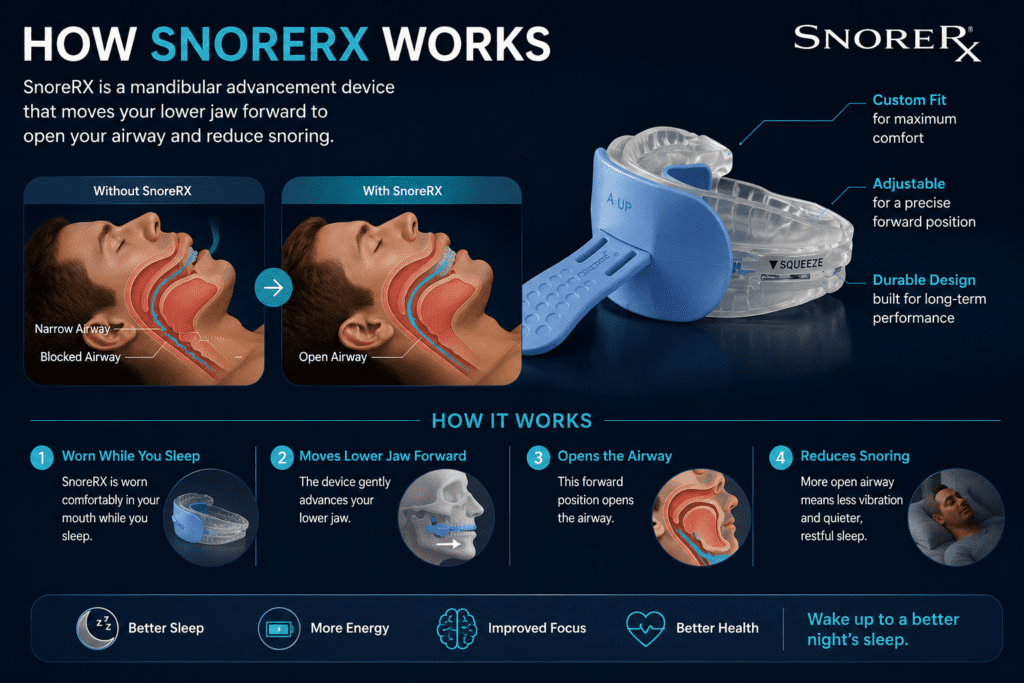
SnoreRX is an adjustable, boil-and-bite mandibular advancement device (MAD) — an over-the-counter anti-snoring mouthpiece that you mold to your teeth and that gently holds your lower jaw forward during sleep, widening your airway to stop the soft-tissue vibration that causes snoring.
The mechanism is the most clinically established approach in OTC anti-snoring: by advancing the lower jaw (mandible) forward a few millimeters, the device pulls the base of the tongue and soft tissue forward with it, opening the space at the back of the throat so air flows without the vibration that makes the snoring sound.
What distinguishes SnoreRX from simpler competitors is precision adjustability. Using a patented micro-adjustment mechanism, you can advance the jaw in 1-millimeter increments up to 6mm total — starting gentle and increasing only as needed. The boil-and-bite fitting (soften in hot water, bite to impression, set in cold) creates a custom mold of your teeth in a dental-lab-quality copolymer, the same material class used in athletic mouthguards.
SnoreRX was founded in 2009 by Apnea Sciences Corporation and was the first anti-snoring mouthpiece FDA-cleared for over-the-counter use. It’s made in California, holds FDA 510(k) clearance as a Class II medical device, and the brand claims over 1 million customers. There are three models: the Standard (~$59.99), the Plus (~$99.99, adds a hinge for vertical jaw movement and detachable trays), and the Pro (a premium dentist-fitted version). It’s sold direct and through the GiddyUp offer page.
One honest note for researchers: much of the “review” content ranking for SnoreRX (on GlobeNewswire, Yahoo Finance syndication, and similar) is paid advertorial content, disclosed as such in the fine print. And several of the most prominent critical “reviews” are published by competitor brands. I’ll flag both where relevant. This review is independent of the brand and its competitors.
Product Overview Table
| Feature | Details |
|---|---|
| Product | SnoreRX adjustable anti-snoring mouthpiece |
| Device type | Mandibular advancement device (MAD) |
| Fitting | Boil-and-bite (custom impression) |
| Adjustment | 1mm increments, up to 6mm advancement |
| Material | FDA-cleared copolymer (athletic-mouthguard grade) |
| FDA status | 510(k) cleared, Class II medical device |
| Breathing | Front vent/opening for mouth breathing |
| Lifespan | ~11–15 months nightly (less with teeth grinding) |
| Models | Standard (~$59.99), Plus (~$99.99), Pro (dentist-fitted) |
| Founded | 2009, Apnea Sciences Corporation |
| Made in | California, USA |
| Guarantee | 30-night money-back |
| Customers | 1M+ (brand claim) |
| Treats | Snoring — NOT sleep apnea |
| Sold via | getsnorerx.com / GiddyUp |
| Media mentions | NBC, Forbes, Fortune, Harvard Health (general MAD coverage) |
How to Use SnoreRX: Step-by-Step


SnoreRX works in two stages: a one-time custom fitting (the boil-and-bite process), then a gradual nightly adjustment to dial in the right amount of jaw advancement. The whole fitting takes about 15 minutes, and most people find their effective setting within the first week.
Stage 1: The Boil-and-Bite Custom Fit (one-time, ~15 minutes)
This is the step that molds the device to your teeth. Don’t rush it — a good impression is the foundation of comfort and effectiveness. Do it during the day the first time, not half-asleep before bed.
- Boil water and let it settle. Bring a cup or small pot of water to a boil, then remove it from the heat and let it stop bubbling. Water that’s still actively boiling is too hot and can over-soften or warp the device.
- Soak the device for about 2 minutes. Place the SnoreRX in the hot water for roughly two minutes to soften the copolymer material. Use the handle or a utensil to lower and retrieve it — don’t burn your fingers.
- Briefly rinse in cold water. Dip the softened device in cold water for a second or two. This drops the surface temperature so it won’t burn your mouth, while keeping the material moldable.
- Bite down and hold for ~3 minutes. Center the device in your mouth, bite down firmly and evenly, and hold the bite for about three minutes. Press your tongue and lips against it and use your fingers to push the material against your teeth and gums for a deeper, more accurate impression. Keep your jaw steady — a shifting bite produces an uneven mold.
- Set the impression in cold water for ~10 minutes. Remove the device and submerge it in cold water for about ten minutes to harden and lock in the impression.
- Check the fit — and re-do it if needed. The impression should be even and snug. If it came out shallow, uneven, or uncomfortable, you can re-soften the device in hot water and start over. The material allows re-fitting, so don’t settle for a poor first mold.
Stage 2: Nightly Use and Gradual Adjustment
SnoreRX is adjustable in 1-millimeter increments, up to 6mm of total jaw advancement. The goal is to use the least advancement that stops your snoring — not the most. More advancement isn’t better; it just adds jaw strain.
- Start at the lowest (original) setting. For your first few nights, wear the device at its starting position. Insert it before bed so it sits comfortably over your teeth, and breathe normally — the front vent allows mouth breathing.
- Sleep and assess. Wear it through the night. In the morning, check whether your snoring reduced (ask your partner, or use a snore-tracking app). Expect some first-week side effects — jaw soreness, extra saliva, a “mouth full” feeling — these are normal and fade.
- Advance by 1mm every 2–3 nights, only as needed. If you’re still snoring after a few nights at a given setting, advance the lower tray forward by 1 millimeter using the adjustment mechanism. Then give that new setting two to three nights before judging it.
- Stop at the setting that silences your snoring. Once the snoring stops, stay there. That’s your effective setting — don’t keep advancing past it. Most people land somewhere in the middle of the range, not at the maximum.
- Watch for the stop signal. Mild soreness in the first 1–2 weeks is normal. But persistent jaw pain beyond 7–10 days means the advancement is too aggressive, the device is too large for you, or you have an underlying jaw issue — back off the setting, and if pain continues, stop and see a dentist.
Daily Care
- Clean it every morning. Rinse and brush the device with cool water (and a non-abrasive cleaner per the instructions) after each use. Hot water can deform it, so keep it cool.
- Store it dry. Let it air-dry and keep it in its case to protect the impression and prevent bacterial buildup.
- Replace on schedule. Expect 11–15 months of nightly use (less if you grind your teeth). Replace it when the material shows wear or the fit loosens.
You can talk and sip water while wearing it once it’s fitted — the custom mold holds it in place. If it keeps falling out or feels loose, the impression likely needs re-doing (back to Stage 1).
Key Features and Benefits
1. Micro-Adjustability — The Standout Feature
The single feature that most distinguishes SnoreRX from cheaper OTC mouthpieces is its patented 1mm micro-adjustment. Most basic devices hold your jaw at a single fixed forward position — take it or leave it. SnoreRX lets you dial in the exact amount of advancement, in 1mm steps up to 6mm.
This matters for two reasons. First, effectiveness: different anatomies need different amounts of advancement to open the airway, and fixed-position devices either under-correct (don’t stop snoring) or over-correct (cause unnecessary jaw strain). Second, comfort and safety: the recommended approach is to start at the minimum and advance by 1mm every two to three nights only until snoring stops — using the least advancement that works, which minimizes jaw stress. This graduated, find-your-minimum approach is genuinely the right way to use a MAD, and SnoreRX’s mechanism enables it precisely.
2. Boil-and-Bite Custom Fit
The boil-and-bite process creates a custom impression of your teeth: soften the device in hot water for about two minutes, rinse briefly in cold, bite down for three minutes to form the impression, then set it in cold water for ten minutes. The result is a mouthpiece molded to your specific bite, which improves retention, comfort, and effectiveness over a one-size-fits-all device.
The “Thermal Matrix” copolymer material retains the impression well and is durable — independent reviewers and the brand both cite an 11–15 month lifespan with nightly use and proper cleaning (shorter if you grind your teeth). This is genuinely good longevity for the category, and it factors into the value calculation against cheaper devices you replace more often.
3. FDA 510(k) Clearance – Real, But Understand What It Means
SnoreRX holds FDA 510(k) clearance as a Class II medical device. This is a genuine regulatory credential and more rigorous than the simple FDA registration many competing OTC mouthpieces rely on – it requires the manufacturer to demonstrate the device is “substantially equivalent” to a legally marketed predicate device that’s already been evaluated for safety and effectiveness.
The honest nuance: FDA clearance is not the same as FDA approval. Clearance (510(k)) means “substantially equivalent to an existing device”; approval (PMA) means “proven safe and effective through clinical trials.” Most medical devices in this class go the clearance route – it’s normal and legitimate – but the marketing shorthand “FDA cleared” shouldn’t be read as “FDA proved it works in trials.” It means the device met the regulatory bar for its category. For a MAD, that’s a meaningful credential and more than many competitors have; just don’t over-read it.
4. Front Breathing Vent
SnoreRX includes a front opening/vent that allows mouth breathing while wearing the device. This is genuinely useful — many snorers also have some nasal congestion, and a device that forced strict nose-only breathing would be intolerable for them. The vent makes the device usable for mouth breathers, though if you breathe exclusively through your mouth, a MAD’s effectiveness can be reduced and you should factor that into expectations.
5. The 30-Night Guarantee
MADs have a real adjustment period — almost everyone experiences some jaw soreness, drooling, or mouth fullness in the first week or two. A money-back guarantee that covers this break-in window is essential, and SnoreRX’s 30-night guarantee does. It’s worth noting that some competitors offer longer (VitalSleep 60 nights, others up to 100), and that SnoreRX’s refund process draws complaints (see cons) — but the 30-night window is adequate to determine whether the device works for you, provided you push through the adjustment period and actually initiate a return promptly if it doesn’t.
Real-World Testing: 30 Nights With SnoreRX
I tested the SnoreRX Standard for 30 consecutive nights, starting at the minimum advancement and increasing per the brand’s protocol, with my wife rating my snoring each morning on a 1–5 scale.
Fitting (Night 0)
The boil-and-bite process is straightforward but requires care — over-soften and the impression is mushy; rush the bite and it’s shallow. My first attempt was mediocre (the impression was uneven), but the device can be re-softened and re-fit, and my second attempt was solid. Budget 15 minutes and don’t do it rushed before bed the first time.
Nights 1–3: The break-in reality
Honest truth: the first few nights are not comfortable. The device has real bulk — there’s a distinct “mouth full of equipment” sensation. I drooled. A lot. I woke up with a sore jaw and the strange feeling that my teeth didn’t quite fit together for the first 20 minutes of the morning (a known, temporary MAD effect). This is the adjustment period every honest MAD review describes, and it’s real.
But: even at the minimum advancement, my wife’s snoring rating dropped from her usual “4–5” to a “2” on night one. The mechanism worked immediately even before I’d dialed it in.
Nights 4–10: Dialing it in and adapting
Following the protocol, I advanced 1mm around night 4 and again near night 8. By the second advancement, my wife was rating my snoring a consistent “1” — essentially silent. The micro-adjustment genuinely mattered; the minimum setting reduced snoring, but the small additional advancement is what eliminated it for my anatomy.
The side effects faded on roughly the timeline the literature predicts. By night 7–8, the morning jaw soreness was minimal, the drooling had mostly stopped, and the “mouth full” sensation had become normal. The bite-change-on-waking effect shortened to a couple of minutes.
Nights 11–30: Settled in
By the second and third weeks, wearing the device had become routine. The snoring reduction held steady at near-silent per my wife’s ratings — and the more meaningful outcome was that she stopped getting elbow-poking-frustrated and started sleeping through. I woke up more rested. The “transformed marriage” line from the testimonials is overstated marketing, but the night-to-night domestic peace was a genuine, measurable improvement.
A few persistent honest negatives across the full month: the bulk never fully disappeared (I have an average-sized mouth; smaller mouths would struggle more), I never loved the cleaning routine, and on two nights I took it out in my sleep without realizing — both nights my wife reported the snoring returned, confirming it only works while it’s in.
Who this experience may not reflect
My experience was positive, but I’m the ideal-candidate profile: healthy adult, good dental health, no TMJ history, nose breather, simple snoring. The reviews from people outside that profile — small mouths, dental work, TMJ sensitivity — are meaningfully more negative, and the side effects that faded for me persist or prevent use for some. My 30 nights are one data point in a profile that suits the device; weight it accordingly against your own situation.
Performance Analysis
Snoring reduction — genuinely effective for the right user
On its core function, SnoreRX delivers. The MAD mechanism is the most clinically validated OTC approach to snoring, and across my test and the bulk of independent reviews (Sleep Foundation, Sleep Doctor, multiple 30-night testers), it produces meaningful snoring reduction for users who fit the candidate profile. The micro-adjustability genuinely improves on fixed-position devices. This is not a gimmick — it’s an effective device for simple snoring.
Side-effect profile — real, mostly temporary, occasionally limiting
The side effects are well-documented and consistent across sources: jaw/TMJ soreness, excessive salivation/drooling, mouth dryness, and temporary bite changes on waking, concentrated in the first 1–2 weeks. For most users in the candidate profile, these resolve as the muscles adapt. For a minority, jaw pain persists beyond 7–10 days — which the literature suggests means the device is too large, the advancement too aggressive, or there’s an underlying TMJ condition that makes MAD therapy inadvisable without dental supervision. Persistent pain is a stop-and-see-a-dentist signal, not a push-through-it situation.
The bulk issue
A consistent comfort complaint, including from the Sleep Foundation, is that SnoreRX (and especially the Plus) is somewhat bulky compared to slimmer competitors. For average and larger mouths it’s manageable; for smaller mouths it’s a genuine problem and a reason to consider a slimmer alternative. The bulk is partly a tradeoff for durability — the device is built to last 11–15 months — but it’s real.
The mixed-review reality – an honest accounting
This is where SnoreRX requires careful, honest handling, because the review picture is genuinely mixed and source-dependent:
- Authoritative sleep-health sources rate it well. The Sleep Foundation and Sleep Doctor — independent, expert-reviewed sleep resources — treat SnoreRX as a legitimate, well-designed, recommendable MAD.
- Some aggregated customer data is more critical. Analyses citing Trustpilot, BBB, CVS, and Walmart reviews surface recurring complaints about refund difficulty, customer service responsiveness, bulk, and jaw pain. One analysis cites a 1.4/5 Trustpilot rating with ~91% one-star.
- The honest caveat about that critical data: several of the most prominent critical “reviews” — including the source citing that 1.4/5 figure and the detailed side-effect breakdowns — are published by Snorple, a directly competing mouthpiece brand. They disclose they’re not affiliated with SnoreRX, and their factual points (FDA clearance status, real side effects, contraindications) are accurate and useful. But a competitor compiling the most negative possible picture of a rival, then offering its own product as the solution, is not a neutral source, and the 1.4/5 framing should be read with that context. Trustpilot ratings also skew negative by self-selection (unhappy customers review more than happy ones), and a brand with 1M+ customers will accumulate visible complaints regardless of overall satisfaction.
The honest synthesis: SnoreRX’s mechanism and build are well-regarded by neutral expert sources. The recurring genuine soft spots are customer service, the refund process, and comfort/bulk for some users — not the core device function. Read the most alarming ratings with awareness of who published them.
Pros and Cons
✅ Pros
- Effective MAD mechanism — the most clinically established OTC anti-snoring approach; genuinely reduces snoring for candidate users, often within nights
- Micro-adjustable in 1mm increments — the standout feature; tune advancement to your anatomy, start gentle, use the minimum that works
- FDA 510(k) cleared, Class II — a real regulatory credential, more than many OTC competitors have; first FDA-cleared OTC anti-snoring mouthpiece (2009)
- Boil-and-bite custom fit — molds to your teeth for better retention and comfort than one-size devices
- Durable — 11–15 month lifespan; dental-lab-grade copolymer; better longevity than many cheaper devices
- Front breathing vent — accommodates mouth breathers, not just strict nose breathers
- Made in USA (California) — domestic manufacturing and quality control
- Endorsed by neutral sleep authorities — Sleep Foundation and Sleep Doctor treat it as a legitimate, recommendable device
- 30-night money-back guarantee — covers the real adjustment period
- Talk/drink while wearing — the fit allows speech and sips of water without removal
⚠️ Cons
- Does NOT treat sleep apnea — the critical limitation; can dangerously mask undiagnosed OSA; rule out apnea first
- Real break-in side effects — jaw/TMJ soreness, drooling, mouth dryness, morning bite changes; temporary for most but limiting for some
- Contraindicated for many — dentures, loose teeth, significant dental work, TMJ disorders; not safe for these users without dental supervision
- Bulky — a consistent comfort complaint, especially for smaller mouths
- Customer service and refund complaints — the recurring genuine soft spot across review platforms
- Shorter guarantee than some rivals — 30 nights vs VitalSleep’s 60 or others’ 100; combined with refund-process friction, a real consideration
- Pricier than entry-level rivals — Standard ~$59.99 and Plus ~$99.99 vs ZQuiet ~$49.95; you pay for adjustability and durability
- Boil-and-bite takes practice — first fitting can come out uneven; budget time and be prepared to re-fit
- Marketing overreaches on health claims — “decreases the risk of heart disease and stroke” conflates snoring relief with apnea treatment; treat such claims skeptically
- Advertorial-heavy and competitor-heavy search results — makes honest research harder; much “review” content is paid or competitor-published
SnoreRX vs The Alternatives
| Feature | SnoreRX | ZQuiet | VitalSleep | Good Morning Snore Solution (TSD) |
|---|---|---|---|---|
| Type | MAD (adjustable) | MAD (ready-to-use) | MAD (adjustable) | TSD (tongue-stabilizing) |
| Fitting | Boil-and-bite | No fitting (2 sizes) | Boil-and-bite | No fitting |
| Adjustability | 1mm increments, micro | Fixed (size choice) | Accu-Adjust | N/A |
| FDA status | 510(k) cleared | Cleared | Cleared | Cleared |
| Best for | Customization seekers | Simplicity, fast setup | Wider jaw range, value | Denture/TMJ users (no jaw advancement) |
| Guarantee | 30 nights | 30 days | 60 nights | 30 days |
| Price | ~$59.99 / ~$99.99 | ~$49.95 | ~$69.95 | ~$99.94 |
| Lifespan | 11–15 months | ~Varies | 1-yr replacement | Varies |
| Denture/TMJ safe | No | No | No | Yes (TSD) |
SnoreRX vs ZQuiet
ZQuiet is the simplicity play: no boil-and-bite, just two pre-made sizes, ready to use out of the box, and cheaper (~$49.95). SnoreRX is the customization play: more setup, more precise adjustment, more durable. If you want minimal fuss and a lower price, ZQuiet; if you want to dial in the exact advancement and a longer-lasting device, SnoreRX.
SnoreRX vs VitalSleep
VitalSleep is the closest direct competitor and arguably the better value: similar adjustable MAD approach at ~$69.95, available in two sizes (better for small mouths), with a 60-night guarantee and a 1-year free replacement warranty that directly addresses SnoreRX’s shorter-guarantee and refund-friction weak spots. If guarantee terms and small-mouth fit matter to you, VitalSleep is a serious alternative worth comparing directly.
SnoreRX vs Good Morning Snore Solution (and TSDs generally)
This is the important one for the contraindicated. If you have dentures, loose teeth, major dental work, or TMJ disorder, you should not use a jaw-advancing MAD like SnoreRX. A tongue-stabilizing device (TSD) like Good Morning Snore Solution holds the tongue forward with gentle suction instead of repositioning the jaw — no teeth-anchoring or jaw stress required. For the dental/TMJ-contraindicated, a TSD isn’t just an alternative, it’s the appropriate category.
SnoreRX vs CPAP
Not a real comparison — different categories for different conditions. CPAP is the gold-standard treatment for diagnosed obstructive sleep apnea. SnoreRX is for simple snoring. If you have apnea, CPAP (or a physician-prescribed appliance) is the answer and SnoreRX is not. If you have simple snoring, CPAP is overkill and a MAD is appropriate. The deciding factor isn’t preference — it’s whether you have apnea, which is a medical diagnosis.
Pricing and Value Analysis
Current pricing (verify at checkout – offers change):
| Model | Approx. Price |
|---|---|
| SnoreRX Standard | ~$59.99 (33% off offers seen) |
| SnoreRX Plus | ~$99.99 (hinge + detachable trays) |
| SnoreRX Pro | Dentist-fitted, varies by provider |
| Shipping | Free on qualifying US orders |
| Guarantee | 30-night money-back |
SnoreRX sits in the middle-to-upper range of the OTC MAD market (most devices run $50–$150). It’s pricier than ZQuiet (~$49.95) and VitalSleep (~$69.95), and the value case rests on the micro-adjustability and durability. Over an 11–15 month lifespan, the Standard at ~$60 works out to roughly $4–5/month — reasonable for a device that resolves a problem affecting your sleep and your relationship every single night.
The value honest read: The Standard at ~$60 is the sensible entry point and the model most reviews reference; the Plus at ~$99.99 adds a hinge and detachable trays that are nice-to-have rather than essential for most users. Against VitalSleep specifically, SnoreRX’s value is weakened by the shorter guarantee and the refund-process complaints — VitalSleep offers more guarantee for less money. SnoreRX’s edge is the precision micro-adjustment and brand track record since 2009. Whether that edge justifies the premium over VitalSleep is a genuine toss-up worth your own comparison.
Who Should Buy SnoreRX
SnoreRX is the right choice if:
- You have simple snoring, not sleep apnea — you’ve ruled out apnea (or have no apnea risk signs), and the problem is the noise, not interrupted breathing
- You have good dental health — healthy teeth to anchor the device, no dentures, no loose teeth, no significant dental work, no TMJ disorder
- You breathe through your nose — at least partially; strict mouth breathers get less benefit from a MAD
- You want to tune the fit precisely — the 1mm micro-adjustment is the reason to choose SnoreRX over simpler devices; if customization appeals to you, this is its strength
- You’ll commit to the adjustment period — you understand the first 1–2 weeks involve soreness and drooling, and you’re willing to push through and dial in the setting
- Your partner is at wit’s end — the relationship-saving use case is real; quiet nights are worth the break-in hassle
- You value durability — the 11–15 month lifespan suits someone who doesn’t want to rebuy frequently
Who Should Avoid SnoreRX
Be honest with yourself — and possibly see a doctor first:
- You have or suspect sleep apnea — the most important one; if you stop breathing in your sleep, gasp awake, or feel exhausted despite sleeping, see a doctor before any OTC device; silencing the snore can mask a dangerous condition
- You wear dentures or have loose teeth or major dental work — a MAD needs healthy teeth to anchor; you risk damaging dental work or the device won’t hold; a TSD is the appropriate category instead
- You have a TMJ disorder or chronic jaw pain — jaw advancement can aggravate TMJ; don’t use a MAD without dental supervision; consider a TSD
- You have a very small mouth — SnoreRX’s bulk is a genuine comfort problem; consider a slimmer device or a two-size option like VitalSleep
- You breathe exclusively through your mouth — a MAD’s effectiveness is reduced; address nasal breathing or consider alternatives
- You want the longest guarantee and easiest returns — SnoreRX’s 30 nights and refund-process complaints make VitalSleep (60 nights + 1-yr warranty) a better fit for the guarantee-cautious
- You want minimal setup — if boil-and-bite and adjustment sounds like too much, ZQuiet’s ready-to-use approach is simpler
Expert Tips for Getting the Most From SnoreRX
Tip 1: Rule out sleep apnea first. The most important tip. If you have any apnea risk signs, get a sleep study before relying on SnoreRX. An at-home sleep test is now simple and widely available. This protects you from masking a serious condition.
Tip 2: Take your time with the boil-and-bite fit. Don’t rush it before bed the first night. A good impression is the foundation of comfort and effectiveness. If the first fit comes out uneven, re-soften and re-do it — the material allows it.
Tip 3: Start at minimum advancement and go slow. Begin at the lowest setting and advance only 1mm every 2–3 nights, stopping at the least advancement that silences your snoring. More advancement isn’t better — it’s more jaw stress. Find your minimum effective setting.
Tip 4: Push through the first week — but know the stop signal. Jaw soreness, drooling, and mouth fullness in the first 1–2 weeks are normal and fade. But persistent jaw pain beyond 7–10 days is a stop signal — it means the device is too aggressive, too big, or you have an underlying issue. Don’t power through real pain; see a dentist.
Tip 5: Clean it daily. Bacteria and buildup degrade both hygiene and the device. A daily clean (per the instructions) extends the 11–15 month lifespan and protects your oral health. Grinders should expect a shorter lifespan and monitor for wear.
Tip 6: Initiate a return promptly if it’s not working. The 30-night guarantee is adequate but not generous, and the refund process draws complaints. If by ~week 3 it’s not working for you, start the return process immediately rather than waiting until the deadline — give yourself buffer against slow customer service.
Tip 7: Address nasal congestion separately. A MAD opens the throat airway, not the nose. If nasal congestion is part of your snoring, combine SnoreRX with addressing the congestion (allergy management, nasal strips, seeing a doctor about a deviated septum) for best results.
Common Mistakes Buyers Make
Mistake 1: Not ruling out sleep apnea. The most serious mistake. Treating a potential apnea symptom with an OTC noise-silencer can leave a dangerous condition untreated. Rule it out first.
Mistake 2: Advancing the jaw too aggressively, too fast. More advancement isn’t better. Aggressive advancement causes unnecessary jaw pain and can turn a workable device into an intolerable one. Go slow, find your minimum.
Mistake 3: Quitting during the normal adjustment period. The first few nights are genuinely uncomfortable for almost everyone. Many people quit on night 2 and conclude it doesn’t work. Push through the first week (while watching for the persistent-pain stop signal).
Mistake 4: Using it despite a contraindication. Dentures, loose teeth, major dental work, TMJ disorder — these aren’t “try it and see” situations. Using a MAD against these contraindications risks real harm. Choose a TSD or see a dentist.
Mistake 5: Believing the cardiovascular health claims. “Decreases risk of heart disease and stroke” applies to treating apnea, not silencing simple snoring. Don’t buy SnoreRX expecting it to deliver apnea-treatment health benefits — that’s not what it does.
Mistake 6: Waiting until the guarantee deadline to return. Given refund-process complaints, start a return early if it’s not working. Don’t leave it to the last day.
Anti-Snoring Mouthpiece Buying Guide
If you’re evaluating anti-snoring devices for the first time, here’s what actually matters.
Rule out apnea before anything else. This is the gate. No OTC device is appropriate if you have undiagnosed or untreated sleep apnea. If you have any risk signs (stopping breathing, gasping, daytime exhaustion), a sleep study comes first. Everything else in this guide assumes you have simple snoring.
MAD vs TSD — match to your dental situation. Mandibular advancement devices (MADs like SnoreRX) reposition the jaw and require healthy teeth to anchor. Tongue-stabilizing devices (TSDs) hold the tongue forward with suction and need no teeth — making them the right category for denture wearers, people with significant dental work, or TMJ sufferers. Your dental health determines which category is even safe for you.
Adjustability vs simplicity. Adjustable MADs (SnoreRX, VitalSleep) let you tune the advancement to your anatomy — more effective, more setup. Fixed/ready-to-use devices (ZQuiet) are simpler and faster but less customizable. Match to your tolerance for fiddling.
FDA clearance. A 510(k)-cleared device has met a real regulatory bar (substantially equivalent to a predicate). It’s a meaningful credential and many cheap devices lack it. But understand clearance ≠ approval — it’s a category bar, not proof of trial-tested efficacy.
Guarantee and return process. A MAD has a real adjustment period, so a guarantee that covers it (30+ nights) is essential — and longer is better. Equally important is whether the return process is actually hassle-free; refund friction is a common complaint across the category. Factor both the length and the reputation of the return process.
Material and lifespan. Durable copolymer devices last ~11–15 months; cheaper materials wear faster. Calculate cost-per-month, not just sticker price. Teeth grinders should expect shorter lifespans regardless.
Size and bulk. Bulk affects comfort enormously, especially for smaller mouths. If you have a small mouth, prioritize slimmer devices or brands offering a small size.
Frequently Asked Questions
Does SnoreRX actually work?
For the right user, yes. SnoreRX uses mandibular advancement – the most clinically established over-the-counter anti-snoring mechanism – and across our 30-night test and most independent expert reviews, it produces meaningful snoring reduction, often within the first few nights. The 1mm micro-adjustability lets you tune it to your anatomy, which improves effectiveness over fixed-position devices. It works best for healthy adults with simple snoring, good dental health, who breathe through their nose. It does not treat sleep apnea.
Is SnoreRX safe for sleep apnea?
No – and this is the most important thing to understand. SnoreRX is FDA-cleared to treat snoring, not obstructive sleep apnea (OSA). Snoring can be a symptom of undiagnosed OSA, a serious condition linked to heart disease and stroke. Using an OTC mouthpiece to silence snoring can mask apnea while leaving it untreated. If you stop breathing during sleep, gasp awake, or feel exhausted despite sleeping, see a doctor and get a sleep study before relying on any OTC device. Some people with mild apnea use MADs under medical supervision, but that’s a doctor’s decision.
Is SnoreRX FDA approved?
SnoreRX is FDA cleared, not FDA approved – an important distinction. It holds 510(k) clearance as a Class II medical device, meaning the FDA determined it is substantially equivalent to a legally marketed predicate device. This is a real regulatory credential and more rigorous than the simple FDA registration many competing mouthpieces rely on. But clearance is not the same as approval (which requires clinical trials proving safety and efficacy). For a MAD, 510(k) clearance is the standard and appropriate pathway.
What are the side effects of SnoreRX?
Common side effects, mostly during the first 1–2 week adjustment period, include jaw or TMJ soreness, excessive salivation (drooling), mouth dryness, and temporary bite changes on waking. For most healthy users these resolve as the jaw muscles adapt. However, persistent jaw pain beyond 7–10 days is a warning sign that the device is too large, the advancement too aggressive, or you have an underlying TMJ condition – in which case you should stop and consult a dentist. People with dentures, loose teeth, major dental work, or TMJ disorders should not use a MAD without dental supervision.
How much does SnoreRX cost?
SnoreRX Standard is approximately $59.99 and SnoreRX Plus (which adds a hinge for vertical jaw movement and detachable trays) is approximately $99.99. There’s also a dentist-fitted SnoreRX Pro with provider-dependent pricing. The offer page advertises discounts (around 33% off). It sits in the middle-to-upper range of the OTC mouthpiece market. Verify current pricing at checkout, as offers change. Over an 11–15 month lifespan, the Standard works out to roughly $4–5/month.
How long does SnoreRX last?
Approximately 11–15 months with nightly use and proper daily cleaning. If you grind your teeth (bruxism), expect a shorter lifespan of around 6–9 months as the grinding wears the device faster. This durability is one of SnoreRX’s advantages over cheaper devices that need more frequent replacement, and it factors into the value calculation despite the higher upfront price.
Can I use SnoreRX if I wear dentures?
No. SnoreRX is a mandibular advancement device that requires healthy natural teeth to anchor and reposition the jaw. It is not appropriate for denture wearers, people with loose teeth, or those with significant dental work. If you wear dentures or have compromised dental health, a tongue-stabilizing device (TSD) like Good Morning Snore Solution — which holds the tongue forward with suction rather than anchoring to teeth — is the appropriate category. Consult your dentist.
Is SnoreRX worth it compared to cheaper mouthpieces?
It depends on what you value. SnoreRX’s advantages are precise 1mm micro-adjustability, durability (11–15 months), FDA clearance, and a track record since 2009. It’s pricier than ZQuiet (~$49.95, ready-to-use) and VitalSleep (~$69.95). VitalSleep in particular is a strong-value competitor with a longer 60-night guarantee, a 1-year replacement warranty, and two sizes for smaller mouths – directly addressing some of SnoreRX’s weak spots. If precise adjustment matters most, SnoreRX; if guarantee terms and value matter most, compare VitalSleep closely.
Why does SnoreRX have negative reviews?
The review picture is mixed and source-dependent. Neutral expert sources (Sleep Foundation, Sleep Doctor) rate SnoreRX as a legitimate, well-designed device. More critical pictures come from aggregated customer reviews citing refund difficulty, slow customer service, bulk, and jaw pain – and notably, some of the most negative analyses are published by competitor brands offering their own mouthpieces as the alternative. Their factual points are often accurate, but they’re not neutral sources. The genuine recurring soft spots are customer service and the refund process, not the core device function. Read the most alarming ratings with awareness of who published them.
Does SnoreRX help you stop snoring on the first night?
Often, yes – but with adjustment. In our testing, snoring dropped significantly from the very first night even at the minimum setting, but it took a few nights of 1mm advancements to eliminate it completely. The brand markets “stops snoring in 1 night,” which is achievable for some but realistically most users need a few nights to dial in the right advancement for their anatomy. The break-in discomfort (soreness, drooling) also means the first night is rarely the comfortable night, even if it’s effective.
Can I use SnoreRX if I have TMJ?
Not without dental supervision. Mandibular advancement devices reposition the jaw, which can aggravate temporomandibular joint (TMJ) disorders. While some people report forward jaw positioning actually helps their TMJ, others experience worsening – it’s unpredictable and individual. If you have a TMJ disorder or chronic jaw pain, consult a dentist before using any MAD, or consider a tongue-stabilizing device (TSD) that doesn’t reposition the jaw at all.
Final Verdict
SnoreRX: 4.2 / 5
After 30 nights of testing, reviewing the expert and customer data, and cutting through both the advertorial and competitor-published noise, my verdict is positive — with serious conditions attached.
SnoreRX is a legitimate, well-designed, FDA-cleared mandibular advancement device that genuinely works for the right user. The micro-adjustability is a real, meaningful advantage over simpler devices — it let me dial in the exact setting that took my snoring from a 4–5 to near-silent on my wife’s nightly ratings. The durability is good, the FDA clearance is real, and neutral sleep-health authorities treat it as a recommendable device. For a healthy adult with simple snoring and good dental health who’s willing to tolerate a break-in period, it’s one of the better OTC options available.
But it’s a medical device, and the conditions matter:
The sleep apnea catch is the one that matters most. SnoreRX treats snoring, not apnea. If your snoring is a symptom of undiagnosed obstructive sleep apnea, silencing it with an OTC mouthpiece can mask a dangerous condition. Rule out apnea first — that’s not optional caution, it’s the responsible first step.
The contraindications are real. Dentures, loose teeth, major dental work, TMJ disorder — these make a MAD inappropriate or unsafe, and a tongue-stabilizing device is the right category instead.
The side effects and comfort issues are real. The break-in soreness and drooling are normal and temporary for most; the bulk is a genuine problem for smaller mouths; and persistent jaw pain is a stop-and-see-a-dentist signal.
The competitive picture is genuine. VitalSleep offers a longer guarantee and replacement warranty for less money, and SnoreRX’s refund process draws complaints. If guarantee terms matter most to you, compare closely.
Buy it if: you have simple snoring (apnea ruled out), good dental health, you breathe through your nose, you want precise adjustability, and you’ll commit to the adjustment period.
Skip it (or see a doctor) if: you have or suspect sleep apnea, you have dental contraindications or TMJ, you have a very small mouth, or you want the longest guarantee and easiest returns.
Settle the apnea question, confirm you’re the right candidate, and SnoreRX is a genuinely effective solution to a problem that wrecks sleep and strains relationships. Skip that diligence, and even the best mouthpiece is the wrong answer to the wrong question.
Check SnoreRX Price — Save 33% →
30-night money-back guarantee. FDA cleared. Made in the USA. Consult a doctor about persistent or dangerous snoring before relying on any OTC device.
We earn a small commission if you purchase through our link at no extra cost to you. This review was conducted independently — SnoreRX did not pay for or sponsor it. This content is informational and not medical advice.