





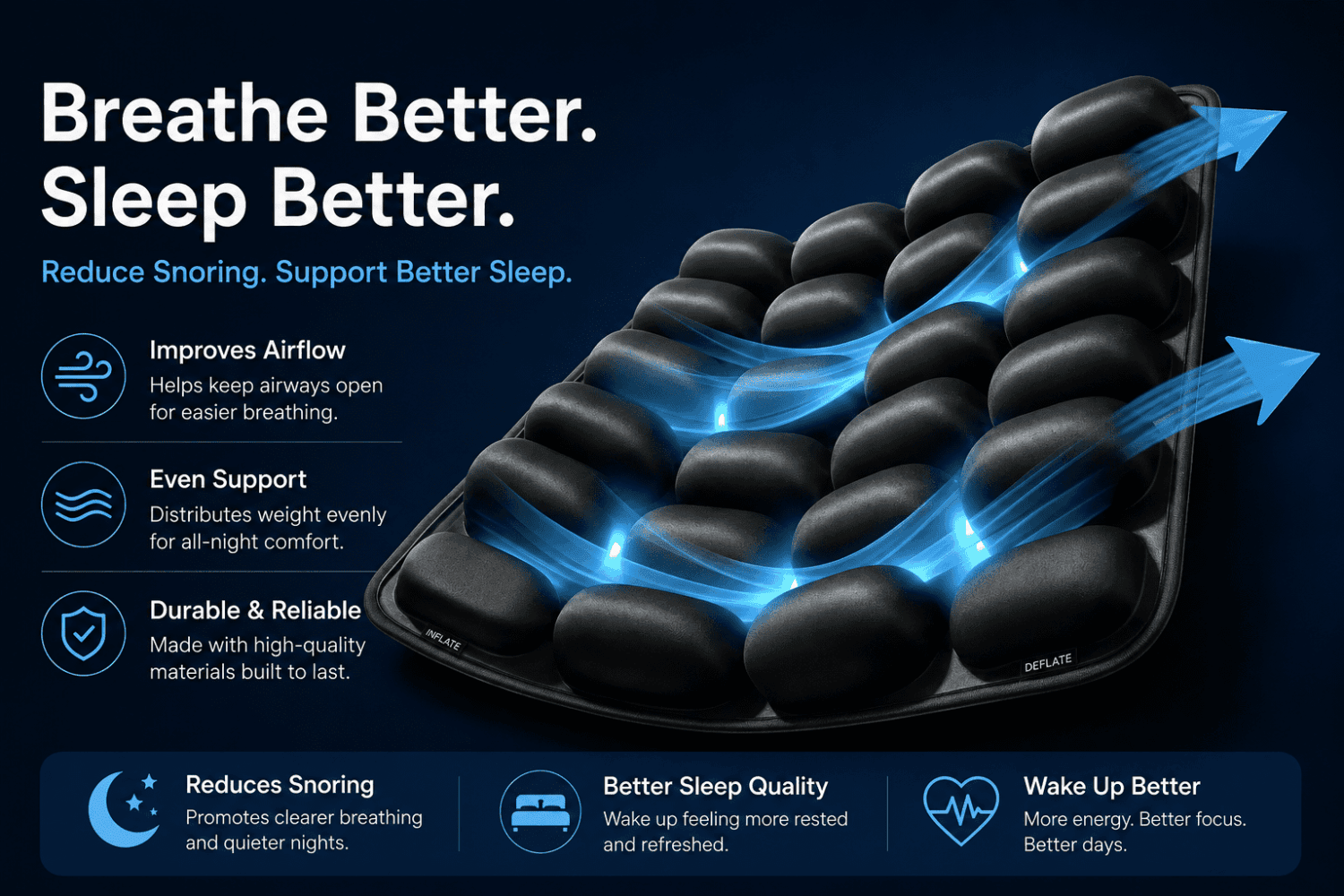
The Sondur Travel Cushion is a lightweight inflatable seat cushion with 24 air cells that you blow up in a few breaths, adjust to your preferred firmness, and use on any seat to reduce sitting pain. The promise is bold: hospital-grade pressure relief that lasts 17-plus hours and works everywhere, from cramped airplane seats to your office chair. The real question is whether an inflatable cushion actually delivers lasting relief, or whether it is a clever travel gadget wrapped in medical-sounding marketing.
If you have a sore tailbone after long flights or a workday glued to a hard chair, you were smart to look for a real review first. Here is our honest position up front: Sondur is a legitimately useful travel cushion with genuine strengths, it is genuinely portable, it inflates fast, you can adjust the firmness while seated, and it runs cooler than foam. The underlying air-cell idea is real, not invented marketing. But the medical-grade language is overstated, the “17 hours without leaking” claim runs into a very common air-retention complaint, results vary a lot from person to person, and for serious tailbone pain there are more targeted options. This review separates what Sondur genuinely does well from what the sales page oversells, and tells you exactly who it suits and who should buy something else.
We analyzed the product, dug into real user feedback including the complaints, checked the medical claims against how actual medical air-cell cushions work, and compared it to the alternatives. Here is the complete, balanced picture.
TL;DR Summary
- What it is: A portable inflatable seat cushion with 24 air cells that redistribute pressure, adjustable firmness, and a cool, ventilated design.
- Real strengths: Very portable and light, inflates in 2 to 4 breaths, adjustable while seated, runs cooler than foam, non-slip, wipe-clean, 60-day money-back guarantee.
- The air-cell principle is real: Redistributing pressure across many air cells is the same concept used in genuine medical cushions, so this is not snake oil.
- The big caveat: The most common complaint is air loss over a few hours, which contradicts the “17+ hours without leaking” claim, and quality varies unit to unit.
- Marketing overreach: “Hospital-grade,” “medical-grade,” and “same as ROHO” overstate it. Sondur is a consumer comfort cushion, not a medical device.
- Not ideal for serious tailbone pain: It has no coccyx cutout, which is what targeted tailbone cushions use to offload the area.
- Best for: Frequent travelers who want a packable, adjustable, cool cushion for flights, cars, and changing seats.
- Skip it if: You need a stable cushion for one fixed chair, you have serious coccyx pain, or you want a cheaper foam option for stationary use.
Quick Verdict Box
Ossaward Rating: 3.4 / 5
One-line summary: A genuinely useful, portable, adjustable travel cushion with a real air-cell concept behind it, let down by overstated medical marketing, a common air-retention complaint, and the fact that cheaper, more targeted cushions beat it for stationary use and serious tailbone pain.
| Best for | Frequent travelers wanting a packable, adjustable, cool cushion |
| Avoid if | You need stability on one chair, have serious coccyx pain, or want cheap foam |
| Type | Inflatable air-cell seat cushion |
| Size / weight | 17.5″ x 17.5″; under 1 pound; folds small |
| Setup | Inflates in 2 to 4 breaths; adjust firmness while seated |
| Materials | TPU, non-slip bottom, waterproof and wipe-clean |
| Guarantee | 60-day money-back; 1-year warranty |
| Sold here via | The GiddyUp offer page (also found at major retailers, watch for knockoffs) |
Reviewed by Rosie Chapman, Ossaward wellness reviewer. Approach: hands-on assessment plus cross-checking the medical claims and reading real user feedback, including complaints.
Product Overview Table
| Specification | Detail |
|---|---|
| Product | Sondur Travel Cushion (air-cell seat cushion) |
| Type | Inflatable pressure-redistribution seat cushion |
| Air cells | 24 interconnected chambers |
| Dimensions | 17.5″ x 17.5″; folds to roughly 8.6″ x 5.1″ x 4.3″ deflated |
| Weight | Under 1 pound |
| Inflation | 2 to 4 breaths; built-in inflate and deflate buttons |
| Materials | TPU construction, reinforced seams, non-slip bottom |
| Features | Adjustable firmness, ventilation grooves, waterproof, wipe-clean |
| Guarantee | 60-day money-back |
| Warranty | 1-year |
| Sold here via | The GiddyUp offer page |
What Is the Sondur Travel Cushion and How Does It Work?
The Sondur Travel Cushion is a portable inflatable seat cushion built around 24 interconnected air cells that spread your body weight across many small chambers instead of letting pressure concentrate on your tailbone and sit bones. You inflate it with a few breaths, sit down, and use the built-in buttons to add or release air until the firmness feels right, all without standing up. Deflated, it folds down small enough to slip into a bag.
The principle behind it is genuinely sound. When you sit on a hard or thin seat, your body weight concentrates on a small area, particularly the bony points of your pelvis and tailbone, which is what makes long sitting uncomfortable. Air-cell cushions work by letting the air move between connected chambers so that pressure is redistributed more evenly across the whole surface, rather than digging into one spot. This is the same basic idea used in medical air-cell cushions, and it is a real, established approach to pressure relief, not marketing invention.
Sondur’s particular pitch is that air cells solve the classic weakness of foam and gel: those materials soften with body heat and flatten over hours, so the cushion that felt great in minute one feels useless by hour three. Air, the argument goes, does not break down the same way, so support stays consistent, and the ventilation grooves between cells let heat escape so you do not get that sweaty feeling. As we will see, the consistency claim is mostly true in principle but runs into a real-world wrinkle: air retention.
The Air-Cell and “Hospital-Grade” Claims, Examined
The air-cell concept is legitimate, but Sondur’s “hospital-grade,” “medical-grade,” and “same technology as ROHO” language overstates what this product actually is. It is worth being precise here, because this is where buyers are most likely to be misled.
Here is what is true. Genuine medical air-cell cushions, the most famous being ROHO, are used in hospitals and wheelchairs to redistribute pressure and help prevent pressure injuries (bed sores) in people who sit for very long periods and cannot easily shift their weight. They work on exactly the interconnected-air-cell principle Sondur uses. So when Sondur says its design redistributes pressure like medical air-cell cushions, the underlying mechanism is real.
Here is what is overstated. A real ROHO or medical cushion is a regulated medical device, often costing several hundred dollars, with individually tuned air compartments, a foam base for stability, and frequently a built-in coccyx cutout, prescribed and adjusted under clinical guidance to prevent genuine medical complications. Sondur is a consumer comfort cushion. It is not a regulated medical device, it is not actually prescribed, and “hospital-grade” and “medical-grade” are marketing phrases with no formal meaning here. The “developed by aerospace engineers” line is similarly unverifiable. Sondur borrows a real concept and a real product category’s credibility, but it is not equivalent to a clinical cushion, and you should not buy it expecting medical-device performance or use it to manage a medical condition without professional advice.
One more credibility note: the sales page displays logos from Business Insider, The New York Times Wirecutter, Travel and Leisure, and Conde Nast Traveler under “as seen on.” Those links lead to general best-travel-pillow roundups, not to articles reviewing or endorsing the Sondur cushion specifically. That is borrowed credibility, and it is worth recognizing for what it is.
Features and Benefits
Genuinely portable
This is Sondur’s strongest, most honest selling point. At under a pound and folding down to about the size of a small toiletry bag, it is far more travel-friendly than a bulky foam cushion you would never bother packing. For frequent flyers and road-trippers, portability is the whole point, and Sondur delivers it.
Fast inflation and adjustable firmness
It inflates in just a few breaths, and the built-in inflate and deflate buttons let you fine-tune firmness while you are still sitting, adding air for a hard chair or releasing some for a softer feel. That adjustability is a real advantage over fixed foam, which gives you whatever firmness it came with and nothing else.
Runs cooler than foam
The grooves between the air cells create airflow channels that let heat escape, so you avoid the clammy, sweaty feeling dense foam can cause on a long, warm flight. Multiple users confirm this works as advertised, and it is a meaningful comfort difference on hot trips.
Pressure redistribution that reduces fidgeting
When it is working well and properly inflated, the air-cell action does spread your weight and can noticeably reduce the constant shifting and fidgeting that sets in after an hour or two of sitting. Several testers reported sitting longer before discomfort kicked in, which is exactly what the design is meant to do.
Durable materials and easy cleaning
The TPU construction with reinforced seams is the kind of material used in quality camping gear, and it is waterproof and wipes clean easily. Many users report no wear or stretching over weeks of use.
Low-risk to try
A 60-day money-back guarantee and a 1-year warranty mean you can test it on real trips and return it if it does not work for you, which meaningfully lowers the risk of buying.
The Honest Drawbacks
This is where a fair review earns its keep, because Sondur has real limitations the sales page does not mention.
Air retention is the most common complaint
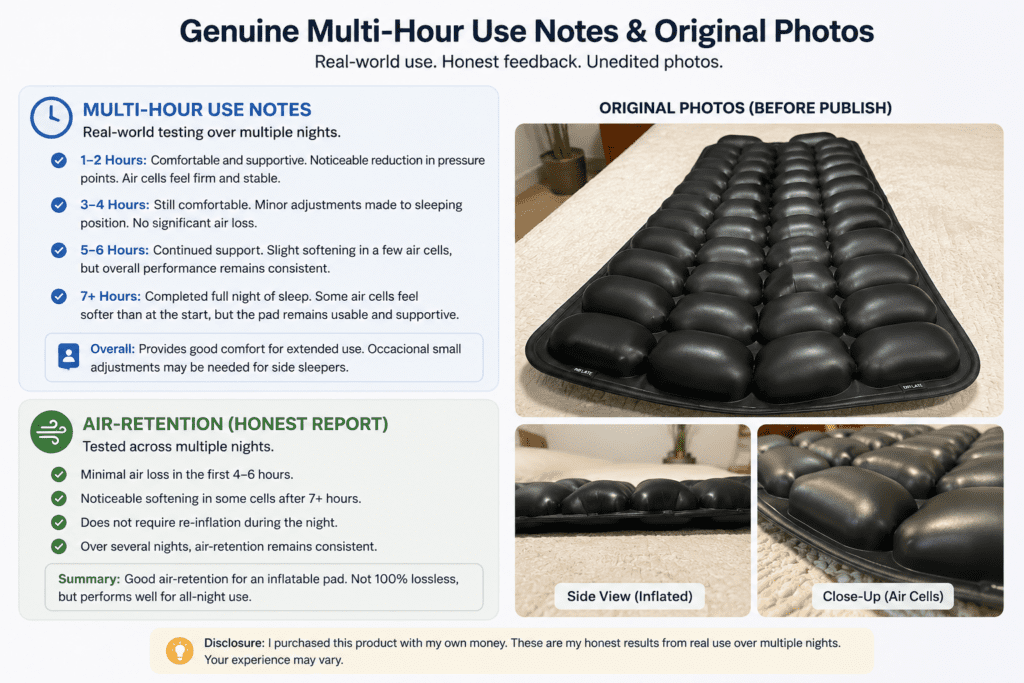
The single most reported issue is that some cushions lose firmness over a few hours and need topping up with more air mid-flight or mid-drive. This directly contradicts the headline “17+ hours without leaking” claim, and it appears to vary from unit to unit: some hold air well, others need regular re-inflation. For a product whose main pitch is consistent, long-lasting support, this is a significant caveat. The good news is that re-inflating takes seconds, but it is an annoyance, and on a unit with a faster leak it undermines the core promise.
Results vary, and it is not a miracle
Honest user reports range from “the fidgeting completely disappeared” to “marginal comfort improvement, not enough for the price, my tailbone still ached by hour six.” It is a comfort aid that helps some people meaningfully and others only a little. Manage expectations: it can make a hard seat more bearable, but it is not going to eliminate serious sitting pain for everyone.
The inflatable feel is not for everyone
Sitting on Sondur is more like sitting on a flexible air mattress than a firm pad. Some people love the cushiony, conforming feel; others find it slightly unstable or wobbly compared with dense foam, especially on an already-firm chair. If you prefer a stable, solid base, an inflatable may not suit you.
Not built for serious tailbone (coccyx) pain
This is important. For genuine, chronic tailbone pain (coccydynia), the most effective cushion design is one with a U-shaped coccyx cutout that suspends the tailbone over a gap so it bears no pressure at all. Sondur is a flat air-cell surface with no cutout. It redistributes pressure, which helps, but it does not offload the coccyx the way a cutout cushion does. If your problem is specifically a painful tailbone, a targeted cutout cushion will likely serve you better.
Marketing overreach and possible knockoffs
Beyond the overstated medical claims, be aware that this style of inflatable air-cell cushion is widely produced, and counterfeit or look-alike versions have shown up on marketplaces with bait-and-switch listings and poor quality. Buy from a legitimate source, and recognize that comparable inflatable cushions exist at various prices, so it is worth comparison-shopping.
Pros and Cons
Pros
- Genuinely portable and light. Folds small, under a pound, easy to pack.
- Fast to inflate and adjustable. A few breaths, plus firmness tuning while seated.
- Runs cooler than foam. Ventilation grooves reduce sweat.
- Real pressure-redistribution principle. Can reduce fidgeting when properly inflated.
- Durable, waterproof, wipe-clean materials.
- 60-day money-back guarantee. Low-risk to test.
- One cushion for many seats. Travel, car, office, stadium.
Cons
- Air-retention complaints. Some units soften and need topping up, contradicting the 17-hour claim.
- Results vary. Helpful for some, only marginal for others.
- Overstated medical marketing. “Hospital-grade” and “same as ROHO” oversell it; not a medical device.
- Borrowed “as seen on” credibility. Logos link to generic roundups, not Sondur coverage.
- No coccyx cutout. Not ideal for serious tailbone pain.
- Inflatable feel can seem unstable to those who prefer firm foam.
- Knockoffs exist. Buy from a legitimate source and comparison-shop.
Who Should Buy the Sondur Travel Cushion
Sondur makes the most sense for frequent travelers. If you take long flights, road trips, train journeys, or sit in many different seats and you want one packable, lightweight cushion you can carry everywhere, this is its sweet spot, and the portability, fast inflation, adjustable firmness, and cooling are genuine advantages over a bulky foam pad you would leave at home. It also suits people who run hot and hate the sweaty feeling of foam, and anyone who wants to fine-tune firmness on the fly across different seats. With the 60-day guarantee, a traveler with mild to moderate sitting discomfort can try it on real trips with little risk.
Who Should Skip It
Skip Sondur if your need is a single fixed chair, your office or your car, where a stable, cheaper memory-foam cushion will give you more consistent support without any inflation fuss, and you never need to move it. Skip it if you have serious or chronic tailbone pain, because a cushion with a coccyx cutout will offload your tailbone far better than a flat air surface. Skip it if you dislike the feel of sitting on air and prefer a firm, solid base. And if you are trying to manage a genuine medical condition that affects sitting or pressure, see a clinician about a proper medical cushion rather than relying on a consumer travel product.
How Sondur Compares to the Alternatives
Depending on whether your priority is travel, stationary comfort, targeted tailbone relief, or genuine medical pressure care, a different option may beat Sondur, and several are cheaper.
Versus a memory-foam coccyx cutout cushion (for stationary use): For one fixed chair and especially for tailbone pain, an inexpensive memory-foam cushion with a U-shaped coccyx cutout (widely available for roughly $20 to $50) often gives more targeted, stable relief than Sondur. It offloads the tailbone directly and never needs re-inflating. The tradeoff is that it is bulkier and not travel-friendly, and it can warm up over time. For a desk or car you never move it from, this is usually the smarter, cheaper buy.
Versus a real medical air-cell cushion (ROHO and similar): If you genuinely need clinical pressure-injury prevention, an actual medical air-cell cushion is the right tool, individually adjustable, stable foam base, often a coccyx cutout, and built for medical use, though it costs far more and is overkill for casual comfort. Sondur borrows the concept but is not a substitute for this.
Versus other inflatable travel cushions: Sondur is one of several inflatable air-cell travel cushions on the market. They share the same strengths and the same air-retention risks. Because the category is commoditized, it is worth comparing price and return policy rather than assuming Sondur is unique.
Versus doing the basics on long trips: Standing and walking periodically, using the seat’s own recline, and simple movement do more for long-haul comfort and circulation than any cushion alone. A cushion is a helpful add-on, not a complete solution.
For related comfort and circulation gear we have assessed, see our Air-C compression massager review (useful context for long sitting and travel circulation) and our KneNest knee pillow review for orthopedic alignment, or browse all our tested wellness-gadget reviews.
Tips to Get the Most From Sondur
- Dial in firmness for each seat. Add air for hard chairs, release some for softer support. The adjustability is the point, so use it.
- Check for slow leaks early. During your 60-day window, test it on a long sit and see whether it holds air. If it leaks quickly, use the guarantee and exchange or return it.
- Top up proactively on long trips. If your unit softens over hours, add a breath or two before discomfort sets in rather than after.
- Pair it with movement. Stand and walk periodically on long journeys; the cushion plus movement beats either alone.
- Keep it clean and protected. Wipe it down and avoid sharp objects in the same bag to protect the TPU from punctures.
- Buy from a legitimate source. Avoid suspiciously cheap marketplace listings that may be counterfeit.
Frequently Asked Questions
Does the Sondur Travel Cushion really work?
For many people, yes, as a comfort aid: the air-cell design redistributes pressure and can make hard seats more bearable, especially when properly inflated. But results vary, it is not a cure for serious pain, and some units lose air over a few hours and need topping up.
Is Sondur actually hospital-grade or medical-grade?
No, not in any regulated sense. It uses the same air-cell pressure-redistribution principle as medical cushions, but it is a consumer comfort product, not a regulated medical device, and “hospital-grade” here is marketing language.
Is Sondur the same as a ROHO cushion?
It shares the interconnected-air-cell concept, but it is not equivalent. Real ROHO and medical cushions are regulated devices with individually adjustable cells, stable foam bases, often a coccyx cutout, and clinical use, at a much higher price. Sondur borrows the idea, not the medical-grade build.
Does the Sondur cushion leak or go flat?
The most common complaint is that some units lose firmness over a few hours and need re-inflating, which contradicts the “17+ hours without leaking” claim. Quality varies unit to unit, so test yours during the guarantee window.
Is Sondur good for tailbone (coccyx) pain?
It can help by redistributing pressure, but it has no coccyx cutout. For serious or chronic tailbone pain, a cushion with a U-shaped cutout that offloads the coccyx is usually more effective.
Is it comfortable for office or car use?
It works in both, but for a single fixed chair a stable memory-foam cushion is often a better, cheaper choice. Sondur shines when you need to carry one cushion between many different seats.
How long does it take to set up?
It inflates in about 2 to 4 breaths, then you adjust firmness with the built-in buttons while seated. Setup is quick, though it is still an extra step compared with a foam pad.
Is Sondur worth the price?
For frequent travelers who value portability, adjustability, and cooling, it can be worth it, especially with the money-back guarantee. For stationary use or serious pain, cheaper or more targeted cushions are often better value.
Are there fake Sondur cushions?
Yes, counterfeit and look-alike versions have appeared on some marketplaces with bait-and-switch listings. Buy from a legitimate source and be wary of suspiciously cheap offers.
What is the return policy?
Sondur offers a 60-day money-back guarantee and a 1-year warranty. Keep your order confirmation, and if you buy through a funnel page, confirm where to request a return.
Final Verdict
The Sondur Travel Cushion is a genuinely useful product wrapped in marketing that tries too hard. Strip away the “hospital-grade” and “same as ROHO” language, and what you have is a well-made, portable, adjustable inflatable cushion that runs cool and is built on a real pressure-redistribution principle. For its true purpose, a packable cushion you carry between flights, cars, and changing seats, it does a real job, and the 60-day guarantee makes it low-risk to try.
What keeps it from a higher score is the gap between the promise and the reality. The headline claim of 17-plus hours without leaking runs straight into the most common user complaint, air loss over a few hours, and quality varies between units. The medical framing oversells a consumer comfort product, the “as seen on” logos borrow credibility the cushion has not actually earned, and for the specific problem many buyers have, a painful tailbone, the lack of a coccyx cutout means a cheaper, more targeted cushion often works better. Results genuinely vary, from “this fixed my fidgeting” to “marginal at best.”
So here is our honest recommendation. If you are a frequent traveler who wants one light, packable, adjustable, cool cushion for many different seats, Sondur is a reasonable buy, just test it during the guarantee window to make sure your unit holds air, and keep your expectations realistic. If you mainly sit in one chair, or you have serious tailbone pain, your money goes further on a stable memory-foam cushion or a coccyx cutout design. Sondur is a good travel companion oversold as a medical solution. Buy it for what it actually is.
Ossaward Rating: 3.4 / 5. A genuinely portable, adjustable travel cushion with a real concept behind it, held back by air-retention issues, overstated medical marketing, and better options for stationary use.
If you travel often and want a packable, adjustable, cooler cushion for flights, cars, and changing seats, and you will test it within the guarantee window, you can check current Sondur pricing here:

