

We may receive a commission for purchases made through the links provided here. Learn More Learn More.
A few years ago, microplastics were the kind of thing you might read about in a scientific journal or an environmental policy brief. Today, they’re in mainstream news, dinner table conversations, and an increasingly crowded supplement aisle. The science has accelerated dramatically, and with it the public anxiety, sometimes productively, often disproportionately.
The goal of this guide is to give you the information you actually need: what microplastics are, where they come from, how they get into and move through the body, what the current science says about health effects, and what practical steps are available. No catastrophizing. No dismissal. Just the honest picture.
TL;DR
- Microplastics are synthetic plastic fragments smaller than 5mm; nanoplastics are below 1 micrometer
- They are found in virtually all food, water, and air in all countries studied
- Average adult ingestion is estimated at 39,000 to 52,000 particles per year from food, up to 121,000 when air inhalation is included
- Microplastics have been detected in human blood, liver, kidney, lung, placenta, breast milk, and most recently brain tissue
- Long-term health effects in humans are not yet definitively established, but associations with cardiovascular disease have been observed
- The most impactful individual action is switching from bottled to filtered tap water
- Chitosan supplementation (Sifts Daily) is the most evidence-backed internal elimination support currently available
The Definition: What Exactly Are Microplastics?
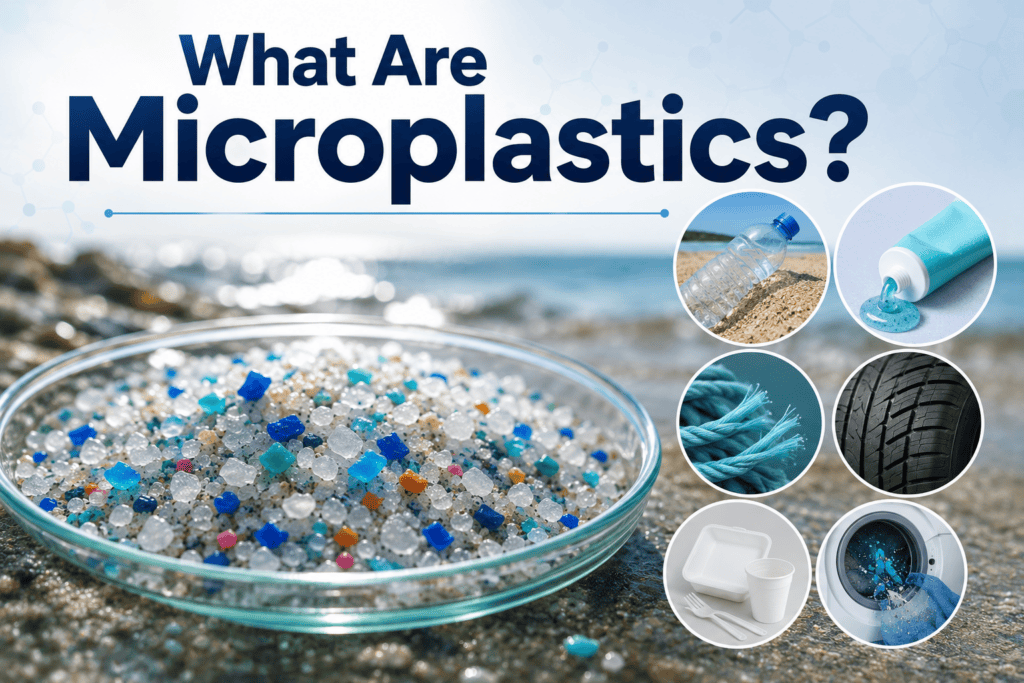
The term “microplastics” was coined by marine biologist Richard Thompson in a 2004 paper published in Science, describing the tiny plastic fragments he observed accumulating in marine sediments. Since then, the term has become the standard scientific descriptor for synthetic plastic particles below 5 millimeters in their longest dimension.
This 5-millimeter threshold was formalized by the National Oceanic and Atmospheric Administration (NOAA) in 2008 and is now the globally accepted scientific standard. To put 5mm in context: it’s roughly the diameter of a pencil eraser. Most environmental microplastics are far smaller, typically measured in micrometers (millionths of a meter) or even nanometers.
The category has two main sub-divisions by size:
Microplastics (1 micrometer to 5 millimeters): Visible to the naked eye at the larger end, requiring microscopy to detect at smaller sizes. This is the primary category in most environmental research.
Nanoplastics (below 1 micrometer, or below 1,000 nanometers): Invisible even under conventional light microscopy. Require specialized techniques including electron microscopy, pyrolysis-gas chromatography-mass spectrometry (Py-GC-MS), and laser-based scattering analysis for detection and quantification. Nanoplastics are increasingly the subject of research concern because their small size allows them to cross biological barriers that larger microplastics cannot.
The definition is based entirely on size, not on the type of plastic, its chemical composition, or how it was formed. A 3mm fragment of a degraded plastic bottle and a 200-micrometer synthetic textile fiber are both “microplastics” under this definition.
The Two Types: Primary vs Secondary Microplastics
Understanding where microplastics come from helps in thinking about both the scale of the problem and which exposure sources are most modifiable.
Primary Microplastics: Manufactured at Microscopic Scale
Primary microplastics are deliberately manufactured at small sizes for specific industrial or commercial applications. They were never larger, they entered the environment already at microplastic dimensions.
Microbeads: Tiny synthetic polymer spheres added to personal care products (facial scrubs, toothpastes, body washes) as exfoliants. Many countries have now banned microbeads in rinse-off cosmetics, the US Microbead-Free Waters Act took effect in 2017, and the EU banned them in 2020, but legacy contamination from decades of microbeaded products remains in waterways.
Nurdles (pre-production pellets): The raw material feedstock of the plastics manufacturing industry. Nurdles are lentil-sized pellets of plastic resin that are melted and reshaped into finished products. Billions of nurdles are transported globally each year, and spills are common. Because they float, they disperse widely in marine environments.
Synthetic textile fibers: When synthetic fabrics (polyester, nylon, acrylic, elastane) are washed, they shed microfibers into wastewater. A single wash cycle of a synthetic garment can release hundreds of thousands of individual fibers. Wastewater treatment plants capture most but not all of them, estimates suggest 35% to 40% pass through to receiving water bodies.
Tire rubber particles: Road vehicles continuously shed rubber particles from tire contact with road surfaces. These particles contain a complex mixture of synthetic rubber polymers and chemical additives. Tire wear particles are a significant source of microplastic contamination in both air and waterways, distributed through stormwater runoff and atmospheric transport.
Dust from synthetic products: Carpets, synthetic upholstery, and plastic consumer goods shed microplastics continuously through normal use and wear.
Secondary Microplastics: Fragmentation of Larger Plastic Items
Secondary microplastics result from the physical, chemical, and biological degradation of larger plastic items that enter the environment. This is the larger category by volume.
Plastic does not biodegrade in the meaningful sense, there are no microorganisms that can fully decompose synthetic polymer chains under normal environmental conditions. Instead, plastic breaks down physically through UV radiation, temperature cycling, mechanical abrasion, and biological activity into progressively smaller fragments, while the polymer backbone itself remains intact. A plastic bag, once in a marine environment, will fragment over years and decades into millions of microplastic particles and eventually nanoplastics.
The most significant secondary microplastic sources:
Ocean and waterway plastic: The world produces approximately 360 million tons of plastics annually, and significant amounts enter aquatic ecosystems. Once in the ocean, UV degradation, wave action, and biological processes generate enormous quantities of secondary microplastics.
Agricultural plastic film: Plastic mulch films, greenhouse coverings, and irrigation pipes degrade in situ in agricultural soils, contributing microplastics directly to the soil where food crops are grown. Microplastics have become thoroughly integrated into agricultural soil, which partially explains why fruit, vegetables, and grains account for a large proportion of dietary microplastic intake, not because the plants are unusually contaminated per serving, but because they are consumed so frequently.
Plastic packaging degradation: Food packaging, particularly single-use plastic packaging, releases particles into food through physical contact, especially when heated or when in contact with acidic foods. This is a high-frequency exposure source given how much packaged food is consumed.
Where Microplastics Are Found: The Environmental Ubiquity
One of the most significant findings of the past decade is the truly global distribution of microplastics. There is no longer any environment on Earth that has been studied and found to be free of microplastic contamination.
Oceans and marine sediments: Microplastics have been found in the surface water, deep sea sediments, and marine organisms of every ocean studied. The Great Pacific Garbage Patch is the most famous accumulation zone, but microplastics are distributed throughout all ocean basins.
Freshwater systems: Rivers, lakes, and groundwater across all continents contain microplastics. Studies have found microplastics in the water of remote mountain lakes, arctic freshwater systems, and even deep groundwater aquifers.
Soil: Agricultural soil, urban soil, and even soil in remote natural areas contains microplastics from atmospheric deposition, irrigation with contaminated water, plastic mulch films, and sewage sludge application (which concentrates microplastics from wastewater treatment).
Air: Indoor air typically has higher microplastic concentrations than outdoor air, due to continuous shedding from synthetic textiles, carpets, furniture, and plastic consumer products. Outdoor air also contains microplastics from road surfaces, degrading outdoor plastics, and industrial emissions.
Food supply: Essentially all food categories have been found to contain some level of microplastic contamination. Seafood and shellfish are particularly notable for high particle counts per serving due to direct marine exposure. Bottled water is among the most contaminated common beverages.
Drinking water: Both tap water and bottled water contain microplastics, though the sources differ. Tap water contamination comes from atmospheric deposition, pipe materials, and treatment processes. Bottled water contamination comes primarily from the plastic bottles themselves. Research estimates that individuals who meet their recommended water intake through only bottled sources may be ingesting approximately 90,000 additional microplastic particles annually compared to those who consume only filtered tap water.
How Much Are We Ingesting? The Current Estimates
The question of how much microplastic the average person ingests is one of the most actively researched and most methodologically challenging questions in environmental health science. Estimates vary significantly depending on which foods are studied, which detection methods are used, and which size ranges are counted. What is consistent across all estimates is that the exposure is substantial and universal.
Evaluating approximately 15% of Americans’ caloric intake, researchers estimate annual microplastic consumption ranges from 39,000 to 52,000 particles depending on age and sex. These estimates increase substantially to 74,000 to 121,000 when inhalation is considered alongside food intake.
On average, a person ingests approximately 5 grams of microplastics every week, roughly the equivalent weight of one credit card.
A 2026 study in the Journal of Hazardous Materials provided updated estimates: The total daily intake of microplastics was estimated to range from a few thousandths to hundreds of millions of particles per kilogram of body weight per day, with a median value of 721 particles per kilogram of body weight per day.
These numbers reflect the current state of detection methodology, which is rapidly improving. As analytical techniques become more sensitive (particularly for nanoplastics below 1 micrometer), these estimates are likely to increase significantly.
Which foods contribute most by particle count? Fruit, vegetables, and grains together account for roughly 99.5% of all microplastic particles consumed daily because they are eaten so frequently. This is important context: these are staple foods eaten multiple times per day, so even modest per-serving contamination accumulates across daily intake. Seafood has higher contamination per serving, but is typically eaten less frequently.
The bottled water outlier: The concentration of microplastics in bottled water is dramatically higher than in most foods. Research published in PNAS found that a single liter of bottled water contains an average of approximately 240,000 plastic particles, predominantly nanoplastics released from the bottle material itself. This makes bottled water one of the highest-concentration exposure sources available, and switching to filtered tap water one of the most impactful single changes any individual can make.
What Types of Plastic Are Most Common in the Human Body?
The plastic polymer types detected in human biological samples largely reflect the composition of plastic production and use:
Polyethylene (PE): The most produced plastic globally. Found in plastic bags, bottles, films, and countless packaging applications. Among the most frequently detected types in human blood and tissue samples.
Polypropylene (PP): Used in food containers, bottle caps, packaging, and automotive parts. Common in human gut samples.
Polyethylene terephthalate (PET): Used in plastic beverage bottles and synthetic fibers (polyester clothing). Frequently detected in human blood samples in the 2022 Leslie et al. study.
Polystyrene (PS): Used in foam packaging, cups, and food containers. Detected in various human tissue samples.
Polyvinyl chloride (PVC): Used in pipes, construction materials, and flexible packaging. Of particular concern because PVC production and degradation release plasticizer chemicals (phthalates) that have significant endocrine-disrupting activity.
Nylon (polyamide): Used extensively in synthetic textile fibers. A major component of airborne indoor microplastics from synthetic upholstery and carpeting.
The polymeric identity of microplastics in food roughly follows production proportions, with PE, PET, and PP being the most prevalent across food categories.
How Microplastics Move Through the Body
The journey of an ingested microplastic particle through the human body is not well-characterized for all particle sizes, but the current understanding is sufficient to identify the key intervention points and the limits of intervention.
The Digestive Tract: First Point of Contact and Key Intervention Point
When microplastics are ingested with food or water, they arrive first in the digestive tract. The stomach’s acidic environment (pH 1.5 to 3.5) is more extreme than most environmental conditions and does affect particle surface chemistry, this is the environment at which chitosan’s electrostatic binding mechanism is active.
In the stomach and upper small intestine, large microplastic particles (generally above 150 micrometers) are typically too large to cross the intestinal epithelium. They continue through the digestive tract with food material and are eliminated in feces. This is the transit pathway that chitosan supplementation is designed to support and accelerate, reducing the time these larger particles spend in contact with the gut wall and increasing the completeness of their fecal elimination.
Smaller particles (below approximately 150 micrometers, and increasingly so as particles approach nanoplastic sizes) can interact with gut tissue more directly. Very small particles can be taken up by M cells in the Peyer’s patches (immune surveillance structures in the gut-associated lymphoid tissue), by enterocytes (absorptive cells lining the gut), and by paracellular routes through gaps in the intestinal barrier.
Blood and Systemic Distribution
Once particles cross the intestinal barrier, they enter the lymphatic system or directly the portal circulation, reaching the liver and then broader systemic circulation. The 2022 Leslie et al. study detected microplastics in 77% of blood samples from anonymous healthy donors, at an average concentration of 1.6 micrograms per milliliter. The most common types were PET, PS, and PE, all major production plastics with high environmental prevalence.
Blood serves as both a transport medium and a potential site of particle-immune system interaction. The exact mechanisms by which particles in the bloodstream affect health are actively being studied.
Organ Deposition
Microplastics and nanoplastics have been detected in multiple human organs, reflecting their distribution through the circulatory system after crossing the gut barrier:
Lung tissue: Microplastics are inhaled as airborne particles and deposited in the lungs. Fibers (from synthetic textiles) are among the most common types in lung tissue samples.
Liver: As the primary filtration organ for portal blood, the liver concentrates particles from gut-absorbed microplastics. Multiple studies have detected microplastics in human liver biopsy samples.
Kidney: Detected in kidney tissue at lower concentrations than liver.
Placenta: A 2021 paper in Environment International detected microplastics in human placentas, in both the fetal and maternal sides, suggesting particles can cross the placental barrier.
Breast milk: Microplastics have been detected in human breast milk samples, indicating transfer from maternal circulation to milk production.
Brain tissue: The most recent and alarming finding: a 2025 Nature Medicine study detected microplastics in post-mortem human brain tissue, finding higher concentrations in brain than in liver or kidney from the same individuals. A 2026 Nature Health study of 191 brain tissue samples found microplastics and nanoplastics in nearly all samples, with elevated concentrations detected in samples from more recent years.
What Health Effects Does the Evidence Support?
This is the section where precision is most critical, because the gap between what the evidence supports and what wellness influencers claim is wide in both directions.
Established in Laboratory and Animal Research
In cell culture and animal studies, microplastic exposure produces a consistent pattern of effects:
Oxidative stress: Microplastic particles induce reactive oxygen species (ROS) production in exposed cells, contributing to cellular oxidative damage. This is a mechanism implicated in aging, inflammation, and disease progression.
Inflammatory response: Animal studies show that microplastics in gut tissue, lung tissue, and liver tissue trigger inflammatory signaling. Chronic low-grade inflammation is a known driver of multiple disease processes.
Gut barrier disruption: Animal research shows microplastic exposure can disrupt tight junction proteins, increasing intestinal permeability (“leaky gut”). This is mechanistically important because it would facilitate the passage of more particles and associated chemicals from the gut into systemic circulation.
Endocrine disruption: Plastic particles carry chemical additives (BPA, phthalates, PFAS, flame retardants) that have established endocrine-disrupting activity in animal models. The “chemical payload” carried by microplastics is considered a significant component of their potential health effects.
Reproductive effects: Multiple animal studies show effects on reproductive hormone levels, sperm quality, and reproductive organ development from microplastic exposure. Human reproductive epidemiology research in this area is emerging.
Observed Human Associations (Not Proven Causation)
Cardiovascular disease: A landmark 2024 study published in the New England Journal of Medicine (Yan et al.) detected microplastics and nanoplastics in carotid artery plaque samples from patients undergoing surgery for carotid artery disease. Patients whose plaque contained detectable microplastics had significantly higher rates of myocardial infarction, stroke, and all-cause mortality over a 34-month follow-up period compared to patients without detectable microplastics in their plaque. This is an important association study, it does not prove causation, but the dose-response relationship across a surgical population is a meaningful epidemiological signal.
Inflammatory bowel disease: Some preliminary research suggests higher microplastic concentrations in gut tissue from IBD patients compared to controls, though the direction of causation is unclear.
Thyroid function: Emerging research links microplastic-associated chemical exposure to thyroid hormone disruption in human populations, though isolating microplastic particles specifically from the chemical exposures they carry is methodologically complex.
What Is Not Yet Established
The definitive causal mechanisms linking microplastic particle exposure specifically (as distinct from the chemical additives they carry) to human clinical outcomes have not been established. Long-term dose-response relationships in humans are not documented. The specific health risk from any particular polymer type, particle size range, or chemical coating is not characterized.
This is not dismissal of the evidence. It is honest characterization of where the science currently stands. The evidence trajectory is concerning, associations are being observed in multiple disease categories, the 2025 Nature Medicine and 2026 Nature Health brain studies represent genuinely alarming findings, and the mechanism research in animals is consistent. But the full picture will take years more research to complete.
What Can You Do? Practical Reduction Strategies
Highest-Impact Changes
Switch from bottled to filtered tap water: This single change removes the highest-concentration microplastic exposure source for most people. A quality water filter (reverse osmosis or high-quality activated carbon block) removes the vast majority of particles from tap water, and filtered tap water has dramatically lower particle counts than bottled water.
Stop heating food in plastic containers: This eliminates one of the most direct particle-to-food transfer pathways. Use glass, ceramic, or stainless steel for all microwave heating and hot food storage.
Switch sea salt to rock salt or inland mineral salt: Sea salt has among the highest measured microplastic concentrations of any common condiment. Himalayan pink salt and inland mineral salts have much lower particle counts.
Use glass or stainless steel food storage: Reduces ongoing leaching from plastic food containers, particularly for acidic foods.
Moderate-Impact Changes
Ventilate your home regularly: Reduces indoor airborne microplastic particle concentration. HEPA air purifiers provide additional benefit.
Wash synthetic clothes in cold water with a microfiber catch bag: Reduces the microfiber release from synthetic textiles into wastewater.
Choose minimally processed food when possible: Reduces packaging-associated particle exposure.
Use filtered shower water: Reduces inhalation and skin exposure during showering.
Internal Support
For people who want to support their body’s gut-based elimination of ingested particles, chitosan supplementation is the most evidence-backed internal approach currently available. The complete analysis is in our Sifts Daily Review.
Are Nanoplastics More Dangerous than Microplastics?
The distinction between microplastics and nanoplastics is emerging as increasingly important in the research literature, and the evidence suggests nanoplastics warrant greater concern for several reasons:
Greater bioavailability: Smaller particles can cross biological barriers that larger particles cannot. Nanoplastics below certain size thresholds can cross the blood-brain barrier, the placental barrier, and the gut epithelium more readily than larger microplastics.
Greater surface area relative to volume: More surface area per unit mass means more surface for chemical adsorption, concentrating associated pollutants (BPA, PFAS, heavy metals) more per particle.
More difficult to detect: Nanoplastics require specialized analytical techniques that are not yet standardized across research laboratories, meaning our current estimates of nanoplastic burden almost certainly undercount actual exposure.
The brain tissue finding: The fact that microplastics and nanoplastics were detected in human brain tissue at higher concentrations than in liver or kidney suggests that the smallest particles (nanoplastics, which can cross the blood-brain barrier) are accumulating preferentially in the brain. This is the most concerning current finding in the human microplastics literature.
Frequently Asked Questions
What are microplastics made of?
Microplastics are made of the same synthetic polymer materials as all plastic products: polyethylene, polypropylene, PET, polystyrene, PVC, nylon, and hundreds of other synthetic polymer types. They are not a single material, they are fragments or particles of any plastic polymer below 5mm.
Are microplastics harmful to humans?
Laboratory and animal research consistently shows cellular stress, inflammation, and physiological disruption from microplastic exposure. The 2024 NEJM study found associations between microplastics in arterial plaque and cardiovascular outcomes in humans. Definitive causal mechanisms in human disease are not yet established but are actively being studied.
How do microplastics enter the body?
Primarily through eating and drinking (food and water), secondarily through inhalation of airborne particles, and to a lesser degree through skin contact with cosmetics and personal care products containing plastic particles.
Can microplastics be removed from the body once inside?
Larger particles in the digestive tract can be supported toward faster fecal elimination through chitosan supplementation. Particles deposited in blood or organ tissue cannot currently be removed by any dietary supplement. Therapeutic apheresis (blood filtration) has been proposed in research literature but is not clinically available.
Is there a way to test my own microplastic levels?
Blood testing for microplastics is available through specialized environmental medicine laboratories in the US and Europe but is not routinely offered by standard clinical laboratories. It is expensive and results interpretation is not standardized. Before-and-after testing would be needed to evaluate any intervention’s effectiveness.
Are microplastics in baby formula?
Yes. Polypropylene baby bottles release microplastic particles into formula when boiling water is added and the bottle is shaken. Research published in Nature Food (Heddagaarda et al., 2020) estimated that standard formula preparation in polypropylene bottles could expose infants to up to 1.3 million microplastic particles per day. Switching to glass bottles and allowing water to cool before adding formula reduces this significantly.
Are microplastics in organic food?
Yes. Organic certification does not imply freedom from microplastic contamination. Organic farms use irrigation water that may contain microplastics, have atmospheric deposition of particles onto crops, and may use organic-approved plastic mulch materials that degrade. Organic produce likely has lower pesticide exposure, but similar microplastic levels to conventional produce.
Which country has the most microplastic pollution?
Global microplastic distribution is studied in all major ocean basins, freshwater systems, and air masses, with no region found to be free of contamination. Concentrations tend to be higher near industrial areas, major population centers, and major shipping routes, but even the most remote studied locations (Arctic ice cores, Antarctic sediments, Mount Everest snow samples) show microplastic contamination.
How much microplastic do children ingest?
Children may ingest proportionally more microplastics than adults because they eat more food relative to body weight and have more hand-to-mouth behavior. A 2020 study estimated that infants and toddlers may ingest significantly more microplastics per kilogram of body weight than adults.
Will microplastics ever be eliminated from the environment?
Not in any foreseeable human timeframe. The plastic already in the environment will continue degrading into progressively smaller particles for centuries. Complete remediation of existing environmental plastic contamination is not technically feasible. Reducing the future input of plastic into the environment is the priority from a systemic perspective, while individual reduction strategies and gut support supplementation address the personal exposure dimension.
Final Thoughts
Microplastics are not a future threat. They are a present reality that every person alive is experiencing regardless of diet, geography, or lifestyle. The research on human health effects is moving quickly and the findings are increasingly difficult to ignore.
The appropriate response is neither panic nor dismissal. It is prioritized, proportionate action: filtering your water, changing how you heat and store food, reducing the highest-concentration exposure sources where possible, and supporting your body’s natural elimination mechanisms where evidence exists for doing so.
For the most evidence-backed supplement approach to gut-based elimination support, see our full Sifts Daily Review, and explore all our tested wellness products in the Wellness Gadgets category.