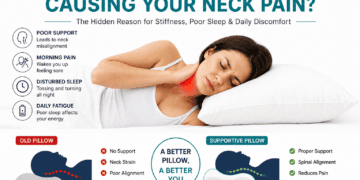
You’ve probably lain there at 11pm, neck aching, scrolling past an ad that says your pillow is “destroying your neck.” The next slide promises “Cervical Decompression Design™.” It sounds like something a physical therapist would nod along to. It isn’t, quite.
“Cervical decompression pillow” is a marketing term used by several direct-to-consumer pillow brands to describe a contoured, multi-zone pillow shape. It borrows language from real medical cervical decompression, a surgical or clinical traction treatment for nerve or disc compression, but the pillow itself does not perform decompression or traction in any clinical sense. It supports neck alignment, which is a real and different thing.
That’s the short version. Here’s the long one, because the gap between those two sentences is exactly where a lot of buyers get misled, sometimes by brands that know better and sometimes by brands that genuinely believe their own marketing copy.
What “Cervical Decompression” Actually Means, Medically
Start with the real thing, because you can’t evaluate a borrowed term without knowing what it’s borrowed from.
In medicine, cervical decompression refers to relieving pressure on a nerve root or the spinal cord in the neck. This happens two main ways. The first is surgical: a procedure like a laminectomy, discectomy, or foraminotomy, where a surgeon physically removes bone, disc material, or other tissue that’s pressing on a nerve or the spinal cord. This is a real operation, typically reserved for confirmed structural problems like a herniated disc, spinal stenosis, or degenerative changes causing measurable nerve compression, and it’s diagnosed with imaging (MRI or CT), not guesswork.
The second is non-surgical cervical traction, a clinical or physical-therapy technique that applies controlled, mechanical pulling force to the neck, either through a device (an over-the-door traction unit, a motorized traction table in a clinic) or manually by a trained provider. The idea is to gently separate the vertebrae enough to reduce pressure on a compressed nerve or disc, at least temporarily. This is a recognized physical therapy modality, though its effectiveness varies by condition and is generally considered most useful as part of a broader treatment plan rather than a standalone fix.
What both of these have in common, and what separates them entirely from a pillow, is force applied over and above your body’s own weight, directed specifically at separating vertebral structures. Surgery removes material. Traction pulls. Neither of those is what happens when your head rests on a piece of shaped foam.
How the Marketing Term Diverges From the Medical One
A pillow cannot apply traction to your spine. There’s no mechanism by which foam under your head, however cleverly shaped, generates a pulling force on your cervical vertebrae. Gravity and your own head weight are the only forces involved, and a pillow’s job is to support and redistribute that weight, not to counteract or exceed it.
So when a pillow box says “Cervical Decompression Design,” what’s actually happening underneath the phrase is contour support: a shaped surface that fills the gap between your head and shoulders, keeps your neck closer to its natural curve than a flat pillow allows, and reduces the strained angle that comes from your head sinking into a collapsed, unsupported surface. That’s a real and useful thing for a lot of people. It is categorically not decompression, traction, or anything a physical therapist would recognize as the clinical procedure of the same name.
The honest translation, every time you see this phrase on a pillow: read “decompression” as “alignment support.” If a brand’s own materials describe the product elsewhere as “non-medical” or “non-invasive,” which several do once you read past the headline claim, that’s the brand quietly conceding the same point this section just made.
Why the Term Exists at All
This isn’t a new trick, and it isn’t unique to pillows. Consumer wellness marketing has borrowed clinical-sounding language for decades because it works: a word associated with treatment implies efficacy in a way that “comfortable” or “supportive” doesn’t. What’s changed in the last few years is the volume of it, as direct-to-consumer brands selling through paid social ads have leaned harder into medical-adjacent naming across categories that have nothing to do with medicine: sleep masks, posture correctors, massage tools, and now contour pillows.
The pattern usually follows a similar shape. A brand identifies a real, legitimate underlying mechanism (in this case, contoured support genuinely helping with posture-related neck strain), then attaches the most clinical-sounding available word to it, trademarks the phrase, and lets the reader’s own assumptions do the rest of the selling. Nobody has to explicitly claim the pillow performs surgery-adjacent decompression. The name just has to sound like it might.
This matters for how you read the rest of a product page, not just the headline. Once you’ve spotted one instance of borrowed medical language, it’s worth rereading the remaining claims (snoring relief, “cooling” technology, cited satisfaction percentages) with the same scrutiny.
The Four Things People Actually Mean by “Cervical Decompression”
Search results and product pages use this phrase for at least four genuinely different things, and conflating them is where most of the confusion starts.
Surgical cervical decompression. The real medical procedure described above. Performed by a spine surgeon, for a diagnosed structural problem, after imaging confirms nerve or cord compression. This is what a doctor means by the phrase.
Clinical cervical traction. A physical therapy or chiropractic modality using a device or manual technique to apply controlled pulling force. Real, recognized, and still something you’d get from or discuss with a licensed provider, not order off a sales page without guidance.
Consumer traction devices. Inflatable neck collars, over-the-door traction kits, and motorized neck stretchers sold directly to consumers (commonly found on general retail sites) that genuinely attempt to replicate a mild version of clinical traction through air pressure or mechanical pulling. These occupy a real middle ground: they’re not surgery, but they do apply an actual physical pulling force, which is closer to the medical mechanism than a pillow gets. They still deserve a doctor’s input before regular use, particularly for anyone with a diagnosed spine condition.
Cervical decompression pillows. Contour memory foam or similar shaped pillows marketed with “decompression” in the name, but which apply no traction or pulling force whatsoever. This is the category this article, and the marketing claim it examines, is actually about. If a product in this category is being compared to the first three, that comparison is doing more marketing work than the physics supports.
Who a Contour “Decompression” Pillow Is Actually For
Setting the trademark aside, a well-designed contour pillow is a reasonable tool for a specific, fairly common problem: posture-related neck stiffness that comes from an unsupportive or flattened pillow, not from a diagnosed structural or nerve issue.
You’re a reasonable candidate if your current pillow has gone flat and no longer fills the gap between your head and shoulder, if you wake up with mild stiffness that loosens up over the course of the morning rather than pain that persists or worsens, or if you’re a side or back sleeper whose neck spends the night at an unsupported angle. In these cases, a genuinely well-shaped contour pillow can measurably reduce the strain your neck holds overnight, which is a real, if modest, benefit worth having.
Who It Is Not For
You are not the right candidate for a marketing-term “decompression” pillow, and should talk to a doctor or physical therapist instead, if your neck pain is severe, persistent across weeks, or radiates into your arm or hand. The same goes for pain accompanied by numbness, tingling, or weakness, all of which can indicate actual nerve involvement that a pillow cannot address and that a delayed diagnosis can make worse.
It’s also worth being honest with yourself if you’re buying a pillow specifically hoping to replicate what you’ve read about clinical traction or spinal decompression therapy. That expectation will not be met by any pillow at any price, and the disappointment usually isn’t about the product being defective. It’s about the name promising something the category was never able to deliver.
Common Misconceptions, Corrected
“Decompression means it’s medically proven.” No. It’s a trademarked marketing name, not a claim that’s been through the kind of clinical evidence review a medical device or treatment would require. Some brands’ own supplementary materials, read carefully, describe the product as “non-medical,” which is the more accurate framing hiding in plain sight.
“If it’s not doing decompression, the pillow is useless.” Also no. The actual mechanism, contoured alignment support, is a legitimate and separately useful thing. The problem is the name overselling it, not the underlying product being worthless.
“A more expensive ‘decompression’ pillow must work better than a cheap one.” Not necessarily, and not because of the trademark. Price differences in this category usually reflect foam density, cover certifications, and return policies, not a more advanced decompression mechanism, because there isn’t a mechanism to advance. A $20 contour pillow and a $60 one can use the identical underlying shape.
“Traction devices and decompression pillows are the same category.” They’re not. A traction device applies real pulling force and carries real considerations around safe use. A pillow applies none. Treating them as interchangeable, in either direction, either overestimates the pillow or underestimates the caution a traction device actually deserves.
What to Actually Look For If You’re Shopping This Category
If you’re evaluating a pillow marketed with “decompression” or similar clinical-sounding language, the trademark itself tells you nothing useful. What does: foam density and how well it’s documented to resist flattening, whether the cover carries a real, checkable certification like OEKO-TEX rather than an unverifiable brand claim, the length and terms of the return window (since fit is unpredictable for any contour shape), and whether the product’s own supporting materials, not just the headline, describe it honestly as a support pillow rather than a treatment device.
For a full breakdown of one specific product in this category, including a claim-by-claim check against exactly this kind of language, see our VelaSleep review.