It is a quarter past one in the morning and the hallway is a cave. Somebody is up for a glass of water or a bathroom trip, one hand flat against the wall, sliding along the paint, feeling for a light switch that is always a foot further than muscle memory says. A toe finds the leg of a side table. A dog, invisible on the floor, gets stepped on and voices its displeasure. Nobody wants the ceiling light, because the ceiling light is a slap in the face at this hour and it wakes the whole house. This small, stupid, nightly problem is the entire reason a product like this exists.
The usual fix is a plug-in night light, and plug-in night lights are a compromise the moment you buy one. They eat a socket you wanted for something else, they stick out where a passing hip can knock them, and the bulbs eventually die. What follows is a review of a different answer to the same 1 a.m. problem: a light built into the outlet cover itself, drawing a trickle of power from the outlet, with nothing to plug in and nothing to replace.
This site earns a commission on purchases through the links below. It does not change the rating, and it did not change this one. Here is how this site handles affiliate links.
In one line
In one line: GuideLight is a genuinely clever, cheap-to-run outlet-cover night light that solves the dark-hallway problem better than a plug-in, and the only real question is whether it fits your outlets.
- It replaces your existing outlet cover and lights the floor automatically at night, with no batteries, no bulbs and no wiring.
- It costs almost nothing to run and the LEDs are rated to outlast the house, so once it is on the wall you forget it exists.
- The one catch that decides everything is compatibility: it needs an outlet with accessible side screws, and not every outlet has them.
- Sold through this offer page it is a GiddyUp bundle of the SnapPower GuideLight, so it is worth checking the per-unit price against buying SnapPower direct.
The score: 8.2 out of 10
The rolled format for this review is an overall score out of ten with four subscores, because a light this simple is best judged on a few clear axes rather than a long grade sheet.
| Axis | Score | One-line reason |
|---|---|---|
| Does the job | 9.0/10 | Soft, automatic floor light exactly where you need it. It genuinely solves the problem. |
| Install and compatibility | 7.0/10 | Five-minute, one-screw install for most people. Loses points for the real side-screw compatibility catch. |
| Running cost and lifespan | 9.5/10 | Pennies a year, LEDs rated around 25 years. Nothing to replace, nothing to think about. |
| Design and light quality | 8.0/10 | Clean, socket-saving, soft glow that does not blind or wake you. Not adjustable in brightness. |
| Overall | 8.2/10 | A small product that does one thing very well. Buy it, once you have confirmed your outlets have side screws. |
Check the current GuideLight price | Official offer →
Quick Verdict
Overall Rating: 4.2 / 5
Best For: Hallways, kitchens, bathrooms, and nurseries where ambient floor lighting is needed without sacrificing outlet access.
The GuideLight is an incredibly clever product that delivers on its core promise: it provides a soft, warm glow that illuminates walkways without taking up an outlet. Installation truly takes seconds for most homes. However, if you live in an older home with deeply recessed electrical boxes, or if you are trying to outfit GFCI (reset button) outlets, you will run into compatibility issues.
Product Overview Table
| Feature | Details |
| Product Name | GuideLight Outlet Cover |
| Price | ~$15 – $20 per cover (Discounts on multi-packs) |
| Power Source | Draws power from outlet side terminals (No batteries) |
| Light Type | LED (Warm White) |
| Sensor | Automatic Dusk-to-Dawn (Light sensor) |
| Styles Available | Duplex (Two holes) & Decorator/Decora (One large rectangle) |
| Compatibility | Standard 110V US outlets. Not for GFCI or USB outlets. |
| Estimated Lifespan | 100,000 hours (approx. 11+ years) |
The problem this actually solves
Nighttime navigation is a bigger safety issue than it sounds, and it is the frame for judging everything here. Falls at home are one of the most common household injuries, and a disproportionate share happen at night, on the way to a bathroom, on stairs and in hallways, in exactly the low-light conditions where a foot misjudges a step or a toy goes unseen. Older adults and small children are most at risk, which is why “safety light” is not just marketing dressing on this category. The job is to put a low, glare-free light at floor level, automatically, in the places people move through in the dark.
A plug-in night light does this, badly. It sits at outlet height rather than casting down at the floor, it throws light forward into the room rather than onto the path, and it occupies a socket. The category GuideLight belongs to, the outlet-cover light, was designed to fix all three at once: light aimed down at the floor, no socket lost, and no protruding object to knock.
What GuideLight actually is
GuideLight is an LED outlet cover, a replacement wall plate for a standard receptacle with small LEDs built into its lower edge that light the floor automatically at night. It draws a tiny trickle of power from the outlet itself through contact prongs, so there are no batteries, no bulbs and no wiring, and it sells for a low double-digit price per unit. A guidelight outlet cover is, in other words, the plate you already have with a night light engineered into it.
For clarity at the point of sale, this is the SnapPower GuideLight, sold on this page through GiddyUp as the direct offer. A snappower guidelight review and a GuideLight review describe the same hardware. SnapPower is the originator, the product has been on sale for roughly a decade, and the brand cites over four million units sold and a very high review count. The practical consequence of the shared identity is pricing: the same plate is available from SnapPower directly and from retailers, so the offer-page bundle is worth comparing against those before you buy.
The design intent is that you never think about it again. There is no consumable, the LEDs are rated to last far longer than you will own the house, and it disappears into the wall as a slightly nicer outlet cover that happens to glow at night.
How it gets power with no wires
This is the part that makes people suspicious, so it deserves a plain explanation, and it is where the research-led lens matters.
A standard wall outlet has two small screws on its sides, the terminals where the household wiring attaches. When you remove the existing cover plate, those side screws are exposed. GuideLight has two thin conductive prongs on its back that press against those side screws when you snap and screw the plate into place. Through that contact it draws a very small current, enough to run three LEDs, without any splicing, stripping or new wiring. That is the whole trick. It is not a battery hidden in the plate and it is not magic. It is a low-power tap onto the screws that are already carrying power to the outlet.
Two things follow from that mechanism, and both matter for a buyer. First, because it feeds off the mains through the side screws, it needs those side screws to exist and to be reachable. Second, because the draw is tiny, the running cost is close to zero and the LEDs, run gently, last on the order of decades. The clever, genuinely patented idea is the contact method, and it is also the source of the single compatibility catch covered below.
An ambient light sensor handles the automation: the LEDs stay off in daylight and come on as the room darkens, at a low brightness that lights the floor without lighting up the room. Some versions in the family add a motion sensor that keeps the light off until someone passes, which trades a little always-on reassurance for a little more energy saving.
Installing it in five minutes
The install is the product’s second-best feature after the light itself, and for most outlets it is genuinely a five-minute, one-screwdriver job. The offer page’s three steps are accurate, with one safety line they underplay.
Step one, kill the power. Turn off the breaker for that outlet. The brand lists this and you should follow it. Even though the job only touches the cover plate and the exposed side screws, you are working next to live mains terminals, and switching off the breaker turns a low-risk job into a no-risk one. If you are not comfortable being near an open outlet at all, this is the honest moment to hand the task to someone who is.
Step two, remove the old cover. One central screw on a standard duplex plate, or the clip-and-screw arrangement on a decor plate. The old cover comes straight off and exposes the receptacle and its side screws.
Step three, snap the GuideLight on. Line the plate up so the contact prongs meet the side screws, press it into place, and drive the single screw. Restore power at the breaker. The sensor does the rest, and the LEDs come on the first night without any setup.
That is the experience the large majority of buyers have. The minority who struggle are the compatibility cases, which is the next number.
The compatibility catch that decides everything
Here is the deduction on the install subscore, and the single most useful thing in this review. GuideLight needs an outlet with accessible side screws, and not every outlet has them.
The most common failure is an outlet that was wired using only the “back-stab” holes on the rear of the receptacle rather than the side screws, which leaves the side screws unused and sometimes not seated in a position the prongs can reach. It also depends on the outlet type matching the plate: a standard duplex receptacle needs the duplex GuideLight, a rocker-style decor or GFCI outlet needs the decor or GFCI version, and buying the wrong shape means it will not fit at all. Owner reports and independent coverage both flag side-screw alignment as the recurring complaint, and it is not a defect. It is the price of the no-wiring trick, which relies on those screws existing.
The practical instruction is simple and it will save you a return. Before you buy, take off one of your existing outlet covers and look. If you can see two screws on the sides of the receptacle, GuideLight will almost certainly work. If the receptacle is fed only from the back with no usable side screws, or if it is an unusual commercial or tamper-resistant type, check the specific version’s compatibility before ordering. Five minutes with a screwdriver now is worth more than a 30-day return later.
The features that matter, and the ones that do not
Three features do real work. The rest is packaging.
The automatic light sensor is the feature you are actually buying. It means the light is on when it is useful and off when it is not, with zero interaction, forever. No switch, no timer to set, no remembering. For a safety light, automatic is the whole value, because a safety light you have to turn on is a safety light you will forget to turn on.
The socket-saving design is the quiet winner. Because the light is in the cover, both outlets stay free. Over a house that is several sockets you do not lose to night lights, which matters most in the exact rooms that are short on outlets, like older bedrooms and bathrooms.
The near-zero running cost and 25-year LED life are real, not marketing. The draw is a fraction of a watt, so the annual cost is measured in cents, and the LEDs run so gently that the decades-long lifespan claim is plausible rather than optimistic. This is a genuine “install once and forget” product.
What does not matter as much as the listing implies: the brightness is fixed, so if you want a brighter or dimmer glow you cannot adjust it, only choose a version. And the “professional lighting” framing oversells what is, in the end, a soft floor-level glow. It is exactly bright enough to navigate by and no brighter, which is the correct design, but it is not room lighting and should not be bought as such.
How It Works (Step-by-Step Installation)
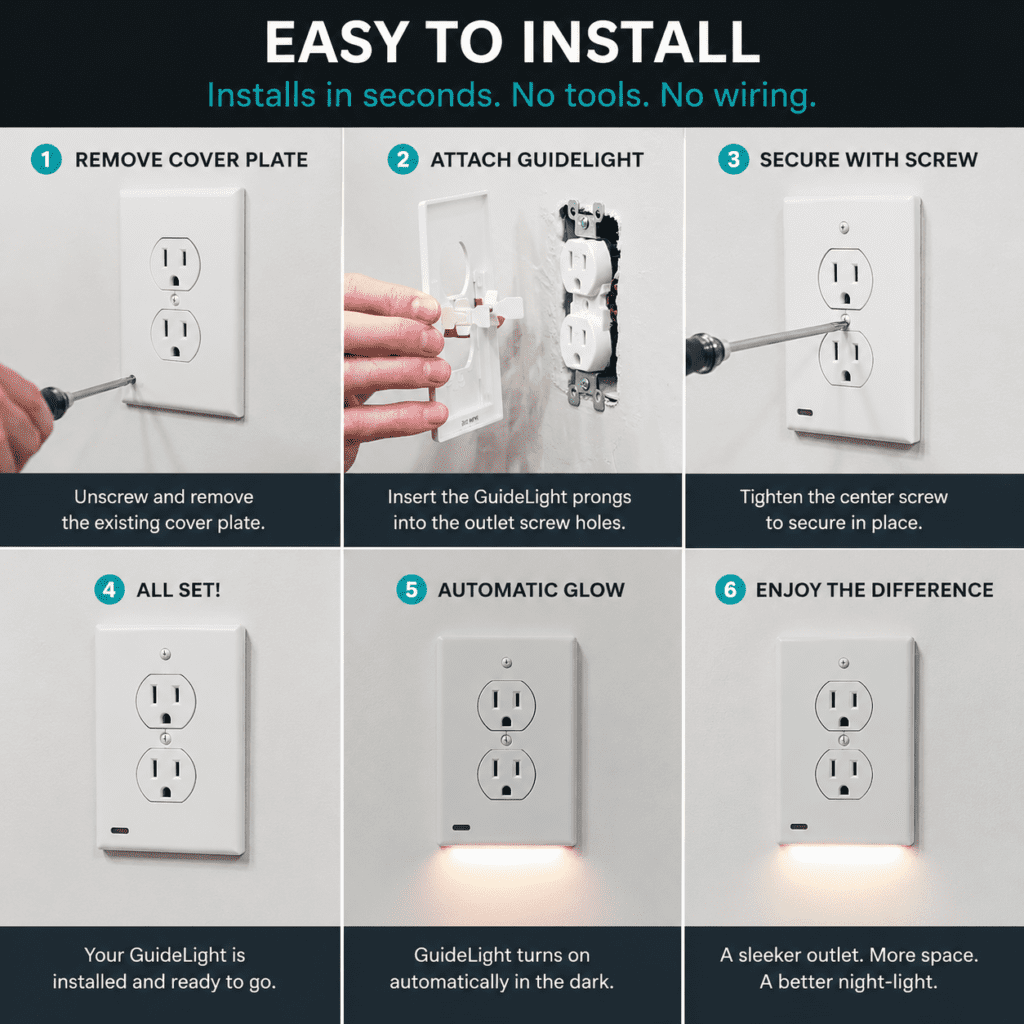
Installing a GuideLight is genuinely as easy as the commercials claim—provided your electrical boxes are standard.
- Turn Off the Power: Head to your breaker box and flip the switch for the room you are working in. Safety first!
- Remove the Old Plate: Take a flathead screwdriver and unscrew the single center screw (for Duplex) or the two top/bottom screws (for Decora) on your current outlet cover.
- Slide on the GuideLight: Push the GuideLight straight over the outlet. Make sure the metal prongs on the back slide around the body of the receptacle, sliding past the side screws.
- Screw It In: Replace the screw(s) to secure the plate to the wall.
- Turn Power Back On: Flip the breaker back on. Cover the light sensor with your thumb to test if the LEDs illuminate.
What owners actually report
Sourcing note: no one at Ossaward has installed a GuideLight. This section is aggregated from published owner reviews, retail listings, independent coverage and the product’s specifications, gathered on 30 July 2026. Where a pattern is thin, we say so.
The owner picture is strongly positive with one consistent caveat, which matches the mechanism.
The recurring delight is that it disappears. The most common structure in positive reports is that people install it, forget it, and only remember it exists when a guest comments on the soft glow or when they walk a dark hallway somewhere else and miss it. For a utility product, “I forgot it was there” is high praise, and it shows up repeatedly.
The soft, non-blinding light draws specific approval. Owners with light-sensitive sleep and parents of small children single out the low brightness as the point: enough to see the floor, not enough to wake anyone or hurt adjusted eyes. That is the design working as intended.
The install speed converts skeptics. A recurring note is surprise that it really is a five-minute job, from people who expected to need an electrician. The no-wiring promise lands for the outlets it fits.
The one recurring complaint, predictably, is compatibility. The reports that go wrong are almost all the same story: an outlet without usable side screws, or the wrong plate style ordered for a decor or GFCI receptacle. This is the mechanism’s limitation surfacing as owner frustration, and it is why the compatibility check above is the most valuable line in the review. Weight the complaint as real, and as almost entirely avoidable with a two-minute look at your outlet first.
A note on the review pool: the very high review counts and star averages the brand cites come largely from its own storefront and retail listings, which skew positive. The install experience and the compatibility catch are the checkable facts, and they hold up regardless of the star average.
The overview: claimed against observed
| Attribute | Brand claim | What we could observe | Checked |
|---|---|---|---|
| Product type | Outlet cover that doubles as an LED night light | Confirmed. Replacement wall plate with lower-edge LEDs | 30 Jul 2026 |
| Power source | No batteries, no bulbs, no wires | Confirmed. Draws a trickle via contact prongs on the outlet side screws | 30 Jul 2026 |
| Automation | Automatic on at night, off in day | Confirmed. Ambient light sensor. Motion-sensor version also exists | 30 Jul 2026 |
| LED life | Up to 25 years | Plausible given the very low draw. Not independently verified | 30 Jul 2026 |
| Running cost | Less than 10 cents per year | Consistent with a sub-watt draw. Effectively negligible | 30 Jul 2026 |
| Install | Snap-and-go in seconds, no electrician | True for outlets with accessible side screws. One screw | 30 Jul 2026 |
| Compatibility | Fits standard outlets | Needs usable side screws; wrong for back-wired or mismatched decor/GFCI outlets | 30 Jul 2026 |
| Brightness | Soft, not blinding | Confirmed by owners. Fixed, not adjustable | 30 Jul 2026 |
| Units sold | Over 4 million | Brand-stated | 30 Jul 2026 |
| Reviews | 13,000+ at 5 stars | Brand-stated, largely first-party storefront and retail | 30 Jul 2026 |
| Price | “Save” pricing, low double digits per unit | Roughly $15-20 per unit class; bundle pricing via the offer page | 30 Jul 2026 |
| Guarantee | 30-day money back | Stated on offer page | 30 Jul 2026 |
| Warranty | 1 year | Stated on offer page | 30 Jul 2026 |
| Sold by | Brand describes itself as the inventor | SnapPower product, sold here via GiddyUp; also SnapPower direct and retail | 30 Jul 2026 |
What works and what does not
The cons here are tagged by severity, because for this product the difference between a deal-breaker and a minor gripe is large and depends entirely on your outlets.
What works
- Automatic, glare-free floor light exactly where nighttime falls happen.
- No socket lost, no protruding night light to knock.
- Near-zero running cost and a lifespan that outlasts your ownership.
- Genuinely five-minute install for the outlets it fits.
- Nothing to maintain: no bulbs, no batteries, no consumable ever.
- Clean look that upgrades a plain outlet cover rather than cluttering it.
What does not
- Needs accessible side screws. (Deal-breaker for back-wired outlets.) If your outlet has no usable side screws, it will not fit at all, and you cannot know without looking first.
- Wrong plate style will not fit. (Deal-breaker if you order blind.) Duplex, decor and GFCI outlets need their matching version. Order the shape your outlet actually is.
- Brightness is fixed. (Annoyance.) You choose a version, not a dimmer. If you want brighter or dimmer, you are picking a different product.
- Bundle price may beat, or be beaten by, buying direct. (Annoyance.) The same SnapPower plate sells direct and at retail, so the offer bundle is worth a price check.
- Working near live mains, if you skip the breaker. (Minor, avoidable.) Turn off the breaker and it is a no-risk job. Skip that and it is a needless small risk.
- “Professional lighting” oversells it. (Minor.) It is a soft floor glow, not room lighting, which is the right design but not what the phrase implies.
How it compares, priced per outlet lit
Anyone shopping for a guidelight alternative is really comparing ways to light a dark path at night. Because the products cost different amounts and cover different amounts, the fair comparison is not sticker price but price per outlet or path lit, with the socket you keep or lose factored in.
| Option | Typical price | Lights the floor? | Socket used? | Running cost | Lifespan | Real cost per lit spot |
|---|---|---|---|---|---|---|
| GuideLight / SnapPower | ~$15-20 each | Yes, downward | None (built into cover) | Pennies/year | ~25 yr LEDs | Low over its life; no socket lost |
| Plug-in night light | ~$5-10 each | Poorly, forward | One socket lost | Low | Bulb/unit may fail | Cheap up front, costs you a socket |
| Legrand radiant night light outlet | ~$20-30 | Yes, from the outlet | Replaces the receptacle | Low | Long | Pricier, needs receptacle swap (more involved) |
| Enover / BESTTEN LED cover | ~$8-15 | Yes, downward | None | Pennies/year | Long | Cheapest cover-light route; check reviews for fit/finish |
| Motion stick-on LED light | ~$10-15 (multi-pack) | Yes, where stuck | None (battery) | Battery changes | Battery-limited | Cheap, but batteries are a recurring chore |
GuideLight against buying SnapPower direct
This is the comparison the offer page does not want you to run, and it is the honest one. GuideLight here is the SnapPower plate sold through a GiddyUp funnel. SnapPower sells the same plate directly and through retailers. So the real question is not whether the product is good, it is, but whether this bundle’s per-unit price beats buying the identical plate direct. Sometimes a multi-pack offer wins on price. Sometimes direct is cheaper. Check both before you buy, because the hardware is the same either way.
GuideLight against a plug-in night light
The plug in night light vs outlet cover contest is decided by the socket and the aim. A plug-in is cheaper up front and you can move it, but it costs you an outlet and it lights the room rather than the floor. GuideLight keeps the socket and aims down where you actually walk. For a fixed hallway, stair or bathroom, the outlet cover is the better tool. For a temporary need or a rental where you will not touch the wiring, a plug-in is the lower-commitment choice.
GuideLight against cheaper LED-cover clones
Brands like Enover and BESTTEN make outlet-cover lights at a lower price using the same basic side-screw idea. They can be genuine value. The trade is consistency: the SnapPower original tends to get better marks for fit, finish and sensor behaviour, while the cheaper clones vary more unit to unit. If budget is the priority and you will read recent reviews for the specific model, a clone can save money. If you want the version most likely to just work and look right, the original is the safer pick.
What it really costs, and the buy-direct question
Whether the guidelight price is worth it is an easy yes on running cost and a “check first” on purchase price.
Running cost is a non-issue. A fraction of a watt is cents a year. Over the LED’s rated life the electricity to run one is a rounding error, and there is no bulb or battery to buy, ever. On total cost of ownership, this is one of the cheapest lights you can install.
Purchase price is where to be a shopper. Per unit these sit in the low double digits, and the offer page uses “save” framing, so read the actual per-unit total at checkout. Then do the one comparison that matters: the same SnapPower plate is sold direct and at retailers, so confirm whether this bundle is cheaper per unit than buying direct for the number you need. If you are doing a whole house, that per-unit gap multiplied out is real money.
Where it is clearly worth it. You have a dark hallway, stair or bathroom, outlets with side screws, and you want a permanent, maintenance-free, socket-saving fix. That is the product’s home turf and it earns the money.
Where to pause. You are not sure your outlets have side screws (check first), or you can buy the identical plate cheaper direct (compare first). Neither is a reason not to buy the product. Both are reasons not to overpay or over-order.
Check the current GuideLight total and bundle →
Who should buy it
The person with a dark hallway, stairs or bathroom. The core buyer. A permanent, automatic floor light exactly where nighttime trips happen.
Households with young kids or older adults. The people most at risk of a nighttime fall get a glare-free path light that needs no interaction and no remembering.
Renters and owners who hate clutter. No lost socket, no protruding plug-in, no cords. It looks like a slightly nicer outlet cover.
Anyone who wants install-once-and-forget. No bulbs, no batteries, no maintenance for decades. Set it and genuinely never think about it.
Who should skip it
Anyone whose outlets lack usable side screws. If a look behind the cover shows a back-wired receptacle with no reachable side screws, this will not fit. Skip it or rewire the outlet first.
People who want adjustable or bright light. The glow is soft and fixed. If you want room lighting or a dimmer, this is the wrong category.
Bargain hunters doing a whole house. If price per unit is everything, compare the SnapPower-direct price and the cheaper clones before committing to a bundle.
Anyone unwilling to remove a cover plate. It is a five-minute job with the breaker off, but if you will not touch an outlet cover at all, this is not for you.
Get more out of it
Look before you buy. Take off one outlet cover and confirm you have side screws and which outlet style you have. This one check prevents the only common disappointment.
Kill the breaker every time. It turns a low-risk install into a no-risk one, and it costs you thirty seconds.
Match the version to the outlet. Duplex for standard, decor for rocker-style, the GFCI version for GFCI. Buy the shape you actually have.
Put them where the falls happen, not everywhere. Hallway, top and bottom of stairs, bathroom, child’s room. You do not need one in every socket to get the safety benefit.
Consider the motion version for bedrooms. If even a soft always-on glow bothers a light sleeper, the motion-sensor version stays dark until someone moves.
Avoid the mistakes that cause returns
Mistake 1: ordering before checking your outlets. The fix: remove one cover and confirm side screws first. This is the single biggest cause of returns.
Mistake 2: buying the wrong plate style. The fix: identify duplex vs decor vs GFCI before ordering, and match it.
Mistake 3: skipping the breaker. The fix: turn off the power for that outlet. Small job, zero reason to do it live.
Mistake 4: expecting room lighting. The fix: reset the expectation to a soft floor glow. That is the design, and it is the right one.
Mistake 5: overpaying by not comparing. The fix: price the bundle against SnapPower direct and retail before you buy a whole-house quantity.
How to shop the category
If you are choosing a night light rather than specifically weighing this one, these seven checks predict satisfaction. For the wider set we have rated, see the other home-safety gadgets we have rated, and for a socket-based option that watches rather than lights, a socket-based security light for the same corners.
1. Where the light points. Floor-aimed beats room-aimed for nighttime navigation. Outlet-cover lights aim down where you walk.
2. Whether it costs you a socket. Cover lights keep both outlets. Plug-ins take one. In outlet-poor rooms this decides it.
3. Automation. An automatic light sensor is the whole point of a safety light. Manual night lights get left off.
4. Compatibility with your outlets. For cover lights, side screws and plate style. For plug-ins, nothing. Check before buying the cover type.
5. Running cost and maintenance. LED cover lights are pennies a year with nothing to replace. Battery motion lights need battery changes. Weigh the chore.
6. Brightness and glare. For sleep areas, softer is better. Decide whether you want fixed-soft or adjustable before you buy.
7. Buy-direct check. For branded products sold through funnels, confirm the per-unit price against buying the same item direct.
Questions buyers keep asking
The framing here is the questions as they actually surface in owner forums and retail Q&A, with the honest answer to each.
Does the GuideLight really work?
How does GuideLight get power with no batteries or wires?
Is GuideLight safe to install yourself?
Will GuideLight fit my outlets?
How much does GuideLight cost to run?
Is GuideLight the same as SnapPower?
Does GuideLight have a motion sensor?
How bright is the GuideLight?
Can you put GuideLight over a GFCI outlet?
Is GuideLight worth the money?
The verdict, scored
GuideLight earns 8.2 out of 10.
The product does one small thing and does it very well. A soft, automatic, floor-aimed light in the exact places nighttime falls happen, with no socket lost, no bulb or battery to replace, a running cost of pennies a year, and a lifespan that outlasts your ownership. Install is a genuine five-minute job for the outlets it fits, and owners overwhelmingly report that it disappears into the wall and just works. As a solution to the 1 a.m. dark-hallway problem, it is better than the plug-in night light most people reach for.
The points come off for one thing above all: compatibility. The no-wiring trick depends on your outlet having accessible side screws, and the recurring disappointment in the owner corpus is people whose outlets do not, or who ordered the wrong plate style. That is avoidable with a two-minute look before buying, which is why it is a caveat rather than a flaw. The smaller deductions are a fixed brightness and the fact that, because this is the SnapPower plate sold through a funnel, you should price the bundle against buying direct.
Buy it if you have a dark path to light, outlets with side screws, and you want a permanent, invisible, maintenance-free fix.
Skip it, or check first, if your outlets are back-wired with no usable side screws, you want adjustable or bright light, or you can buy the identical SnapPower plate cheaper direct.
The score would nudge higher if the offer page did two honest things: show the side-screw requirement clearly before purchase, and state the per-unit price plainly so buyers can compare it against direct. The product is good enough to survive both.
Where to buy it
GuideLight is sold through this direct offer page as a GiddyUp bundle, and the same SnapPower plate is available from SnapPower directly and from retailers. The offer page lists a 30-day money-back guarantee and a 1-year warranty.
Before you order, do three things. Remove one outlet cover and confirm you have accessible side screws and which plate style you need. Read the actual per-unit total at checkout rather than the “save” headline. And compare that per-unit price against buying the identical SnapPower plate direct, especially if you are doing several rooms.
Whichever page you buy from governs your price, your guarantee and your warranty, so keep the confirmation email from the one you used.

If you buy through that link we earn a commission. It costs you nothing extra, and it did not shape the 8.2 score, the compatibility warning, or the advice to compare the bundle against buying direct.