






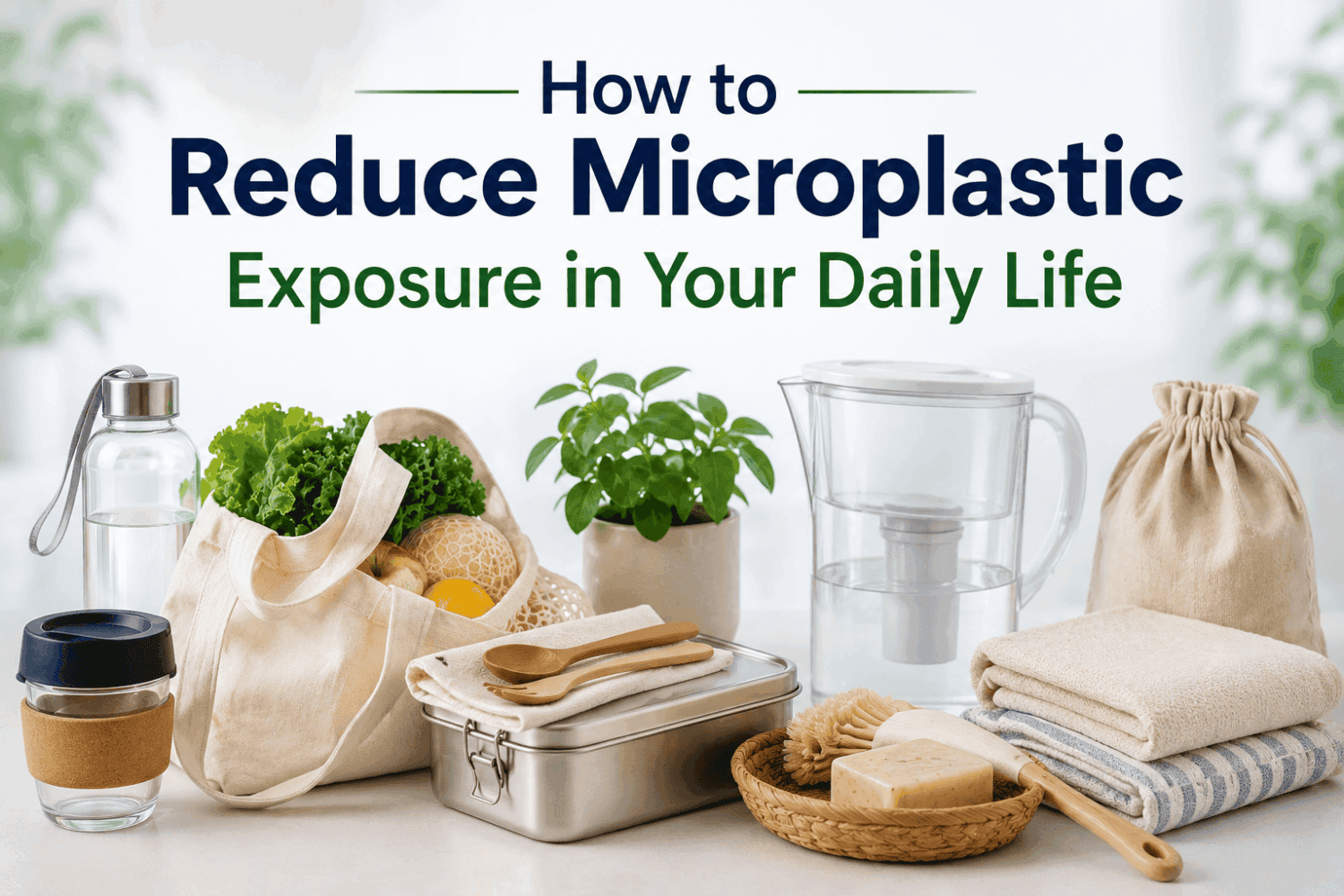
Here is the frustrating truth about microplastic exposure reduction: elimination is not possible, the most meaningful changes are surprisingly simple, and the wellness industry has managed to make most people focus on exactly the wrong things.
You cannot detox your way out of microplastic exposure with a tea cleanse. You cannot “reset” your gut with a three-day juice fast. You cannot fix a systemic environmental contamination problem by buying expensive supplements as your primary strategy while continuing to drink bottled water and heat food in plastic containers every day.
What you can do is meaningfully reduce your daily exposure burden through a small set of well-evidenced, practical changes that address the highest-concentration sources. Some of these cost nothing. Some require a one-time purchase. A few are worth keeping as ongoing daily habits. Together, they can substantially reduce the quantity of microplastic particles entering your body each day.
This guide covers 14 specific changes, ranked by the evidence for their impact. The ranking is based on which sources contribute the most particles per day and which changes eliminate or reduce those sources most completely.
TL;DR
- Bottled water is one of the highest per-serving microplastic sources and switching to filtered tap water is the single highest-impact individual change
- Never heating food in plastic containers eliminates a major high-concentration exposure pathway
- Source reduction (reducing input) is more impactful than any supplement approach (supporting elimination)
- Chitosan supplementation (Sifts Daily) is the best evidence-based internal strategy as a complement to source reduction, not a replacement for it
- Indoor air has higher microplastic concentrations than outdoor air, ventilation and HEPA filtration help
- Sea salt is one of the most contaminated common condiments and can easily be swapped
- Many “natural” or “organic” products have similar microplastic contamination as conventional alternatives
Understanding the Priority Framework Before You Start
Before diving into specific steps, the single most useful concept is the exposure hierarchy: not all exposure sources are equal, and not all reduction strategies are equally impactful.
Individuals who meet their recommended water intake through only bottled sources may be ingesting an additional 90,000 microplastics annually compared to 4,000 microplastics for those who consume only tap water.
This single data point should reframe how you think about the problem. The difference between bottled water and filtered tap water is approximately 22-fold in annual microplastic exposure from water alone. No supplement, dietary change, or detox protocol comes close to matching that impact.
Fruit, vegetables, and grains account for roughly 99.5% of all microplastic particles consumed daily because they are eaten so frequently, not because they are individually the most contaminated foods per serving.
This is also important context: produce is high on the list by volume not because each piece of fruit is unusually contaminated, but because you eat multiple servings daily. The per-serving contamination of a single apple is modest; eating three pieces of fruit, multiple vegetables, and whole grains daily accumulates.
The hierarchy that emerges from the research:
Highest individual impact changes: Water source, food heating practices, food storage materials Moderate impact changes: Salt source, cookware type, textile choices, air quality management Supporting internal strategy: Gut-based elimination support (chitosan supplementation) Marginal or unproven impact: “Detox” protocols, specific food avoidance without addressing primary sources
With that framework established, here are the 14 most impactful steps.
Step 1: Switch from Bottled to Filtered Tap Water
Impact: Very High
This is the single most impactful change most people can make, and it costs less than the bottled water habit it replaces.
Research published in PNAS found that a single liter of bottled water contains an average of approximately 240,000 plastic particles, with the majority being nanoplastics released from the PET bottle itself through a combination of normal degradation, carbonation (if applicable), heat exposure during transport and storage, and mechanical stress during opening and pouring.
The contrast with high-quality filtered tap water is stark. Filtered tap water using a quality activated carbon block or reverse osmosis system typically contains a small fraction of the particle count of bottled water. The contamination sources for tap water (atmospheric deposition, pipe materials, treatment processes) are present but produce far lower particle counts than the bottle-water interface.
The filter matters. Not all filters are equal:
Standard pitcher filters (Brita, PUR carbon pitcher versions): Remove some microplastics but are generally less effective than installed systems. Pore sizes vary and the filtration mechanism does not capture the smallest nanoplastics.
High-quality activated carbon block filters (NSF/ANSI 53 certified): More effective than pitchers at removing particles above their rated pore size. Installed under-sink or countertop options provide higher flow rates and better contact time.
Reverse osmosis (RO) systems: The most effective option for both microplastics and associated chemical contaminants (PFAS, heavy metals). RO membrane pore sizes are approximately 0.0001 micrometers, far smaller than microplastics and most nanoplastics. The trade-off is flow rate (slower) and water waste (RO produces some reject water). For home drinking water, this is the gold standard.
For on-the-go: Switch from single-use plastic water bottles to stainless steel or glass bottles filled with filtered tap water. This eliminates the bottled water particle load for portable hydration.
Step 2: Never Heat Food in Plastic Containers
Impact: Very High
Heat is the primary trigger for accelerated microplastic release from plastic food containers into food. The physics are straightforward: elevated temperatures increase the mobility of polymer chains, accelerate surface degradation, and dramatically increase the rate at which plastic particles are transferred from the container into food.
“Microwave-safe” labels on plastic containers mean only that the container will not warp, melt, or structurally fail under microwave heating, they explicitly do not mean the container won’t release particles into food. The FDA’s definition of “microwave-safe” is entirely about the container’s structural integrity, not about particle release.
Research published in multiple food safety journals has quantified the particle release from heated polypropylene (the most common microwave-safe plastic). A 2020 study measured particle release rates from polypropylene containers during microwave heating and found release of millions of particles per use, with rates increasing substantially with temperature and with wear/scratching of the container surface.
The practical solution is simple and inexpensive: Use glass, ceramic, or stainless steel containers for all food heating. Most households already have glass bowls or ceramic plates that can serve this function. A set of glass food storage containers with airtight lids (Pyrex, Anchor Hocking, or equivalent) is a one-time purchase that eliminates this exposure pathway.
Hot beverages in plastic cups and takeout containers: The same physics apply. Hot coffee in a plastic-lined paper cup (most disposable coffee cups have a polyethylene lining) or in a polystyrene foam cup releases significant plastic particles into the beverage. Using a personal ceramic mug or a double-walled stainless steel travel mug eliminates this.
Step 3: Switch Food Storage to Glass or Stainless Steel
Impact: High
Cold food storage in plastic containers is lower risk than heated storage, but the exposure is not zero, particularly for acidic foods. Tomatoes, citrus-based sauces, vinegars, fermented foods, and other acidic items accelerate plastic leaching from containers even at room temperature and during refrigerated storage.
The progressive degradation of plastic containers over time (through repeated washing, scratch accumulation, and UV exposure) also increases particle release rates. A scratched polypropylene container releases more particles into stored food than a new one.
Glass and stainless steel food storage eliminate this exposure pathway entirely. Glass is chemically inert and does not leach particles or chemicals into stored food under any normal food contact conditions. Stainless steel (food-grade 304 or 316) is similarly inert.
Practical priority: Start with the containers used most frequently for acidic or hot foods. Tomato sauce storage, leftover curry, orange juice containers, and meal prep containers for hot foods are the highest-priority swaps.
Step 4: Use a Quality Water Filter for Your Shower
Impact: Moderate to High
Shower water exposure is frequently overlooked in microplastic discussions, which focus heavily on ingestion. But during a hot shower, you are simultaneously:
- Inhaling steam that carries fine particles from the water into your respiratory tract
- Having skin contact with water at elevated temperature, which increases skin permeability
- Being in an enclosed space where airborne particle concentration is elevated
Shower head filters designed to reduce chlorine and particulate matter can meaningfully reduce the particle load in shower water. Our NUUD Showerhead Review covers one quality filtered showerhead option in detail, including how it addresses both chemical and particulate filtration.
Step 5: Replace Non-Stick Cookware with Safer Alternatives
Impact: High
PTFE (Teflon) and other fluoropolymer non-stick coatings present a dual concern: PFAS chemical exposure from the coating chemistry, and polymer particle release when the coating is scratched, degraded, or overheated.
When non-stick coating is scratched, flaked, or heated above its safe temperature range (typically above 260°C/500°F), fluoropolymer particles enter food. These particles are persistent synthetic polymers, microplastics by any relevant definition.
The PFAS concern is separate from but related to the microplastic concern: the fluoropolymer chemistry that makes non-stick coatings work is chemically related to the PFAS class of compounds, some of which are associated with thyroid disruption, immune effects, and cancer.
Safer alternatives:
- Cast iron: Extremely durable, effectively non-stick when properly seasoned, and adds trace dietary iron. Requires more maintenance (seasoning, careful washing) but lasts decades.
- Stainless steel: Excellent durability, completely inert, handles high heat. Requires cooking technique adjustment (proper preheating, oil use) to prevent sticking.
- Ceramic-coated cookware: True ceramic coatings (not ceramic-look coatings that are actually fluoropolymer-based) are genuinely non-stick without PTFE/PFAS. Quality varies significantly by brand.
- Carbon steel: Similar to cast iron but lighter. Excellent heat conductivity, naturally non-stick when seasoned.
Step 6: Switch Sea Salt to Rock Salt or Himalayan Pink Salt
Impact: Moderate (low effort, no cost)
Sea salt is consistently among the most heavily contaminated common food ingredients for microplastics, due to the harvesting and concentration process from marine environments that are themselves heavily contaminated.
Studies measuring microplastic content in various salt types have found:
- Sea salt: 0 to 1,674 microplastic particles per kilogram (wide range due to regional variation)
- Lake salt: somewhat lower contamination than sea salt
- Rock salt (mined from ancient salt deposits): significantly lower contamination than sea salt
- Himalayan pink salt (mined from land-locked deposits): among the lowest measured concentrations
The swap from sea salt to rock salt or Himalayan pink salt costs nothing extra (these salts are similarly priced) and is a single habit change. Given that the average adult uses approximately 2 to 3 grams of salt per day, the absolute particle reduction is not enormous, but it is genuinely meaningful and requires zero effort or expense beyond the initial bag swap.
Step 7: Ventilate Your Home Daily
Impact: Moderate
Indoor air consistently shows higher microplastic particle concentrations than outdoor air in studies conducted in residential environments. The sources of indoor airborne microplastics include:
- Continuous shedding from synthetic textile carpets, rugs, and upholstery
- Synthetic clothing fibers released during normal movement and wear
- Degradation of plastic consumer goods and packaging
- Resuspension of settled particles from floor surfaces with foot traffic and air movement
Outdoor air, while not free of microplastics (particles are transported globally by wind currents), is typically diluted by the far larger air volume of the open environment.
Regular ventilation, opening windows for 15 to 30 minutes per day, particularly after cleaning or high-activity periods, dilutes indoor particle concentration by exchanging indoor air with outdoor air. In urban environments, outdoor air quality matters (heavily polluted outdoor air may be worse than indoor air), but in most residential contexts, regular ventilation reduces indoor particle concentrations.
HEPA air purification: A HEPA filter captures particles down to 0.3 micrometers with 99.97% efficiency. This covers most microplastic particles in the indoor air size range (note: it does not capture nanoplastics below 0.3 micrometers). HEPA air purifiers in regularly occupied rooms (bedroom, living area) meaningfully reduce the airborne particle load over time.
Step 8: Vacuum Regularly with a HEPA Vacuum
Impact: Moderate
Settled microplastics in carpets and on hard floor surfaces are continuously resuspended into air by foot traffic, air movement from HVAC systems, and cleaning activities. Regular vacuuming removes this accumulated particle reservoir before it can be repeatedly resuspended.
The critical detail: the vacuum must have HEPA filtration. Standard vacuum bags and non-HEPA filters allow particles below their filtration threshold to pass directly through the exhaust back into the room air, you are redistributing particles, not removing them. A HEPA vacuum traps particles during collection. This is a meaningful distinction for indoor air quality generally and for microplastics specifically.
Step 9: Reduce Synthetic Textile Exposure in Your Immediate Environment
Impact: Moderate
You cannot eliminate synthetic textiles from your life (they are pervasive in modern clothing), but you can make choices that reduce the ongoing shedding in your home environment:
Laundry approach: Wash synthetic clothing in cold water (lower temperature reduces fiber shedding). Wash full loads (fewer abrasive friction events per garment). Use a microfiber-catching laundry bag (Guppyfriend and similar) that captures 85 to 90% of released fibers before they reach wastewater.
Bedding priority: You spend approximately 7 to 9 hours in bed each night, in close contact with your bedding. Switching bed sheets, duvet covers, and pillowcases from synthetic to natural fiber (cotton, linen, bamboo-derived) reduces the continuous overnight shedding in your breathing zone.
Carpet consideration: Synthetic carpets (nylon, polyester) are significant sources of indoor airborne microplastics. When carpet replacement is needed, natural fiber options (wool, sisal, jute) or hard flooring with natural fiber rugs are meaningful long-term improvements.
Step 10: Avoid Canned Food with BPA or Chemical Lining
Impact: Moderate (primarily chemical, somewhat particle-related)
Most canned food uses an epoxy-resin inner lining to prevent the metal from reacting with food contents. These linings often contain bisphenol A (BPA) or BPA alternatives. The BPA concern is primarily chemical (endocrine disruption) rather than microplastic (particle), but the two categories of plastic-related exposure overlap here.
Some can linings also release polymer particles into food, particularly for acidic foods (tomatoes, citrus, vinegar-based products) stored for extended periods. Switching to glass-jarred alternatives where available (pasta sauce, diced tomatoes, beans), fresh produce, or frozen options reduces this exposure.
Step 11: Filter Your Tap Water if You Have Concerns About Pipes
Impact: Site-specific
While tap water generally has far lower microplastic concentrations than bottled water, the pipes delivering it to your tap matter. Older homes with PVC or other plastic plumbing may introduce particles into tap water as water moves through the pipe system. Buildings with older lead or galvanized pipes that have been retrofitted with PVC connectors are particularly relevant.
Running your tap for 30 seconds before collecting drinking water clears the standing water in household pipes. A point-of-use filter (under-sink or countertop) addresses residual particles from the final delivery pipe section.
Step 12: Choose Minimally Packaged or Glass-Packaged Foods
Impact: Moderate for high-frequency items
Foods stored in or in contact with plastic packaging throughout their supply chain absorb particle contamination from that packaging. The degree of contamination depends on: contact surface area, contact duration, temperature during storage and transport, acidity of the food, and the specific plastic polymer.
Choosing minimally packaged alternatives (loose produce, glass-jarred sauces and condiments, bulk grains in paper bags) reduces the packaging-associated particle input for high-frequency consumption items.
This is not practical for all food purchases, and the impact is smaller than water source switching. But for items you buy every week and eat daily, the cumulative difference across a year is meaningful.
Step 13: Support Gut-Based Elimination with Chitosan Supplementation
Impact: Moderate (as complement to source reduction)
For people who want to address not only the input side (reducing exposure) but also the elimination side (supporting faster removal of ingested particles), chitosan supplementation is the most evidence-backed internal approach currently available.
A 2026 materials chemistry study found chitosan achieves up to 87% topological entrapment of common plastic polymer types under simulated gastric conditions, providing the mechanistic basis for its role in gut-based microplastic elimination.
The 2025 human crossover study showed 45% more fecal microplastic excretion within 12 hours of a chitosan dose. The 2026 blood study showed 26.3% reduction in blood microplastic concentration after 15 days of daily supplementation.
This internal strategy is meaningfully effective when combined with source reduction. Used in isolation while continuing to drink bottled water and heat food in plastic containers, its impact is overshadowed by the continuous high-level input.
Our complete analysis of the most evidence-backed chitosan supplement: Sifts Daily Review.
Step 14: Advocate for Systemic Policy Change
Impact: Long-term systemic (individual actions have collective value)
The 14 steps above represent the full scope of practical individual action available. Together, they can meaningfully reduce personal microplastic burden. But they do not address the systemic drivers of environmental microplastic contamination.
The largest sources of environmental microplastic input, industrial plastic waste mismanagement, agricultural plastic film use, synthetic tire wear, synthetic textile production, require policy responses and industry structural changes that individual consumption choices cannot achieve alone.
Engaging with policy processes, supporting organizations working on plastic pollution legislation, choosing companies with credible plastic reduction commitments, and participating in community-level conversations about plastic regulation all amplify individual action into collective impact.
This is not a call to abandon individual action while waiting for systemic change. Both matter. The individual steps above reduce your personal burden and the market signal they create (reduced demand for single-use plastic, filtration system purchases, natural fiber product choices) contributes to industry and policy direction over time.
What Does NOT Work: Common Myths About Microplastic Reduction
Myth 1: “Organic produce has fewer microplastics.”
False. Certified organic farmland contains microplastics from irrigation water, atmospheric deposition, and organic-approved plastic materials. Multiple studies have found similar microplastic concentrations in organic and conventional produce for equivalent food items. Organic certification meaningfully reduces pesticide exposure but does not significantly affect microplastic contamination.
Myth 2: “Drinking a ‘detox tea’ or doing a juice cleanse removes microplastics.”
No evidence supports this claim. Microplastic removal from the gut requires a specific binding mechanism (like chitosan) or simply the normal progression of digestive transit. Herbal teas and juice cleanses do not provide either. They may have other health benefits, but microplastic removal is not among them.
Myth 3: “Biodegradable plastics are safer.”
In standard environmental conditions (landfill, ocean, soil), biodegradable plastics do not degrade significantly differently from conventional plastics. Industrial composting conditions (high temperature, specific microbial environment) are required for biodegradable plastics to degrade as intended, conditions that don’t occur in the open environment. In nature, biodegradable plastics fragment into microplastics just like conventional ones.
Myth 4: “Filtering water with a standard pitcher is sufficient.”
Standard pitcher filters (Brita and similar) reduce some microplastics but are significantly less effective than installed activated carbon block or reverse osmosis systems. If your goal is meaningful microplastic reduction from drinking water, verify the filter specification, pitcher filters are not equivalent to quality installed systems.
Myth 5: “Activated charcoal supplements remove microplastics daily.”
Activated charcoal has no human study evidence for microplastic removal specifically, is not recommended for daily use due to non-selective nutrient and medication binding, and lacks the specific electrostatic mechanism that makes chitosan appropriate for this purpose. See our full comparison in the Sifts Daily vs Activated Charcoal article.
Myth 6: “Sauna use removes microplastics through sweat.”
Sweat is produced by sweat glands from plasma filtration. While some very small molecules are excreted through sweat, microplastic particles (which are solid insoluble polymer fragments, not dissolved molecules) are not excreted through skin. Sauna use has other health benefits but is not a microplastic elimination mechanism.
Building Your Personal Reduction Plan: A Practical Prioritization
Not everyone can implement all 14 steps immediately. Here is a suggested prioritization based on impact and implementation difficulty:
Immediate changes (cost: minimal to zero)
- Run tap water for 30 seconds before collecting drinking water
- Stop using plastic containers for microwave heating (use glass or ceramic plates you already have)
- Swap sea salt for rock salt at next grocery shop
Short-term changes (low to moderate cost, one-time)
- Purchase a quality water filter (pitcher at minimum, installed activated carbon block or RO for best results)
- Purchase glass food storage containers for frequent-use high-temperature applications
- Purchase a HEPA air purifier for your bedroom
Ongoing habit changes (no recurring cost)
- Open windows daily for ventilation
- Wash synthetic clothes on cold setting with a microfiber catch bag
- Choose glass-jarred alternatives when available at similar price
Ongoing supplementation (recurring cost)
- Chitosan-based gut support (Sifts Daily) if you do not have shellfish allergy and want internal elimination support
Long-term home decisions (when replacement is natural)
- Replace synthetic carpets with natural fiber when carpets need replacement
- Replace non-stick cookware with cast iron or stainless steel when it needs replacement
- Consider whole-home water filtration if budget allows
Frequently Asked Questions
What is the most effective single change to reduce microplastic exposure?
Switching from bottled water to quality-filtered tap water. Research shows this reduces annual water-related microplastic ingestion by approximately 22-fold. It is also one of the least expensive changes, a quality water filter is a one-time purchase that pays for itself quickly.
Does organic food reduce microplastic exposure?
Not significantly. Certified organic produce has similar microplastic contamination to conventional produce because microplastics enter crops through irrigation water, atmospheric deposition, and soil contamination, all of which affect organic farming equally. Organic certification reduces pesticide exposure but not microplastic contamination.
Is tap water safer than bottled water for microplastics?
Filtered tap water, yes, significantly. Unfiltered tap water varies by location but is typically lower in particle count than bottled water. The bottled water bottle itself is the primary contamination source, releasing hundreds of thousands of particles per liter from the PET container.
Do HEPA air purifiers remove microplastics from air?
Yes, for particles above 0.3 micrometers. HEPA filters capture particles at this size and above with 99.97% efficiency, covering most microplastic particles in the indoor air size range. They do not capture nanoplastics below 0.3 micrometers.
Does cooking with non-stick pans increase microplastic ingestion?
Yes. Scratched or degraded PTFE (Teflon) non-stick coatings release fluoropolymer particles into food. Overheated non-stick pans also release particles and PFAS-related chemicals. Switching to cast iron, stainless steel, or true ceramic-coated cookware eliminates this exposure source.
Can I reduce microplastics by drinking filtered water but still using plastic bottles for storage?
No. The filter reduces particles from the source water, but storing filtered water in a plastic bottle recontaminates it with particles from the container. Use glass or stainless steel bottles for storing and transporting filtered water.
Does washing vegetables reduce microplastic contamination?
Partially. Surface-deposited particles may be reduced by thorough washing. However, microplastics that have been taken up into plant tissues (which some research shows is possible for certain plants) cannot be removed by washing. Washing is still beneficial but is not a complete solution.
Is sea salt really that contaminated with microplastics?
Yes. Multiple studies have found sea salt to contain measurable microplastic concentrations, with some samples measuring over 1,000 particles per kilogram. The contamination comes from the marine environments where the salt is harvested. Inland mineral salts (Himalayan pink salt, rock salt) show substantially lower contamination.
Does exercising outdoors expose me to more microplastics?
In some environments, yes. High-traffic urban areas with significant tire wear particles, industrial areas, and areas near plastic waste sites have elevated airborne microplastic concentrations. Parks, green spaces, and areas away from heavy traffic generally have lower concentrations. However, the cardiovascular benefits of outdoor exercise almost certainly outweigh the marginal microplastic exposure from most outdoor environments.
How long does it take to see results from microplastic reduction strategies?
Source reduction strategies reduce ongoing daily input immediately upon implementation. The effect on blood and tissue microplastic levels over time has not been well-characterized in research, but the 2026 chitosan blood study showed measurable blood concentration reductions in 15 days with daily supplementation. The body continuously eliminates some microplastics through normal fecal elimination, so reducing input while supporting elimination should produce gradual reductions in circulating burden over weeks to months.
Should I be concerned about microplastics in my child’s food?
Yes, proportionally. Children eat more food relative to body weight than adults and may ingest more microplastics per kilogram. Some research suggests particular concern for formula-fed infants, who may be exposed to millions of particles daily from polypropylene bottles. Using glass bottles and allowing water to cool before adding formula significantly reduces this.
Is there a blood test to check my microplastic levels?
Specialized environmental medicine laboratories offer blood microplastic testing, but it is expensive, not standardized across labs, and not routinely offered by clinical laboratories. It is primarily a research tool at this stage rather than a practical clinical monitoring approach.
Final Thoughts
Reducing microplastic exposure is not about achieving zero, that’s impossible. It’s about targeted, evidence-based reductions in the highest-impact exposure sources, combined with supporting your body’s natural elimination mechanisms where research supports doing so.
The steps above, implemented progressively rather than all at once, provide a practical roadmap. Start with water source (highest impact, often lowest cost). Add food heating changes (free if you already have glass or ceramic). Supplement with chitosan-based gut support if it’s appropriate for you.
For the complete review of the most evidence-backed internal supplement approach, see our Sifts Daily Review. For a broader look at all our tested wellness products, explore the Wellness Gadgets category.

