






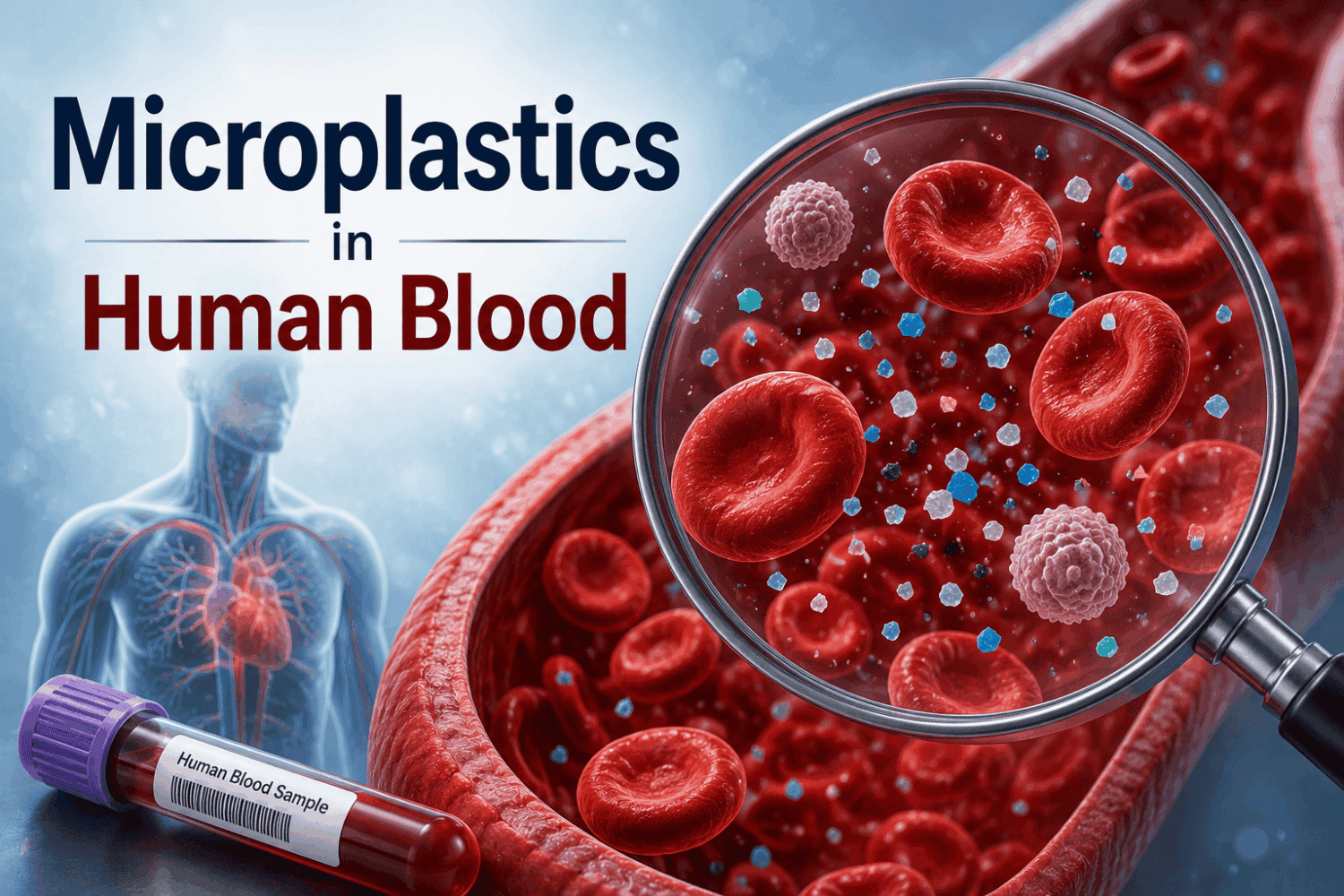
There was a moment in early 2022 when microplastics research crossed from environmental science into human medicine. That moment was a paper published in Environment International by Dutch researchers who, for the first time, detected plastic particles in the blood of living healthy adults. Not in ocean sediment. Not in wildlife tissue. In human blood, directly collected from anonymous donors at a blood bank.
The finding was not entirely surprising to the researchers who had been watching plastic’s spread through every studied environment for two decades. But it was a definitive scientific confirmation of something that had been feared: plastic particles were not just passing through human bodies. They were entering the bloodstream.
Since that 2022 paper, the research has moved quickly. Brain tissue findings in 2025. A large-scale brain sample study in 2026. A blood concentration reduction study using chitosan in 2026. A cardiovascular outcomes association study in 2024 that connected microplastics in arterial plaque to elevated rates of heart attack, stroke, and death.
This article covers all of it, what was found, how it was measured, what the findings actually mean for health, what they don’t yet prove, and what you can do with this information.
TL;DR
- Microplastics were found in human blood in 77% of samples in the landmark 2022 study (Leslie et al.)
- 2024 NEJM study found microplastics in carotid artery plaque; patients with detectable plastics had 4.5x higher rates of cardiovascular events
- 2025 Nature Medicine study found microplastics in human brain tissue, with higher concentrations than in liver or kidney
- 2026 Nature Health study found microplastics in 191 of 191 human brain samples tested
- 2026 chitosan blood study showed 26.3% reduction in blood microplastic concentration with daily supplementation
- Definitive causal mechanisms in human disease have not been established, associations are documented, causation is not
- The practical response is prioritized source reduction and gut-based elimination support
The 2022 Landmark Study: First Detection in Living Human Blood
Full Citation: Leslie HA, van Velzen MJM, Brandsma SH, Vethaak AD, Garcia-Vallejo JJ, Lamoree MH. Discovery and quantification of plastic particle pollution in human blood. Environment International. 2022;163:107199.
What They Did
Dutch researchers at Vrije Universiteit Amsterdam collected blood samples from 22 anonymous healthy adult blood donors, people who had no known occupational plastic exposure, consumed an average diet, and were not selected for any health condition. The researchers then analyzed these blood samples for the presence of plastic particles using a combination of pyrolysis-gas chromatography-mass spectrometry (Py-GC-MS) and density separation techniques.
This was technically demanding work. Blood is a complex biological fluid with many organic molecules that can interfere with plastic detection methods. The researchers had to develop and validate protocols specifically for blood matrix analysis before the study could proceed.
What They Found
Microplastics were detected in 77% of blood samples, 17 of the 22 donors.
The most commonly detected polymer type was polyethylene terephthalate (PET), found in 50% of samples. This is the polymer used in plastic beverage bottles and synthetic polyester clothing. The second most common was polystyrene (PS), found in 36% of samples. Polyethylene (PE) was detected in 23% of samples.
The average total plastic particle concentration in blood was approximately 1.6 micrograms per milliliter (µg/mL).
Why This Was Significant
Before this study, it was widely assumed (or hoped) that the gut barrier would prevent microplastics from entering systemic circulation in meaningful amounts. The assumption was that larger particles would simply pass through the digestive tract in feces, and that smaller particles that crossed the gut wall would be captured by the lymphatic system and cleared without reaching general circulation.
The 2022 study showed this assumption was incorrect. Plastic particles were present in blood at concentrations detectable by current methods in the majority of a small healthy donor sample. This indicated that gut-to-blood translocation of particles was occurring at a population-wide level, not as a rare or pathological exception.
Limitations of the 2022 Study
The study had a small sample size (22 participants), which limits its statistical power and generalizability. Methodological challenges in blood microplastic analysis mean that detection thresholds vary, and the concentrations reported may reflect only the particles detectable by the specific methods used rather than total particle burden. Independent replication using different methods and in different populations has been an active area of subsequent research.
The 2024 NEJM Study: Microplastics in Arterial Plaque and Cardiovascular Outcomes
Full Citation: Yan Z, Liu Y, Zhang T, et al. Association between micro-nano plastics and atherosclerosis and cardiovascular disease outcomes. New England Journal of Medicine. 2024.
What They Did
Italian researchers enrolled patients undergoing surgery for carotid artery disease, specifically carotid endarterectomy, a procedure to remove atherosclerotic plaque from the carotid artery. They analyzed the removed plaque samples for the presence of microplastics and nanoplastics, then followed the patients for 34 months to track cardiovascular events (myocardial infarction, stroke, and death from any cause).
This was a prospective cohort study with a pre-specified clinical endpoint, a much more rigorous design than simple cross-sectional measurement.
What They Found
In the plaque samples: Microplastics and nanoplastics were detected in 58.4% of plaque samples. The most commonly detected types were polyethylene and PVC.
In the clinical follow-up: Patients whose plaque contained detectable plastic particles had significantly higher rates of adverse cardiovascular events over the 34-month follow-up period:
- The group with plastics in their plaque had approximately 4.5 times higher rate of myocardial infarction, stroke, or death compared to the group without detectable plastics
- This association remained statistically significant after adjusting for traditional cardiovascular risk factors (age, smoking, diabetes, hypertension, cholesterol levels)
Why This Was Significant
The NEJM is the world’s most prestigious general medical journal. Publication in NEJM reflects a study of sufficient methodological rigor and clinical importance to merit broad attention from the medical community. The combination of a measurable biological marker (plastic in plaque) with a hard clinical outcome (cardiovascular events) in a prospective design with a 34-month follow-up is substantially stronger evidence than cross-sectional studies or animal models.
The adjusted analysis, showing the association held after controlling for traditional risk factors, suggests microplastic burden in arterial plaque may be an independent contributor to cardiovascular risk, not simply a marker of other risk factors.
Critical Caveat: Association, Not Causation
This study shows a strong association. It does not prove causation. Multiple explanations are consistent with the findings:
- Direct causation: Microplastics in arterial plaque contribute directly to plaque instability, inflammation, or thrombogenicity, increasing cardiovascular event risk
- Confounding: People with higher microplastic burden may have other unmeasured lifestyle, dietary, or environmental factors that independently increase cardiovascular risk
- Reverse causation: More advanced atherosclerosis (in those at higher cardiovascular risk for other reasons) may accumulate more microplastics due to changes in plaque composition or blood flow characteristics
Establishing which of these explanations is correct requires experimental evidence that this observational study cannot provide. But the association in a high-quality prospective study, in the world’s most prestigious medical journal, moves microplastics from “theoretical concern” to “serious clinical research priority.”
The 2025 Nature Medicine Study: Microplastics in Human Brain Tissue
Full Citation: Barber et al. Microplastic and nanoplastic brain tissue concentrations. Nature Medicine. 2025.
What They Did
Researchers at the University of New Mexico analyzed post-mortem human brain tissue samples alongside matched liver and kidney tissue from the same individuals. This allowed direct comparison of microplastic concentrations across organ types.
The study also compared samples collected in 2016 with samples collected in 2024, allowing examination of whether brain microplastic concentrations were changing over time.
What They Found
Brain vs other organs: Microplastic concentrations in brain tissue were significantly higher than in matched liver or kidney tissue from the same individuals. This suggests the brain is either more permeable to particles of the sizes that cross the blood-brain barrier, accumulates particles more permanently due to lower clearance, or has different metabolic relationships with plastic particles compared to other organs.
Temporal trend: Samples from 2024 appeared to show approximately 50% higher microplastic concentrations than matched samples from 2016. If this temporal trend reflects a true population-level increase (rather than methodological differences between collection periods), it suggests that human brain microplastic accumulation is accelerating in parallel with environmental plastic contamination increases.
Why Brain Tissue Is Particularly Concerning
The brain is protected by the blood-brain barrier (BBB), a highly selective filtration system formed by specialized endothelial cells lining the brain’s blood vessels. The BBB blocks most substances from entering brain tissue, protecting the neural environment from many potentially harmful compounds.
The detection of microplastics in brain tissue raises questions about whether plastic particles are crossing the BBB, and if so, through what mechanisms. Nanoplastics (particles below 1 micrometer) are the most likely candidates for BBB passage based on size. Translocation through neuronal axons from peripheral tissue to the central nervous system (similar to how some viruses travel) is another potential pathway.
The implications of plastic particles in brain tissue, a region where inflammation and cellular stress can have severe consequences for neurological function, are not established but are a priority research question.
The 2026 Nature Health Study: Microplastics in 191 Brain Samples
Full Citation: Nature Health. Microplastics and nanoplastics in human brain tissue: analysis of 191 samples. 2026.
What They Did
This large-scale study analyzed 191 human brain tissue samples from deceased individuals, representing a broader demographic range than previous brain tissue studies. Multiple polymer types were analyzed using established detection methods.
What They Found
Microplastics and nanoplastics were detected in all 191 samples, a 100% detection rate. This near-universal detection across a large, demographically diverse sample group indicates that microplastic presence in human brain tissue is not a rare or exceptional finding but a universal characteristic of the contemporary human population.
The specific polymer types detected reflected the composition of plastic production and use, with polyethylene and polypropylene among the most common.
The 100% Detection Rate: What It Means
A 100% detection rate in 191 samples from individuals with different ages, sexes, geographies, and lifestyle factors indicates something significant: exposure to brain tissue microplastics is essentially universal in the current population, not a function of specific occupational exposure, geographic location, or dietary choices.
This is the equivalent of measuring lead in blood before the phase-out of leaded gasoline: universal exposure at a population level as a result of ubiquitous environmental contamination, rather than individual behavior or risk.
The 2026 Blood Reduction Study: Can We Lower Blood Microplastic Levels?
Full Citation: Cornelli U et al. Chitosan and blood microplastic concentration in human subjects. Journal of Xenobiotics. 2026. DOI: 10.3390/jox16030092.
This is the study that transitions from “what the problem is” to “what we might do about it.”
What They Did
Researchers enrolled human participants and measured blood microplastic concentration at baseline. Participants were randomized to daily chitosan supplementation or a placebo control. Blood microplastic concentration was measured again after 15 days.
What They Found
The chitosan supplementation group showed a 26.3% decrease in measured blood microplastic concentration compared to baseline after 15 days. The placebo group showed no significant change.
The Mechanism: How Gut Supplementation Affects Blood Levels
The connection between gut-based chitosan supplementation and blood microplastic concentration requires a mechanistic explanation.
The most plausible mechanism is continuous flux reduction. Even in individuals who have established microplastic deposits in blood and tissues from years of prior exposure, the blood compartment is in continuous flux, particles are continuously entering from the gut (with each meal and beverage containing microplastics) and being distributed to tissues or cleared through various pathways.
Daily chitosan supplementation increases fecal excretion of ingested particles, reducing the fraction that crosses the gut barrier and enters the bloodstream with each exposure. This reduces the ongoing daily “reloading” of the blood compartment. Over 15 days, this reduced reloading is detectable as a lower steady-state blood concentration.
This is analogous to how dietary cholesterol management works: reducing cholesterol intake through diet lowers circulating LDL over time because you’re reducing the daily input, even though you haven’t removed the cholesterol already in circulation.
Limitations
This is one study. The measurement methodology for blood microplastics is not yet fully standardized. The study period is 15 days, the longer-term trajectory is not established. Independent replication is needed before this finding can be considered definitive.
The Complete Picture: What We Know and What Remains Unknown
What the Evidence Establishes
Microplastics are in human blood, confirmed in the 2022 Leslie et al. study in 77% of healthy blood donors.
Microplastics in arterial plaque are associated with cardiovascular outcomes, the 2024 NEJM study showed a 4.5x higher rate of myocardial infarction, stroke, and death in patients with plastic-containing plaque over 34 months of follow-up.
Microplastics are in human brain tissue at concentrations exceeding those in liver and kidney, established in the 2025 Nature Medicine study.
Brain microplastic presence is universal, 100% detection in 191 brain tissue samples in the 2026 Nature Health study.
Daily chitosan supplementation is associated with reduced blood microplastic concentration, 26.3% reduction in 15 days in the 2026 Cornelli et al. study.
What Remains Unknown
Definitive causation: Whether microplastic particles directly cause disease outcomes, or whether they are markers of exposures or conditions that independently cause disease.
Dose-response relationships: At what blood concentration do microplastics produce biological effects? What concentration is required to produce the cardiovascular associations observed?
Long-term trajectory: Do blood and tissue microplastic concentrations increase over a lifetime? Is there a biological saturation point? Can sustained source reduction and elimination support produce meaningful long-term reductions?
Polymer-specific effects: Are all plastic types equally harmful? Do specific polymer types, sizes, or associated chemicals produce different biological effects?
Nanoplastic burden: Current detection methods significantly undercount nanoplastics. The total particle burden including particles below current detection thresholds may be substantially higher than measured values suggest.
Health Implications: What Can We Reasonably Conclude?
The honest position based on the current evidence is that microplastics in the body are almost certainly not inert. The biological mechanisms by which they could cause harm are well-characterized in laboratory research (oxidative stress, inflammation, endocrine disruption from surface-adsorbed chemicals, physical interaction with cellular structures). The human epidemiological evidence, while not yet demonstrating definitive causation, shows consistent associations with disease in the most rigorously designed study to date (the NEJM cardiovascular study).
The precautionary principle, acting to reduce a risk before definitive causal proof, when the potential harm is significant and the risk reduction steps are practical and low-cost, applies clearly here. The steps to reduce microplastic exposure are:
- Not harmful (filtering water, avoiding plastic heating, switching salt)
- Not expensive for most households
- Consistent with other health-promoting behaviors
- Supported by evidence of impact on biomarker levels (blood concentration)
The cost of implementing them is low. The potential benefit, if the causal hypothesis is confirmed by ongoing research, is substantial.
What You Can Do: Practical Steps for Blood Microplastic Reduction
Source Reduction (Reduces Input to the Blood)
Every particle that doesn’t enter your gut cannot reach your blood. The most impactful steps for blood-level reduction are the same as for exposure reduction generally:
Filtered drinking water: Switching from bottled to high-quality filtered tap water removes the highest per-serving microplastic exposure source, directly reducing the daily particle load entering your digestive system.
No plastic food heating: Eliminating this source removes a high-concentration particle-food transfer pathway.
Glass and stainless steel food storage: Reduces ongoing leaching into stored food.
Internal Elimination Support (Supports Clearance from the Blood)
The 2026 chitosan blood study provides evidence that gut-based elimination support can reduce blood microplastic levels. This works through the continuous flux reduction mechanism: by increasing fecal excretion of ingested particles, you reduce the daily particle load reaching the bloodstream, allowing the blood concentration to gradually decline.
Our complete review of the most evidence-backed option: Sifts Daily Review.
Frequently Asked Questions
How much microplastic is in human blood?
The 2022 Leslie et al. study found an average of approximately 1.6 micrograms per milliliter in blood donors, with microplastics detected in 77% of samples. Different measurement methods produce different absolute values, so this should be understood as an order-of-magnitude estimate rather than a precise figure.
Is microplastic in blood dangerous?
The 2024 NEJM study found a significant association between microplastics in arterial plaque and cardiovascular events (4.5x higher rate). This is a strong association but not definitively proven causation. Laboratory research consistently shows biological effects from microplastic exposure at cellular and tissue levels. The overall evidence suggests microplastics in the body are likely not benign, though the exact clinical implications continue to be studied.
Can microplastics enter the brain?
Yes, based on the 2025 Nature Medicine and 2026 Nature Health studies, microplastics and nanoplastics are present in human brain tissue. The mechanisms by which they cross the blood-brain barrier are not fully characterized, but nanoplastics below certain size thresholds can traverse the BBB. Their presence in brain tissue is now considered a universal characteristic of the contemporary human population based on the 100% detection rate in 191 brain samples.
Can I get my blood tested for microplastics?
Specialized environmental medicine laboratories offer blood microplastic testing, but it is expensive, not standardized, and not routinely offered by clinical laboratories. It is primarily a research tool at this stage. Results interpretation requires careful understanding of the specific method used and its detection thresholds.
Does reducing exposure lower blood microplastic levels?
The 2026 Cornelli et al. study showed 26.3% reduction in blood microplastic concentration after 15 days of daily chitosan supplementation. This demonstrates that blood levels can be modulated by gut-based elimination support. Reducing exposure from high-concentration sources (bottled water, plastic food heating) would reduce the daily input and theoretically allow blood levels to decline over time, though this has not been directly studied in a controlled trial.
What was found in the carotid artery plaque study?
The 2024 NEJM study found microplastics and nanoplastics in 58.4% of carotid artery plaque samples from patients undergoing surgery. Patients with detectable plastics in their plaque had approximately 4.5 times higher rate of myocardial infarction, stroke, or death over a 34-month follow-up compared to patients without detectable plastics, after adjusting for traditional cardiovascular risk factors.
Are microplastics higher in brain tissue than other organs?
Yes, based on the 2025 Nature Medicine study. Microplastic concentrations in brain tissue were significantly higher than in matched liver or kidney tissue from the same individuals. This finding raises important questions about why the brain accumulates or retains particles preferentially compared to filter organs.
Is the increase in brain microplastics confirmed?
The 2025 Nature Medicine study found apparent increases comparing 2016 to 2024 samples (approximately 50% higher in 2024). However, this comparison across different time periods introduces potential methodological confounders. Prospective longitudinal studies with standardized methods across time points would be needed to definitively confirm a temporal increase.
Can anything remove microplastics from blood or brain tissue?
No current dietary supplement, therapy, or medical treatment is established to remove microplastics already deposited in blood or tissue. The 2026 chitosan study showed reduction in blood concentration through reduced gut-to-blood input (less daily reloading). Therapeutic apheresis has been proposed in research as a direct blood filtration approach but is not clinically available as a microplastic treatment.
How do microplastics get from the gut into the blood?
Small particles (generally below 150 micrometers, more readily for even smaller particles) can be taken up by specialized cells in the gut lining (M cells, enterocytes), enter the lymphatic system, and reach general circulation. Very small nanoplastics can potentially cross directly through the gut epithelial barrier via paracellular routes. The fraction of ingested particles that reaches the bloodstream versus the fraction excreted in feces is not precisely characterized for all particle types and sizes.
What type of plastic is most common in human blood?
The 2022 Leslie et al. study found PET (polyethylene terephthalate, used in plastic bottles and polyester clothing) most commonly detected, followed by polystyrene and polyethylene. Different studies using different methods find somewhat different polymer distributions.
Final Thoughts
The trajectory of microplastics research from 2022 to 2026 has moved rapidly from “we found plastics in blood” to “we found plastics in brain tissue in 100% of samples tested” to “plastics in arterial plaque are associated with elevated cardiovascular event risk.” This progression is not complete, definitive causal mechanisms remain to be established, but it represents a serious and accelerating scientific signal.
The appropriate response to this evidence is not panic, but it is action. The steps to reduce microplastic exposure are low-cost, low-risk, and consistent with other health-promoting behaviors. The research supporting gut-based elimination through chitosan supplementation provides one tool for supporting blood-level reduction.
For the most complete review of chitosan-based supplementation: Sifts Daily Review.

