






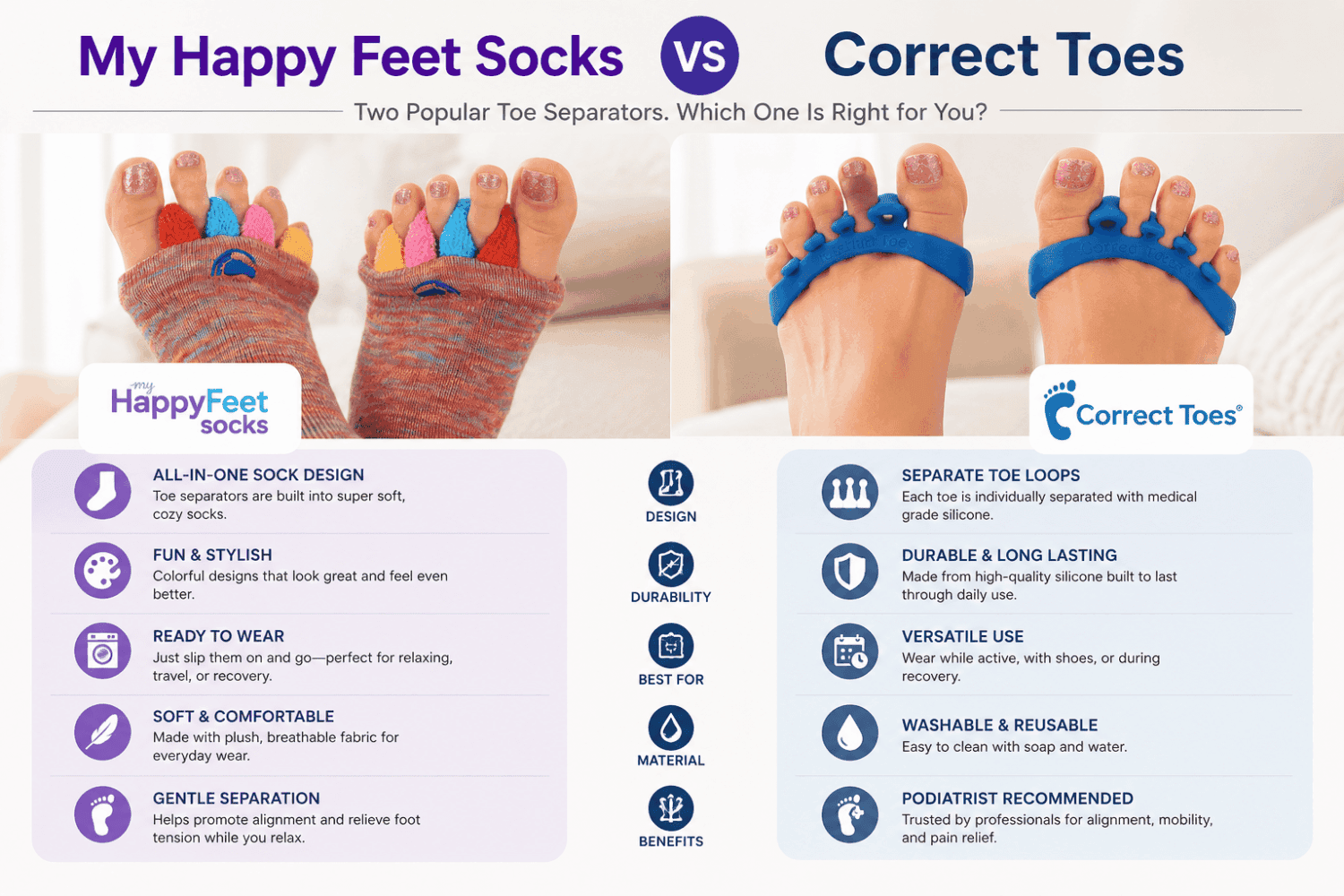
Choose My Happy Feet Socks if you want soft, low-cost, passive toe stretching while you relax or sleep. Choose Correct Toes if you want firmer, anatomical spacers you can wear inside shoes and during activity to actively strengthen and realign your feet over the long term. They sound like competitors, but they are really built for two different moments in your day: one for resting, one for moving.
Both work on the same sound idea, that decades of narrow shoes crowd the toes and spreading them relieves pressure, and both are honest in the same way: they relieve symptoms and support better alignment, but neither structurally cures a bunion. The right choice depends almost entirely on when and how you want to wear them, and how much you want to spend. This guide breaks down every difference so you can pick once and pick right.
Quick Verdict: Who Should Buy Which
Pick My Happy Feet Socks if you:
- Want the most comfortable option for overnight or couch wear.
- Want the lowest price and the simplest experience.
- Mainly want gentle relief and a relaxing stretch, not athletic training.
- Do not want to buy new shoes to use them.
Pick Correct Toes if you:
- Want to wear spacers inside shoes and while walking, running, or training.
- Care about long-term foot strength and function, not just evening comfort.
- Want a podiatrist-designed, anatomically shaped device that lasts for years.
- Already wear, or are willing to buy, wide-toe-box or barefoot-style shoes.
Honestly, many people end up using both: the socks at night for a passive stretch, and Correct Toes by day for active alignment. They are complementary more than they are rivals.
At-a-Glance Comparison
| My Happy Feet Socks | Correct Toes | |
|---|---|---|
| Type | Fabric socks with sewn-in separators | Standalone silicone toe spacers |
| Material | Soft cotton blend | Medical-grade silicone (firmer) |
| Designed by | Eva Nemcik (product developer) | Dr. Ray McClanahan, sports podiatrist |
| Wear in shoes? | No, rest and sleep only | Yes, in wide-toe-box or barefoot-style shoes |
| Wear while active? | No | Yes (walking, running, yoga, lifting) |
| Toe spacing | Uniform width separators | Anatomical, customizable, trimmable |
| Comfort for lounging | Very high (soft fabric) | Good, but firmer feel |
| Break-in needed | Yes, build up gradually | Yes, build up gradually |
| Typical price | Budget (often around $20 to $30 a pair) | Premium (around $60 to $65 a pair) |
| Lifespan | Months (a washable sock) | 1 to 5 years (durable silicone) |
| Guarantee | Money-back (60 to 90 days, varies by seller) | 30-day return, 90-day materials warranty |
| Best for | Passive overnight relief, comfort, budget | Active alignment, foot strengthening, all-day use |
What Each One Is
My Happy Feet Socks, in brief
My Happy Feet Socks are soft cotton-blend socks with four cushioned separators sewn between the toes. You wear them while sitting, relaxing, or sleeping, never inside shoes, and the fabric gently holds your toes apart for a passive stretch. They were developed by Eva Nemcik in Ohio, hold a US patent, and are sold with a money-back guarantee. Their whole appeal is comfort and simplicity: pull them on, relax, and let your toes decompress. We cover them in depth in our full My Happy Feet Socks review.
Correct Toes, in brief
Correct Toes are standalone toe spacers made of firm, medical-grade silicone, designed by sports podiatrist Dr. Ray McClanahan. Their defining feature is that they are built to be worn while you are active and weight-bearing, including inside roomy or barefoot-style shoes, so your feet realign and strengthen through natural movement rather than only at rest. They are widely regarded in the natural-foot community as the benchmark spacer, with anatomical spacing, four sizes, and a design you can trim to customize.
Head-to-Head: The Differences That Matter
1. Design and mechanism
This is the fundamental split. My Happy Feet Socks are a passive, soft-stretch device: the fabric separators spread your toes while you are still. Correct Toes are an active-alignment device: the firmer silicone maintains toe splay even as you bear weight and move, which is what lets them work during walking and exercise.
The firmness difference is the whole story. A soft sock separator feels lovely but collapses under the pressure of standing. A firmer silicone spacer holds its shape, which is exactly why Correct Toes can function inside a shoe and why they feel more intense at first. Correct Toes are also anatomically shaped rather than uniform, which addresses one of the most common My Happy Feet complaints, that the same-width separators feel great on the big toe but too much near the small toes.
2. Comfort and wearability
My Happy Feet Socks win on pure comfort. Soft cotton against the skin is more pleasant for long, relaxed sessions and for sleeping, and many people who find rigid spacers too intense to sleep in get along fine with the socks. If your goal is to unwind on the couch or wear something overnight, the socks are the gentler experience.
Correct Toes are comfortable too, but firmer, and a minority of users report they can slip slightly during walking, which the newer Sport version with left/right shaping aims to reduce. The trade-off for that firmness is capability: you can actually do things while wearing them.
3. In-shoe and active use (the biggest practical difference)
If you remember one thing, make it this. My Happy Feet Socks cannot be worn inside normal shoes. They are bulky, and cramming separated toes into a shoe defeats the purpose. They are a stationary, resting product.
Correct Toes are specifically engineered for in-shoe and weight-bearing use, but with an important condition: they need a wide toe box. In standard narrow shoes, the shoe compresses the spacer and causes irritation, so to get the most from Correct Toes, many people switch to roomy or barefoot-style footwear. That is a real, sometimes significant, added cost to factor in. But if you want spacers that work while you live your life rather than only while you rest, Correct Toes are the only one of these two that can do it.
4. Effectiveness and the honest evidence
Here is where both brands deserve a reality check, because the marketing on both sides runs ahead of the science.
What the evidence supports for toe spacers in general: meaningful short-term pain relief for bunion-related soreness, plus support for natural toe splay. A controlled study of painful bunions found a toe separator significantly reduced pain but did not significantly change the bunion angle. That finding applies to both products: they make the foot feel better, they do not straighten the bones. No toe spacer or sock reverses a structural bunion. Only surgery does that, and serious deformities belong with a podiatrist.
Where Correct Toes has a stronger theoretical edge: because you wear them while active and weight-bearing, the idea is that your foot strengthens and realigns through natural use over time, not just stretches passively. That mechanism is plausible and is the foundation of the whole natural-foot movement, and Correct Toes carries the credibility of a podiatrist designer with decades of clinical experience. The high-quality, long-term clinical trial evidence is still limited, so treat “treats the root cause” claims as reasonable theory rather than proven fact.
For plantar fasciitis specifically, be cautious with both. Neither directly treats the plantar fascia. The primary evidence-based care is calf and plantar-fascia stretching, supportive footwear, and orthotics. If arch and heel pain is your main issue, pair either product with a proper insole; our Soul Insole review covers that side of the equation.
5. Break-in and ease of use
Both require patience, and both punish people who overdo it on day one. The universal rule for spacers and alignment socks alike: start with short sessions, around 10 to 20 minutes, and build up gradually, stopping at mild irritation rather than pushing into pain.
My Happy Feet Socks are slightly easier to live with during break-in because the softer material is more forgiving. Correct Toes ask a little more upfront, both because of the firmer silicone and because getting the fit and placement right (and possibly trimming them) takes some fiddling. The payoff for that effort is a device you can wear actively.
6. Durability and care
This is where the price gap narrows. My Happy Feet Socks are washable socks; with cold washing and air drying they last months before the elastic and separators wear. Correct Toes are durable silicone that can last anywhere from one to five years with proper care, washed with mild soap and air dried. So while Correct Toes cost more upfront, the per-year cost can actually be competitive, because you replace socks far more often than silicone.
7. Price and value
My Happy Feet Socks are the budget choice, typically in the rough range of $20 to $30 a pair depending on the seller and bundle, with a money-back guarantee whose window varies by channel (the offer page advertises 90 days; the brand’s main site has listed 60). Correct Toes are premium, generally around $60 to $65 a pair, with a 30-day return and a 90-day materials warranty.
On pure upfront price, the socks win easily. On long-term value, it is closer than it looks once you account for lifespan, though Correct Toes can carry the hidden cost of wide-toe-box shoes to use them properly. Value really comes down to use case: for occasional evening comfort, the socks are better value; for daily active wear over years, Correct Toes can justify the premium.
8. Sizing
My Happy Feet Socks come in a few sizes, and the common advice is to size up if you are between sizes, as they can run snug. Correct Toes offer four sizes based on US shoe size, with printable size guides, and they can be trimmed for a custom fit, plus free size exchanges from most sellers. Correct Toes give you more precise fit control; the socks are simpler but less adjustable.
Use-Case Verdicts
For overnight relief and morning stiffness: My Happy Feet Socks. Soft enough to sleep in comfortably, which is when many people get the most benefit.
For wearing in shoes and staying active: Correct Toes, hands down. They are the only one of the two designed for it, provided you have roomy footwear.
For bunion pain relief: Both help symptomatically. Choose by lifestyle: socks for passive evening relief, Correct Toes for all-day support while moving. Neither corrects the deformity.
For long-term foot strengthening: Correct Toes. Active, weight-bearing wear is the mechanism that may build foot strength over time.
For the lowest budget: My Happy Feet Socks, clearly.
For runners and minimalist-shoe wearers: Correct Toes. They were practically made for this crowd.
For sensitive feet or people new to toe spacing: Start with My Happy Feet Socks. The gentler introduction is easier to tolerate, and you can graduate to Correct Toes later.
For the best of both: Use the socks at night and Correct Toes by day. This is what a lot of dedicated foot-health enthusiasts actually do.
Can You Use Both Together?
Yes, and it is a genuinely sensible approach rather than a cop-out. They cover different parts of your day: Correct Toes provide active, in-shoe alignment while you are up and moving, and My Happy Feet Socks provide a soft, passive stretch while you wind down or sleep. Just do not wear both at once, and apply the same gradual break-in to each. If budget allows only one to start, pick based on whether your priority is resting comfort (socks) or active correction (Correct Toes), then add the other later.
Safety: Who Should Be Careful With Either
Toe spacing is low risk for most healthy adults, but not for everyone, and this applies equally to both products.
If you have diabetes or any neuropathy (reduced sensation in your feet), talk to your doctor before using either. Anything placed between the toes can cause skin irritation or breakdown that you will not feel, and small foot wounds can become serious for people with diabetes. Do not push through sharp or lasting pain with either device; a strong stretch is expected, real pain is a signal to stop, and podiatrists have documented injuries from spacers used too aggressively. And remember that advanced deformities, suspected fractures, infections, or worsening pain need a professional, not a sock or a spacer. For broader recovery and circulation needs that neither product addresses, a different category of tool such as a compression massager may suit you better. You can browse more of our tested wellness-device reviews to compare options.
Frequently Asked Questions
Are My Happy Feet Socks or Correct Toes better for bunions?
Both relieve bunion-related pain in the short term, and neither straightens the bunion. For passive evening relief, the socks are gentler and cheaper. For all-day support while you stay active, Correct Toes are better. Severe bunions need a podiatrist.
What is the main difference between them?
My Happy Feet Socks are soft fabric socks for passive stretching at rest, and cannot be worn in shoes. Correct Toes are firmer silicone spacers you can wear inside roomy shoes and during activity for active alignment.
Can you wear Correct Toes in regular shoes?
Only in shoes with a wide toe box or barefoot-style shoes. Standard narrow shoes compress the spacers and cause irritation, so many users buy roomier footwear to use them properly.
Which is more comfortable?
My Happy Feet Socks, because of the soft cotton material, especially for sleeping or long relaxed sessions. Correct Toes are firmer by design so they can hold toe splay while you move.
Which lasts longer?
Correct Toes. The medical-grade silicone can last one to five years with care, while the socks wear out in months like any washable sock.
Which is better value?
For occasional evening use, the cheaper socks. For daily active wear over years, Correct Toes can justify the higher price, though factor in the possible cost of wide-toe-box shoes.
Can I use both?
Yes. Many people wear Correct Toes by day for active alignment and My Happy Feet Socks at night for a passive stretch. Do not wear both at the same time, and break each in gradually.
Do either of them cure bunions or plantar fasciitis?
No. Both can ease symptoms, but neither structurally corrects a bunion, and neither directly treats the plantar fascia. Pair them with proper footwear or orthotics, and see a professional for serious or worsening problems.
Which should a beginner choose?
My Happy Feet Socks are the easier introduction because the soft material is more forgiving during the adjustment period. You can move to Correct Toes once your feet are used to being spread.
Are they safe for people with diabetes?
Not without medical advice. Reduced foot sensation makes anything between the toes risky, so consult your doctor or podiatrist before using either product.
Final Verdict
My Happy Feet Socks and Correct Toes are not really rivals so much as tools for two different jobs. The socks are the soft, affordable, low-effort choice for passive toe stretching while you rest or sleep, and they are the easiest entry point if you are new to toe spacing or shopping on a budget. Correct Toes are the firmer, premium, podiatrist-designed choice built to be worn while you are active and inside roomy shoes, which makes them the stronger pick for long-term foot strengthening and all-day alignment, as long as you have the footwear to use them and the patience to break them in.
If you want one sentence to decide by: buy My Happy Feet Socks if your goal is comfortable evening relief, and buy Correct Toes if your goal is active, all-day correction. And if you are serious about your feet and can swing it, owning both, socks for night and spacers for day, genuinely gives you the most complete approach.
Whichever you choose, go in with realistic expectations. These are comfort and alignment tools that relieve symptoms and support healthier foot positioning, not cures for structural problems. Used consistently by the right person, both can make a real difference to everyday foot comfort.
Ready to start with the soft, budget-friendly option for evening and overnight relief?
Check the latest My Happy Feet Socks price and guarantee
If you want spacers for active, in-shoe wear instead, Correct Toes are available from the official Correct Toes website.

