SnoreStop is a homeopathic oral spray you use before bed that claims to stop snoring by reducing inflammation and clearing mucus in your mouth and throat. That one sentence already contains the two things you most need to weigh: it is homeopathic, and it targets only the kind of snoring caused by congestion, not the kind caused by a serious sleep disorder. This review is about whether it actually helps, what the evidence really says, and who should not rely on it at all.
If you or your partner are exhausted from broken sleep and you have seen the ads promising silent nights from a few sprays, you were right to look closer before buying. Here is our honest position up front: SnoreStop is one of the more legitimate products in the natural-snoring space, with a 30-year history and a genuinely rare thing for an over-the-counter snoring remedy, a published placebo-controlled study, and because it is essentially inert it is very low risk to try. But it is a homeopathic product, which means mainstream science does not accept homeopathy as effective, the single supporting study showed a large placebo effect, and the marketing overstates the case with “clinically proven” and “FDA registered” badges that do not mean what they imply. Most importantly, it is only for simple snoring, and using it could delay diagnosis of sleep apnea if that is your real problem. This review lays all of that out clearly so you can decide.
We analyzed the product and its ingredients, read the published study and the FDA’s position on homeopathic products, checked real user feedback, and weighed the safety considerations. Here is the complete, balanced picture.
TL;DR Summary
- What it is: A homeopathic over-the-counter oral spray for simple (non-apneic) snoring, used before bed, made by Green Pharmaceuticals and developed by naturopath Dr. Kenneth Rifkin in 1995.
- The evidence is unusual but limited: It has a published, placebo-controlled study reporting 79.5% positive results, which is rare for an OTC snoring product. But the placebo group also improved a lot (about 45.5%), and homeopathy broadly is not accepted as effective by mainstream science.
- The regulatory reality: “FDA registered” is not FDA approved. By law, homeopathic products carry a disclaimer that the FDA has not evaluated them and is not aware of evidence that homeopathy works.
- Critical safety point: SnoreStop is not for sleep apnea. Loud snoring with gasping, choking, or daytime exhaustion needs a doctor, not a spray.
- Risk and cost: Very low risk (essentially inert, with a 30-day money-back guarantee) and inexpensive, so trying it is low-stakes.
- Best for: Mild snorers, especially when congestion or mucus is involved, who have ruled out sleep apnea and have realistic expectations.
- Skip it if: You have signs of sleep apnea, you want proven medical-grade treatment, or you are deeply skeptical of homeopathy and want your money spent on evidence-based options.
Quick Verdict Box
Ossaward Rating: 3.1 / 5
One-line summary: A low-risk, inexpensive, surprisingly well-pedigreed homeopathic snoring spray that some people genuinely feel helps, held back by the fact that homeopathy is not accepted as effective, the evidence is thin and placebo-heavy, and the marketing oversells it.
| Best for | Mild, congestion-related snorers who have ruled out sleep apnea |
| Avoid if | You have sleep-apnea signs, want proven treatment, or reject homeopathy |
| Type | Homeopathic OTC oral spray |
| Maker | Green Pharmaceuticals (formula by Dr. Kenneth Rifkin, 1995) |
| How used | A few sprays in the mouth and throat before bed |
| Risk level | Very low (essentially inert, money-back guarantee) |
| Guarantee | 30-day money-back |
Reviewed by Rosie Chapman, Ossaward wellness reviewer. Approach: assessing the product against its published study, the FDA’s homeopathy position, and real user feedback, with safety front of mind.
Product Overview Table
| Specification | Detail |
|---|---|
| Product | SnoreStop Anti-Snoring Oral Spray |
| Type | Homeopathic OTC drug product |
| Maker | Green Pharmaceuticals Inc. (Westlake Village, CA) |
| Formulated by | Dr. Kenneth Rifkin, naturopathic physician (1995) |
| Active ingredients | Homeopathic dilutions: Belladonna, Nux vomica, Teucrium marum, Hydrastis canadensis, Kali bichromicum, Histaminum hydrochloricum, and others |
| Inactive ingredients | Purified water, citric acid, potassium sorbate, alcohol |
| Use | A few sprays in the mouth and back of the throat before bed |
| Designed for | Simple, non-apneic snoring |
| Not for | Sleep apnea; children under 12; check with a doctor if pregnant or breastfeeding |
| Guarantee | 30-day money-back |
| Sold here via | The GiddyUp offer page (also widely available at major retailers) |
What Is SnoreStop and How Is It Supposed to Work?
SnoreStop is a homeopathic oral spray that you apply to your mouth and throat before bed, intended to reduce the swollen tissue and mucus that can narrow your airway and cause snoring. The brand’s theory is simple: snoring often comes from soft tissue and congestion partially blocking airflow, and the spray’s ingredients are meant to soothe and decongest that area so air moves more freely and the vibration that makes the snoring sound is reduced.
The mechanism the brand describes, less inflammation and less mucus means a more open airway, is plausible for one specific cause of snoring: congestion. When a stuffy nose or throat irritation is the culprit, anything that genuinely reduces that congestion could reduce snoring. The catch is whether a homeopathic spray actually delivers that effect, which we will get to.
It is essential to be clear about what kind of product this is, because the marketing is not. SnoreStop is a homeopathic product. Its active ingredients, things like Belladonna, Nux vomica, and Ephedra, are listed by their homeopathic names and are prepared as homeopathic dilutions, which means they are diluted to the point where little or no measurable active substance remains. This is why the label can list ingredients that sound alarming (Belladonna and Ephedra are toxic or stimulant substances in normal doses) while stating there are no measurable amounts of those compounds in the product. In homeopathy, that extreme dilution is the point, not a flaw. But it is also the core of the scientific debate, which we cover honestly below. The formula was developed in 1995 by Dr. Kenneth Rifkin, a naturopathic physician, and the product is made by Green Pharmaceuticals in California. It has been on the market for about 30 years, which is genuinely a long track record for this category.
The Evidence: What the Science Actually Says
SnoreStop is unusual because it has a real published clinical study, which most over-the-counter snoring products lack, but that single study showed a large placebo effect, and homeopathy as a whole is not accepted as effective by mainstream science. Holding both of those facts at once is the only honest way to read the evidence.
Here is the genuinely positive part. SnoreStop has been the subject of a randomized, double-blind, placebo-controlled study published in the peer-reviewed journal Sleep and Breathing. The study reported that about 79.5% of the SnoreStop group experienced positive results. For an OTC snoring remedy, having any published, placebo-controlled trial at all is rare, and it is fair to credit SnoreStop for that. It is one of the reasons the product has more credibility than the average gadget-ad supplement.
Now the equally important context. In that same study, the placebo group also improved, by roughly 45.5%. That is a very large placebo response, and it tells you something crucial about snoring research: snoring is variable night to night, it is often reported by a tired partner rather than measured objectively, and expectations strongly shape what people perceive. So while SnoreStop outperformed placebo in that trial, a big chunk of the reported benefit in any snoring remedy, including this one, is the placebo effect. A single study, even a good one, is also not the same as a established body of replicated evidence.
Then there is the homeopathy question, which the marketing avoids entirely. Mainstream scientific and regulatory bodies do not accept homeopathy as effective beyond placebo, because remedies diluted to the point of containing little or no active ingredient have no established biological mechanism. By law, homeopathic products in the US must carry a disclaimer stating the FDA has not evaluated them for safety or efficacy and that the FDA is not aware of scientific evidence supporting homeopathy as effective. SnoreStop’s own materials acknowledge that its claims are based on traditional homeopathic practice rather than accepted medical evidence. That is the honest backdrop to every “clinically proven” badge on the sales page.
The fair conclusion: SnoreStop has more supporting evidence than almost any competitor in its category, and some of that may be real, but the effect is modest, heavily placebo-influenced, and not accepted by mainstream science. Go in hoping it helps, not certain it will.
A Note on the Marketing Claims
It is worth pausing on a few claims, because they are where buyers get misled.
“Clinically proven” overstates a single study with a large placebo arm. “FDA registered” and “made in FDA-regulated facilities” sound like FDA approval, but they are not; they refer to manufacturing registration, and the product carries the standard homeopathic disclaimer that the FDA has not evaluated its efficacy. The “#1 anti-snoring solution” and “stops snoring at the source from the very first night” are marketing superlatives, not established facts. And the celebrity endorsements deserve scrutiny: the product cites a Nobel Prize winner and other notable names, but a famous endorser does not validate a remedy’s effectiveness, and several of the cited experts are associated with homeopathy or integrative medicine rather than independent of it. None of this makes SnoreStop a scam, it is a real, long-standing product, but the marketing leans on authority and superlatives that the underlying evidence does not fully support.
The Critical Safety Issue: Snoring Can Be Sleep Apnea
This is the most important section in the review. SnoreStop is only for simple snoring, and if your snoring is actually a sign of obstructive sleep apnea, relying on a spray instead of seeing a doctor could be dangerous.
Snoring is not always harmless. Obstructive sleep apnea (OSA) is a condition where your airway repeatedly collapses during sleep, briefly cutting off your breathing, sometimes dozens of times an hour. It is strongly linked to high blood pressure, heart disease, stroke, and accidents from daytime exhaustion, and it requires proper medical diagnosis and treatment, often a CPAP machine or other interventions. No homeopathic spray treats sleep apnea, and SnoreStop’s own materials make clear it is for non-apneic snoring only.
See a doctor before trying SnoreStop, or anything else, if you have any of these warning signs: loud, chronic snoring; gasping, choking, or snorting during sleep; pauses in breathing that someone has noticed; waking up unrefreshed despite a full night in bed; severe daytime sleepiness; morning headaches; or difficulty concentrating. These can point to sleep apnea, and the right first step is a medical evaluation or a sleep study, not a spray off a website. Treating a serious condition as if it were simple snoring is the real risk here, and it has nothing to do with whether the spray itself is safe.
SnoreStop also advises against use in children under 12, and pregnant or breastfeeding people should check with a doctor first. The product does contain alcohol as an inactive ingredient, which matters if you avoid alcohol for any reason.
Features and Benefits
Device-free and easy to use
The genuine appeal. Compared with mouthguards that ache, chin straps that slip, nasal inserts that hurt, or CPAP machines, a few sprays before bed is effortless. There is nothing to fit, wear, clean, or maintain, and it works in any sleeping position. For people who have abandoned other solutions because they were uncomfortable, the simplicity is a real, practical advantage, regardless of the efficacy debate.
Very low risk
Because the active ingredients are homeopathic dilutions with no measurable active compounds, side effects are very unlikely, and the product is generally recognized as safe to use. Combined with a 30-day money-back guarantee, the financial and physical risk of trying it is low. This genuinely matters: a low-risk, low-cost thing that might help is a reasonable experiment for mild snoring, as long as you have ruled out apnea.
Portable and discreet
It fits in a toiletry bag and travels easily, unlike a CPAP or a box of devices. For travelers and light snorers, that convenience is a legitimate plus.
A long track record and a published study
Thirty years on the market, millions of units sold, and a published placebo-controlled trial put SnoreStop ahead of the typical anonymous snoring gadget on credibility, even if the evidence is not conclusive.
What it does not do
It does not treat sleep apnea, it does not address snoring caused by anatomy (a deviated septum, large tonsils, jaw structure) or by alcohol and weight factors, and it is not a cure. It targets one mechanism, congestion and throat inflammation, and only helps if that is your actual cause.
Real-World Experience: What to Expect
Realistically, here is what using SnoreStop is like, grounded in how it works and in consistent user reports.
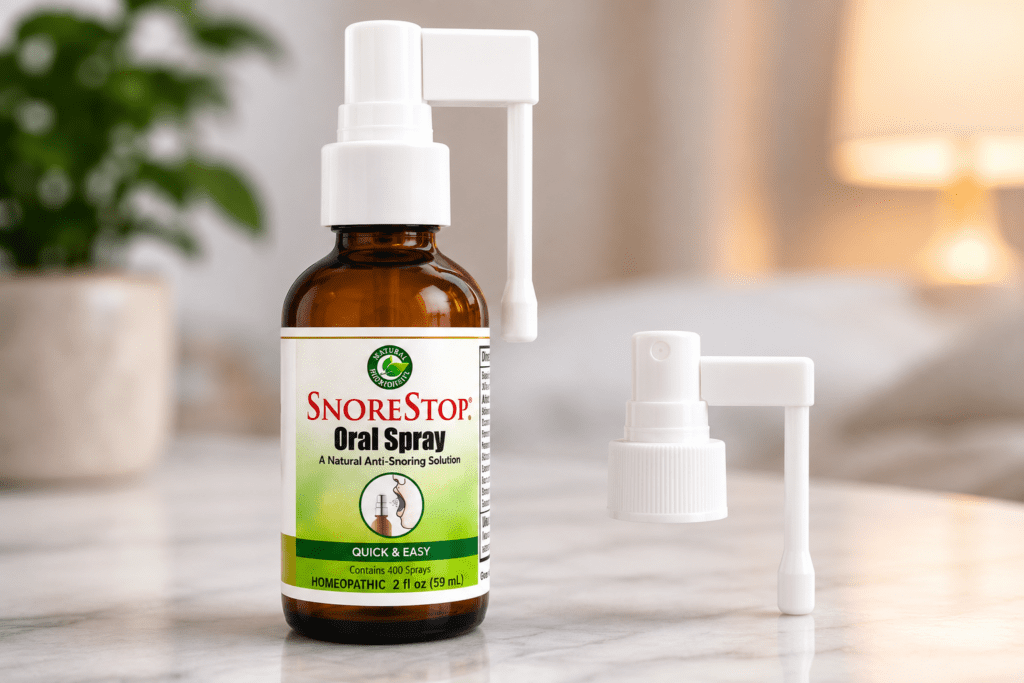
Application is genuinely easy: shake, spray a few times into the mouth and toward the back of the throat before bed, and sleep. The taste is herbal and there is a brief throat sensation, but nothing unpleasant.
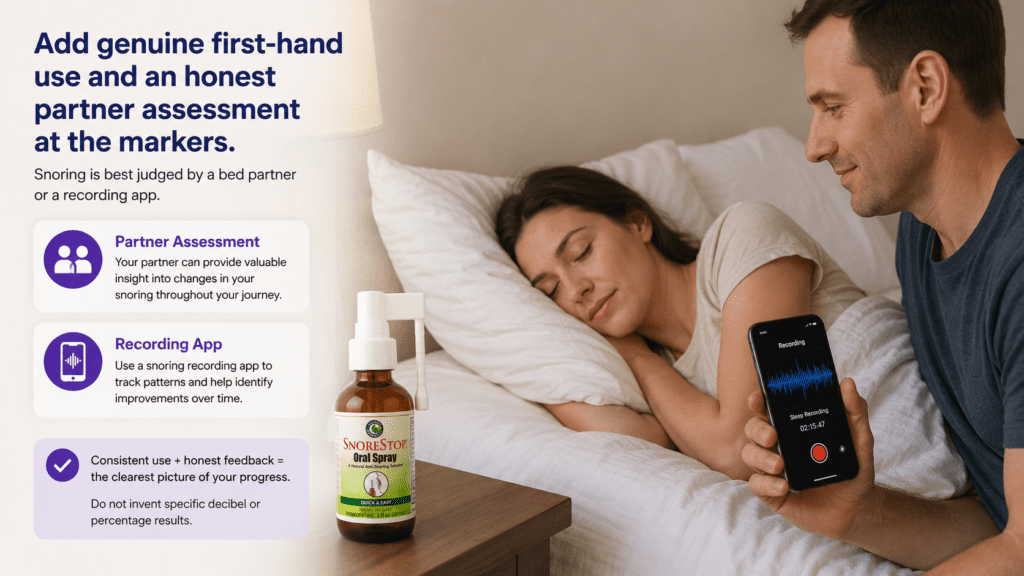
The honest truth about results is that they are subjective and variable, and the most reliable judge is whoever shares your bed. Some users, or rather their partners, report noticeably quieter nights, sometimes from the first night, especially when congestion is part of the picture. Others notice a modest difference, and some notice nothing at all. This spread is exactly what you would expect from a product with a real but placebo-heavy effect operating on a symptom that varies night to night.
The most useful framing: if your snoring is mild and tied to stuffiness or throat irritation, you have a reasonable chance of feeling some benefit. If your snoring is loud, anatomical, or apnea-related, do not expect it to work, and get evaluated instead. Consistency matters too; the brand recommends nightly use, and sporadic use is unlikely to give a fair trial. For overall sleep quality, pairing good sleep habits and environment, the kind of thing we cover alongside products like the Illo wearable sleep mask, tends to do more than any single product.
Pros and Cons
Pros
- Genuinely easy and device-free. A few sprays beats mouthguards, straps, and machines for convenience.
- Very low risk. Essentially inert homeopathic formula, side effects unlikely, plus a money-back guarantee.
- Has a published placebo-controlled study. Rare for an OTC snoring product.
- Long track record. Around 30 years on the market with a large user base.
- Portable and discreet. Easy for travel.
- Inexpensive to try. Low financial stakes.
- Plausible for congestion-related snoring. If stuffiness is your cause, it may help.
Cons
- It is homeopathic. Mainstream science does not accept homeopathy as effective beyond placebo.
- The evidence is thin and placebo-heavy. One study, with a large placebo response, is not conclusive proof.
- Misleading marketing. “Clinically proven” and “FDA registered” overstate the regulatory and evidentiary reality.
- Useless against sleep apnea. And could delay diagnosis of a serious condition.
- Will not help anatomical snoring. Deviated septum, large tonsils, and jaw structure are out of scope.
- Results vary widely. Some users get nothing.
- Contains alcohol. Relevant for those who avoid it.
- Not for children under 12. And pregnancy and breastfeeding require a doctor’s okay.
Who Should Consider SnoreStop
It is a reasonable, low-risk thing to try if you are an adult with mild or occasional snoring, especially when congestion, allergies, or a stuffy nose seem to play a part, and you have ruled out sleep apnea. It suits people who have found devices like mouthguards or CPAP-adjacent gadgets too uncomfortable to stick with and who want the easiest possible option, and who go in with realistic, hopeful-not-certain expectations and the safety net of the money-back guarantee. If that is you, the low cost and low risk make it a defensible experiment.
Who Should Skip It
Skip it, and see a doctor instead, if you have any signs of sleep apnea: loud chronic snoring, gasping or choking in your sleep, witnessed breathing pauses, or heavy daytime exhaustion. That is not a job for a spray. Skip it if your snoring is clearly anatomical, since a deviated septum, large tonsils, or jaw structure will not respond to a throat spray. Skip it if you want a proven, evidence-based treatment and are not comfortable spending money on a homeopathic product whose efficacy mainstream science does not accept. And approach with appropriate skepticism if you have already tried it consistently with no result, in which case continuing is unlikely to help.
Honest Alternatives to Consider
Depending on what is actually causing your snoring, several alternatives may help more than a homeopathic spray, and some are free.
Lifestyle and positional changes (free): Snoring often improves with sleeping on your side rather than your back, losing excess weight, avoiding alcohol close to bedtime, and treating nasal congestion. These address real, common causes and cost nothing. They are the sensible first step.
Nasal strips or nasal dilators (cheap): If your snoring is nasal, simple external nasal strips or internal dilators physically open the nasal passages and are inexpensive and evidence-supported for nasal-origin snoring.
Mouthpieces (mandibular advancement devices): These reposition the jaw to keep the airway open and have stronger clinical support for snoring than a homeopathic spray, though they are less comfortable. A dentist can fit a quality one.
A medical evaluation (the important one): If there is any chance of sleep apnea, a doctor or sleep study is the right path, and it can be life-changing or even life-saving. No OTC product substitutes for this.
For more sleep-related products we have assessed, browse our tested wellness-gadget reviews. And remember that comparison shopping is worth it here: SnoreStop is widely sold at major retailers, so check whether the funnel offer is actually the best price before buying.
Frequently Asked Questions
Does SnoreStop really work?
Is SnoreStop FDA approved?
Is SnoreStop safe?
Will SnoreStop help with sleep apnea?
How do I know if my snoring is sleep apnea?
How do you use SnoreStop?
How long does it take to work?
Is SnoreStop a scam?
What is the return policy?
Where is the cheapest place to buy SnoreStop?
Final Verdict
SnoreStop sits in an unusual spot. On one hand, it is among the more credible products in the natural-snoring category: it has been around for 30 years, it is backed by a published placebo-controlled study that most competitors cannot match, it is genuinely easy to use, and because it is essentially inert it is very low risk to try, especially with a money-back guarantee. For a mild snorer whose problem is tied to congestion, who has ruled out sleep apnea and goes in with realistic expectations, it is a reasonable, low-stakes experiment.
On the other hand, honesty requires saying clearly that this is a homeopathic product, that mainstream science does not accept homeopathy as effective beyond placebo, that the single supporting study showed a large placebo response, and that the marketing’s “clinically proven” and “FDA registered” framing overstates the reality. And the safety point cannot be repeated enough: snoring can be a symptom of sleep apnea, a serious condition, and the worst outcome here would be using a spray to quiet a symptom while leaving a dangerous problem undiagnosed.
So here is our honest recommendation. If your snoring is mild, congestion-related, and you have confirmed it is not apnea, SnoreStop is cheap and low risk enough to try, use the guarantee, give it a consistent two-week trial, and let your bed partner be the judge. If you have any signs of sleep apnea, or you want a treatment with real clinical backing, skip the spray and start with lifestyle changes, evidence-based options, and a doctor. SnoreStop is a low-risk maybe, not a proven solution. Treat it that way.
Ossaward Rating: 3.1 / 5. Low risk and easy, with a rare-for-its-category study, but unproven by mainstream standards and oversold by its marketing.
If your snoring is mild, you have ruled out sleep apnea, and you want to try the easiest, lowest-risk option with a money-back guarantee, you can check current SnoreStop pricing here: