Hold your phone up to a window and look at the screen at an angle. The greasy fog of a hundred fingerprints, the smear where your cheek pressed during a call, the fine mist that a shirt hem only pushes around. Everyone has wiped a screen on their clothes and made it worse. The WaterBear is built for that exact moment: a small carbon cleaning patch that sticks to the back of your phone or camera so it is always there, ready to swipe a screen or lens clear in seconds. The idea is genuinely handy, and the material behind it is real, which is why this review is not a takedown so much as a value check.
The honest headline is that the WaterBear works and is legitimately convenient, that its carbon cleaning has a real edge on oily smudges, and that it is a premium price for something a microfiber cloth does most of. Judge it on that, and it lands as a good little product with a value asterisk.
This site earns a commission on purchases through the links here. It does not change the grade, and it did not change this one. Here is how the affiliate side of this site works.
The verdict in three rows
| Verdict | Grade B minus. A real, convenient carbon screen and lens cleaner that handles oily smudges better than a dry cloth, sold at a premium over a microfiber cloth that does most of the same job. |
| Best for | Someone who cleans phone screens, glasses and camera lenses often, values a cleaner that is always attached and streak-free on oils, and does not mind paying for the convenience. |
| Deal-breaker | Expecting it to do something a cloth cannot, or believing the “NASA technology” framing. It is good carbon microfiber, not space hardware, and a $2 cloth covers the basics. |
Check the current WaterBear price | Official site →
What is the WaterBear?
The WaterBear is a reusable carbon-microfiber screen and lens cleaner shaped as a small patch with a silicone adhesive back, so it sticks to your phone, case or camera and is always on hand. You peel it off, wipe the screen or lens, and stick it back; it is washable and comes in several sizes for phones, glasses and larger screens. A waterbear screen cleaner is, in plain terms, a stick-on version of the carbon cleaning pads that eyeglass shops have sold for years.
The category is real and established. Carbon-based cleaners, the best-known being the Peeps eyeglass cleaner, use a carbon compound that lifts oils and smudges without liquid and without streaking, which is genuinely better than a dry cloth for greasy fingerprints. WaterBear’s contribution is the format: a sticky patch that lives on your device rather than a tool you have to find. It came out of a Kickstarter and has sold in large numbers, so it is a real product with a real following, sold here through a funnel.
Key Features & Benefits
Nano-Suction Backing
- Why it matters: Traditional adhesives wear out and leave a gummy mess. Nano-suction relies on physics (vacuum grip).
- Real-world usefulness: You can transfer the WaterBear from your phone to your tablet without ruining the grip.
Synthetic Chamois Cleaning Surface
- Why it matters: Microfiber can sometimes push oils around. Chamois is highly absorbent and effectively lifts grease and oils away from glass.
- Real-world usefulness: One or two swipes clear a phone screen completely, saving time and keeping your device looking pristine.
100% Washable Design
- Why it matters: Cloths get dirty and hold onto abrasive particles that can scratch your screen.
- Real-world usefulness: When it stops sticking or gets visibly dirty, you just rinse it under the tap, let it air dry, and it functions like new.
How It Works (Step-by-Step)
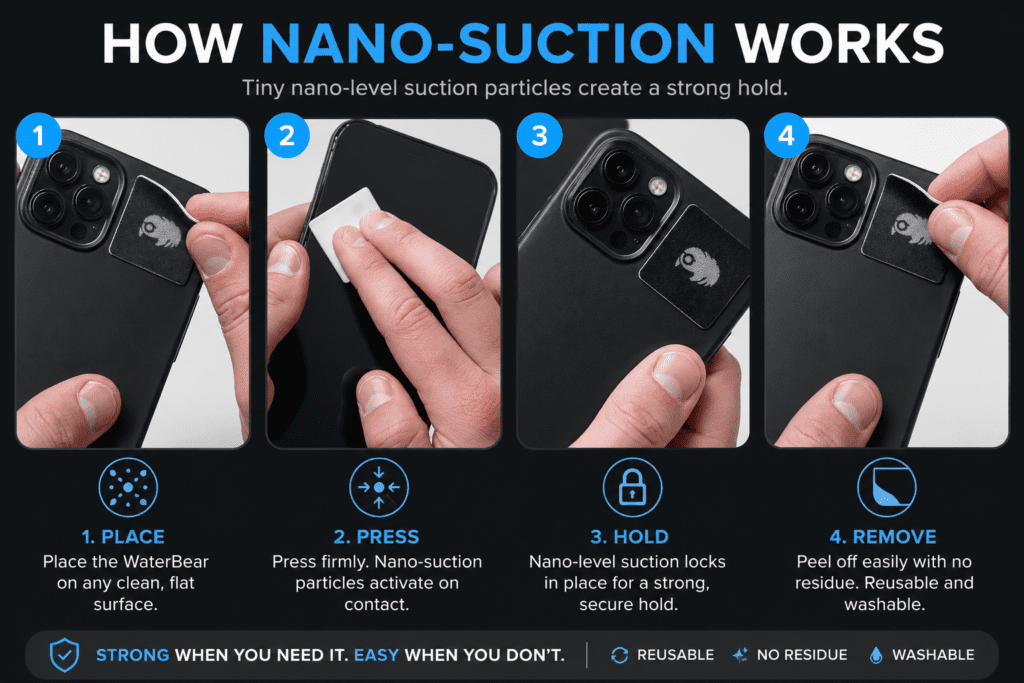
Using the WaterBear is incredibly intuitive:
- Peel: Simply peel the WaterBear off the back of your device.
- Wipe: Use the soft side to gently buff away fingerprints, smudges, and dust from your screen.
- Stick: Press the nano-suction side back onto a flat, smooth area of your device or case.
- Wash (When Needed): If the pad loses stickiness, run it under cold water, rub a tiny drop of dish soap on the back, rinse, and air-dry. The suction returns immediately.
Do the brand’s claims hold up?
The offer page makes a handful of claims. Audited against how carbon cleaning actually works, they mostly hold, with the marketing turned up.
Claim: it cleans screens and lenses streak-free. Supported. Carbon cleaning genuinely lifts oils and leaves a clear, streak-free finish, better than a dry cloth on greasy smudges. This is the real, working core of the product.
Claim: it uses “the same technology as NASA.” Hype. This is marketing. Carbon and microfiber cleaning materials are widely used and effective, but “NASA technology” is a framing device, not a meaningful spec. The material works; the space-agency branding adds nothing you can verify.
Claim: reusable and washable without losing stickiness. Largely supported. The carbon pad is reusable, and rinsing refreshes it, which is how carbon cleaners work. The silicone adhesive is designed to re-stick many times. Over long-term heavy use, any adhesive and any cleaning pad wear, and the lifetime warranty exists to cover that, so treat “forever” as covered-by-warranty rather than literally permanent.
Claim: will never scratch. Reasonable, with normal care. Carbon microfiber is gentle and unlikely to scratch a screen or lens in normal use. As with any cleaner, grit trapped on the surface is what scratches, so brushing off loose debris first is sensible regardless of the cleaner.
Claim: antimicrobial. Minor and plausible. An antimicrobial treatment on the pad is plausible and a minor nice-to-have; it is not a health feature to buy the product for.
The pattern is a genuinely functional cleaner with the volume of the marketing turned to maximum. Nothing is fake; the NASA and “forever” language just oversells an honest little tool.
How does it compare?
Anyone weighing a waterbear alternative is choosing how to keep screens clean. Here it is on the attributes that differ.
| Option | Typical price | Cleans oils streak-free | Always with you | Reusable | Best for |
|---|---|---|---|---|---|
| WaterBear | ~$15-20 (set) | Yes (carbon) | Yes (sticks to device) | Yes, washable | Convenience + oily smudges |
| Peeps eyeglass cleaner | ~$15-20 | Yes (carbon) | No (carry it) | Yes | Glasses specialists |
| Microfiber cloth | ~$2-5 | Partly (smears oils dry) | If you carry it | Yes, washable | Cheap everyday cleaning |
| Screen wipes (wet) | ~$5-10 pack | Yes | Bulky to carry | No (disposable) | Disinfecting, one-time |
The comparison frames the grade. Against a plain microfiber cloth, the WaterBear wins on two real points: it cleans oily smudges streak-free where a dry cloth smears them, and it is always attached so you actually have it. It loses on price by a wide margin, because a cloth costs a couple of dollars. Against Peeps, the established carbon cleaner, it is functionally similar; WaterBear’s edge is the stick-on convenience, Peeps’ is a longer track record. The honest read of waterbear vs peeps is that they clean about the same, and the choice is format and price. Against wet wipes, the WaterBear is reusable and non-disposable, but wipes disinfect where carbon does not.
What do owners report?
Sourcing note: no one at Ossaward has used a WaterBear. This section is aggregated from published owner reviews, the maker’s materials and the Kickstarter history, gathered on 30 July 2026. Where a pattern is thin, we say so.
Owner sentiment is broadly positive and practical. The recurring praise is convenience, that it is always stuck to the phone so it gets used, and effectiveness on greasy smudges and glasses. The reservations are value, that it is a premium for a small cleaning pad, and occasional notes that the adhesive picks up lint or loses some grip over time, which the lifetime warranty is meant to address. The waterbear reviews and complaints corpus also carries the usual funnel frictions around pricing. Nothing contradicts the picture: a genuinely useful, convenient cleaner whose main weakness is price relative to a cloth.
What works and what does not
| What works | What frustrates |
|---|---|
| Cleans oily smudges streak-free. Carbon lifts oils a dry cloth just smears. | Premium price for a small pad. A microfiber cloth costs a couple of dollars. |
| Always attached to your device. You actually have it when you need it. | “NASA technology” is hype. Real material, oversold framing. |
| Reusable and washable. Rinse to refresh; lifetime warranty. | Adhesive can pick up lint. May need occasional cleaning of the sticky back. |
| Works on screens, lenses and glasses. Genuinely multi-surface. | Does not disinfect. Carbon cleans oils, not germs; wipes do that. |
| Gentle, low scratch risk. Fine for screens and coated lenses with care. | Grip can fade over long use. Warranty covers replacement. |
What does it cost, and is it worth it?
Whether the waterbear price is worth it comes down to how much you value the convenience. There is no consumable, so the purchase is the whole cost, and at a set price in the mid-teens to twenties it is a real premium over a microfiber cloth. What that premium buys is genuine: streak-free oil removal and a cleaner that is always attached and therefore actually used. If you clean screens and glasses constantly and a smeary cloth annoys you, that convenience is worth a modest premium. If you just wipe your phone occasionally, a two-dollar cloth does the job. For the wider set of everyday gadgets we have graded, see the other everyday gadgets we have graded. The honest value verdict: good value if you will use it daily and want the carbon edge, poor value if a cloth would satisfy you.
Check the current WaterBear total →
Who should buy it, and who should skip it?
Buy it if you clean phone screens, glasses or camera lenses often, you want a cleaner that is always attached and streak-free on oils, and you accept a premium over a cloth for that convenience.
Skip it if you only wipe your screen occasionally and a microfiber cloth would do, you are put off paying a premium for a small pad, or you specifically want to disinfect, where a wet wipe is the right tool.
Frequently asked questions
Does the WaterBear really work?
Is the WaterBear worth it?
How does the WaterBear clean screens?
Is the WaterBear reusable?
Is the WaterBear a scam?
Does the WaterBear scratch screens?
Can you use the WaterBear on glasses?
How is the WaterBear different from a microfiber cloth?
How do you clean a WaterBear?
Is the WaterBear antimicrobial?
The verdict
The WaterBear earns a B minus.
Give it credit where due. Carbon screen cleaning is a real, effective technology, and the WaterBear delivers it in a genuinely clever format: a small pad stuck to your device so it is always there and streak-free on the oily smudges a dry cloth just smears. For someone who cleans phones, glasses and lenses constantly, that convenience is real and the results are good, which is why owners like it.
The grade is held below the top by value and marketing rather than function. It is a premium price for a small cleaning pad, and a microfiber cloth does most of the everyday job for a couple of dollars, while the established Peeps cleaner matches its carbon performance. The “NASA technology” and “forever” framing oversells an honest, ordinary material. None of that makes it a bad buy; it makes it a good little product you should buy for the convenience and the oil-lifting edge, not because it does something magical.
Buy it if you clean screens and glasses often and want an always-attached, streak-free cleaner.
Skip it if a cheap cloth would satisfy you or you want to disinfect rather than de-smudge.
Where to buy it
The WaterBear sells through its direct offer page, with a lifetime warranty and a “50% off” headline, so read the actual price at checkout. If you buy it, pick the sizes that match your devices, rinse the pad to keep it working, and set expectations to “convenient carbon cleaner,” not the NASA framing. If you just want cheap, a microfiber cloth does the basics; if you clean glasses a lot, this or Peeps is the better tool.
Check the current WaterBear price →
If you buy through that link we earn a commission. It costs you nothing extra, and it did not shape the B minus grade, the “NASA is hype” finding, or the note that a cloth covers the basics.