






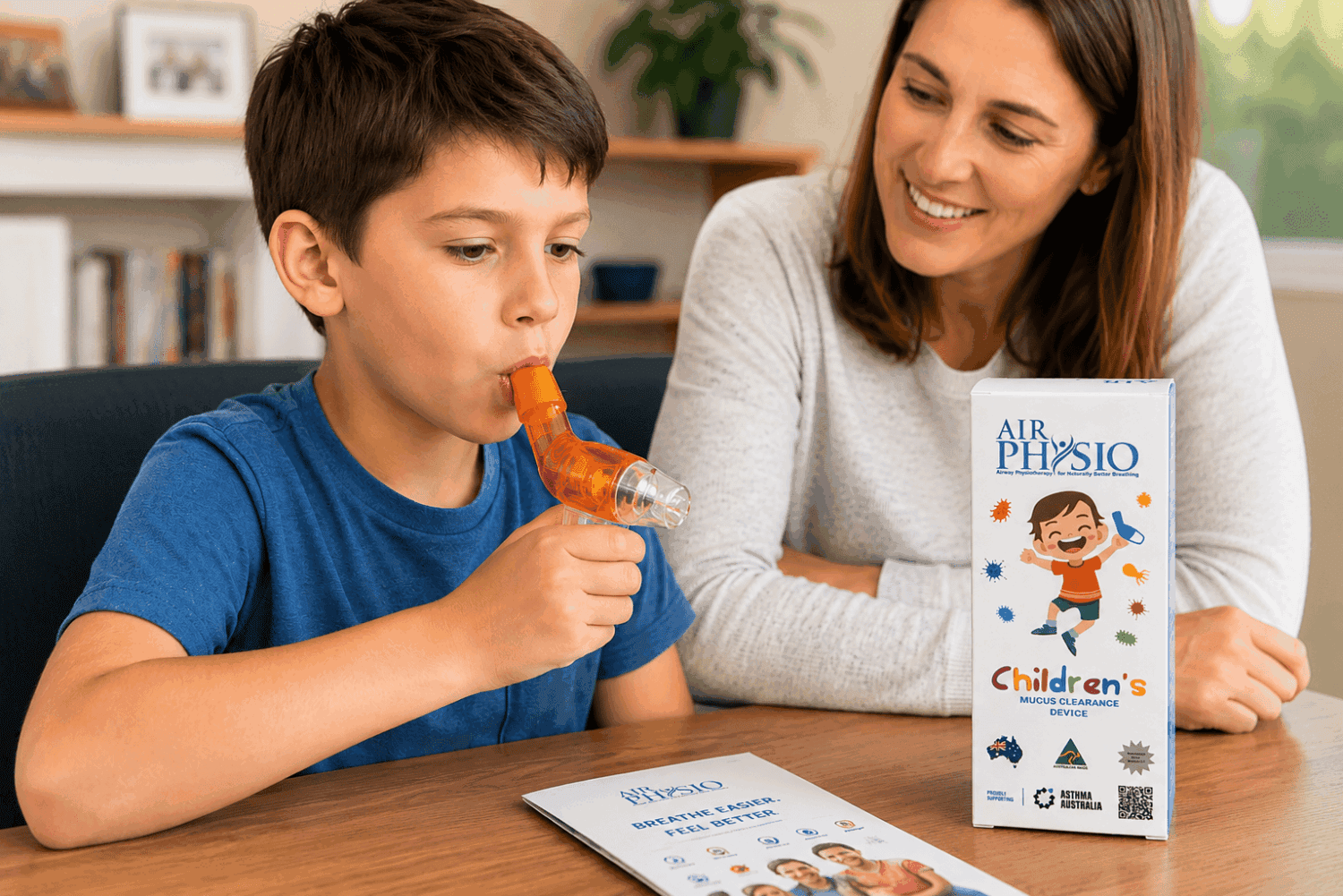
Your child had a cold two weeks ago and the cough has hung on, chesty and rattly, the kind where you can hear the mucus they cannot quite clear. That is the moment parents look at a device like AirPhysio for Children and wonder whether it helps, and whether it is safe. The reassuring part is that the therapy behind it is real: this is a child-tuned version of an oscillating positive expiratory pressure device, and OPEP is an established, evidence-based way to help loosen and clear mucus that clinicians use in respiratory care. So the honest answer to whether it works, for appropriate children, is yes.
The equally honest part is that a child is not a small adult, so this review foregrounds the caveats parents actually need: it should be used with adult supervision, your pediatrician should be in the loop, especially if your child has asthma, and it supplements rather than replaces any prescribed treatment. Judged with those front and center, it is a genuinely useful device that earns a strong grade.
Quick Verdict
AirPhysio for Children is a scientifically grounded OPEP (Oscillating Positive Expiratory Pressure) device that can genuinely help children aged 4 and up clear mucus and breathe more easily. The underlying therapy is clinically recognized and validated by independent research. Most parents and children notice real improvement in breathing comfort with consistent use.
But it’s not a cure. It works alongside — not instead of — prescribed inhalers and medical treatment. And there are a few purchasing caveats you should know.
Best for: Children aged 4–12 with asthma, recurrent bronchitis, or chronic mucus issues who need a drug-free complement to their respiratory care
Rating: 4.1 / 5
| ✅ Pros | ❌ Cons |
|---|---|
| OPEP technology is clinically backed | 30-day guarantee only (not 90) |
| Drug-free, battery-free, no prescription | Customer pays return shipping |
| Validated by Griffith University study | Durability complaints (cracking) |
| Simple for children to use | Some units have weak ball bearing vibration |
| Portable — fits in a pocket or school bag | Higher-priced than generic OPEP alternatives |
| Backed by Asthma Australia partnership | Not a replacement for prescribed medications |
| 3,900+ 5-star reviews (brand claim) | Results take consistent use over weeks |
Bottom line: If your child has asthma, bronchitis, or frequent mucus congestion and you want a proven, drug-free tool to complement their treatment plan, AirPhysio for Children is worth serious consideration. Just go in with realistic expectations and verify it’s appropriate with your pediatrician first.
Check the current AirPhysio for Children price →
Product Overview Table
| Detail | Information |
|---|---|
| Product | AirPhysio for Children (OPEP device) |
| Manufacturer | AirPhysio Pty Ltd, Australia |
| Mechanism | Oscillating Positive Expiratory Pressure (OPEP) |
| Age Range | 4 years and up (under adult supervision) |
| Conditions Targeted | Asthma, bronchitis, colds/flu, cystic fibrosis, low lung capacity |
| Session Time | 5 minutes, 1–2 times per day |
| Batteries Required | None |
| Prescription Required | None |
| Price (single unit) | ~$59.99 |
| Price (3-pack) | ~$199.90 |
| Guarantee | 30-day satisfaction (customer pays return shipping) |
| Where to Buy | Official AirPhysio website or getairphysiokids.io |
| Made In | Australia |
| Clinical Backing | Griffith University validation study; PubMed OPEP research |
What AirPhysio for Children is
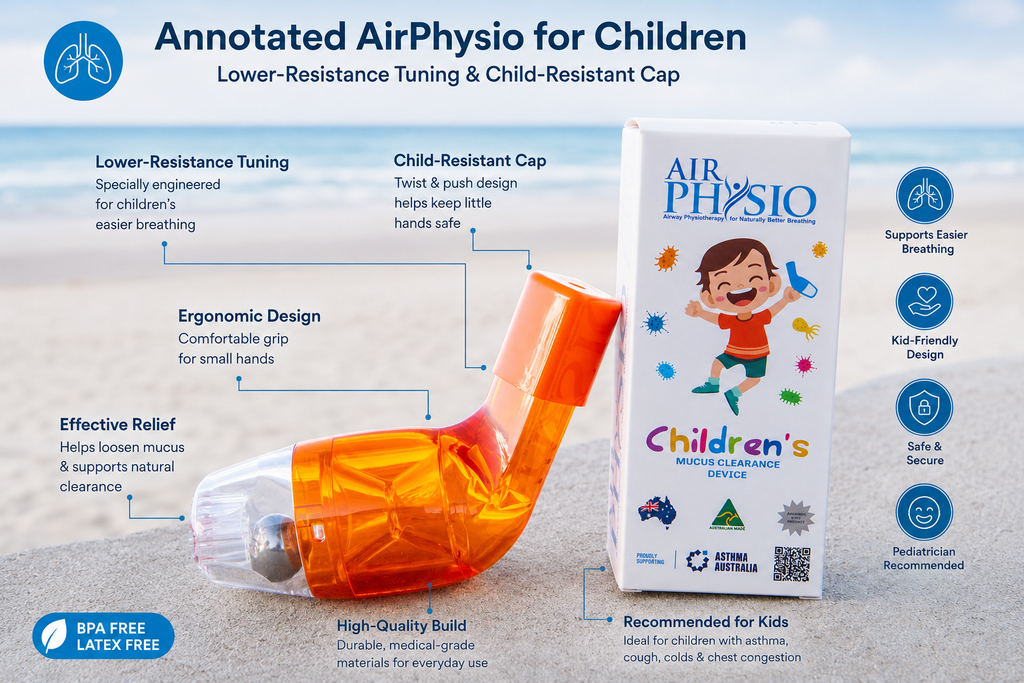
AirPhysio for Children is a airphysio for kids version of the popular OPEP device, tuned for smaller lungs: the child exhales through it, an internal steel ball creates gentle oscillating pressure and vibration, and that helps loosen mucus from the airways so it can be cleared by coughing. As a opep device for children it uses lower resistance suited to a child’s breath and adds a child-resistant cap so the device cannot easily be taken apart. It is intended to help with mucus clearance and lung expansion during recovery from colds and flu, and with asthma-related mucus buildup. As a child mucus clearance device it is drug-free and battery-free.
The technology behind it is called OPEP – Oscillating Positive Expiratory Pressure. It’s not a gimmick. OPEP therapy has been used in clinical respiratory physiotherapy for decades, typically with devices called the Flutter, the Acapella, and the Aerobika. AirPhysio is an at-home, consumer-friendly version of the same principle.
The children’s version is scaled down in size for small hands and designed with lower airflow resistance – appropriate for children’s lung capacity. It’s specifically aimed at children aged 4 and older.
The honest framing: this is a legitimate, child-appropriate version of a real therapy, not a gimmick. Its core function is credible, and the review’s job is to weigh that against the pediatric caveats that matter to a parent.
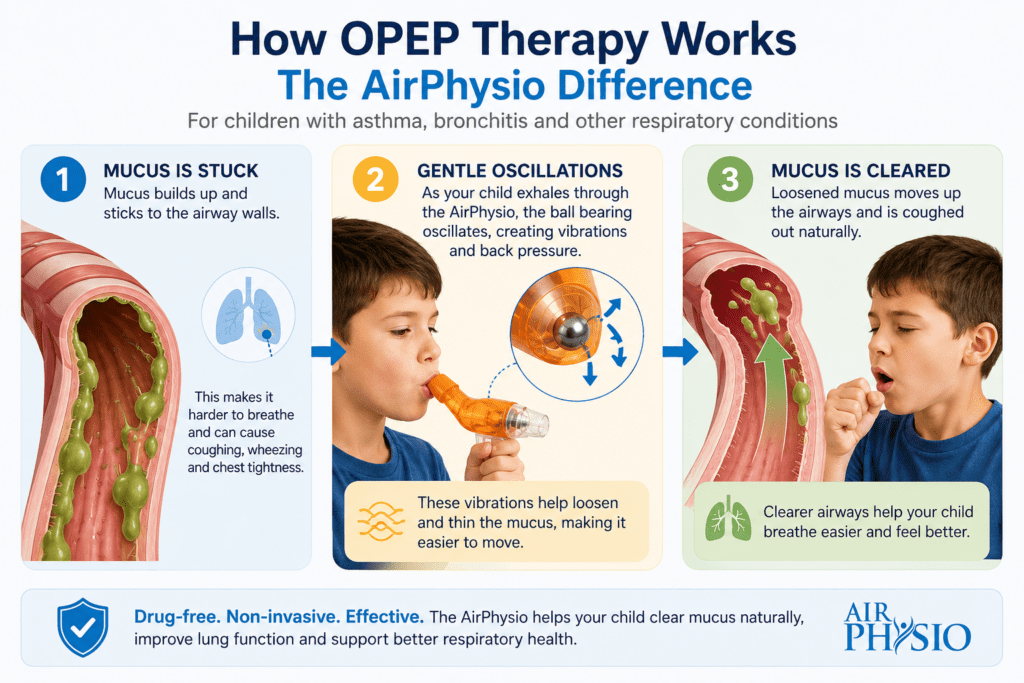
Inside the device is a steel ball bearing. When your child exhales through the mouthpiece, the ball oscillates, creating gentle pulses of pressure. Those pulses travel into the airways, loosening mucus that’s stuck to the airway walls. Once loosened, the mucus can be coughed out cleanly and productively.
This is the same physiological process that respiratory physiotherapists use when doing manual chest physiotherapy – just packaged in a device your child can use themselves at home.
Does it actually work?
For its purpose, yes. Because OPEP is a recognised airway-clearance technique, the child device genuinely helps loosen and clear mucus for kids who produce it, and parents commonly report it helps a child bring up a lingering chesty cough after a cold. The lower resistance means a child can generate the oscillation their smaller lungs need, which is what makes the child version, rather than the adult one, the right tool. So does airphysio for children work? For clearing mucus in appropriate kids, it does, and that aligns with how the therapy is meant to work.
The honest boundary is the same as for adults: it clears mucus, it does not treat the underlying condition. It will not cure a cold, and it is not a treatment for asthma itself, only an aid to clearing the mucus that conditions and infections leave behind, used within proper care.
Is it safe for a child?
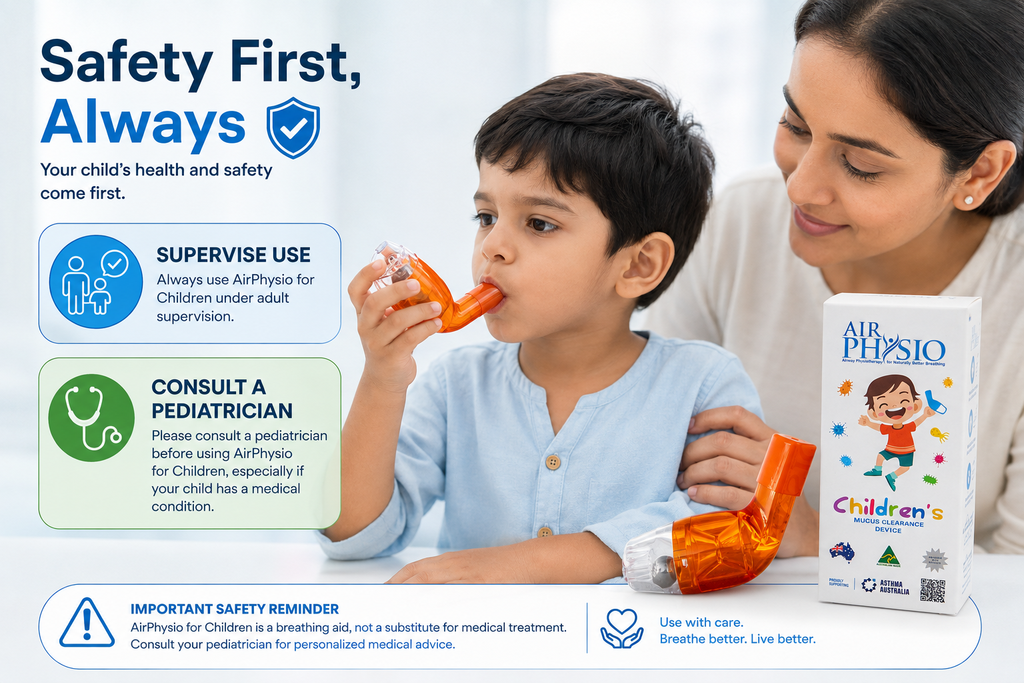
This is the question parents ask first, and it deserves a careful answer. Used correctly by a suitable child, is airphysio for children safe? Broadly yes, as a drug-free device with a child-resistant cap and lower resistance designed for kids, but with real conditions. It should be used with adult supervision, both to ensure correct technique and for safety. Because it involves forced, positive-pressure breathing, a pediatrician should be consulted before use, especially for a child with asthma or any respiratory or other health condition, as such conditions can carry contraindications. And critically, it is not a substitute for medical care: if a child is genuinely unwell, wheezing badly, or struggling to breathe, that is a reason to seek medical help, not to reach for a device. Safe, for the right child, with supervision and a doctor’s awareness.
What age is it for?
Age-appropriateness is central, because a device like this only works if the child can use it correctly. The airphysio children age guidance varies across sources and the maker’s listing, generally covering school-age children rather than infants or toddlers, so a young child who cannot follow the breathe-out instructions or who might misuse it is not a candidate. Check the maker’s current stated age range and, more importantly, judge whether your specific child can use it properly and safely, ideally with your pediatrician’s input. It is a tool for a child old enough to cooperate with it, not for the very young.
Can it help with asthma?
Carefully, and only as an adjunct. For a child with asthma-related mucus buildup, OPEP clearance can be a helpful part of management, and the device is marketed for exactly that. But asthma is a medical condition managed with prescribed medication and a care plan, and this device does not replace inhalers, preventers or your pediatrician’s guidance. For a child with asthma, airphysio for children asthma use should be discussed with and guided by their doctor, fitting into their asthma plan rather than substituting for it. Used that way it can help; used instead of prescribed care, it is a mistake.
Who is it for?
AirPhysio for Children is aimed at children who deal with:
- Asthma (one of the most common childhood chronic conditions)
- Recurrent bronchitis or chest infections
- Colds and flu with heavy chest congestion
- Cystic fibrosis (as a supplemental airway clearance tool)
- Generally low lung capacity
It is also marketed for children who participate in sports and want to build lung endurance — though the primary use case is respiratory health, not athletic performance enhancement.
How OPEP Therapy Works – The Science Parents Should Know
Before trusting any device with your child’s lungs, you deserve to understand the science.
The Problem: Mucus Accumulation
The lungs naturally produce mucus every day. In healthy lungs, tiny hair-like structures called cilia sweep mucus upward and out. But in children with asthma, bronchitis, or cystic fibrosis, excess mucus builds up faster than the cilia can clear it. Airways become partially blocked. Breathing becomes harder. Infections become more frequent.
The OPEP Solution
Oscillating Positive Expiratory Pressure works on two levels simultaneously:
Level 1 — Pressure. When your child exhales against resistance (the ball bearing), positive pressure builds up behind the mucus. This pressure gently pushes mucus away from the airway walls, where it’s been sticking.
Level 2 — Oscillation. The ball bearing doesn’t just create pressure — it oscillates (vibrates) as air flows over it. These vibrations travel back through the airways. The vibration frequency helps shake mucus loose from the walls at a level no cough alone can reach.
Together, the pressure and vibration make mucus mobile. Once mobile, a productive cough can clear it completely.
Over time, repeated exhalation against resistance also strengthens the muscles of the respiratory system — similar to how any resistance exercise strengthens muscles.
What the Research Says
AirPhysio references four pieces of evidence on its product page:
- Griffith University Validation Study — An independent Australian academic study that validated the device’s OPEP mechanism. This is the most directly relevant study for AirPhysio specifically.
- PubMed Clinical Study on OPEP Effectiveness — Peer-reviewed research confirming OPEP therapy’s effectiveness for mucus clearance in patients with obstructive lung disease.
- European Respiratory Journal — OPEP for COPD — Research on OPEP therapy effectiveness in a related (adult) population.
- IP Australia Patent — Confirms the device’s patented design, not a clinical study but evidence of a unique, registered mechanism.
Honest assessment of the science: OPEP as a therapy is well-established and clinically credible. The AirPhysio device’s specific mechanism has been independently validated. However, the large-scale randomized controlled trials specifically on children using this exact device are limited. The evidence base is solid at the therapy level; the device-specific pediatric evidence is promising but still growing.
Key Features and Benefits
1. No Batteries, No Medication, No Prescription
This is the feature that matters most to busy parents.
You don’t need to remember to charge it. You don’t need a prescription. You don’t need to refill it. AirPhysio works purely through mechanics — a steel ball bearing, a sealed chamber, and your child’s breath.
In practical terms, that means it’s always ready. Take it to school. Take it on holiday. Slip it in a jacket pocket. There’s nothing to run out of.
2. Takes Only 5 Minutes Per Session
The recommended protocol is 5 minutes of use, 1–2 times daily.
That’s achievable even for restless children. Most parents build it into the morning routine (before school) or the evening (before bed). Some children with asthma find the evening session especially helpful for clearing accumulated daytime mucus before sleep.
3. Two Resistance Options
The children’s version comes with interchangeable ball bearings:
- Average lung capacity ball bearing — for children with mild respiratory conditions (mild asthma, occasional bronchitis)
- Low lung capacity ball bearing — for children with more significant respiratory muscle weakness, severe asthma, or conditions like cystic fibrosis
Starting with the low-resistance bearing and working up as lung capacity improves is generally the recommended approach for beginners.
4. Designed for Small Hands
The children’s model is noticeably smaller than the adult AirPhysio. A child aged 4–5 can hold and use it without adult assistance, which builds independence and makes the routine sustainable.
5. Drug-Free
This is the headline benefit for many parents.
Long-term steroid inhaler use in children raises legitimate questions — about growth, about bone density, about the impact on a developing immune system. Parents naturally want to minimize medication where safely possible.
AirPhysio doesn’t replace prescribed medications. But used consistently, it may reduce the frequency of severe mucus episodes — and with fewer blockage events, some children find they need their rescue inhaler less often. One Trustpilot reviewer noted their use of a medicated inhaler was completely eliminated after consistent AirPhysio use — though this is an individual result and should not be treated as guaranteed or typical.
6. Portable and Discreet
The device is roughly the size of a small inhaler. Children don’t feel self-conscious using it. Several parents on Trustpilot mention their children proactively use it at school without prompting, which is the highest praise a compliance-dependent device can receive.
How to Use AirPhysio For Children – Step-by-Step
Using AirPhysio correctly matters. Incorrect technique produces weaker results.
Before starting:
- Your child should be sitting upright or standing
- Remove the protective cap from the mouthpiece
- Attach the correct ball bearing for your child’s lung capacity
Step 1: Have your child take a slow, deep breath in through their nose. Hold for 2–3 seconds.
Step 2: Seal their lips around the mouthpiece and breathe out slowly and steadily through the device. Aim for 3–5 seconds of even exhalation. They should feel a slight vibration or resistance.
Step 3: When the urge to cough arises, let them cough productively. This is the mucus clearing.
Step 4: Repeat this cycle 5–10 times per session. One complete session takes about 5 minutes.
After the session:
- Disassemble the device (it comes apart into a few simple pieces)
- Rinse with warm soapy water
- Allow all parts to air dry completely before reassembling
- Do not use a dishwasher
Parent supervision notes: Young children (especially ages 4–6) should be supervised during every session. Check that they’re sealing their lips properly and breathing steadily — not too fast, not too slow. Rushing through the exhalation reduces the oscillation effect.
Real-World Performance: What Parents Report
AirPhysio Pty Ltd has accumulated over 7,190 reviews on Trustpilot with a strong overall average. Here’s an honest synthesis of the most common feedback patterns.
What Parents and Children Love
Immediate sensation: Most children feel the vibration on their very first use, which creates immediate buy-in. Children who feel something happening are more likely to keep using the device consistently.
Productive coughing: The most commonly praised outcome is the quality of coughing after a session. Parents describe it as “real” coughing — the kind that actually brings mucus up — rather than the irritating, unproductive dry cough typical of mucus buildup.
Better sleep: Multiple Trustpilot reviewers mention that children sleep more peacefully after an evening AirPhysio session, with less waking from coughing or congestion.
Sports performance: Older children (8–12) who are active in sports report feeling less winded. The lung strengthening effect, while gradual, is real.
One parent’s experience (Trustpilot, verified): The AirPhysio team’s response to one review specifically mentioned helping “your son breathe easier as he navigates asthma” — confirming real pediatric use cases in their review base.
What Parents Complain About
Durability issues: This is the most significant recurring complaint in verified Trustpilot reviews. One verified buyer reported that two out of three devices purchased in October 2025 had cracked where the top joins the arm by February 2026 — just 4 months later. The plastic housing, despite looking and feeling solid, may not hold up to the daily drop-and-go use of active children.
Inconsistent vibration on some units: A minority of reviewers report that the ball bearing doesn’t vibrate properly — either too little resistance or inconsistent oscillation. One reviewer noted that a cheaper Chinese OPEP device actually produced stronger vibration. This appears to be a quality control issue rather than a design flaw.
Return shipping cost: The 30-day guarantee requires customers to pay their own return shipping. For international customers especially, this adds a meaningful cost to a dissatisfied return.
No instruction pamphlet in some boxes: Multiple Trustpilot reviewers report receiving the device without an instruction booklet. AirPhysio customer service directs users to their website for the user guide. This is a minor but avoidable frustration, especially for non-tech-savvy parents.
Shipping delays: Some customers using DHL for international shipping report significant delays. AirPhysio’s policy requires contacting the carrier first before issuing refunds or re-ships, which can extend resolution time.
Pros and Cons (Honest and Balanced)
✅ Real Pros
- Clinically validated mechanism — OPEP therapy has strong published research behind it
- Griffith University independent validation — specifically validates the AirPhysio device’s design
- Drug-free — no steroids, chemicals, or toxins
- Completely passive — no batteries, no electricity, no subscriptions, no refills
- Size-appropriate for children — smaller form factor than adult devices
- Portable — fits in a pocket, works anywhere
- High compliance — children actually use it because they feel it working
- Recognized by Asthma Australia — credible organizational endorsement
- Genuine mucus clearance effect — most users report real results
- Durable enough for most users — quality concerns exist but are a minority experience
❌ Real Cons
- 30-day guarantee only — some competitors offer 60–90 days
- Customer pays return shipping — not prominently disclosed at purchase
- Durability complaints — cracking reported on some units after 3–4 months
- Inconsistent vibration on some units — quality control concerns
- No instruction booklet in some boxes
- Price premium vs. generic OPEP alternatives — cheaper options exist
- Not a medical device — FDA has not evaluated it for disease treatment
- Not a replacement for inhalers — must be used alongside prescribed treatment
- Age 4+ recommended — limited use for very young children
The value and how it compares
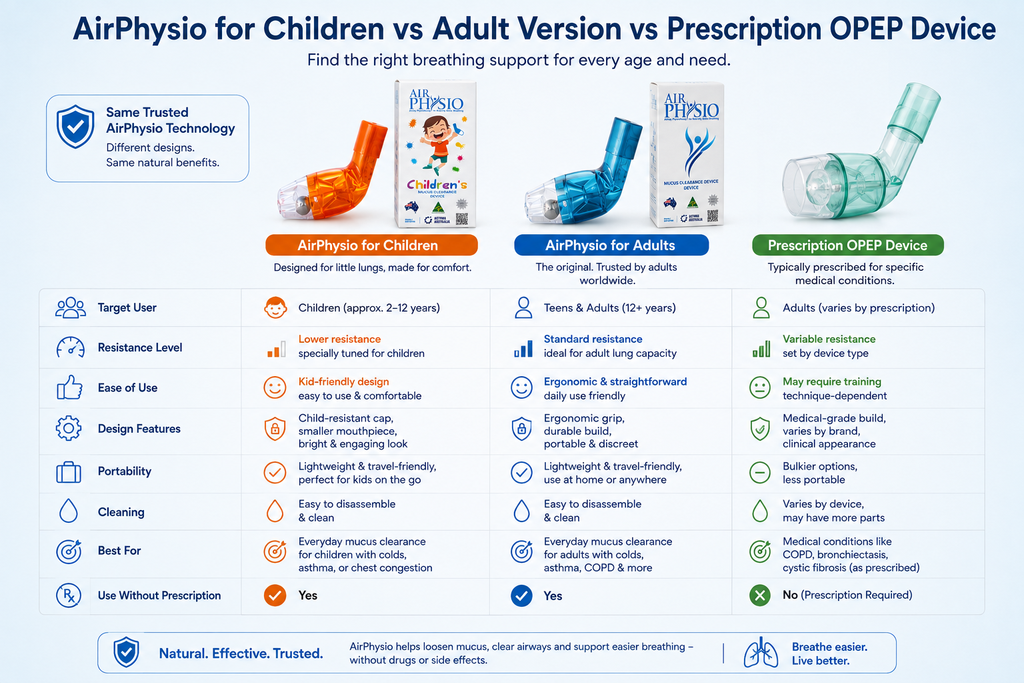
The price is modest for what it is, and the value depends on need. For a child who genuinely gets mucus-clearing benefit, it is a reasonable, drug-free addition to their routine. Anyone considering a airphysio children alternative should weigh the options.
| Option | Rough cost | Evidence | Access | Notes |
|---|---|---|---|---|
| AirPhysio for Children | modest | OPEP, evidence-based | Over the counter | Child-tuned; drug-free; supervise |
| Adult AirPhysio | modest | Same therapy | Over the counter | Higher resistance; not for small lungs |
| Prescription pediatric OPEP | varies | Clinically established | Via doctor | May be covered; clinician-guided |
| Nebulizer / prescribed care | prescribed | Treats the condition | Prescribed | Different job; treats, not just clears |
| Chest physiotherapy | varies | Established technique | Taught by clinician | Hands-on clearance, no device |
The comparison sets the grade. The honest read of airphysio for children vs adult is that the child version’s lower resistance makes it the correct choice for a young child, not the adult one. Against a prescription pediatric OPEP device, the clinical route may be covered and doctor-guided, worth asking about. A nebulizer or medication does a different job, treating the condition, and chest physiotherapy is a hands-on clearance technique a clinician can teach. AirPhysio for Children competes as an accessible, child-appropriate clearance aid within proper care, not as a replacement for it.
User Reviews and Community Feedback
Trustpilot (7,190+ Reviews Across AirPhysio Pty Ltd)
The overall rating is strong. Positive reviews frequently mention:
- Immediate sensation during first use
- Reduced frequency of chest infections
- Children using the device independently without prompting
- Improvement in athletic breathing endurance
Critical reviews cluster around:
- Hardware cracking (upper housing/arm joint)
- Variable vibration quality between units
- Return process complications and shipping delays
- Price vs. alternatives comparison
Amazon Feedback Patterns
AirPhysio appears on Amazon primarily through third-party sellers. Verified purchase reviews show similar patterns to Trustpilot — majority positive with specific concerns about durability and the occasional unit that doesn’t vibrate properly.
Reddit Insights
Parent communities on r/Parenting, r/Asthma, and r/CysticFibrosis mention AirPhysio occasionally. General sentiment:
- Parents who bought it for asthmatic children are mostly positive
- Respiratory therapists in these communities note that clinical OPEP devices (Acapella, Flutter) are equivalent and sometimes cheaper
- No widespread scam accusations or systemic complaints
- Some skepticism about whether the premium price over generic OPEP devices is justified
YouTube Reviews
The YouTube review landscape for the children’s version is sparse. Adult AirPhysio reviews are more common. Most video reviewers are positive but lack clinical expertise. The best YouTube references come from respiratory physiotherapists discussing OPEP therapy generally, not AirPhysio specifically.
Pricing and Value Analysis
Current Pricing (Official Site)
- Single unit: ~$59.99
- 3-pack bundle: ~$199.90
- Shipping: Free on qualifying US orders; international shipping extra
Is It Worth the Price?
Yes, with caveats.
At $60, AirPhysio for Children is priced in the middle of the OPEP device market. The Acapella Choice (a clinical-grade alternative) costs around $40–$45. Generic OPEP devices on Amazon can cost as little as $15–$25.
What you pay for with AirPhysio:
- Australian manufacturing and quality control (mostly — with the noted exceptions)
- Child-specific sizing and design
- The brand’s customer support infrastructure
- The Griffith University validation
- Asthma Australia endorsement
If your child’s respiratory therapist or pediatrician has recommended a specific clinical OPEP device, follow that recommendation — it may be covered by insurance or available through your medical provider. If you’re looking for an at-home option without clinical prescription, AirPhysio is a credible, well-supported choice.
One-time cost vs. ongoing medication: A single AirPhysio unit at $60 is a one-time purchase with no ongoing costs. Compare this to the cumulative cost of monthly inhaler prescriptions. For many families, this represents genuine long-term value if it reduces reliance on rescue medications.

What works and what does not
| What works | What frustrates |
|---|---|
| Real, evidence-based OPEP therapy. Genuinely helps clear mucus. | Not a replacement for care. (Serious.) Supplements prescribed treatment. |
| Child-tuned. Lower resistance for small lungs; child-resistant cap. | Needs supervision and a pediatrician. (Safety.) Not a hands-off device. |
| Drug-free and simple. No medication or batteries. | Not for the very young. Child must use it correctly. |
| Helpful for post-cold coughs and asthma mucus. Real aid. | Does not treat the condition. Clears mucus only. |
| Modest price. Reasonable for the benefit. | Coaching needed. A child must learn the technique. |
Deciding as a parent
Whether is airphysio for children worth it comes down to your child and your doctor. For a school-age child who can use it, who gets mucus-clearing benefit after colds or with asthma-related buildup, and whose pediatrician is on board, yes, it is worth it as a drug-free aid used with supervision. For a child too young to use it correctly, or if you are hoping it will replace prescribed asthma care or fix a cold, no. For the other wellness devices we have graded on the evidence, see the other wellness devices we have graded. The honest value verdict: genuinely worthwhile for the right child, within proper medical care and with a grown-up guiding its use.
Check the current AirPhysio for Children price →
Who Should (and Shouldn’t) Buy AirPhysio For Children
✅ Ideal for:
- Children aged 4–12 with diagnosed mild-to-moderate asthma
- Children who get frequent chest infections or bronchitis
- Children recovering from colds and flu with stubborn chest congestion
- Children with cystic fibrosis (as a supplemental home tool between therapist sessions)
- Parents seeking a drug-free complement to their child’s existing respiratory treatment plan
- Active children whose breathing endurance is limited by mucus accumulation
- Families without easy access to respiratory physiotherapy appointments
❌ Not appropriate for:
- Children under 4 years old (insufficient lung control for proper use)
- Children with untreated pneumothorax (collapsed lung)
- Children with active tuberculosis
- Children who have had recent esophageal surgery
- Children with right-sided heart failure
- Children with tympanic membrane (eardrum) perforation
- Any child without a pediatrician’s awareness of the therapy
- Parents expecting the device to replace prescribed inhalers or nebulizers
Frequently Asked Question
What age can children start using AirPhysio?
The manufacturer recommends AirPhysio for Children for ages 4 and up. The child must be able to breathe into the device on instruction and should always be supervised by an adult during sessions.
Does AirPhysio replace inhalers for children with asthma?
No. AirPhysio is a complementary tool for mucus clearance, not a replacement for prescribed inhalers or any medication. Continue all prescribed medications and discuss adding AirPhysio to your child’s routine with their pediatrician.
How long before my child sees results?
Most children feel the vibration and experience some mucus clearance on the very first use. Meaningful improvement in overall breathing comfort typically takes 2–3 weeks of consistent daily use (5 minutes, 1–2 times per day). Full benefits often become apparent after 4–6 weeks.
Is AirPhysio for Children FDA approved?
No. AirPhysio is not classified as an FDA-approved medical device. The brand explicitly states that claims have not been evaluated by the FDA. It is sold as a wellness and breathing aid, not as a medical treatment device.
What is the return policy?
AirPhysio offers a 30-day satisfaction guarantee from the date of delivery. If you’re not satisfied, you can return the device — but you must pay your own return shipping costs. You’ll receive a refund on the device price.
Can I use AirPhysio with a child who has cystic fibrosis?
Some families use AirPhysio as a supplemental tool for CF-related mucus clearance at home. However, cystic fibrosis requires a comprehensive, clinician-directed airway clearance program. Always consult your child’s CF care team before introducing any new airway clearance device.
Does the device make a loud noise?
No. AirPhysio produces a gentle vibration and a mild sound during exhalation — similar to a light humming. It’s quiet enough to use at school or in shared living spaces without drawing attention.
How do I clean AirPhysio for Children?
Disassemble after each use. Rinse all parts in warm soapy water. Rinse thoroughly to remove all soap. Lay flat on a clean surface to air dry completely before reassembling. Do not put it in a dishwasher. The company also sells optional disposable external filters for added hygiene, though these are not required for the device to function.
What’s the difference between AirPhysio for Children and the adult AirPhysio?
The children’s version is smaller (better for small hands), has lower airflow resistance settings appropriate for children’s lung capacity, and comes in a more compact design. The core OPEP mechanism is the same.
Can a child use AirPhysio during an active asthma attack?
No. During an acute asthma attack, the priority is bronchodilator therapy (rescue inhaler). AirPhysio is designed for routine airway maintenance and recovery, not for acute emergency use. Keep prescribed rescue medications on hand and accessible at all times.
Is AirPhysio the same as the Acapella or Flutter device?
They use the same therapy type (OPEP) but are different products. The Acapella and Flutter are clinical-grade devices with adjustable resistance and strong RCT research bases. AirPhysio is a consumer product with a simpler resistance adjustment system and a focus on ease of at-home use. All three devices produce the oscillating positive expiratory pressure effect.
Does AirPhysio help with sport performance in children?
For children whose breathing is compromised by mucus accumulation or reduced lung capacity, clearing airways can improve physical endurance. AirPhysio is not a performance enhancement device for children with healthy lungs, but it can help level the playing field for children whose activity is limited by respiratory conditions.
What should I do if the device doesn’t seem to vibrate?
Ensure the ball bearing is correctly seated. If your child is exhaling too quickly or too slowly, the oscillation reduces. Aim for a slow, steady 3–5 second exhalation. If the problem persists, contact AirPhysio customer support at support@betterbreathingdevices.com.
Is there a warranty against manufacturing defects?
The 30-day guarantee covers satisfaction. For manufacturing defects beyond 30 days, contact AirPhysio’s customer service directly. Based on Trustpilot feedback, the company is responsive but resolution for durability issues (like cracking) can be slow.
Can both children and adults in the same family use the children’s version?
The children’s version is designed for lower lung capacity. Adults with normal lung capacity would find it too low in resistance. Each person should ideally have their own device for hygiene reasons regardless.
The verdict
AirPhysio for Children earns 7.5 out of 10: a genuinely effective, child-tuned OPEP device based on real therapy, held short of the top by the pediatric caveats every parent should keep front and center.
The core is legitimately good. OPEP is established airway-clearance therapy, the children’s version is sensibly tuned with lower resistance for small lungs and a child-resistant cap, and for a school-age child with a lingering chesty cough or asthma-related mucus, it genuinely helps clear phlegm, which parents in that situation report and the evidence supports. As a drug-free aid, it does its job.
The score is held to 7.5 for responsible reasons, not doubts about efficacy. It needs adult supervision and correct technique; a pediatrician should be involved, particularly for a child with asthma; it supplements rather than replaces prescribed care; it is not for children too young to use it properly; and clinical pediatric OPEP options exist. None of that undercuts the device. It places AirPhysio for Children where it belongs, as a genuinely useful clearance aid for the right child, used with supervision and medical guidance, and never as a stand-in for seeking care when a child is truly unwell.
Buy it if your school-age child can use it, benefits from mucus clearance, and your pediatrician is on board.
Skip it if your child is too young, you want it to replace asthma care, or your child needs a doctor rather than a device.
Where to buy it
AirPhysio for Children sells through the official AirPhysio site and retailers. If you buy it, confirm the age guidance and that your child can use it correctly, involve your pediatrician, supervise its use, and treat it as an aid within your child’s respiratory care. If your child has asthma, use it only as part of their doctor-guided plan, and if your child is ever struggling to breathe, seek medical help rather than relying on the device.

If you buy through that link we earn a commission. It costs you nothing extra, and it did not shape the 7.5-out-of-10 score, the supervision and pediatrician framing, or the safety notes.

