






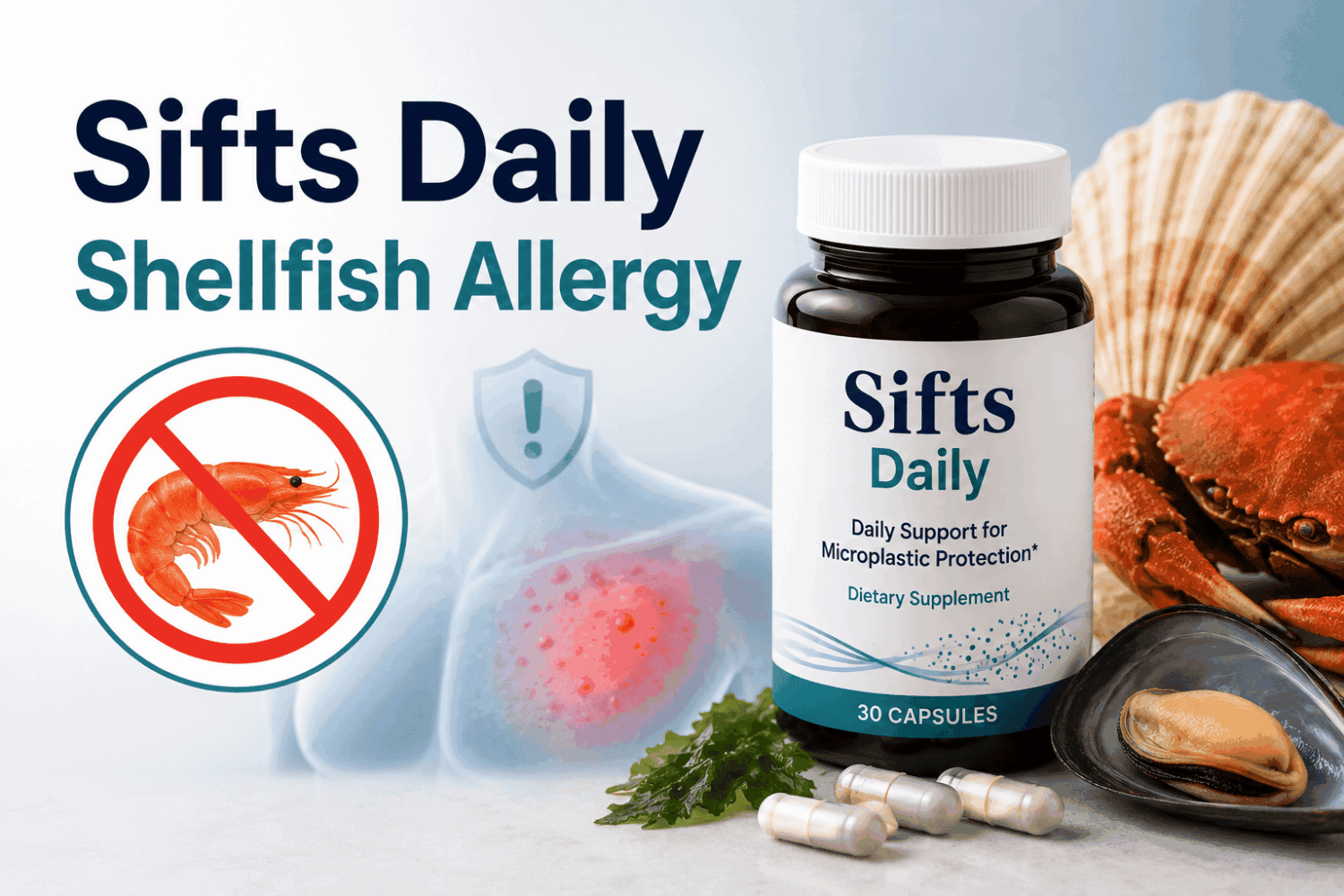
Sifts Daily Shellfish Allergy: The most commonly searched question about Sifts Daily after “does it work?” is “what if I have a shellfish allergy?” The frustration is real. You’ve read about the microplastic research, you understand the mechanism, you want to support your body’s gut-based elimination, and then you hit the chitosan wall.
Chitosan is derived from crustacean shells. Sifts Daily’s entire formulation is built around chitosan. If you have a shellfish allergy, Sifts Daily is not an option, and there is no workaround within this specific product.
But that doesn’t mean you have no options at all. This article covers every meaningful alternative, from the closest chitosan-adjacent approaches to broader gut health strategies to source reduction, and gives you an honest assessment of what each one can and cannot do compared to the evidence for chitosan specifically.
TL;DR
- Chitosan from crustacean shells is the only ingredient with peer-reviewed human evidence for microplastic fecal excretion, no shellfish-free equivalent exists with the same evidence base
- Fungal-derived chitosan exists but lacks equivalent human study evidence and is not widely available in finished consumer supplement form
- Apple pectin (a secondary ingredient in Sifts Daily) is shellfish-free and has mechanistic plausibility for microplastic support, though weaker evidence than chitosan
- General soluble fiber (psyllium husk, inulin, pectin) supports gut transit and microbiome health, providing indirect benefit
- Source reduction (filtered water, no plastic heating, glass storage) is more impactful than any internal supplement for total microplastic burden
- Research on plant-derived fiber types for microplastic binding is ongoing, new options may emerge in the near future
Why Chitosan Cannot Be Used with Shellfish Allergy
Chitosan is produced from chitin, the structural polymer in crustacean shells (shrimp, crab, lobster). Even after the significant chemical processing involved in producing chitosan (deacetylation with sodium hydroxide), shellfish-derived proteins can remain at low concentrations in the final product.
Shellfish allergy is mediated by IgE antibodies that recognize specific allergenic proteins in shellfish. Even trace amounts of these proteins can trigger reactions in highly sensitized individuals. The severity is unpredictable, someone who has had mild reactions previously can have severe anaphylaxis with subsequent exposures.
This makes chitosan from crustacean sources a genuine contraindication for shellfish-allergic individuals, not just a precautionary advisory. There is no dose small enough to be safe for someone with confirmed IgE-mediated shellfish allergy.
Fungal-Derived Chitosan: The Closest Alternative
What It Is
Chitosan can also be derived from fungal sources. The cell walls of certain fungi, including Aspergillus niger (the mold used in citric acid production) and Mucor rouxii, contain chitin that can be processed into chitosan through the same deacetylation chemistry used for crustacean-derived chitosan.
Fungal-derived chitosan is shellfish-free by definition. It is also suitable for vegans and vegetarians, unlike crustacean-derived chitosan.
Why It’s Not a Complete Solution Yet
The evidence gap: All four peer-reviewed studies on chitosan and microplastics (2025-2026) used crustacean-derived chitosan or chitosan without specifying the source. No peer-reviewed human study has specifically tested fungal-derived chitosan for microplastic excretion. The electrostatic binding mechanism is the same in principle (fungal chitosan also has positive charge at physiological pH), but the molecular properties of fungal versus crustacean chitosan differ in ways that may affect binding performance.
The 2026 Journal of Materials Chemistry B study established that the specific molecular weight and degree of deacetylation of chitosan determines its microplastic entrapment efficiency. Fungal chitosan has different molecular weight distributions and degree of deacetylation profiles than crustacean chitosan. Whether commercially available fungal chitosan meets the performance threshold identified in that study is not established.
Availability: Commercial finished supplements using fungal-derived chitosan with transparent molecular weight and deacetylation specifications are not widely available at the time of writing. Several academic sources have characterized fungal chitosan for various applications, but a consumer supplement specifically formulated for microplastic support using fungal chitosan with appropriate molecular specifications does not yet appear to be commercially available.
Safety for shellfish allergy: The safety of fungal chitosan specifically for confirmed shellfish-allergic individuals is not documented in clinical studies. The proteins in fungal cell walls are completely different from crustacean shell proteins, so there is no obvious cross-reactivity mechanism. However, absent specific allergy testing and medical guidance, even fungal chitosan should not be assumed safe for a highly sensitized individual without consultation with an allergist.
Bottom line on fungal chitosan: It is the most likely candidate for a genuinely equivalent shellfish-free alternative as research and commercial development continues. As of 2026, it is not yet a validated consumer supplement option for this specific application.
Apple Pectin: The Best Current Shellfish-Free Option
Apple pectin is one of the secondary ingredients in Sifts Daily, included for its gel-forming properties that create intestinal viscosity to complement chitosan’s electrostatic binding. Used as a standalone supplement, it is shellfish-free and has two relevant properties:
Gel-Formation and Particle Trapping
Apple pectin is a high-DE (degree of esterification) soluble fiber that forms viscous gels in the presence of water. In the gut environment, this gel formation creates increased intestinal viscosity, think of it as making the gut contents more gel-like and sticky, which may physically trap and retain microplastic particles within the fecal mass rather than allowing them to remain freely mobile and in contact with the gut wall.
This is a mechanistically plausible effect, though it is less specific than chitosan’s electrostatic binding. Where chitosan has a specific electrochemical affinity for charged microplastic surfaces, pectin’s gel formation is a more general physical trapping effect that is less selective.
Prebiotic Function
Apple pectin is a highly fermentable prebiotic fiber that selectively stimulates the growth of Bifidobacterium species in the large intestine. A healthy gut microbiome with robust Bifidobacterium populations is associated with better gut barrier integrity, more efficient elimination, and healthier overall digestive function, all of which have indirect relevance to microplastic transit and elimination.
The Evidence Gap
No peer-reviewed study has specifically measured apple pectin’s effect on fecal microplastic excretion in humans or animals. The 2025 animal study that tested four fiber types (Liu and Shimizu) did not include pectin, it tested indigestible dextrin, lactosucrose, eggshell membrane proteins, and chitosan. Apple pectin was not directly compared.
The available evidence for apple pectin is mechanistic and indirect rather than directly experimental. This is a meaningful gap compared to chitosan’s evidence base.
Practical Supplementation
Apple pectin supplements are widely available, inexpensive (typically $15 to $25 per month), shellfish-free, vegan, and well-tolerated. Standard supplement doses of 1 to 3 grams per day provide meaningful prebiotic benefit and contribute to the gel-forming properties in the gut.
For someone with shellfish allergy who wants to do something specific beyond general fiber intake, apple pectin at 1 to 3g per day is the most rationally justified choice based on current evidence.
General Soluble Fiber: Broad Support
The Fiber-Microplastic Connection
The 2025 animal study (Liu and Shimizu) established that chitosan outperforms other dietary fiber types for microplastic excretion. This finding does not mean that general fiber has no role, it means that general fiber’s role is different and smaller in magnitude.
General soluble fiber (psyllium husk, inulin, FOS, various prebiotic blends) supports microplastic management through three indirect mechanisms:
Transit time: Adequate fiber intake supports healthy gut motility and transit speed, reducing the time microplastics spend in contact with the gut wall. Shorter transit time means less opportunity for smaller particles to interact with intestinal epithelial cells.
Microbiome support: Prebiotic fiber feeds beneficial bacteria that support gut barrier integrity. A healthy, diverse gut microbiome is associated with tighter intestinal junctions, which reduces the permeability through which nanoplastics and small microplastics cross into systemic circulation.
Stool volume: Larger stool volume from adequate fiber intake dilutes the concentration of particles per unit volume and may support more complete fecal elimination.
Best Shellfish-Free Fiber Options
Psyllium husk: The most researched general soluble fiber for gut health. High water-binding capacity creates significant stool bulk and slows transit in a way that may allow more complete particle association with the fecal matrix. Available as powder ($10-15/month) or capsules.
Inulin/FOS (fructooligosaccharides): Highly fermentable prebiotics that specifically feed Bifidobacterium species. Available as powders from chicory root ($15-20/month). Particularly relevant for microbiome diversity and gut barrier support.
Beta-glucan: Found in oats and available as a supplement. Gel-forming soluble fiber with strong prebiotic activity. Well-studied for cholesterol reduction; microplastic-specific evidence is not available but the gut health mechanisms are relevant.
Mixed prebiotic fiber blends: Products combining multiple prebiotic fiber types (inulin + pectin + psyllium) may provide more comprehensive support than any single fiber type.
Source Reduction: The Most Impactful Strategy for Shellfish-Allergic Individuals
For someone with shellfish allergy who cannot use chitosan supplementation, the relative importance of source reduction strategies increases substantially. When the internal elimination support option with the best evidence is unavailable, preventing exposure becomes proportionally more important.
The steps with the highest impact:
Filtered Drinking Water (Highest Priority)
Individuals who meet their recommended water intake through only bottled sources may be ingesting an additional 90,000 microplastics annually compared to 4,000 microplastics for those who consume only tap water.
This single change, switching from bottled to quality-filtered tap water, removes more microplastic exposure than any available supplement approach for most people. For shellfish-allergic individuals who cannot use chitosan, this is the single most important action available.
A reverse osmosis filter removes both microplastics and associated chemical contamination (PFAS) from drinking water, addressing the broadest range of water-borne contaminants.
No Plastic Food Heating
Eliminating plastic containers from all food heating removes a high-concentration particle-food transfer pathway. This costs nothing if you already have glass or ceramic containers and is a one-time investment otherwise.
Glass and Stainless Steel Food Storage
Reduces ongoing leaching from containers, particularly for acidic foods and hot food storage.
For the complete 14-step guide to source reduction, see our article on how to reduce microplastic exposure.
The Research Pipeline: What May Be Coming
The plant-derived fiber research on microplastic interaction is an active area. Several recent studies have characterized the microplastic adsorption properties of plant-based materials:
Wheat bran insoluble fiber: A 2026 Journal of Food Chemistry study characterized wheat bran insoluble dietary fiber’s microplastic adsorption properties in simulated intestinal fluid, suggesting physical trapping capability though at lower efficiency than chitosan.
Cellulose nanocrystals: Research on cellulose-derived nanocrystals for environmental microplastic removal is exploring whether plant-derived cellulose materials with surface modification could provide charged surfaces similar to chitosan for microplastic binding. This is primarily environmental remediation research at present, not supplement research.
Modified starch: Some research has explored starch modifications that introduce charged groups onto the starch backbone, potentially creating a plant-derived charged fiber with chitosan-like properties.
None of these are currently available as consumer supplements for microplastic support with human study evidence. They represent the research directions most likely to produce shellfish-free alternatives in the next several years.
A Practical Strategy for Shellfish-Allergic Individuals
Given the current state of evidence, here is a practical prioritization for someone with shellfish allergy who wants to address microplastic burden:
Priority 1: Filtered drinking water (replace bottled water) Highest-impact, lowest-cost single change. Switch to a quality filtered tap water source and use glass or stainless steel for transport.
Priority 2: Eliminate plastic food heating Glass, ceramic, or stainless steel for all microwave heating. Free if you already have appropriate vessels.
Priority 3: Apple pectin supplementation (1-3g daily) Best available shellfish-free supplement with mechanistic relevance to microplastic gut support. Not equivalent to chitosan’s evidence base but better than general fiber supplementation alone for this purpose.
Priority 4: General soluble fiber support Psyllium husk, inulin, or a mixed prebiotic blend supports gut transit, microbiome health, and gut barrier integrity, all of which have indirect relevance to microplastic management.
Priority 5: Monitor for emerging alternatives Fungal chitosan and plant-derived alternatives are active research areas. Check for new peer-reviewed evidence annually, as this category is moving quickly.
Frequently Asked Questions
Can someone with shellfish allergy take Sifts Daily?
No. Sifts Daily contains chitosan derived from crustacean shells. Anyone with a shellfish allergy should not take this product.
Is there a version of Sifts Daily without shellfish?
Not currently. Sifts Daily’s formulation is built around crustacean-derived chitosan. There is no shellfish-free variant of this specific product.
Is fungal chitosan safe for people with shellfish allergy?
The safety of fungal chitosan for confirmed shellfish-allergic individuals has not been clinically documented. Fungal proteins are completely different from crustacean shell proteins, so there is no obvious cross-reactivity mechanism. However, without specific allergy testing and medical guidance, this should not be assumed safe without consulting an allergist.
What is the best microplastic supplement for shellfish allergy sufferers?
Currently, there is no supplement with human study evidence equivalent to chitosan for shellfish-allergic individuals. Apple pectin at 1 to 3g daily has the best mechanistic rationale of available shellfish-free options. Source reduction strategies are more impactful than any current supplement alternative.
Does apple pectin bind microplastics?
Apple pectin has not been specifically studied for microplastic excretion in human or animal research. Its gel-forming properties create intestinal viscosity that may physically trap particles, and its prebiotic effect supports gut barrier integrity, both of which are mechanistically relevant. It is a plausible indirect support approach, not a direct equivalent to chitosan’s electrostatic binding mechanism.
Is psyllium husk helpful for microplastic elimination?
Psyllium husk was not tested in the 2025 animal study that compared fiber types. Its general fiber properties (bulk formation, transit support, prebiotic activity) have indirect relevance to microplastic management. It is a reasonable general gut health supplement and provides some of the same general fiber benefits that contribute to the supporting fiber matrix in Sifts Daily, but it lacks chitosan’s specific charged binding mechanism.
What source reduction strategies are most important for shellfish-allergic individuals?
Switching from bottled to filtered tap water is the single most impactful change for anyone, and particularly important for those who cannot use chitosan supplementation. Eliminating plastic food heating is the second highest-impact change. Together these address the two highest-concentration microplastic exposure sources.
Will there be shellfish-free chitosan supplements soon?
Fungal-derived chitosan is the most likely near-term candidate. Academic research on fungal chitosan’s microplastic binding properties is ongoing, and if that research produces positive results, commercial development of finished consumer supplements could follow. The timeline for human study evidence and commercial availability is uncertain, but this is the most watched area for shellfish-free alternatives.
Can I use activated charcoal instead of Sifts Daily if I have a shellfish allergy?
Activated charcoal is shellfish-free, but it is not recommended for daily use and has no human study evidence for microplastic excretion specifically. Its non-selective binding mechanism depletes nutrients and interacts with medications. It is not a suitable daily alternative to chitosan for microplastic support. See our comparison article for the detailed analysis: Sifts Daily vs Activated Charcoal.
Does a high-fiber diet reduce microplastic exposure as effectively as chitosan supplementation?
A high-fiber diet reduces microplastic exposure indirectly through improved gut transit and microbiome health. The 2025 animal study showed chitosan significantly outperformed other dietary fibers for direct microplastic excretion. A high-fiber diet is beneficial for overall gut health and provides some of the supportive benefits, but does not replicate chitosan’s specific electrostatic binding mechanism.
Conclusion
The shellfish allergy limitation of Sifts Daily and chitosan-based microplastic supplements is a genuine gap in the current product landscape. For the subset of the population who cannot use crustacean-derived chitosan, the situation is that no fully equivalent evidence-based alternative currently exists.
The practical path forward for shellfish-allergic individuals combines aggressive source reduction (filtered water, no plastic heating, glass storage) as the primary strategy, with apple pectin supplementation as the most rationally justified internal support option, and attentive monitoring of the developing research on plant-derived and fungal alternatives.
The category is moving quickly. The chitosan microplastic research that changed the supplement landscape in 2025 and 2026 has created commercial incentive for developing shellfish-free alternatives. Expect new options in the next two to three years as the research advances.

