






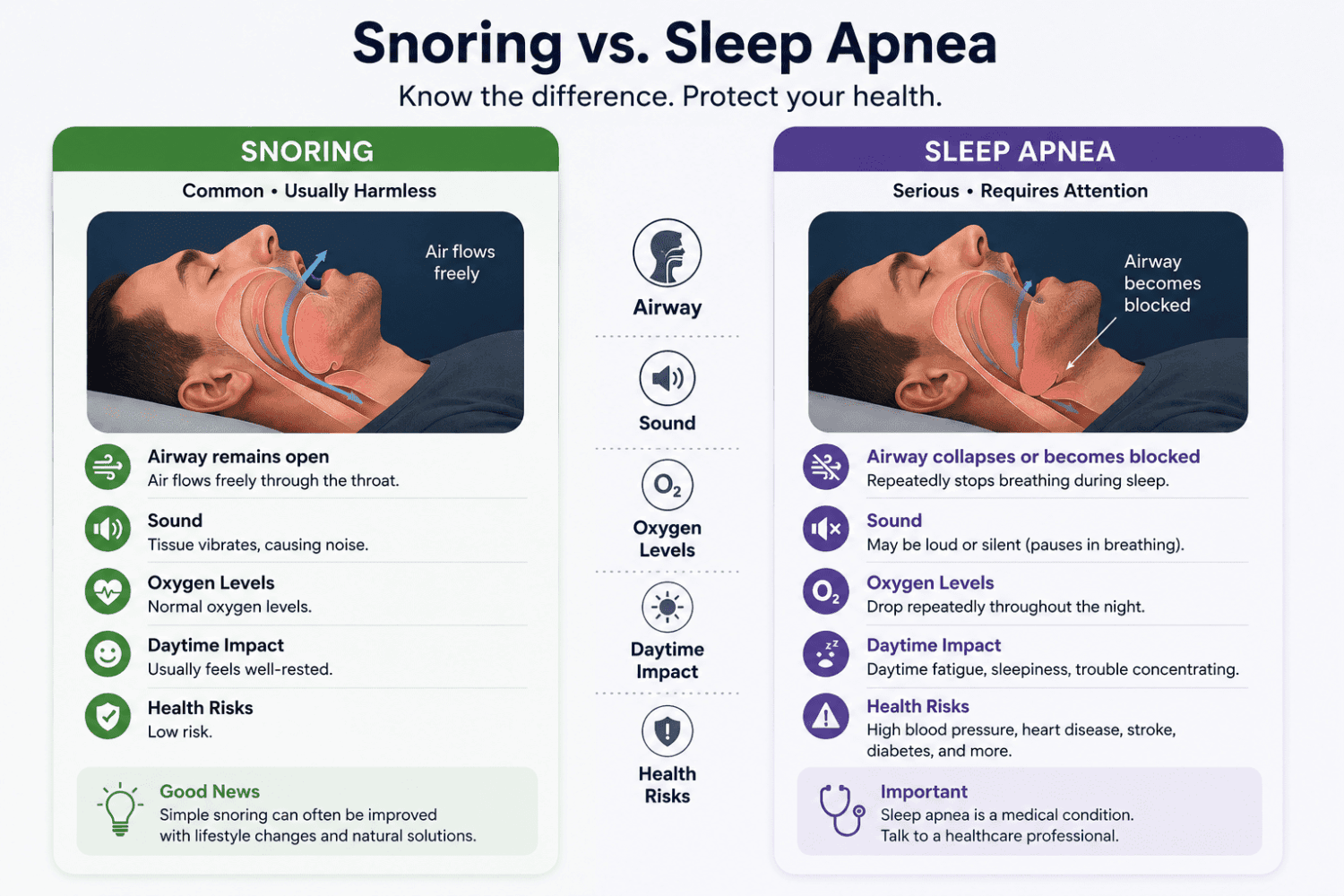
Snoring is the sound of air vibrating past relaxed tissues in your airway, and on its own it is usually harmless. Sleep apnea is a medical condition in which your breathing repeatedly stops and starts during sleep, and it can be dangerous if untreated. The key difference is that snoring is a noise, while sleep apnea is interrupted breathing, and the warning signs that separate them are gasping or choking in sleep, witnessed pauses in breathing, and heavy daytime exhaustion. Most people with sleep apnea snore, but not everyone who snores has sleep apnea, and the only way to know for sure is a medical sleep evaluation.
If you only remember one thing from this article, make it this: loud, chronic snoring combined with gasping, choking, or daytime tiredness is a reason to see a doctor, not a reason to reach for an over-the-counter spray.
Why This Distinction Matters
Snoring is incredibly common. By various estimates, somewhere between a quarter and half of adults snore regularly, and for most of them it is a social nuisance rather than a health threat. That is exactly why sleep apnea is so dangerous: it hides inside something we have all been taught to treat as harmless. Many people, and their partners, assume that snoring is just snoring, and so a serious, treatable condition goes unrecognized for years. Researchers estimate that a large majority of people with moderate to severe sleep apnea remain undiagnosed.
Untreated obstructive sleep apnea is not a minor problem. It is linked to high blood pressure, heart disease, heart failure, stroke, type 2 diabetes, and a significantly higher risk of accidents from daytime drowsiness, including car crashes. The good news is that it is very treatable once diagnosed, and treatment can dramatically improve both how you feel and your long-term health. So learning to tell the difference is genuinely worth a few minutes of reading.
What Is Snoring?
Snoring is a sound, nothing more and nothing less. When you fall asleep, the muscles in your mouth, tongue, and throat relax. In some people, that relaxed tissue narrows the airway just enough that the air you breathe makes it vibrate, and that vibration is the snore. Think of it like air whistling through a partly pinched straw.
Plenty of ordinary things make snoring more likely or louder: nasal congestion from a cold or allergies, sleeping on your back, drinking alcohol before bed, being overtired, the natural loss of muscle tone as we age, and carrying extra weight around the neck. For many people, snoring is occasional and harmless, and it responds well to simple changes.
The defining feature of simple snoring, sometimes called primary snoring, is that it is just the sound. Your breathing continues normally, your oxygen levels stay steady, and your sleep is not seriously fragmented. You might annoy your bed partner, but your body is still getting the rest it needs. That is the crucial dividing line.
What Is Sleep Apnea?
Sleep apnea is a medical disorder in which your breathing actually stops or becomes dangerously shallow many times during the night. The most common form, obstructive sleep apnea (OSA), happens when the airway collapses or becomes blocked during sleep, briefly cutting off airflow despite your body still trying to breathe. Each pause can last ten seconds or longer, and it can happen anywhere from a handful of times an hour to dozens or even hundreds of times a night.
Every time your airway closes, your oxygen level dips and your brain briefly rouses you, just enough to reopen the airway, often with a gasp or snort, before you fall back asleep without remembering it. You may have no memory of these events at all, which is part of what makes apnea so easy to miss. But the consequences are real: your sleep is shattered into fragments, your body is repeatedly starved of oxygen, and the cardiovascular strain adds up night after night.
Doctors measure the severity of sleep apnea using the apnea-hypopnea index (AHI), the average number of breathing interruptions per hour of sleep. Broadly, an AHI of 5 to 15 is considered mild, 15 to 30 is moderate, and above 30 is severe. There is also a less common form called central sleep apnea, in which the brain does not send the right signals to the breathing muscles, but obstructive sleep apnea is by far the most common type and the one most often confused with simple snoring.
Snoring vs Sleep Apnea: The Key Differences
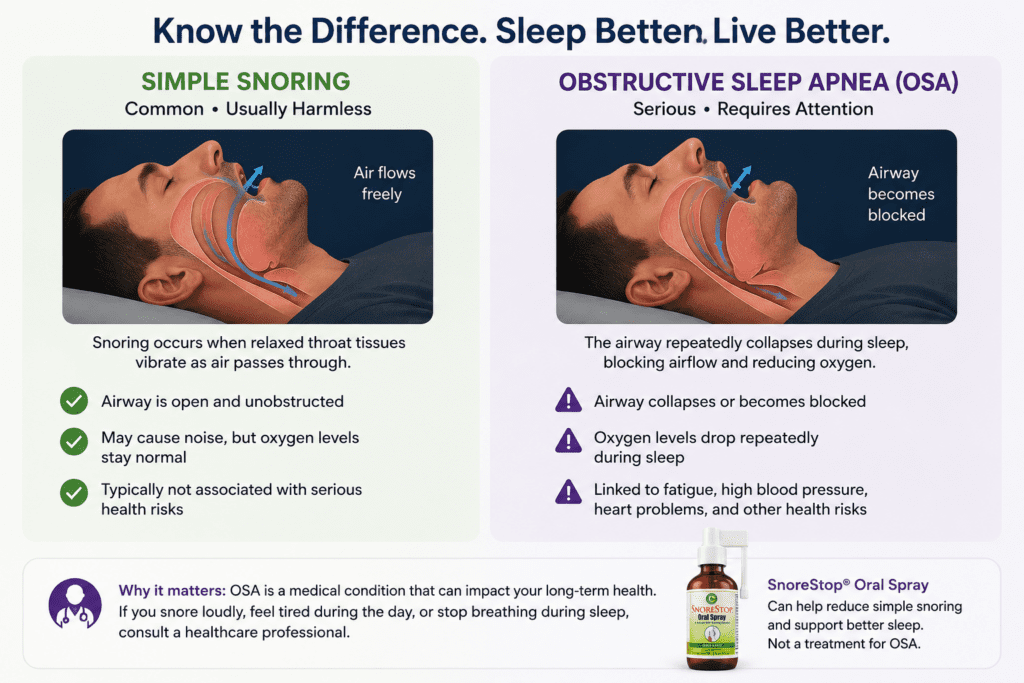
| Simple Snoring | Sleep Apnea | |
|---|---|---|
| What it is | A sound from vibrating airway tissue | Repeated stops or near-stops in breathing |
| Breathing | Continuous and normal | Repeatedly interrupted (pauses over 10 seconds) |
| Oxygen levels | Stay steady | Drop with each pause |
| Gasping or choking | No | Yes, often, on reopening the airway |
| Sleep quality | Largely intact | Severely fragmented |
| Daytime effect | Usually none | Exhaustion, brain fog, irritability |
| Health risk | Low on its own | High if untreated (heart, stroke, accidents) |
| Needs a doctor? | Not usually | Yes, diagnosis and treatment required |
The single most useful way to think about it: simple snoring is a noise problem, while sleep apnea is a breathing problem. If the issue is only the sound, you are likely dealing with simple snoring. If breathing is actually being interrupted, with gasping, pauses, and exhaustion, that points toward apnea and a doctor’s visit.
Warning Signs That Snoring Might Be Sleep Apnea
You cannot diagnose sleep apnea from symptoms alone, but certain signs strongly suggest you should be evaluated. Take these seriously, especially if several apply.
Signs others may notice while you sleep:
- Loud, chronic snoring, often night after night.
- Gasping, choking, or snorting sounds during sleep.
- Pauses in breathing that a partner has witnessed (often the most telling sign of all).
- Restless, thrashing sleep.
Signs you may notice yourself:
- Waking up unrefreshed even after a full night in bed.
- Heavy daytime sleepiness, dozing off at your desk, while reading, or, dangerously, while driving.
- Morning headaches.
- A dry mouth or sore throat on waking.
- Trouble concentrating, memory problems, or brain fog.
- Irritability, low mood, or anxiety.
- Waking frequently to urinate at night.
A particularly important point: the classic loud-snoring-and-gasping picture is more typical in men. Women with sleep apnea more often report fatigue, insomnia, morning headaches, and low mood rather than dramatic snoring, which is one reason apnea is underdiagnosed in women. If you are a woman with unexplained daytime exhaustion and poor sleep, do not rule out apnea just because your snoring is not loud.
A Simple Self-Check (Educational, Not a Diagnosis)
Doctors often use a quick screening questionnaire called STOP-BANG to flag people who should be evaluated for sleep apnea. You can run through it yourself as an awareness tool. It cannot diagnose anything, but a higher number of “yes” answers means you should talk to a doctor. Each “yes” counts as one point.
- S, Snoring: Do you snore loudly, loud enough to be heard through a door or to bother your partner?
- T, Tiredness: Do you often feel tired or sleepy during the day?
- O, Observed: Has anyone seen you stop breathing, gasp, or choke during sleep?
- P, Pressure: Do you have high blood pressure, or are you treated for it?
- B, BMI: Is your body mass index over 35?
- A, Age: Are you older than 50?
- N, Neck: Is your neck circumference large (roughly over 16 inches or 40 cm)?
- G, Gender: Are you male? (This reflects population statistics, not that women are not at risk.)
As a general guide, a score of 0 to 2 suggests lower risk, 3 to 4 suggests intermediate risk, and 5 or more suggests a high risk of moderate to severe sleep apnea. Again, this is only a conversation starter. A low score does not rule apnea out, and only a proper sleep study can diagnose it. If your score is 3 or higher, or you have any of the warning signs above, make an appointment.
Who Is More at Risk of Sleep Apnea?
Sleep apnea can affect anyone, including slim, fit people and children, but some factors raise the risk. Carrying excess weight, particularly around the neck and upper body, is the biggest modifiable risk factor. Other contributors include a larger neck circumference, being male, being over 50, the natural changes of menopause in women, a family history of apnea, and anatomical features such as a recessed jaw, large tonsils, a thick tongue, or a deviated septum. Smoking, alcohol use, and nasal congestion can worsen it. None of these guarantees you have apnea, and their absence does not rule it out, but they help explain who should be especially alert to the warning signs.
How Sleep Apnea Is Diagnosed
You cannot confirm sleep apnea at home with certainty, and no app or wearable substitutes for a medical diagnosis, though some can hint that something is off. Diagnosis is done with a sleep study. There are two main types: an in-lab polysomnography, where you spend a night at a sleep center wired to monitors that track your breathing, oxygen, heart rate, and brain activity; and a home sleep apnea test, a simpler take-home device your doctor may prescribe for suspected straightforward cases. The study measures your AHI and other markers, and a sleep physician interprets the results to confirm whether you have apnea and how severe it is. The process is more accessible than many people expect, and it is the essential step that turns guesswork into answers.
How Each One Is Treated
Treating sleep apnea (a medical matter)
If you are diagnosed with sleep apnea, treatment is guided by your doctor and depends on severity. The most established treatment for moderate to severe OSA is CPAP (continuous positive airway pressure), a machine that gently keeps your airway open with a stream of air through a mask. It is highly effective, and modern machines are far quieter and more comfortable than their reputation suggests. Other options include custom oral appliances that reposition the jaw (often used for milder cases or people who cannot tolerate CPAP), positional therapy, weight loss, treatment of nasal problems, and, in selected cases, surgery. The point is that effective treatment exists, and getting it can transform your energy, mood, and long-term health.
Managing simple snoring (often DIY)
If a doctor has confirmed that your problem is simple snoring rather than apnea, you have many low-stakes options, and the best first steps are free. Sleeping on your side instead of your back, losing excess weight, avoiding alcohol close to bedtime, staying hydrated, and treating nasal congestion all target real, common causes of snoring. Beyond that, simple aids can help depending on the cause: nasal strips or dilators for nasal-origin snoring, mandibular advancement mouthpieces fitted by a dentist for jaw-related snoring, and anti-snoring sprays for congestion-related snoring.
If your snoring seems tied to throat inflammation or mucus and you have ruled out apnea, a natural oral spray is one of the easiest, lowest-risk things to try, and we cover one popular option in our honest SnoreStop review, including what its evidence does and does not show. For overall sleep quality, the fundamentals of good sleep hygiene and a comfortable sleep environment, the kind of thing we consider alongside products like the Illo wearable sleep mask, often matter more than any single gadget. You can browse more options in our tested wellness-gadget reviews.
A vital caveat: never use an over-the-counter snoring aid to silence snoring that might be apnea. Quieting the sound does not fix interrupted breathing, and it can give false reassurance while a serious condition goes untreated. Rule out apnea first, then treat simple snoring.
When to See a Doctor
Make an appointment if any of the following are true: a partner has seen you stop breathing, gasp, or choke in your sleep; you snore loudly and chronically; you wake up unrefreshed or have severe daytime sleepiness; you fall asleep unintentionally during the day, especially while driving; you have morning headaches, brain fog, or unexplained mood changes; or your self-screen score is in the intermediate-to-high range. If you ever fall asleep at the wheel or while operating machinery, treat that as urgent. None of these symptoms should be brushed off as “just snoring.” A simple conversation with your doctor is the first step, and it could protect your heart, your safety, and your quality of life.
Frequently Asked Questions
Is snoring the same as sleep apnea?
No. Snoring is the sound of air vibrating past relaxed airway tissue, and on its own it is usually harmless. Sleep apnea is a medical condition where breathing repeatedly stops during sleep. Most people with apnea snore, but most snorers do not have apnea.
Can you have sleep apnea without snoring?
Yes. While snoring is common with sleep apnea, some people, particularly women, have apnea with little or no loud snoring, presenting instead with fatigue, insomnia, or morning headaches. That is why symptoms beyond snoring matter.
How do I know if my snoring is dangerous?
The warning signs are gasping or choking during sleep, witnessed pauses in breathing, waking unrefreshed, heavy daytime sleepiness, and morning headaches. If any of these are present, your snoring may signal sleep apnea and you should see a doctor.
Can a smartphone app diagnose sleep apnea?
No. Apps and wearables may record snoring or hint that something is off, but they cannot diagnose sleep apnea. Only a medical sleep study, interpreted by a doctor, can confirm it.
What happens if sleep apnea goes untreated?
Untreated sleep apnea is linked to high blood pressure, heart disease, heart failure, stroke, type 2 diabetes, and a higher risk of accidents from daytime drowsiness. It is serious but very treatable once diagnosed.
Will anti-snoring sprays or devices help sleep apnea?
No. Over-the-counter snoring aids are for simple snoring, not apnea. Using them to quiet apnea-related snoring can mask a dangerous problem. Always rule out apnea with a doctor first.
Does losing weight cure snoring or sleep apnea?
Weight loss can significantly reduce both snoring and the severity of obstructive sleep apnea for many people, and it is a recommended part of treatment. It does not always eliminate apnea entirely, so continue to follow your doctor’s guidance.
Is sleep apnea more common in men or women?
It is diagnosed more often in men, but it is underdiagnosed in women partly because women’s symptoms differ, more fatigue, insomnia, and headaches than loud snoring. Women, especially after menopause, should take the warning signs seriously too.
What is a sleep study like?
It is either an overnight stay at a sleep center with sensors monitoring your breathing and sleep, or a simpler home test your doctor prescribes. It is painless and is the definitive way to diagnose sleep apnea.
Can children have sleep apnea?
Yes. Children can develop sleep apnea, often related to enlarged tonsils or adenoids, and signs include snoring, restless sleep, bedwetting, and behavior or attention problems. See a pediatrician if you are concerned.
Conclusion
Snoring and sleep apnea are easy to confuse because they share a soundtrack, but they are fundamentally different. Snoring is a noise made by vibrating tissue, and for most people it is harmless or easily managed with simple changes. Sleep apnea is interrupted breathing, a genuine medical condition that strains your heart and brain and raises real long-term risks, yet hides behind the everyday assumption that snoring is nothing to worry about.
The practical takeaway is simple. If your snoring is just a sound, with no gasping, no witnessed breathing pauses, and no daytime exhaustion, you are probably dealing with simple snoring, and you can try the low-risk lifestyle changes and aids that target your specific cause. But if there are warning signs, loud chronic snoring with gasping, choking, pauses, or heavy daytime tiredness, do not try to silence it with a spray or a gadget. See a doctor, get evaluated, and let a proper diagnosis guide you. Sleep apnea is very treatable, and getting the right answer is one of the best things you can do for your health and your safety.
Worried about your snoring? Start by checking yourself against the warning signs and self-screen above, and if anything raises a flag, book a conversation with your doctor.
If you have confirmed that your snoring is simple and not apnea, and you want low-risk ways to quiet it, see our honest, evidence-checked SnoreStop review and our other tested wellness-gadget reviews for options that match your cause.

